It really does--cannibalism, that is. One of my ancestors was Matthew Joy, second mate on the nineteenth-century whaling ship the Essex, which sailed out of Nantucket in 1819 in search of sperm whales. Sometime in November 1820, when they were right on the equator and about 1,500 miles west of the Galapagos Islands, the ship was attacked by a large [85 feet?] sperm whale and capsized, leaving the captain and crew in three small boats. Even though they were not that far from the Society Islands, apparently at the urging of my relative, second mate Joy, who expressed the belief that if they sailed further into the South Pacific they would be sure to be eaten by cannibals, the captain, George Pollard, decided they should head for South America, which was over 3,000 miles away. Big mistake.
Still wandering at sea in January 1821 [after a brief pit-stop on a small island that did not have enough resources to sustain them for too long], my relative Matthew Joy was lucky enough to be the first to die and was given a burial at sea. This was early enough in the voyage that cannibalism had not yet been resorted to, but when another crew member, Isaac Cole, died in February, first mate Owen Chase suggested they consume his remains in order to stay alive, and this was agreed upon, perhaps with some reluctance. Initially, the crew members in the different boats only ate whoever died of whatever causes [mainly dehydration], but later, in extreme desperation, they also drew lots to select which of them would be killed and eaten next. As Nathaniel Philbrick, author of
In the Heart of the Sea: The Tragedy of the Whale Ship Essex, has said, "the great, terrible irony of the 'Essex' story" is that "their fear of cannibalism drove them on this impossible voyage and ultimately required them to enact their own worst fears, to cannibalize the bodies of the dead sailors because they had nothing left to eat." Further,
All the boats would become separated. One of them would never be heard from again. And it was really the captain's boat, which was out for 94 days, more than three months, where the most excruciating sufferings occurred. It would come down to the captain and a teenage boy, Charles Ramsdel, just two of them. And they would be found by the crew of a Nantucket whale ship almost within sight of the Chilean coast. And these men were found sucking the bones of their dead messmates. And I'm quoting here, "which they were loathe to part with." Even after they had been rescued, these men were so delirious with their sufferings, that they were reluctant to surrender the bones. And they had been living for about a week on just the marrow that they could get out of the center of these bones. [Interview with Nathaniel Philbrick]
Technically speaking, I am not descended from cannibals, but from someone who helped create a situation in which cannibalism was unavoidable. "Cannibalism happens," or something like that, is the moral of this story of danger and disaster at sea in which the very palpable fear of being cannibalized caused a group of whalers [most of whom were only in their twenties, including the captain] to make a very stupid decision which led to their cannibalization and even murder. Apparently, the shameful stigma of what might be called necessary acts of cannibalism is so great that survivors of such "ordeals" do not always fare well afterwards. Owen Chase, who wrote the
Narrative of the Most Extra-Ordinary and Distressing Shipwreck of the Whaleship Essex (published in 1821), suffered from debilitating headaches most of his life, eventually became mentally unstable, and was found late in his life to be hoarding food in his attic. The descendants of the famous
"Donner Party," to this day, often seek to either minimize or claim as falsified mythology the episodes of cannibalism that occurred when the Donner travelers were snowbound in the Sierra Nevada mountains in 1846-47. So, even though "cannibalism happens"--
has to happen, even, in certain circumstances--it carries with it the deep shame of what Heather Blurton refers to in her book, following the terminology of the Old English poem
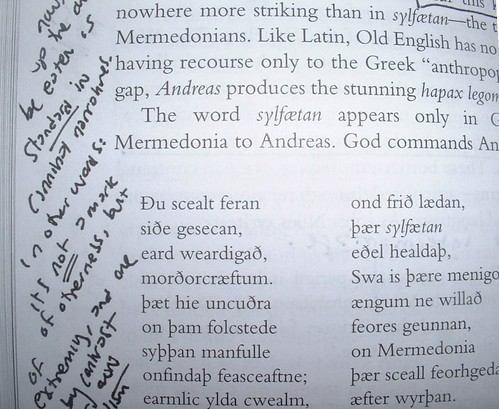
Andreas, "self-eating."
And herein, I think, lies the difficulty of defining what, exactly, cannibalism is--whether as, in the case of the Essex and Donner disasters, an actual historical event or, with Cyclops and Grendel, as a fictional event, or as what Blurton calls a politico-cultural "discourse" or "metaphor." For, if cannibalism, at some level, has to mean self-eating [and I think it does] it implies a necessary intimacy--a biological, species-specific intimacy or "likeness," more specifically--between eater and eaten. To eat humans [anthrophagy] is one thing; to eat oneself [cannibalism] is yet another. But is this just the academic splitting of semantic hairs, or does the difference between the two really matter, and how? At some level, it would have to matter a great deal, I think, for when humans slaughter cows and chickens and quails and pigs, etc. for dinner, or when a grizzly bear decapitates and eats a human, neither is cannibalism, although the latter, in "polite society," is deemed more "savage" than the other. "Meat is murder," the vegetarian's political adage goes, and that, too, is something else. Likewise, to return us to Blurton's book, is the eating of a human by a dog-headed "man," a "Donestre" [which would appear to be part-lion, part-man, but which is derived from the crocodiles and half-hyena/half-lioness "corocottas" of classical legend], a Mermedonian, a Grendel, and an "eoten" [capitalized or otherwise] the same experience of "cannibalism" in each instance, or are there varying degrees and types of "self" being consumed by "self" in each, and how might that matter in our interpretation of these cannibalisms [with an emphasis on the plural]? Is the "sameness" or "likeness" between eater and eaten in these cases dependent upon physiology, biology, language, gesture, cultural habits (of eating, hygiene, dress, and otherwise), religion, politics, or some combination thereof and
to what degree?, and why does that matter? Further, if the so-called "cannibal," whether a Cyclops or a Donestre or a Grendel, only kills and eats what is
foreign or culturally "strange" or Other to him [a traveling Greek warrior or Anglo-Saxon or Dane], what "self," exactly, is he consuming, and why and how does
that matter?
Following this line of thought, I was particularly impressed with chapter 1 of Blurton's book, "Self-Eaters: The Cannibal Narrative of
Andreas" [pp. 15-33], in which she appears to be raising some of these same questions in her delineation of how that hagiographic narrative, rather than simply affirming a particularly well-worn story of heroic Christian ethics and conversion [which, in Blurton's view of this text, is also a type of colonization and vice versa], actually complicates "the identification of cannibal and colonized" and suggests "that the borderlines of identity are the territory that is at stake" [p. 16]. The Mermedonians of this story, unlike Homer's Cyclops or the Donestre of the Anglo-Latin
Wonders tradition, are clearly
all human [if seemingly morally depraved and therefore ethically "monstrous" or "twisted"], and while their cannibalism is initially [and even legally] restricted to foreigners whom they imprison and then apportion in systematic and bureaucratic fashion, in a time of dire necessity [when Andreas sets all their prisoners free, kills the guards, and destroys the prison], they
do resort to killing and eating their own "members," which, in Blurton's view, "highlights their depravity, and by extension, the righteousness of Andreas' mission" [pp. 17-18]. And yet, the poet is also at pains to let his readers know, as Blurton points out, that the Mermedonians are "self-eaters," not because they prefer human flesh over anything else [which would indicate a deep and self-willed wickedness as well as a depraved "appetite"], but because they don't have any other alternatives: "there was neither sustenance of bread . . . nor drink of water . . . to partake of" [qtd. on p. 21]. In this way, the poem would seem to keep open a border, if even a slim one, between less and more acceptable practices of cannibalism [after all, since the Mermedonians exist only through a
necessary cannibalism, their availability as Christian converts is made possible through that very same cannibalism], as well as between different "like" selves [i.e. it is worse for a Mermedonian to eat another Mermedonian than it is to eat, say, a wayward Scythian--therefore, to be "foreign," depending on your placement on a map, even an imaginary one, at any given moment, affects your quality of "self-sameness," which also affects, ultimately, your "human" rights].
Ultimately, in Blurton's analysis,
Andreas is a political narrative that is more about colonization than it is about conversion [although the two terms often appear collapsible into each other], and because the poet, as Blurton describes in detail, conflates the geography of Mermedonia with England and also the social habits and bearing of the Mermedonians with that of the Anglo-Saxons, "the collapsing of Mermedonia into England, alongside the simultaneous confusing of generic, political, and religious categories of difference between cannibals and Christians, frames the question of the construction of individual and corporate identity," and "[g]iven this accumulation of associations, it is suggestive to read the narrative of
Andreas as a response to the complex cultural negotiations that accompanied the continuous barrage of invasion and settlement by the Vikings in the ninth and tenth centuries" [p. 30]. And since a forceful and violent conversion of the Mermedonians by Andreas and his military forces can be viewed as a kind of metaphoric cannibalism [the consumption of Mermedonians and their subsequent absorption into the corporate "body of Christ" as well as into the "body politic" of Andreas' "nation," wherever that may be], the poem frustrates an overly simplistic
exemplum-type reading, for the "eating" of foreigners [and foreign races] is necessary to the project of empire-building. Eating "others," in other words, is okay. Eating "yourself" is not. In other words, "go out to eat [yourself]."
The real truth of human history is that all living matter [whether trees or cows or pigs or humans] is potentially a disposable resource if the occasion can be justified in such a manner to "warrant" it. But human societies, although they have always had need to consume others in order to both "survive" and "consolidate," have also always had need to erect borders between "inside" and "outside" [borders, moreover, which they can shift at will in a given moment and without warning and with great harm to those living on "the other side"]. This is one reason, I really believe, that "cannibalism," not as historical action but as myth, has such force in our culture as what might be called a "warning system." The truth is, we are, all of us, cannibals, but we have need of the prohibition against cannibalism in order to fool ourselves into thinking we are, if not human, then
humane. Thanks to Blurton's analysis, I can see that the Old English poet of
Andreas was well aware of this fact.
But, is Grendel a cannibal? And can every instance of "eoten" in
Beowulf really be construed as "cannibal"? That, my friends, is a tale for me to take up in my next installment.