Thursday, February 06, 2014

REMEDIAEVAL: Proposal for a New Minigraph Book Series

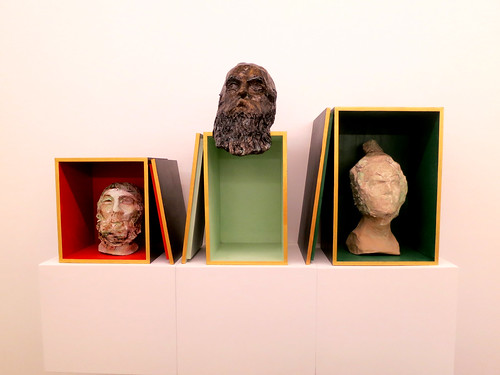
Liz Glynn, On the Possibility of Salvage.
by EILEEN JOY and KARL STEEL

This week Karl and I have been working together, in Brooklyn, to compose a proposal for a new shorter-form, minigraph book series that would represent an alliance of medievalists, early modernists, and cultural theorists working in more contemporary periods who might be interested in collaborating on the question of contemporary theory's relations to an historical past that is often either completely overlooked or badly-shallowly historicized. In addition, we're eager to create a space for new shorter-form [and multi-modal] work that desires to place texts and objects from so-called "premodernity" into [para-textual, adjacent, etc.] contact with texts and objects of what we are calling "the contemporary scene," and in a fashion that would supplement and/or move somewhat beyond the traditional cultural-historical and hermeneutic frameworks.

Two days ago we asked all of our Facebook and Twitter friends to help us come up with a title for the book series [which we plan to pitch to a university press that would be willing to offer these book in paperback and also in Kindle and other e-reader formats at very affordable prices], and we received an amazing array of suggestions, from Chronick to In The Middle to Meddling to Media Res to Ligatures to Palinopsis and beyond. Thanks to Marty Shichtman, we settled on REMEDIAEVAL. A huge THANK YOU as well to everyone who helped to crowd-revise our initial stab at a vision statement for the series, also on Facebook. This morning, we want to share the newly revised vision statement and ask again that everyone help us to continue to refine it, and thus we can say, we did this together!

REMEDIAEVAL: A Minigraph Book Series

Currently, the Middle Ages serve as a sort of “hot” contact zone in a wide variety of cultural, social, and political scenes, events, media, and disciplines. From fantasies of origin to the desire to escape from the present into the past, and from social, political, racial, and sexual caricatures of the Other as “medieval” to historical reenactors and what some have termed a new resurgence of “living history” attractions (Bede’s World, Jorvik Viking Centre, Provins, etc.), the Middle Ages inhabits a space of intimate exteriority with the modern. It can be argued, further, especially with regard to the development of theory in various fields — philosophy, sociology, political science, literary studies, cultural studies, history of science, etc. — that the Middle Ages occupy a sort of “black hole” position that stretches from the fall of the Roman Empire all the way to 1700.  

For example, most contemporary theory skips the Middle Ages and Renaissance altogether, often taking leaps from Kant or Hobbes to Plato, or from Heidegger to Heraclitus, or from Carl Schmitt to Cicero, and so on. And yet, there has been much work done within medieval studies to unsettle the philosophical narratives that imagine the Middle Ages as the abjected past of a modernity that exists only in the contemporary, capitalist West and that refer exclusively to a very small subset of classical and Enlightenment thinkers. Thus, in recent years, journals like postmedieval (an editorial alliance of medieval and early modern researchers with cultural theorists in various fields), scholars such as Kathleen Biddick, Jeffrey Jerome Cohen, Aranye Fradenburg, Bruce Holsinger, and Steven Kruger (to name only a few), and a host of specialized conferences and symposia hosted by the BABEL Working Group, George Washington University’s Medieval and Early Modern Studies Institute, and the Australian Research Council’s Centre of Excellence for the History of Emotions (Europe: 1100-1800) have brought premodern subjects into vibrant contact with contemporary theory. In addition, both medieval and early modern studies have led the field in taking up some of the most exciting recent innovations in humanistic practice and thought, including new media studies, the digital humanities, new materialisms, eco-studies, the descriptive turn, post-humanisms, critical animal studies, the geological turn, and speculative realism.

Thanks to various open-access and other publishing initiatives (such as Minnesota’s Forerunners series, Stanford Briefs, The Atlantic and Bloomsbury’s Object Lessons, and Palgrave’s Pivot series), academic writing is poised to capture a broader public audience. Moreover, the traditional monograph is not the only, nor necessarily always the best, mode for disseminating scholarship that aims to speak to and even create the contemporary scene. And finally, an emerging para-academic movement using new technologies to give rise to presses such as Zero Books and punctum books, journals such as continent. and Speculations, and groups such as the Brooklyn Institute for Social Research, The Public School New York, the Dublin Unit for Speculative Thought (D.U.S.T.), and the Department of Eagles (Albania), provide an ideal moment to reach out to different and globally-networked publics for cultural studies.

Therefore we propose a minigraph book series (of works between 30,000 and 60,000 words), REMEDIAEVAL, that will revise and renew contemporary theory by salvaging the missing texts and objects of the premodern archive (500-1700), bringing those into contact with various currents in contemporary life and thought. The idea of a premodernity that comprises both medieval and early modern periods is critically important here for pushing back against theories that imagine modernity simultaneously as exceptional and/or as emerging inevitably from narrowly conceptualized and shallow historical chronologies.

It will be the objective of REMEDIAEVAL to invite short-form work in a variety of disciplines, formats, genres, and delivery platforms, that would assemble a wide variety of premodern texts and objects — such as, relics, illustrated manuscripts, architecture, music, law codes, historical chronicle, chivalric romance, bestiaries, Books of Hours, textiles, astrolabes, encyclopedias, cosmographies and atlases, and the like — and put them into mutual conversation with contemporary theory, texts and objects, such as video games, films, television series, political theater, graphic arts, fashion, architecture, toys, landscapes, and so on. In recent years, there has been a renewed attention to the question of the meaningfulness of cultural texts and objects, whether the novel or a painting (and so forth), and how the disciplines of the humanities should best approach their respective subjects at a moment when many are looking for ways to supplement and also to question cultural-historical methodologies and traditional hermeneutics. It is the aim of REMEDIAEVAL to encourage experiments in bringing together culturally and temporally disparate objects (a sort of temporary “working group”) — whether through practices of paratext, adjacency, neighborliness, collage, assemblage, network, ontography, mapping, performance, and so on — to produce novel relations that would not only give rise to new forms of critical thought and intellectual communities, but would also help to reshape the more narrowly-defined disciplines in which these disparate objects are located.

Wednesday, January 29, 2014

How Prismatic Ecology got its cover

by J J Cohen

The University of Minnesota Press blog has a nice little piece on how artist Jeff Clark arrived at his design for the cover of Prismatic Ecology: Ecotheory Beyond Green. He was inspired by a photo I took of Gullfoss in Iceland, and experimented with various materials before arriving at the vivid image he eventually created.

Remarkably, Clark's process has much in common with how James le Palmer, John Ryan and the Mississippi River compose with color, at least as I argue in the book's introduction.

Read the piece here.

Monday, January 27, 2014

Guest Post: Irina Dumitrescu on the Future of Old English

by Irina Dumitrescu

Preface by Mary Kate Hurley: 

[first, congrats to Alfred Kentigern Siewers on his edited volume, just published with Bucknell University Press]


This year at the MLA convention in Chicago, I spent the vast majority of the conference waiting to attend what I decided in advance would be the most invigorating panel I went to – 743, “Anglo-Saxon Studies in the Profession.” The panel was at high noon on Sunday, the last day of MLA – a somehow fittingly late moment for such an “early” field.

The panel did not disappoint. We heard from a number of prominent Anglo-Saxonists, each speaking to the role our field might play in the university. Mary Dockray-Miller (Lesley University) examined the role of Old English in women’s colleges in the 19th century; Eddie Christie (Georgia State University) spoke on the perceptions and misperceptions of the Anglo-Saxonist, and the value of slow reading; Damian Fleming (Indiana University-Purdue University, Fort Wayne) reminded us that we can often be our own best PR, and therefore we should embrace it!; and Elaine Treharne (Stanford) reminded us that medievalists and Anglo-Saxonists in particular have always been at the forefront of digital ventures, and that our most important task is to remember to be generous. Each of these papers was thought-provoking and useful – and each gave me hope for the potential of my field. The live-tweeting of the session from several scholars added to my experience (and gave me a good source by which to remember everything when I went to write this preface!).

Today I wanted to share one of the papers from this panel with you all. Irina Dumitrescu (Southern Methodist University and Berlin) – who I’ve had the pleasure of knowing since my very early days back in NYC – gave a paper I found particularly moving and useful. She has been kind enough to allow me to post her paper here at ITM, as a spur to continuing discussions. What I found most important about her talk is its call for closer attention to the place where the study of Old English must always begin: the classroom.  It's easy to forget, after a time, that we speak what can only be a foreign language (as all medievalists do, but especially Anglo-Saxonists) -- here, Irina gives a powerful argument that, as scholars and as teachers, we are also custodians of how students approach this foreign/native tongue, and the poetry written in it.


Thinking about the future of Anglo-Saxon studies begins for me, always, in the classroom. It is, of course, necessary to argue against presentist bias among our colleagues and administrators, and to interrogate how our field fits into the structures of academe. And yet I cannot help but think that much of the battle starts in graduate and undergraduate courses on Old English. I believe this because of my own conviction of the importance of teaching, and of elementary teaching in particular, but also because when a new acquaintance from another field of English finds out I’m an Anglo-Saxonist, they usually insist on telling me about their Old English professor and that one course they had to take as part of their historical requirements. Sometimes their face brightens, and they recount how surprised they were by the fact that they liked the material. They might even insist on relating to me the topic of their term paper. (I cannot be the only one this happens to regularly.) Just as often, sadly, I think, more often than not among the older generations of scholars – the ones who lead departments and scholarly organizations – their memory is of dull, uninspiring teaching, of professors who thrust them into what Borges called “las junglas de las declinaciones” without a bag of crumbs. No scholar has ever told me about an amazing essay they read on Anglo-Saxon literature, or even about a boring one; our greatest and most profound chance as a field to shape what other scholars of English think of us is by teaching them well when they are still students.
            The next question is how we do this. The performance of passion for our subject coupled with personal charisma goes a long way – there is a reason why students who take medieval literature with my colleague Bonnie Wheeler wind up installing medieval-style toilets into their mansions decades down the road. (This is not a joke, and those things are very hard to flush.) I myself have been known to be shameless in my attempts to make Anglo-Saxon texts memorable, but in my defense, students really connect to Ælfric Bata if you lecture on him with a whip. Depending on the nature of the text, I might try and make the medieval work speak to their own experiences, despite the vast disparity in time, and I am willing to sacrifice a bit of their awareness of historical difference for this. Some of my colleagues would argue that literary theory is the answer, that discussing our corpus using the same language our colleagues employ will make it relevant to our students. Others might focus on an historicist approach, or on the manuscript context. I suspect that in the hands of dedicated and engaged teachers, all of these approaches work. And yet I have become convinced that there’s a problem at the center of our teaching, of our attempts to reach our students, that has been left unaddressed.
            When I think of those moments when I stood in front of a classroom leading a discussion and saw that look of mingled surprise, recognition, and pleasure on a student’s face, an expression I think of and experience as a little poetry orgasm, I recognize that they almost always occurred when we were engaged in a really good close reading. It tends to happen with the better students, the ones who are there due to a genuine passion for literature. These students can handle and are interested in both historicist and theoretical approaches, but I believe what brought them to my classroom, and to an English major, is the sheer pleasure of literary complexity. And, like it or not, our colleagues in later fields have an easier time producing this experience, if they try. Moreover, the texts they study – and I think “poetry orgasms” can happen with prose or drama or narrative poetry too, although they do seem to privilege lyric – the texts they study can often do this on their own, simply because they are written in a language whose nuances and connotations our better students understand. A seminar on Shakespeare can be badly taught, because the good students will experience Shakespeare as richly literary anyway. Or the sole focus can be on interrogating the works of Shakespeare from a certain theoretical perspective, or on framing them historically. I do not think we have that luxury. If we do not make our works speak to our students as literature, they simply will not experience them as literature.
            But here is the next problem: when I read much of the criticism we write, and I am willing to include my own work in this, I am not sure that we feel Old English and Anglo-Latin texts as literature. We have to work so hard, sometimes, even to know the basic denotation of a word, how are we to trace the delicious ambiguity and tension that was the legacy of New Critics to our intellectual and aesthetic experience of literature? Wallace Stevens once wrote, “I do not know which to prefer,/The beauty of inflections/Or the beauty of innuendoes,/The blackbird whistling/Or just after.” We are, I think, so busied sometimes with the beauty of inflections that we forget to attend to the beauty of innuendoes. At the risk of offending, well, everyone, I’m willing to say that I think that finding an explanation for a textual crux in a biblical passage or a theological work, or neatly putting a text in some historical context – Poem A is explained by the Eucharistic controversy, Poem B is a response to the Viking attacks – is cognitively easier than figuring out what work the text is doing, and how its language contributes or pulls away from it. What I want to read more of in our field is what Michael Wood, in an essay on William Empson, called “criticism which attends to the behaviour of words, but also evokes the dark rich world of the words, analysis which is also appreciation.” Maybe the reason we teach The Wanderer and the Dream of the Rood so often is not simply because they are short and they satisfy Post-Romantic preferences for lyric. Maybe it is also because we have, as a field, done the work on them, and if we craft and publish more sensitive analyses of, say, Solomon and Saturn, Christ C, and Bede’s Ecclesiastical History for each other to read, we will teach them more often too. It’s a wild dream, but I have a dream that one day, when English faculty sit and consider whether to ask for their early medieval line to be renewed, they will think back to that undergrad professor who so sublimely unfolded for them the witty wordplay of Andreas or the erotic irony of The Life of Mary of Egypt.

Re-Imagining Nature: Environmental Humanities and Ecosemiotics

by J J Cohen

Congratulations to Alfred Kentigern Siewers for the publication of his new edited collection, Re-Imagining Nature: Environmental Humanities and Ecosemiotics [Amazon link since Buknell UP doesn't have the book online yet, and here you can search and preview the volume].

I'll reproduce the ToC below. You will see that the book offers quite a mix of new and "classic" material. The introduction ("Song, Tree and Spring: Environmental Meaning and Environmental Humanities") is quite good, arguing for the ways in which medieval and American Indian sources for ecocriticism interconnect. Indigenous traditions are essential to the volume, but without romanticizing such tradition into earthy wisdom (or deploying what Larry Buell famously labelled the Ecological Indian). An animating tension of the volume is between the materialism so important to recent ecocriticism and the "immaterialities" of life as communication-making that are foregrounded within phenomenology and ecosemiotics.

Re-Imagining Nature is, unfortunately, rather expensive ($75-90 depending on where purchased) but this would be a good one to request that your library order.


Contents 
Chapter 1: Introduction - Song, Tree, and Spring: Environmental Meaning and the Environmental Humanities Part One: Backgrounds 
Chapter 2: The Ecopoetics of Creation: Genesis LXX 1-3 By Alfred Kentigern Siewers 
Chapter 3: Place and Sign: Locality as a Foundation for Ecosemiotics By Timo Maran 
Chapter 4: Learning from Temple Grandin, or, Animal Studies, Disability Studies, and Who Comes after the Subject By Cary Wolfe Part Two: Medieval Natures 
Chapter 5: "The Secret Folds of Nature": Eriugena's Expansive Concept of Nature By Dermot Moran 
Chapter 6: The Nature of Miracles in Early Irish Saints' Lives By John Carey 
Chapter 7: Inventing with Animals in the Middle Ages By Jeffrey Jerome Cohen Part Three: Re-Negotiating Native Natures 
Chapter 8: The Yua as Logoi By Fr Michael Oleksa 
Chapter 9: Intersubjectivity with "Nature" in Plains Indian Vision-seeking By Kathryn W. Shanley 
Chapter 10: The Experience of the World as the Experience of the Self: Smooth Rocks in a River Archipelago By Katherine M. Faull 
Chapter 11: Human Geographies and Landscapes of the Divine in Ibero-American Borderlands By Cynthia Radding 
Chapter 12: Call and Response: The Human/Non-Human Encounter in Linda Hogan's Solar Storms By Sarah Reese 
Suggested Reading 
Bibliography 

Tuesday, January 21, 2014

pause

by J J Cohen

The beginning of the spring semester has been rough. I'm teaching two courses I love: "Myths of Britain" (a reconceived Intro Brit Lit 1) and "Medieval Literature" (a postcolonial-inflected tour of the literatures of the British archipelago). Both are filled to capacity, and the students seem eager. But coming directly from the MLA convention in Chicago to teaching these courses means there has not been much in the way of downtime lately, especially because Stories of Stone is due to press Feb. 1 -- and I have many administrative obligations at the moment as well.

So I was not sad to have an unexpected snow day. I got up early to run before the storm, then headed to campus before the kids were awake. On my way I stopped at the undisclosed location at which I used to write, a place I haven't been able to visit since this semester's 9:30 AM class came along. There I drafted the epilogue to my book (and said hello to the people who work there; I've missed them). I went to my office to revise the syllabus for each class and accommodate the snow day (Sir Gawain and the Green Knight will suffer as a result). I processed all the receipts that I needed to allocate and document for MEMSI, a two hour task. I straightened my desk and filed my stack of accumulated papers. And for the first time in a very long time, I caught up on email. Then I headed home to sled with the kids, both of them.

As I walked to my house from the Friendship Heights Metro station, I cut through an abandoned park that follows Little Falls stream. This tiny tributary of the Potomac is the victim of mismanaged urban planning: much of its course flows under large roadways and behind very tall apartment buildings, often with its native rocky bed replaced by concrete culverts in order to facilitate rapid drainage. Yet every now and again the stream reasserts itself. As the waters flow through a patch called Willard Park, the terminus of a streetcar system that connected Friendship Heights to downtown DC in the late 1800s, they emerge from an industrial shaft and purl along small boulders before vanishing beneath a busy street a half mile away. A small forest of tuliptrees, oaks and bamboo grows alongside the stream. Ducks cluster in the brisk water, and deer somehow find their way to the banks from time to time. I like to walk through Willard Park because it reminds me of how the land once was, how it might be again. That it is surrounded by apartment buildings taller than any in downtown DC adds to its oasis-like feel. It is no Eden: clearly the stream follows a bed that was altered for the vanished streetcar tracks, and its flow is so swift because of human engineering. Invasive species (bamboo, porcelain berry, kudzu) overwhelm native plants. The deer are often struck by cars and buses because they must cross a busy road to enter the little woods.

I write all this because as I walked through the little park on my home from campus today, the place seemed transformed. Snow will do that. The falling white hushed the traffic. A cardinal sat on an oak branch with ivy, and I thought about Sir Gawain and the Green Knight. I stood on a small bridge that crosses the water and I took many pictures. It felt good to pause.

This year brings a significant birthday my way. On the way back to DC from MLA in Chicago, I thought about how busy I've been of late. I'm happy with the projects I've worked upon, and the years ahead will see numerous publications important to me personally and professionally. I was glad to see Prismatic Ecology so well received at MLA, and enjoyed the conference. But as I decided on the plane, and as today's moment of quiet in the snowfall reaffirmed, I feel the need for what I am calling an Epochal Pause. That, I think, will be my gift to myself in November, as a birthday present: some time off from traveling and writing commitments, a fallow stretch, a catching of the breath after many years of running.

I've already been saying no to commitments that would have stretched into this period. It would not be all that long: I'm going to New Zealand, after all, in the summer of 2015 to keynote a conference there. But some time away from the demanding structure I've organized my life around will be a good thing, a significant gift. I hope I can actually give it to myself.