 |
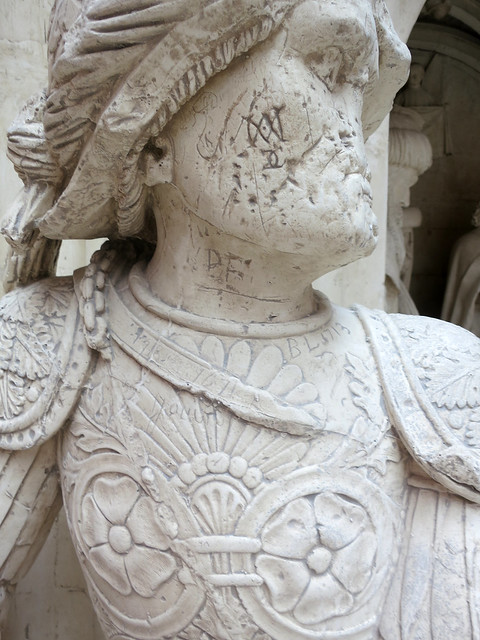
| Plaster cast from the Palais de Chaillot |
First, join us in wishing Jeffrey safe travels.
Then, lest it be said that my promises or threats aren't worth the nose they're printed on, here, for your use, is my monumental post on the noselessness of Bisclavret's wife.
Recall that towards the end of Marie's lai, Mr. B's wife shows up at court, only to be attacked by her lupine husband:
Oiez cum il s'est bien vengiez!The loss of the nose has long been a rich interpretative site in Bisclavret criticism. We can divide the readings into several groups:
Le nes li esracha del vis.
Que li peüst il faire pis? (Bisclavret 234-36)
"Just hear how successfully he took his revenge. He tore the nose right off her face. What worse punishment could he have inflicted on her?" (translation by Gallagher. My own translation would go like this: "Listen to how well he avenged himself! He tore her nose off her face. What worse could he have done to her?")
- psychoanalytic ones, which pun on vis [face] and vit [penis]: e.g., Bloch, Labbie, and Dolores Warwick Frese, "The Marriage of Woman and Werewolf: Poetics of Estrangement in Marie de France's 'Bisclavret'" in A. N. Doane's and Carol Braun Pasternack's anthology Vox Intexta: Orality And Textuality in the Middle Ages, rooted, I believe, in Jean-Charles Huchet, "Nom de femme et ecriture feminine au Moyen Age: Les Lais de Marie de France," Poetique 48 (1981): 407-30. Essentially, Ms. B had illegitimately taken on the phallic function and has it torn from her. This helps explain why only her female descendants are noseless;
- claims that nose-removal was a common torture in the Middle Ages, which I think is a wild exaggeration: I'm looking forward to seeing Larissa Tracy's further contextualization: I believe she's arguing that the court of Henry II, being antipathetic to torture, would have found the scene repugnant;
- claims that the nose-removal makes the wife more bestial: for reasons I'll explain (far) below, I disagree; I'm more in the neighborhood (less in the same block than on the same bus line) as Laurence M. Porter's proposal in Women's Vision In Western Literature: The Empathic Community that "Wolves have prominent muzzles and the missing nose makes Bisclavret's wife's face resemble a human skull more than a wolf's head, suggesting the skull underneath the skin, the illusoriness and transcience of sexual delight";
- interconnections with many, many stories of Roman virgins and, in particular, virgin saints, who cut off their noses to make themselves unattractive to the Barbarian invaders [see Claude Thomasset, 'La femme sans nez', Littérature et médecine II, ed. Jean-Louis Cabanès, Eidolôn, 55 (Bourdeaux: Université Michel de Montaigne, Bourdeaux III, 2000), 57-52 and Jane Tibbetts, 'The Heroics of Virginity: Brides of Christ and Sacrificial Mutilation," Women in the Middle Ages and the Renaissance: Literary and Historical Perspectives Ed. Mary Beth Rose. Syracuse: Syracuse UP, 1986]: implicitly, then, Bisclavret's assaulting his wife's attractiveness;
- and finally, most influentially, a great many claims that losing the nose [or losing the nose and ears] was a punishment for an adulterous wife. See Stith Thompson Q451.5.1, Nose cut off as punishment for adultery. This requires a lot of detail.
Saxo Grammaticus tells the story of Hjalte, who's with a ladyfriend while his king's being betrayed. When Hjalte hears the sound of battle, he decides to leave her to rescue his lord. His ladyfriend asks him "si ipso careat, cuius aetatis viro nubere debeat," if she should lose him, how old a man ought she to marry? He answers her by cutting off her nose.
Robert Stanton directed me to the laws of Cnut, which punish a female adulterer with the loss of her nose and ears. Frederick II of Sicily (1194-1250) commanded that an adulterous woman's nose be amputated, unless her husband didn't want this: otherwise, she would just be flogged ("adultera convicta de adulterio traditur viro, ut in recompensationem thori violati, truncetur ei nasus, & si maritus ei truncare non vult, fustigabitur"; h/t Shulamith Shahar The Fourth Estate for this reference).
Still earlier law codes might be referenced, with increasingly remote chances of relevance: Ezekiel 23:25 hints at the loss of nose and ears for adultery: medieval Biblical commentaries might profitably be consulted; the Byzantine Ecloga of 726 punishes adulterers of both sexes with nose-slitting; and Diodorus of Sicily's 1st c. BC universal history says that in Egypt, "In case of adultery, the man was to have a thousand lashes with rods, and the woman her nose cut off. For it was looked upon very fit, that the adulteress that tricked up herself to allure men to wantonness, should be punished in that part where her charms chiefly lay" (thanks to Sharon Kinoshita for proposing the web search that led me to these sources).
Looking ahead,
We might also look to the witness of medieval translations and adaptations of "Bisclavret." In Biclarel [warning: pdf], Mr. B just mutilates his wife's face (373-74), with no specific reference to her nose, and then she's walled up, presumably to be crushed or to starve to death (454-5). In the Icelandic version, he tears off her clothes and nose, and in the Old Norse version, "Bisclaret," he tears off his wife's clothes, but her female descendants are still born noseless. Incidentally, "Bisclaret" ends in a tantalizing way for werewolf scholars: "Nothing that happens now is more true than this adventure we have told you about, for many strange things happened in olden times that no one hears mentioned now. He who translated this book into Norse saw in his childhood a wealthy farmer who shifted his shape. At times he was a man, at other times in wolf's shape, and he told everything that wolves did in the meantime. But there is no more to be said about him. The Bretons made a lai, 'Bisclaret', of this story which you now have heard" (translation by Robert Cook and Mattias Tveitane).
And that would seem to be that: Ms. B loses her nose as a sign of her marital infidelity, or to humiliate her, or to disfigure her. Absent legal or (other) narrative evidence particularly from the court of Henry II, we don't have firm ground for these explanations, but we probably have enough to make our claims with sufficient confidence, and to say, as well, that any further interpretation would just be fanciful, evidence only of our critical ingenuity in this ongoing professional party game we call "producing a reading."
But I can't help myself: I have to propose one more possibility. Recall how my previous Bisclavret post takes the lai's opening as structurally analogous to a bestiary. From that, I'm led to illustrations in the bestiaries of Adam naming the animals:
 |
| Aberdeen Bestiary f 5r, detail |
She had been afraid of a husband able to shift from man to wolf; she wanted to be married only to a human, and nothing more; and for that, she's punished with nothing less that an inescapable humanity. In a lai, it's hard to imagine a worse punishment! She and her daughters, barred from the dangerous fun of men, have been made...well, boring.
More to come, perhaps, if you think this is worth developing.

