Showing posts with label monsters. Show all posts

Saturday, February 16, 2013

The Werewolf Painting of Poligny (Jura)

by KARL STEEL

Werewolf and monster scholarship loves to cite a painting of three werewolves holding knives, supposedly in (or once in) Poligny, in the Jura, in the Church of the Jacobins (i.e., a Dominican church). For example, see Collin de Plancy, Dictionnaire infernal, ou Recherches et anecdotes sur les démons (501, s.v. Michel Verdun); Charles Thuriet, Traditions populaires du Jura (66, and sorry for no Gallica or archive.org link); and more recently, well, this google search should work.

The ultimate source seems to be Henry Boguet's Discours exécrable des sorciers, 123, from 1603.


Here's an English translation, from Charlotte Otten's Lycanthropy Reader, 89:

And if anyone ask with what instrument witches, when appearing to be wolves, effect the death of those whom they kill, I shall answer that they have only too many contrivances for this purpose. For sometimes they use knives and swords, as did Perrenette Gandillon, who killed Benoist Bidel with his own knife, and therefore he who painted the three were-wolves of Poligny represented them as each carrying a knife in its right paw. 
Que si quelqu'un desire de sçavoir avec quel instrument les sorciers estans en apparence de loup dónent la mort aux personnes qu'ils tuent, je luy diray qu'ils n'ont que trop d'inventions pour cela: car quelquefois ils se servent de cousteaux, et de glaives, comme nous avons dict de Perrentte Gadillo, qui tua Benoist Bidel se son propre cousteau: et je tiens, que c'est la raison pour laquelle celuy qui a depeint trois loups garoux de Pouligny leur faict porter à chacun un cousteau en la patte dextre. (French very roughly edited by me, some early modern spellings preserved)
I've been trying to track down the painting. No luck. Poligy's tourist board says nothing about it, and no one on flickr gives me a picture. Nothing on Wikipédia either.

So! Conversation on the MEARCSTAPA listserv has been very helpful in leading me to believe that while the painting might once have existed, it may also just be lost. I'm inclined to think it's as legendary as the "lost" pig execution painting of Falaise, Normandy, well-known to animal trial scholars as the greatest artistic loss in human  (and porcine) history.

Have any of you ever seen it? Or seen it reproduced? Citoyens de Poligny, aidez-moi !

(h/t, merci bcp to Zachary Fisher for sending me towards the image above, which is from here, page 17, and case not of lyncanthropy but rather hypertrichosis)

Wednesday, June 13, 2012

GOT YOUR NOSE: Bisclavret defaces his wife

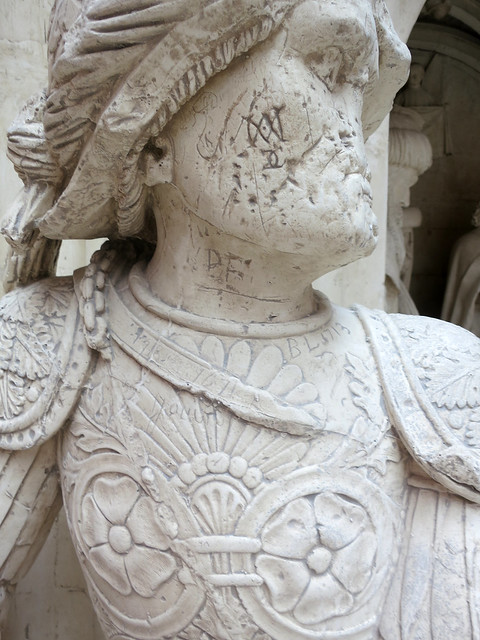
Plaster cast from the Palais de Chaillot
by KARL STEEL

First, join us in wishing Jeffrey safe travels.

Then, lest it be said that my promises or threats aren't worth the nose they're printed on, here, for your use, is my monumental post on the noselessness of Bisclavret's wife.

Recall that towards the end of Marie's lai, Mr. B's wife shows up at court, only to be attacked by her lupine husband:
Oiez cum il s'est bien vengiez!
Le nes li esracha del vis.
Que li peüst il faire pis? (Bisclavret 234-36)
"Just hear how successfully he took his revenge. He tore the nose right off her face. What worse punishment could he have inflicted on her?" (translation by Gallagher. My own translation would go like this: "Listen to how well he avenged himself! He tore her nose off her face. What worse could he have done to her?") 
The loss of the nose has long been a rich interpretative site in Bisclavret criticism. We can divide the readings into several groups:

  • psychoanalytic ones, which pun on vis [face] and vit [penis]: e.g., Bloch, Labbie, and Dolores Warwick Frese, "The Marriage of Woman and Werewolf: Poetics of Estrangement in Marie de France's 'Bisclavret'" in A. N. Doane's and Carol Braun Pasternack's anthology Vox Intexta: Orality And Textuality in the Middle Ages, rooted, I believe, in Jean-Charles Huchet, "Nom de femme et ecriture feminine au Moyen Age: Les Lais de Marie de France," Poetique 48 (1981): 407-30. Essentially, Ms. B had illegitimately taken on the phallic function and has it torn from her. This helps explain why only her female descendants are noseless; 
  • claims that nose-removal was a common torture in the Middle Ages, which I think is a wild exaggeration: I'm looking forward to seeing Larissa Tracy's further contextualization: I believe she's arguing that the court of Henry II, being antipathetic to torture, would have found the scene repugnant;  
  • claims that the nose-removal makes the wife more bestial: for reasons I'll explain (far) below, I disagree; I'm more in the neighborhood (less in the same block than on the same bus line) as Laurence M. Porter's proposal in Women's Vision In Western Literature: The Empathic Community that "Wolves have prominent muzzles and the missing nose makes Bisclavret's wife's face resemble a human skull more than a wolf's head, suggesting the skull underneath the skin, the illusoriness and transcience of sexual delight";
  • interconnections with many, many stories of Roman virgins and, in particular, virgin saints, who cut off their noses to make themselves unattractive to the Barbarian invaders [see Claude Thomasset, 'La femme sans nez', Littérature et médecine II, ed. Jean-Louis Cabanès, Eidolôn, 55 (Bourdeaux: Université Michel de Montaigne, Bourdeaux III, 2000), 57-52 and Jane Tibbetts, 'The Heroics of Virginity: Brides of Christ and Sacrificial Mutilation," Women in the Middle Ages and the Renaissance: Literary and Historical Perspectives Ed. Mary Beth Rose. Syracuse: Syracuse UP, 1986]: implicitly, then, Bisclavret's assaulting his wife's attractiveness; 
  • and finally, most influentially, a great many claims that losing the nose [or losing the nose and ears] was a punishment for an adulterous wife. See Stith Thompson Q451.5.1, Nose cut off as punishment for adultery. This requires a lot of detail.
Stith Thompson's most frequent citations here are to the Kathasaritsagara, "The Ocean of the Stream of Stories," an enormous 11th-century Sanskrit tale collection in which adulterous wives often lose their noses (or their noses and ears), sometimes while embracing the reanimated (and bitey) corpses of their executed lovers. Anna Kłosowska suggested to me that the stories could have made their way to Latin Europe: I want to know more about this: perhaps via Iberia or Norman Sicily?

Saxo Grammaticus tells the story of Hjalte, who's with a ladyfriend while his king's being betrayed. When Hjalte hears the sound of battle, he decides to leave her to rescue his lord. His ladyfriend asks him "si ipso careat, cuius aetatis viro nubere debeat," if she should lose him, how old a man ought she to marry? He answers her by cutting off her nose.

Robert Stanton directed me to the laws of Cnut, which punish a female adulterer with the loss of her nose and ears. Frederick II of Sicily (1194-1250) commanded that an adulterous woman's nose be amputated, unless her husband didn't want this: otherwise, she would just be flogged ("adultera convicta de adulterio traditur viro, ut in recompensationem thori violati, truncetur ei nasus, & si maritus ei truncare non vult, fustigabitur"; h/t Shulamith Shahar The Fourth Estate for this reference).

Still earlier law codes might be referenced, with increasingly remote chances of relevance: Ezekiel 23:25 hints at the loss of nose and ears for adultery: medieval Biblical commentaries might profitably be consulted; the Byzantine Ecloga of 726 punishes adulterers of both sexes with nose-slitting; and  Diodorus of Sicily's 1st c. BC universal history says that in Egypt, "In case of adultery, the man was to have a thousand lashes with rods, and the woman her nose cut off. For it was looked upon very fit, that the adulteress that tricked up herself to allure men to wantonness, should be punished in that part where her charms chiefly lay" (thanks to Sharon Kinoshita for proposing the web search that led me to these sources).

Looking ahead, Valentine Groebner Valentin Gröbner 'Losing Face, Saving Face: Noses and Honour in the Late Medieval Town," trans. Pamela Selwyn History Workshop Journal 40 (1995): 1-15 (in work that I expect appears in some form in her his 2009 Defaced: The Visual Culture of Violence in the Late Middle Ages) talks about a 1479 case in Nuremberg in which a certain Fritz Schreppler tried to cut off his wife's nose in the marketplace. We have several others like this from the same period, including multiple instances in which a husband and wife teamed up to cut off still another woman's nose. 

Groebner Gröbner also records fourteenth-century denasatio punishments against prostitutes in Augsburg, and then, finally, she he cites evidence of pan-medieval texts that link the loss of a nose to public humiliation and punishment for sexual crimes: there's Du Cange, where "the examples under the adjective denasatus alone fill an entire column," and Aenied VI.496-7, where Deiphobus's terribly mutilated in his face, perhaps for the crime of sleeping with Helen of Troy. And, finally, the Knight of La Tour Landry speaks of a husband who breaks his disobedient wife's nose and "all her lyff after she had her nose croked, the whiche shent and dysfigured her uisage after, that she might not for shame shewe her uisage, it was so foule blemisshed."

We might also look to the witness of medieval translations and adaptations of "Bisclavret." In Biclarel [warning: pdf], Mr. B just mutilates his wife's face (373-74), with no specific reference to her nose, and then she's walled up, presumably to be crushed or to starve to death (454-5). In the Icelandic version, he tears off her clothes and nose, and in the Old Norse version, "Bisclaret," he tears off his wife's clothes, but her female descendants are still born noseless. Incidentally, "Bisclaret" ends in a tantalizing way for werewolf scholars: "Nothing that happens now is more true than this adventure we have told you about, for many strange things happened in olden times that no one hears mentioned now. He who translated this book into Norse saw in his childhood a wealthy farmer who shifted his shape. At times he was a man, at other times in wolf's shape, and he told everything that wolves did in the meantime. But there is no more to be said about him. The Bretons made a lai, 'Bisclaret', of this story which you now have heard" (translation by Robert Cook and Mattias Tveitane).

And that would seem to be that: Ms. B loses her nose as a sign of her marital infidelity, or to humiliate her, or to disfigure her. Absent legal or (other) narrative evidence particularly from the court of Henry II, we don't have firm ground for these explanations, but we probably have enough to make our claims with sufficient confidence, and to say, as well, that any further interpretation would just be fanciful, evidence only of our critical ingenuity in this ongoing professional party game we call "producing a reading."

But I can't help myself: I have to propose one more possibility. Recall how my previous Bisclavret post takes the lai's opening as structurally analogous to a bestiary. From that, I'm led to illustrations in the bestiaries of Adam naming the animals:
Aberdeen Bestiary f 5r, detail
I know I'm stretching things, but I'm struck by the protuberance of the animal faces in this and other medieval illustrations of Adam before the animals, and by Adam's comparatively flat face. Had the deer, or even the round-faced lions lost their noses, they would have a face that more resembled Adam's than that of any other animal. That is, as Laurence M. Porter observes, the loss of a nose doesn't make Ms. B more "bestial" (despite what's commonly said in the criticism) but rather less bestial. Porter takes the injury as making her face more skull-like, turning her into a kind of vanity figure somewhat avant la lettre. However, I take the injury as one that traps her in being only human, denying her the freedom of movement, and of the freedom of ontological (or, for that matter, ethical) positions enjoyed by her husband and by the masculine court to which he belongs.

She had been afraid of a husband able to shift from man to wolf; she wanted to be married only to a human, and nothing more; and for that, she's punished with nothing less that an inescapable humanity. In a lai, it's hard to imagine a worse punishment! She and her daughters, barred from the dangerous fun of men, have been made...well, boring.

More to come, perhaps, if you think this is worth developing.

Friday, June 01, 2012

Bisclavret's (Secret) Diet


by Karl Steel

Our readers likely remember how Marie de France's "Bisclavret" begins, because it's one of our favorite stories:
Quant de lais faire m'entremet
ne voil ubliër Bisclavret.
Bisclavret a nun en Bretan,
Garwalf l'apelant li Norman.
Jadis le poeit hum oïr
e sovent suleit avenir,
hume plusur garwalf devindrent
e es boscages maisun tindrent.
Garwalf, ceo est beste salvage;
tant cum il est en cele rage,
humes devure, grant mal fait,
es granz forez converse e vait.
Cest afere les or ester:
del bisclavret vus voil cunter. (Bisclavret, 1-14)
[In my effort to compose lays I do not wish to omit Bisclavret--for such is its name in Breton, while the Normans call it Garwaf. In days gone by one could hear tell, and indeed it often used to happen, that many men turned into werewolves and went to live in the woods. A werewolf is a ferocious beast which, when possessed by this madness, devours men, causes great damage, and dwells in vast forests. I leave such matters for the moment, for I wish to tell you about Bisclavret" (translation by Gallagher)].
Frightening, no? Well, no, not really, since we never see our werewolf hero [hereafter Mr. B] eat anyone. Or really, anything (barring, perhaps, his estranged wife's nose). When Mr. B's wife wheedles him into giving up his secret, lupine life, he confesses that when he becomes bisclavret he goes into the great forest, into the deepest part of the woodland, and there lives on prey and plunder ("vif de preie e de ravine").

This is violent language, but there's nothing here about his explicitly eating humans. At least not so far as he tells his wife, or us, for that matter. Jeffrey will remark on the vagueness of Mr B's account of his diet in a forthcoming piece in Studies in the Age of Chaucer; Burgwinkle's talked about it too ("As he ceases to be dangerous – no devouring of men that we know of – his wife appears ever more treacherous" (166); no doubt there's more: I don't have Bynum's discussion on hand, for example (although I don't think McCracken and Kinoshita discuss this matter in their recent critical companion to Marie).

Readers of my AVMEO essay would expect me to suspect Mr. B of anthropophagy: wolves like to eat people, and Marie's already told us werewolves eat people. Only special pleading could get Mr. B off the hook: maybe, some might say, Mr. B would be unlikely to find many humans to eat in the deepest part of the forest. That's not much of a defense. It's easier to accuse Mr. B of hiding the nastiest truth from his wife, who nonetheless proves that she understands him perfectly well by immediately plotting to get rid of him. More sympathetically, we might even suspect Mr. B not of being duplicitous, but of being too self-deluded to admit, even to himself, what he's really doing.

Maybe we can suspect worse. For while there's something marvelous about not being confined by the armor of an alienating (human) identity, there's also something horrific (to us) about letting the human frame slip. Again following the path laid by my AVMEO essay, I suggest that Mr. B's own vagueness hints at the consequences of giving up on human supremacy, namely, that once human supremacy doesn't matter, humans fall under the general category of "prey and plunder." There's no need for Mr. B to conceal anthropophagy, but neither does he need to disguise it with a euphemism, because, for him, human flesh is just like other fleshes. There's violence here; there's a wrong being done, to someone or something; but it's not a particular violence, or a violence that quite knows what it's injuring, unless it's the particular violence through which a nobleman sustains his position within the state of exception.

The dehumanized point of view isn't the only stance the lai takes, however. Its opening doesn't forget about the specificity of human flesh, not at all. I propose that we read the opening lines as modeled on a bestiary, not at all an inconsequential genre for the late twelfth-century England in which Marie wrote. See the Aberdeen Bestiary's entry on the wolf, for example. Like Marie's lai, we have an initial discussion of names, followed by a summary of behavior. To be sure, I may be over-reading the resemblance, but I suggest it to call attention to the generic difference between the lai's narrative and the lai's opening. Marie opens with what we might call a scientific and humanist voice, maybe like a bestiary, maybe not. Whatever the voice, it's knowledgeable, distant, one that looks out at the nonhuman world, always thinking of how it might help or hurt people. To this voice, a werewolf, like wolves in general, can only be a threat.

(Monday edit: I really do need to say, here, that Susan Crane's Animal Encounters will be doing interesting stuff with bestiaries and Bisclavret in ways that will be enormously important to my own developing Bisclavret argument)

The narrative voice, on the other hand, doesn't care so much about human supremacy. For this point, in the next few months, look for Cohen and, as well, Susan Crane's Animal Encounters; also see McCracken on translation and movement. The narrative voice concerns itself with gender and sexuality (see Burgwinkle and Tovi Bibring), and with feudal loyalties, but not with humanity, except to observe how it's slipped. Note that when the King meets (the) bisclavret, he declares, first, that "ele [i.e., this beast] a sen d'ume" [154; this beast has human intelligence], and then revises himself three lines later: "ceste beste a entente e sen" [157; this beast has understanding and intelligence]. Beasts, he realizes, have their own intelligence, not a wan imitation of human reason, but rather their own. When anthropocentrism collapses, what dangers follow?

We might therefore hear Mr. B's "preie e ravine" as at once being aware of the violence of appetite and unaware of the specificity of human flesh as compared to the flesh of deer, or pigs, or sheep. Mr. B may be hiding something from his wife; or he might just have forgotten, like most eaters, that what he eats has any significance apart from how it benefits him. After all, he's concerned mainly with his own safety, not hers, and not with--it seems--ours.

Or he might be observing that eating means subjecting someone or something to prey and plunder; that it means taking someone's "better part" (again, my AVMEO essay), regardless of what that thing is. This is a lai, in other words, that knows what it is to eat in a world without the comforts of a naturalized, absolute human privilege.

Next-Day Edit: that should read "without the comforts of a naturalized, absolute privilege, human or otherwise." For some recent discussions of posthuman ethics, relevant to my post, see Levi Bryant and Scu at Critical Animal. I think Scu gets it exactly right when he says "Ethics is not a pathway for innocence. Rather, it is about how to live after innocence, how to exist in a fully post-lapsarian world." I think that "Bisclavret" might answer Levi's statement that he's "not even sure what a non-anthropocentric ethical theory would look like." Well, here's one, and it's lycanthropocentric. It's not a flat ontology (edit of the edit: or rather, not a flat ethics), because--as Bogost reminds us--there's no escaping -centrism, of whatever sort. But to eat from the perspective of the wolf (as I suggest the Wolf-Child of Hesse does) or the werewolf (as Mr. B does), is certainly to be non-anthropocentric. Edit of the edit: although I may be speaking far above my pay grade, and certainly far outside my expertise, while we might be able to conceive of a flat ontology, I'm not sure we, or anything else, can conceive of a flat ethics.

And one more next-day edit: I know that going into the deep woods to "vif de preie e de ravine" essentially describes the life of a poacher, which matters, of course, in late twelfth-century England, given the rising importance of royal forest privileges. But I just don't see that observation leading to an interesting reading. I'm willing to be convinced otherwise.

That's all I have for now, though I have notes on hand for talking about the eaten nose. Those who looked at my book two proposal might suspect (correctly) that this material will probably form the introductory section to second chapter, leading up--of course--into my Wolf Child of Hesse discussion. Time, and effort, will tell. For now, though, I'm planning to learn what the latest issue of postmedieval has to say about about lepers.

 (video from Emilie Mercier's animated Bisclavret)

Tuesday, January 18, 2011

Animals, Saints, and Monsters in the Middle Ages: Spring 2011 Version

by KARL STEEL
Brooklyn College starts its Spring semester in two weeks. For those of you already teaching, you have my sympathy, which I expect will be returned to me (with interest?) in the last week of May, when my Spring will have done with me. Today's task? Retool my graduate "Animals, Saints, and Monsters" course. Last year's version is here.

In the spirit of sharing Spring courses (see Jeffrey, here, and Eileen, here, especially if you want to see who I'm ripping off):

This time around, in response to student complaints that I was teaching too many things, I'm dropping, among other texts, Yvain and Guillaume de Palerne, the first because I'd rather spend half a semester on it, and the second because of its price and because so much of it tends to all-too-familiar medieval battle scenes, perhaps interesting to my students but dull, dull, dull to me. I also dropped Geoffrey of Monmouth's Vita Merlini, because I very much want to teach it with Timothy Morton's The Ecological Thought, and because I don't feel comfortable assigning my students a $40 hardcover that runs less than 200 pages. I'll teach the Vita again when Morton comes out in paperback.

In response to student requests for, I kid you not, more werewolves, I'm providing just that (thank you, Liverpool Online Series: Critical Editions of French Texts). I'm keeping the Melusine legend from Geoffrey of Auxerre, adding in Chaucer and Marie de France (because, well, I just should teach canonical texts from time to time) and, as well, Raymon Llull's fables because they're good...and because I don't think my students want to finish their semester by fighting through Henryson's Middle Scots, despite Henryson's highly peculiar sympathy for the violence he has his fable figures suffer (for a tantalizing discussion of this, see Jill Mann, From Aesop to Reynard); see lines 1874-1880.

The schedule follows:
  • Introduction: Background to the Middle Ages and Critical Animal Theory; “The Wolf Child of Hesse,” from The Chronicle of Saint Peter of Erfurt
  • Critical Animal Theory: Foundations: Jacques Derrida, “And Say the Animal Responded?” The Animal That Therefore I am, 119-40; Jacques Lacan, “The Mirror Stage as Formative of the I Function as Revealed in Psychoanalytic Experience,” Écrits, 3-9; Genesis Chapters 1-3; Psalms 73:12-17 (DRV)
  • Critical Animal Theory: Foundations II: Judith Butler, “Introduction: Precarious Life, Grievable Life,” Frames of War, 1-32; 'Canis Legend' from Killis Campbell, ed., The Seven Sages of Rome, lxxviii-lxxxii, 26-32, ll. 775-944, Sidney Herrtage, ed., Early English Versions of the Gesta Romanorum, 98-99, “The Queen of France and the Unfaithful Husband” (from Medieval German Tales in English Translation), and Stephen of Bourbon, on “St. Guinefort,” from De Superstitione
  • Critical Animal Theory: Foundations III: Donna J. Haraway, “When Species Meet: Introductions,” When Species Meet, 3-42; Marie de France, Lays, “Bisclavret”
  • Monsters: Jeffrey Jerome Cohen, “Monster Culture (Seven Theses),” Monster Theory: Reading Culture, 3-25; Melion and Biclarel
  • Monsters II: Luce Irigaray, “This Sex which is Not One,” This Sex which is Not One, 23-33; Ovid, Heroides XIV, “Hypermnestra to Lynceus”; Ruth Evans, “Gigantic Origins: An Annotated Translation of De Origine Gigantum,” Arthurian Literature 16 (1998): 197-211
  • Monsters III: Geoffrey of Auxerre, On the Apocalypse, Joseph Gibbons, trans., 139-57; Gerald of Wales, History and Topography of Ireland, John O'Meara trans., 69-77; Ratramnus of Corbie's “Letter on the Cynocephali” (from Paul Edward Dutton, trans., Carolingian Civilization: A Reader, 2nd Ed., 452-55); Cursor Mundi on the “Conversion of Monsters,” lines 8069-8132
  • Inventing with Animals: Jeffrey Jerome Cohen, “Inventing with Animals in the Middle Ages,” Engaging with Nature, 39-62; Marie de France, Lays, “Guigemar,” “Yonec,” “Laüstic,” "Milun,” and the anonymous “Lay of Tyrolet”
  • Into the Wild I: The Travels of Sir John Mandeville, 43-115; Vibrant Matter, i-62
  • Into the Wild II: The Travels of Sir John Mandeville, 116-190; Vibrant Matter, 63-finish
  • Talking Animals: Susan Crane, “For the Birds,” Studies in the Age of Chaucer 29 (2007): 23-41; Geoffrey Chaucer, “The Parliament of Fowls”
  • Saints: The Little Flowers of St Francis
  • Talking Animals II: The Owl and the Nightingale; Monica Brzezinski Potkay, “Natural Law in 'The Owl and the Nightingale,'” The Chaucer Review 28.4 (1994): 368-83
  • Talking Animals III: Raymon Llull, “The Book of the Beasts”
  • Review: Cary Wolfe, “Human, All Too Human: 'Animal Studies' and the Humanities” PMLA 124.2 (2009): 564-75; Bruce Holsinger, “Of Pigs and Parchment: Medieval Studies and the Coming of the Animal,” PMLA 124.2 (2009): 616-23: Lynn White, Jr., “The Historical Roots of Our Ecologic Crisis,” Science 155.3767 (1967): 1203-1207.
(image, f 28r, from here, Robbins MS 005)

Friday, September 19, 2008

Monster Theory at TheoFantastique

by J J Cohen

Some readers of ITM may be interested in this recent interview about an old book of mine.

The hardest question was coming up with a monster for our times. I don't know, readers: what's our zeitgeist? why don't we have a dominating monster?

Saturday, September 13, 2008

For Your Weekend Entertainment: Goat Man

by J J Cohen

Forget Netflix: here is your weekend amusement on demand, right at ITM. Grab a bowl of popcorn. Turn down the lights. My son shot this little horror film and then used iMovie to edit. A six minute re-enactment of the Legend of Goat Man (the deformed sibling of the Blair Witch: alert MEARCSTAPA!), it features some summer camp friends. You'll even glimpse bonus footage at the end in which Alex makes an appearance.

Your nightmares will endure for years. Really...

Saturday, March 22, 2008

Albina Myth: Standard Reading

So in the comments to this post, Karl writes:
As for the Lynch: "not only as a British foundation myth but also as a cautionary tale about the dangers to society of ambitious-and foreign-women who usurp masculine privilege." That's a standard reading of the text (admittedly little read when Lynch did her article, and still not much read)

That standard reading would be, um, mine ... I admit to being the one who gave it to Lynch, albeit at that time it was part of my dissertation. I think it was also the first time I made it into someone's footnote for something I said.

Anyway, I thought just for fun I'd cut and paste the standard reading here. It's from the second chapter of my book Of Giants. Read Karl's post first ... then, (as Slavoj Zizek would say) Enjoy!


--------------------
The Albina myth conjoins the rapinous tradition of biblical giants with Geoffrey [of Monmouth]'s secular version and produces a smaller product through the combination, a history with familial interests behind its nationalistic gestures. The spirits who copulate with Albina and her sisters in [the Anglo-Norman account of the founding of Britain] Des grantz geanz are called incubi, malfez, and deables; their offspring are consequently horrifying to behold (a regarder hidous) and abnormally large. Incubi in medieval myth are, like giants, always male. They have no material body of their own, but are nonetheless able to implant an organism (organization of being) within the bodies of the women they violate, causing the birth of a monster. Sexual mother, rapinous incubus, and infant monster are the vertices of an unholy family triangle which obscenely contrasts with the model medieval family of Virgin Mother, sexless Holy Spirit, and sinless divine Son. The Holy Family remains an incorporeal ideal by wholly eliminating sexuality and the body from its narrative of origins, but this second familial triangle violently reinscribes flesh and sex into bodily generation.

The Albina myth translates into monstrous form two conceptualizations of the biological origin of human life as medical science understood it in the Middle Ages. For medieval theorists of the body who followed Aristotle, the mother contributes formless bodily matter (materia) to the child, while the man imposes with his seed (semen) a structure that organizes this inert substance into a sexed and gendered being. The Aristotelian model is obviously another version of Brutus' mythology of nation-building: the woman is the elemental matter from which offspring are produced, just as the land is the raw materia of nation. The influential treatises of the physician Galen, on the other hand, argued that both men and women contribute seed (and therefore structure) to their progeny. The Galenic conceptualization of reproduction corresponds to the rejected model of origin which Albina represents. She and her sisters contribute as much to their progeny as their sexual partners. The conjoining of incubus and errant woman results in a new body that mixes the nature of both, the repudiating monstrum. This monstrous family invokes the domestic triangle of father, mother, and child to illustrate what happens when a body strays from its properly subordinate place in the regulative trigonometry of the idealized medieval household. Albina oversteps her (cultural, biological) place as submissive wife, and disaster ensues. Brutus must intervene and overwrite Galenic equality with Aristotelian masculinism: feminine bodies become as passive in the generation of progeny as they must be in the articulation of familia.

Geoffrey's Historia brought a fragmented political field into widespread coherence through an ideologically cohesive master-signifier: Britain/England, the "Nation-Thing" as sublime object of ideological identification. Circulated almost two hundred years later, long after that cultural unity has been achieved, the Albina myth extends the same ideological intervention to a basic identity relationship by which the larger imagined community writes itself in parvo. Albina and her sisters refused their subject-positions in marriage and attempted to erect a structure for human relationships in which femininity and the maternal were not dominated by or absorbed into masculine mastery. The sisters strove in Greece to bring about a world in which their agency would be absolute, where "none of them would be willing to have a master, nor be placed under anyone's duress, but always be mistress of her husband and of whatever he owned [mestresce de sun seignur e quant q'il out]" (58-61). Albina would destroy a culture which depends for its continuance on the replicative reinscription of the family, the miniature version of the patriarchal state.

After retelling the Albina story, John Hardyng wrote that "women desyre of al thynges soveraynte, and to my concept, more in this land than any other, for they have it of the nature of the said sisters." He could easily be quoting Chaucer's antimatrimonial nightmare, the Wife of Bath. The tale which the Wife tells begins, significantly, with incubi and threats of rape. Its hero is a knight who, in punishment for having casually violated a maiden, is compelled to discover what thing women most desire, and determines that "wommen desiren to have sovereyntee" (III 1038). This prideful desire for mastery in marriage motivates the Wife of Bath herself. Her prologue to her tale chronicles long fights to gain absolute dominance over a succession of five husbands, whom she consecutively reduces to subordination. The Wife of Bath inhabits that same male fantasy space from which Albina derives, so that she can be invoked by Chaucer in the "Lenvoy a Bukton" as a monstrous warning of the woe that is in marriage. Both Albina and Alisoun of Bath teach husbands that governance in marriage is as authoritarian and severe as the autocratic governance of the state. Rather than argue that this aggressive dominance comes naturally to men, or that submissiveness is an affect of the feminine body, the Albina myth naturalizes the occurrence of both by showing how, through "historical necessity," such an ordering of gendered relations came to be established. The myth constructs aggressively constricted roles for husbands at the same time as it illustrates through negative exemplum the properly domestic boundaries of the ideal wife.

Nature, Culture, and Language
This not owning of one's words is there from the start, however, since speaking is always in some ways the speaking of a stranger through and as oneself, the melancholic reiteration of a language that one never chose.
-- Judith Butler, Bodies That Matter 242

In translating into English Wace's French translation of Geoffrey's Latin Historia, Robert Mannyng of Brunne was forced to admit that he was uncertain about the existence of giants. As he describes the monsters who await the arrival of Brutus in England, Mannyng observes that: "Geant is more than man / so says the boke, for I ne kan" ("A giant is bigger than a man -- so says the book, but I don't know," The Chronicle 1751-52). They are "like men ... in flesch & bone," he asserts, even if "in my tyme, I saw neuer non" (1753-54). Mannyng's understated incredulity is endearing, but at the same time as he casts some doubt about the existence of the monsters, he is happy to pass along official information about them to his readers. Most of all, he states, giants are characterized by their similitude: they present an exact if inflated replica of a the masculine body (1755-56), a perfect simulacrum.

"Man" is used as if it were a universal category throughout Middle English writing, but in Mannyng's description of the giant it retains its gendered specificty. His "membris" and "lymes" mark the giant as man-like, but also as male -- as the description of Gogmagog and his monstrous crew which follows next in the Chronicle makes clear. The giant as the magnified, insistently physical masculine corpus is Geoffrey of Monmouth's contribution to medieval gigantology, and although Mannyng might undercut the possibility that giants existed, he does not doubt their sex. Whereas Galfridian tradition chronicles only male giants battling for supremacy against male foes, however, the Anglo-Norman Albina myth repeatedly inserts feminine and maternal bodies, even after Albina and her sisters have vanished into biological function. Invoking the giants' primal associations with sexual violation, the narrative details their race's continuance by linking its monstrous life to the transgression of what Claude Lévi-Strauss has called the first patriarchal law, the incest prohibition. The male first generation of giants begets children upon their own mothers. A cycle of historical repetition through incest is then set into motion, in which "filz et filles" (sons and daughters) engender more monsters "par grant outrage" -- sometimes on their mothers, sometimes on each other (434-36). The offspring of these unions likewise grow large, becoming a people "of immense body" (438-40). Until the arrival of Brutus, Albion exists as a hideously closed world of continuous sexual confusion which re-enacts, relentlessly, the failure of the first family triangle established in the narrative. Signification and sexuation are conjoined in their monstrous impropriety.

Maud Ellmann has observed that "Kinship laws, which govern the system of combinations in mating, correspond to linguistic laws governing the combinations of words in a sentence or letters in a word." The antifamilial, antimatrimonial system which the women established is doubly incestuous, somatically and linguistically. Its monstrousness inheres in its "bad grammar" that at first will not culturally differentiate wives from husbands, and then cannot separate mothers from children, brothers from sisters: "For without kinship nominations, no power is capable of instituting the order of preferences and taboos that bind and weave the yarn of lineage through succeeding generations." Albina does in fact establish that order of human relations which she sought to materialize through a usurped speech act, only to learn that she is excluded by the language she invokes, that its power will monstrously transform her feminine body as it flings her back to the passive materiality from which she fled. Albion under Albina devolves into a realm of pure, undifferentiated nature. It awaits the imprint of a new, masculine language to materialize an order, to precipitate culture through some foundational prohibition, through some heroic fiat.

The organization of bodies into culture through the instigation of a kinship system is very like the ordering of the phenomenological world into reality which language accomplishes, or of the past into history which narrativization executes. All three of these performances are strongly gendered acts. Yet they do not receive their gendering prior to their effects upon reality; rather, "gender" is produced through the very fantasies in which these systems ground themselves, and through the continued repetition of their "foundational" gestures. In order to assert male dominance within these structures, originary myths are invented which authorize an oppressive present through anchorage in a similar past. Lévi-Strauss bequeathed such a myth to anthropology when he wrote the Elementary Structures of Kinship, a work which equates "raw" nature with feminine bodies, and the legitimizing power of culture with the founding fathers who invent the incest prohibition (i.e., Law itself) and therefore also invent gender. According to Lévi-Strauss, "man's sexual life" (the gender of the noun is important) is originally wild, "natural" (12). The incest prohibition, synonymous with the institution of a law which generates family relations, organizes this formless sexuality into a culturally legible norm; it allows the exchange of women between men, which in turn generates endogamy and exogamy, which in turn transform nature into culture (because an "absence of rules seems to provide the surest criterion for distinguishing a natural from a cultural process," 8). Culture here is the same as kinship systems; culture arrives at the same time as "relationless" bodies are hierarchized into families.

Lévi-Strauss writes in an Aristotelian vein. Men invent the laws regulating sexuality which distinguish the human from the animal; women are passively invested with the meaning by these laws as their bodies trace paths of affiliation between the men who exchange them. Lacan reiterated this originary myth when he used Lévi-Strauss as his own foundation for a semiotics-inflected psychoanalysis: "The primordial Law is therefore that which in regulating marriage ties superimposes the kingdom of culture on that of nature abandoned to the law of mating ... This law, then, is revealed clearly enough as identical with an order of language" ("Function and field of speech and language," Écrits 66). The Albina myth is an early version of the same kind of originary narrative. It allows a masculinist logic to equate nature with femininity (a "mystery," because it is prelinguistic, and therefore also excessively corporeal), and culture and language with men (fully knowable, because they invent speech, and speech orders the world). The Albina myth, Lévi-Strauss' incest fantasy, Lacan's dream of a wholly phallogocentric language are all moments in a long history by which the masculine gender is erected as a universal, and women are allied with the abjected, the marginal, the monstrous. If the world and the linguistic structures used to understand it inevitably and eternally took their origins in this way, men and women alike would be right to heed Luce Irigaray, and despair of ever using language to construct a nonexclusive reality for all bodies, regardless of anatomy. Fortunately, the Albina myth suggests a different fate for masculinist originary fantasies: a change in the structure of linguistic and cultural signification via some historical rupture which reconfigures the "master-signifiers," resigning old myths to the quiet loneliness of the archive, where they can teach but cease to harm. No system of human meaning is ever complete, invulnerable, and impervious to history.

Like many medieval writers, Alain de Lille imagined in his "handbook" (enchiridion) on the laws of nature that the power of language over material reality, including sexuality, is absolute. A telling scene of De planctu naturae (The Complaint of Nature, c.1165) describes Genius at his writing table:
In his right hand he held a pen, close kin of the fragile papyrus, which never rested in its task of inscription. In his left hand he held the pelt of a dead animal, shorn clear of its fur of hair by the razor's bite. On this, with the help of his obedient pen, he endowed, with the life of their species, images of things that kept changing from the shadowy outline of a picture to the realism of their actual being. As these were laid to rest in the annihilation of death, he called others to life in a new birth and beginning.

The (masculine) stylus, perfect vehicle of an unfailing language, inscribes the world upon the stilled surface of the vellum -- once a living body, now passive materia. Likewise, the Anglo-Norman version of the Albina myth imagines an unchanging masculine order of pure language through which human and historical identity are solidified. Divorced from its own materiality, the male body becomes as impossibly airy, disembodied, and indestructible as a language that exists outside of time and change; the male body becomes synonymous with the frozen verba et grammatica that inscribe meaning upon the body of the world, as well as upon bodies in the world. Albina's naming of the land linguistically parallels Brutus' expressed desire for geographical immortality, his fathering of a country and a people through a name:
Albine est mon propre noun,
Dunt serra nomé Albion;
Par unt de nous en ceo pais
Rembrance serra tutdis. (ll.347-50)
Because my name is Albina, this land shall be called Albion; by this our eternal memory shall live in this country.

Compare the same scene written in the masculine gender in the Historia:
Denique Brutus de nomine suo insulam Britoniam appellat sociosque suos Britones. Uolebat enim ex diruatione nominis memoriam habere perpetuam. (13-14)

Brutus called the land Britain after himself. His intention was that his memory be made eternal through the derivation of the name.

Albina invokes the reifying power of language, as if she were a hypermasculine Trojan hero, not a monstrously transgressive Greek woman. She "repeats" in the past the same linguistic ritual which will render Brutus the generative parent of Britain. Fathering a nation (and its substructure and support, the family) is metaphorically possible without recourse to female agency; indeed, both rely upon female passivity, on the provision of a "natural state" or formless materiality on which to impose structuration. Albina's linguistic ordering of reality yields only monstrous forms: bodies which are at once male and female and incestuous, bodies that do not know their proper cultural place because they pre-exist the masculine "invention" of place. Brutus is able to repeat the same words and, by reference to a linguistic authority his by dint of the subject-position from which he articulates his words, he produces a nationalistic matrix for the proper gendering of identities, a model for male dominance.
In Brutonian history, both the monsters and the feminine body vanish at this moment of origin, evacuated of meaning "in their own right" and installed into the progress narrative of history. Like those monumental statues in Guildhall, they commemorate a monstrous past which exists only to envalue an architecture of power in the present. This haunting presence-in-death is foregrounded by giving the giants an archeological reality. The monsters are visible now not only as huge petrified bones qe hom puet trover / En mult des leus de la terre ("which a man can find in many places across the land," 443-56), but as earthworks and ruins. The narrative stresses that these remnants are, like Gogmagog's Leap in Geoffrey's Historia, still a part of the landscape of England. Past and present intersect and filiate. Brutus slaughters the giants upon his arrival in Britain, but he spares Gogmagog. This giant tells him the very tale which Des grantz geanz itself relates: the creation and lineage of the giants, how they came into the land, and why Britain should once have been called Albion. Brutus responds by ordering the story memorialized "so that others afterwards might know the marvel of this story," 543-4. Appropriately enough, historical narrativization is performed through the mouth of a monster.

Medieval England is far from alone in imagining that its land was once ruled by a primordial matriarchy. The Albina myth partakes of a long tradition of fantasies of female sovereignty. One manuscript of Guiron le Courtois, a French grail quest romance which opens with a survey of English history, compares the Greek sisters directly to the archetypal gynecocracy of the West, the Amazons. Since the publication of Jacob Bachofen's Das Mutterrecht in 1861, many scholars have seen in the pervasive literary imaginings of primal matriarchies like the Amazons an encoding of historical fact. Other critics have pointed out that these myths of female rule function instead to justify the subjugation of women "by providing a purportedly historical account of how this reality came about." Such times and places in the Western imagination are primarily the creations of men, who imagine these inversions in order to validate their own dominant position. According to the classical myth, Theseus invades the Amazonian mutterland, and the rebuked matriarchs are transformed into properly subordinated wives. Similarly, Brutus and his men purge the land of its subhuman citizens in order to rewrite the wrongdoing of the Greek sisters. Along the way, they also establish a double sovereyntee: for the management of the nation, and for the management of the family. In both, the feminine body is conjoined with the monster, to vanish in a foundational act.

The story of Albina's colonization of England was wildly popular. Manuscript evidence suggests that the narrative was originally composed in Anglo-Norman, then quickly translated into English and then Latin. As Carley and Crick point out, vernacular texts were rarely rendered into Latin in the Middle Ages, so that "when it did occur, it represented an elevation of the text, its enshrinement in linguistic authority." This translation into the language of Geoffrey's Historia Regum Britanniae also marks an elevation into history: from the early fourteenth century to the last surviving days of the giants in Guildhall, the maternal body and the monstrous with which it is intimately connected receive a foundational, structural positioning within the identity of the English historia. Albina and Gogmagog become mother and son.

Tuesday, March 18, 2008

Mothers (and Giants) to Think Back Through

Maybe you know what to do with the Arthurian opening of the Wife of Bath's tale. I don't, not quite, but then again, I've only just started my path towards planting my flag on some portion of Chauceriana. I found one answer in Patricia Clare Ingham's "Utopia, Conquest, and the Wife of Bath's Tale," Texas Studies in Literature and Language 44.1 (2002) 34-46, but I'm sorry to say I found it more interesting than convincing. I'm sure the fault is my own. Ingham argues on behalf of the pastoral against its critics, who condemn it for its occlusions of material realities. In her hands, the pastoral and other utopian fantasies of the time before the proliferation of "halles, chambres, kichenes, boures / citees, burghes, castels, hye toures / Thropes, bernes, shipnes, dayeryes" (3.869-71) become a site of fantasy for the conquered and therefore a way to read past the conquering, dominant culture to otherwise lost voices. However, although a British Arthur is always a Welsh hero, although there's Celtic myth and memory in the loathly lady, the sovereignty hag, or whatever you want to call her, and although "Britons" (3.858) could be Welsh, I just can't hear the Welsh in the Wife's Tale. Maybe I don't have my ear pressed hard enough to the ground.

What I do sense are incubi, now exorcised by the friars, and the elf-queen, all of whom, inspired by Ingham, I read as a site of fantasy. As much as we love Gowther's father, his fourteenth-century fame barely rates in comparison to the cultural dominance of the incubi of the Albina legend. In a story that was translated from Insular French into Middle English, Latin, and Welsh--and what follows is a summary of one version--a Greek princess and her twenty-nine sisters plot to murder kings whom their father, a more powerful king, wants them to marry. Betrayed by the youngest sister, the remaining sisters are sent into exile on a rudderless boat, which drifts to an island christened Albion, after the oldest sister, Albina. After living for a time on a vegetarian diet, the sisters rejuvenate themselves with wild game and grow lustful. Their lust attracts incubi, by whom the sisters engender gigantic children. The children then breed with their mothers, and everyone continues interbreeding. Thus the island fills up with giants, who fight with each other so viciously that by the time Brutus arrives, 270 years later, only 24 giants remain, including a giant named Gogmagog who tells Brutus their history.

For a tale dominated by Guinevere, the voices of wives, widows, and maidens, and by an magical crone, I want Albina and her sisters to be its first gynocentric model of rule. It's a stretch, but I also want Albina and her sisters to be the "ladyes foure and twenty and yet mo" (3.992) that the rapist sees fleetingly "under a forest syde." I want Albina and her children to be an alternate genealogy for the Wife, one that's traced backed to a founding mother. After all, Albina lays claim to the island, bestows her name on it, and declares that these actions will memorialize the sisters forever in Albion. Her speech is a charter identifying the land with a noble and self-perpetuating lineage (think here of the women in the prologue, so many of whom--okay, two--are named Alys); nothing, barring of course the gender and gianthood of Albina and her children, is abnormal about eponymous identification with a land or claims that attempt to undercut other claims by declaring temporal priority. The sisters’ reproduction is also normative (or the normative in drag), because its outcome is a lineage, of sorts, one traceable directly to a founder and connected via that founder to a particular piece of land.

In essence, I want to trapdoor Ingham; but mainly I want to watch the Wife trapdoor everyone else. I want to read the first line of the tale, "In th'olde dayes of the Kyng Arthour" (3.858) not as "In the old days, the time of King Arthur" but as "In the days Arthur would have considered old," the time when in fact "this land fulfild of fairye" (3.859). After all, so far as I know (folklorists? Arthurian specialists?), in Arthur's time the land was mainly full of knights, who sometimes encountered a scattered a fairy or two like Gromer Somer Joure or a faux fairy like Bertilak; for throngs of fairies, we need to go back to Albina's day. Following Ingham, we might be able to recover Welsh resistance in this monstrous origin; but I think we can follow this back still further, to the Wife's own desires. What that would get us I don't know yet (please don't say the presymbolic Maternal!).

Hell, I don't know if I'm just recapitulating something that's been said 100 times already.

But, correcting for the nobility, I can't help but hear the Wife in this:
My fair sustres, ful weel ȝe knowiþ þat þe kyng oure fadir, vs hath reprouyd, schamed & dispised, for encheson to make vs obedient vn-to oure housbandes; but certes þat schal y neuere, whiles þat I lyve, seth þat I am come of a more hyere kynges blod þan my housband is.
And I'm not even sure I have to correct for the high kindred of Albina, since, after all, the Wife is so puffed up that "in all the parisshe wife ne was ther noon / that to the offrynge bifore hire sholde goon; / and if ther dide, certeyn so wrooth was she / that she was out of alle charitee" (1.449-52). And, if I can sense Albina in the tale's own prologue, maybe I can account for an episode that--maybe--doesn't get the respect it deserves. What the next step would be, I don't know yet.
==
(conversations continue below, and much excellence to read that merits more conversation: the Carnivalesque; Publishing and Our Discontents; the Frenchness of English Jews; Mary Kate on monsters and resistances to knowledge; and, of course, Eileen's mother of a post and its gigantic thread, "On the Virtues (and Loves) of Beautiful Singularities": all great stuff)

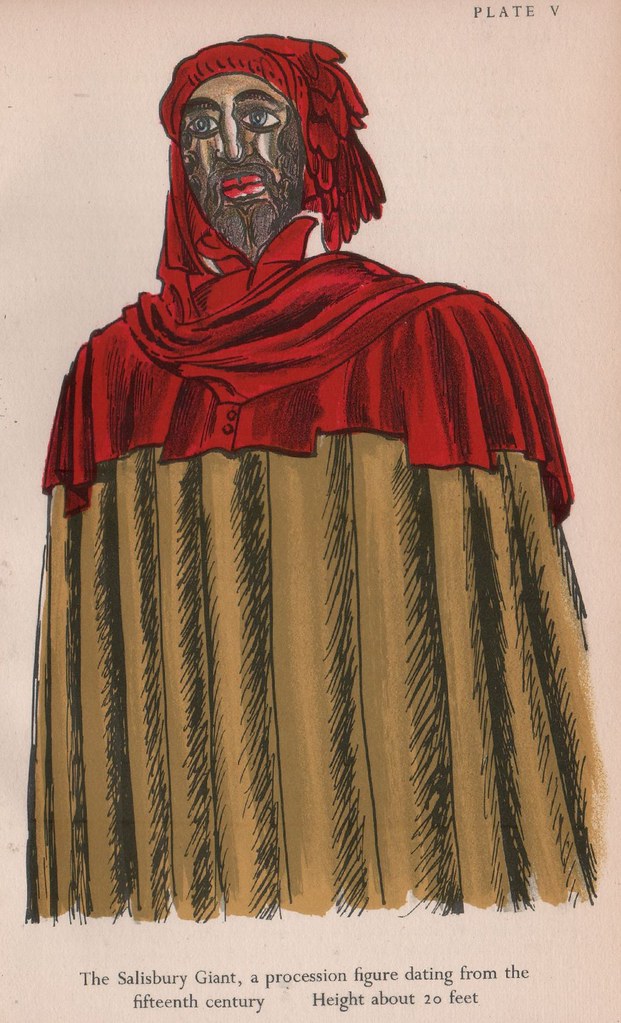
(image scanned from the delightful English Popular Art of Margaret Lambert and Enid Marx.

Thursday, March 13, 2008

Wondering about the Wonders: CELCE's "Crossing Borders"

If writing -- and, shall I add, blog writing -- is a practice, I've clearly fallen down on the job lately. I like to think of it as "dissertation block." It's like writer's block, only it happens more slowly: first, you start noticing that every time you sit down to write those 20 pages of dissertation material for your adviser, your chest gets tight and you feel the compulsive need to do yoga until you have to go to an appointment (which conveniently eliminates the chest tightness as the dissertation time you'd planned). Eventually, you find it extending to every time you sit down at a computer -- whether it's to write an email, comment on a student draft, or even write a blog post. I'm actually in a the midst of a short post on this very topic -- titled, in honor of this new stage of my grad school career, "Growing Pains." However, for today, I thought I'd post about another New York City Medieval Happening (and if you missed a very fruitful Happening LAST Friday -- read Eileen's latest below!)

Tomorrow, I will take part in the the CELCE conference at NYU: "Crossing Borders". In fact, in mere minutes, I will be traveling south on the 1 train to Christopher Street, and trekking over to the conference location in order to hear Carolyn Dinshaw's keynote address.

Tomorrow, however, I will be debuting a version of a paper I wrote two years ago (and will repeat in altered format at Kalamazoo). It's called "The Space Between: Mapping Monsters in the Old English Wonders of the East." In it, I will argue that the location of the Mambres and Jamnes section of the Wonders, in the largely "scientific" focus of the MS Cotton Tiberius, actually makes an argument for how monsters ought to be encountered (textually or otherwise): as a strict warning that some knowledge isn't meant to be known. Mambres and Jamnes are, of course, the magicians who go up against Moses and Aaron, and the text of the Mambres section of the Tiberius tells of how the damned soul of Jamnes warns his brother that by learning "the deep secrets of his idolatry" (literally, the word is deoflegildes -- devil-wages!) he too shall be banished to a hell-pit, which is 2 x 4 cubits (ah, the level of detail!).

This paper has plagued me for a long time. Originally, and ultimately (if I ever revise it into an article), I was making a much larger argument about contingency, monstrous bodies, and dangerous knowing. It used a lot of Agamben, and so engaged my major difficulty with theoretical texts: I am utterly incapable of writing about them. I think that that indeterminate status of a contingency is still present in the part of the paper I will post here: however, I should note that you're not missing anything about Agamben, as I have completely cut him from the argument for lack of space and eloquence. Here follows (in beautiful, Word 2007 formatting!) a portion of my conclusion. I've been told it's too poetic, and hence too unclear. I'll probably clean it up a bit come time for the conference tomorrow. But for now -- poetics and all -- I offer the conclusion to my go on the monsters.


Of course what I really want to know: Anybody catch the Dave Matthew's Band reference in the title?

The message implied by the Mambres section is that the creatures of the Wonders are so guarded [by dangers, threats and distance] because they are not meant to be known. The text is not attempting to illuminate their existence so much as their meaning. Like the trees of the Letter of Alexander, the knowledge apportioned to each man is limited: Ac ne frign ðu unc nohtes ma ne axa, for þon wit habbað oferheloðred þæt gemære uncres leohtes (But ask no more of the two of us, for we have spoken beyond the limits of our light).[1] Just such a limit may also be intimated by the Wonders, by the descriptions that approach but never fully see the far off creatures the text treats. Creatures that do not fit into regulatory categories may be monsters, and it seems better to take from them the lesson they may teach than to know what they are in themselves. Their message is acceptance, a lack of querying, and the injunction of the trees: ne frign. These creatures are different, and some are dangerous, and traveling to find them is itself marked by obstacles that may be set in place for a reason. If one does ask – if one opens the books, and learns by this opening the secrets of the deep mysteries, the risk is of one’s own dissolution. The marvel takes the unwary explorer in – into a hell-pit of 2 by 4 cubits, or more chillingly, inside itself via ingestion.[2] The specifics of their existence are not the point: rather, their warning against inquiry and the dangers of knowing monsters allows the reader to escape entrapment by his own arcane knowledge.

Monsters and marvels are dangerous because they defy categorization, they hybridize, and they hijack human language to use for their own monstrous purpose. The unsettling suggestion of Wonders is that these creatures might not be simply “bodies” that signify only God’s power over the physical, his ability to raise the physical, human body from the dead written in His creation of bodies fantastic.[3] Rather, more than just the inhabitants of Ciconia may be “thought to be men” – a potential best left unexplored, and its consequences left unsuffered. Thus the final injunction of the Mambres and Jamnes segment of the text leaves us where the text began -- in the midst of an unresolved possibility of beings, fragmented beyond perfect comprehension of a reason, with only the stern warning that it isn’t ours to know, or even to ask about. We end with two magicians, deep secrets of idolatry, knowledge written in books, and the warning that some things are not supposed to be known.


[1] Orchard, Pride and Prodigies, 253.

[2] Jeffrey Cohen’s visualization of the Donestre (as literally incorporating was key in connecting these concepts. Cf. Of Giants p. 3-5, most specifically: "in the last scene of the narrative, the traveler has been completely transformed. The severed head is an empty point of fascination that directs the viewer’s gaze back to the alienating form in which the traveler is now contained, at the monster he has now become."

[3] Cf. Austin for a cogent description of Augustine’s theory. Austin, Greta. “Marvelous Peoples or Marvelous Races ? Race and the Anglo-Saxon
Wonders of the East
” in Marvels, Monsters and Miracle: Studies in the Medieval and Early Modern Imaginations. Ed. Timothy S. Jones and David A Sprunger. Kalamazoo: Medieval Institute Publications, 2002.


cross posted at Old English in New York.

Wednesday, October 31, 2007

For October 31: A severed head, skeletal fairies, ghosts and a bog man

Fodder for several of our longrunning conversation here at ITM: the Museum of Natural History at Rouen in Normandy has decided that a mummified Maori head in its collections ought to be returned to New Zealand for burial, while the Ministry of Culture has declared the body part preservation-worthy art. Today's NYT meanwhile provides a queer ghost story that ends up rather straight (no gay wizards are involved). Bioephemera has breathtaking images of skeleton fairies attacking a bee and a spider, the mixed media work of artist Tessa Farmer. Lastly, today's illustration is the poster for my impending Holloway Lecture at McDaniel College. Nothing says scholarly fun like an executed peat bog body. The poster was, I'm told, the product of a student competition. Click on the image to enlarge.

Monday, October 22, 2007

Monster Theory (Lytton Smith)

(The following is excerpted from the sequence "Monster Theory," in Lytton Smith's forthcoming chapbook, to be published by the Poetry Society of America in Februray 2008. Several other medieval-leaning poems are in the book; I recommend the work highly for its crystalline elegance and its sonorousness. The poems are composed by an artist with a love of words and sound; they beg to be read aloud. I apologize for screwing up the mis en page of the poetry sequence below. See also this post).

Monster Theory


I
It is always at the outset a displacement—
[the monster] is fragment, obscured glance,
suspicion, boneshard, is one town over
and can be seen footprint or silhouette
at the Gates of Difference, dependent
on their unlocking. It does not test
the height of the wall, try to scale it;
is bound to rules even in deformity.


III
All knowledge is local, all cartographies sketched
with a lead of local origin and coloured with dye from the petals
of flowers picked and crushed in nearby woods.
All cartographers are men and all their wives,
their thimble and needle wives, would not understand
the sense of scale that such men are forced into:
how borders fit within the boundaries of a singlesheet.


IV
Pattern: [the monster] sated, moving on just before the townsfolk
uncover its lair in a rabble of pitchfork and brandish. The walls of
the cave are without painting: [the monster], incapable of literal or
emotional representation, is incapable of art. The thrown flicker of
torches reveals red daub: blood of cattle of flock of the missing
daughters of the pastor and the blacksmith. In the absence of bone
or skeleton, the librarian proffers two readings: [the monster] has
devoured all remnants of his slaughter; [the monster] bears
trophies. In the recess of the cave, a huddle of swan feathers
crudely sharpened: instruments of torture, blood-hardened.
Rumour: two anxious and too young sentries posted at the cave
entrance—[the monster] always escaping always returns—the mob
empty-hands its way into town where their wives and daughters are
not waiting and candles are not kept burning in the windows.
Rumour: [the monster] come upon, nor’wards and asleep, by a
single shepherd who dared not take life in his own hands. Rumour:
on [the monster’s] bare torso, a map cut as if by jagged knives. His
body a readable text.

(from the chapbook's back matter)
Monster Theory is the title of a collection of essays edited by Jeffrey Jerome Cohen; his
introductory essay, “Monster Culture: Seven Theses,” provided the inspiration and a
number of key phrases for “Monster Theory” and I owe a debt to his scholarship,
especially regarding how present the medieval is.

Biographical Note:
Lytton Smith lives in New York City, where he studies Anglo-Saxon literature, plays
in goal for Division United, and, with Tom Haushalter, runs the Blind Tiger Poets, a
group that helps promote books of poetry.

Tuesday, August 14, 2007

Susan Kim: Receiving Cannibalism/ Cannibalizing Reception

[posted on behalf of guest blogger Susan Kim. Thanks, Susan!]

Heather Blurton, introducing Chapter 2, “Eotonweard: Watching for Cannibals in the Beowulf-manuscript,” argues, “Eotonweard is not just the work of the hero, it is also the work of reception, as watching for cannibals becomes an interpretive stance for decoding the manuscript” (35). Her reading of the manuscript, “attentive to the appearance of cannibals” (37) in fact significantly challenges us to reconsider the resonances among the texts and images of the manuscript as a whole and the de-politicization of many current approaches to the study of the manuscript.

Blurton’s tenacity in grounding her argument in the immediate context of the manuscript enables us, for example, to consider the Life of Saint Christopher not as bound by the genre of hagiography alone, or even in the intersection of hagiography and literature of the monstrous, but as existing in a complex of discourses, including that of political expansion. The reading offered in this chapter thus really does open discussion of the manuscript as a whole as well as discussion of Beowulf and its place in that manuscript. As Blurton argues, “Re-situating Beowulf in its manuscript context thus suggests ways in which in the texts of the Beowulf –manuscript…the repeated appearance of cannibals in narratives that deal with conquest and resistance can provide an interpretive framework for Beowulf, in particular for thinking about Grendel’s cannibalism”(56).

It seems to me that a problem here is that while Blurton argues for the evocation of cannibals in the “other” texts of the manuscript, and for the similarity between Grendel and the cannibals evoked by those texts, to do so, she must often import those cannibals from sources or related texts and images. That is, we can only read the Christopher of this manuscript as a dog-headed cannibal if we read him in the context of texts not included in this manuscript: the Christopher fragment in Vitellius Axv, as Blurton notes, does not contain the description of Christopher as such. Similarly, we can only say that Grendel looks like the Donestre if we look at the Donestre of Tiberius Bv. The Donestre of the Vitellius Axv illustration is no larger than his female victim, and seems to have no hair at all. He is waving a leg in his left arm (presumably the female victim’s otherwise missing leg), but I see no evidence of the leg in his mouth which Blurton notes in her description. The Tiberius Donestre, in contrast, is hairy-headed, bigger than his victim, and clearly eating him. One might thus make the argument that, especially given the extra-manuscript context which Blurton illuminates, the “other” texts of the Beowulf-manuscript themselves are not full of cannibals, but rather strangely reticent about them.

I write this not to quibble with the trivia of the argument but because I am genuinely excited by Blurton’s opening claim that “eotonweard …is also the work of reception.” Reception of this manuscript, and in particular of the Wonders of the East contained in it, has been characterized by at best avoidance of what is actually in the manuscript. An easy, though maybe cheap example is the cover of Andy Orchard’s invaluable Pride and Prodigies, with its beautiful image of the Blemmye not from the Beowulf-manuscript. My own tendency has been to read this turning away from the Vitellius texts themselves as a reaction to the ways in which these texts amplify anxieties less literal, or less visible in the related texts. The Vitellius Wonders of the East, for example, significantly increases the aggressivity of the images with respect both to their frames and to the texts, so much so that, for example, the ant-dog illustration is wholly unframed, with one of the ant-dogs wrapping himself around the last word of the text describing them. The Tiberius images, in contrast, demonstrate interaction with the frame, but never leave the frame entirely. The Tiberius images, I would have argued before reading this book, consistently replace the Vitellius images in discussions of these texts because they present us with a much safer questioning of boundaries, including the boundaries between text and image, and between image and viewer: they present us with a border which can be stepped on, a frame which can be problematized, but not with a frame which does not exist, or a border which cannot be drawn. What I have located as a problem with Blurton’s reading (though it really may not be a problem) may thus focus our attention on the ways in which these “other” texts may evoke the complex of discourses Blurton reads in cannibalism while, like the monster-as-portent, pointing elsewhere, away from themselves as the locus of significance. Reception of these texts thus both responds to and is directed by the project of “eotonweard” within the texts, at once watching for, and keeping watch against what Blurton reads in the figure of the cannibal.

Wednesday, August 08, 2007

Blurred Boundaries

In his comment to the first post on Cannibals, JJC ask in reference to Anglo-Saxon monsters: “Do any offer crisp boundaries, unblurred lines?” Of course, the implied answer is no, none really stand as distinct, isolated Others, and this is the source of much of their appeal and power in the period. I want to expand this question outward to monstrous geography. In Blurton’s discussion of Mermedonia, we see the blurring of the boundary between the local and familiar (Britain) and the distant and apparently monstrous (Mermedonia). This is only one method, though, in which Blurton’s monstrous texts use geographic confusion to challenge the reader’s sense of fixed location. Blurton writes that the Wonders of the East has:

“an almost obsessive concern with measuring distance and mapping location. The distances to and from the reader’s stops on this strange journey through a fabulous eastern landscape are carefully measured out on two different scales, by direction (south of), or topography (near a river; on an island). The effect of these descriptive directions is to paint a mental map of the east, with location, distance, and landmarks all clearly located.” (48)

This notion is somewhat similar to that espoused by Lisa Verner in The Epistemology of the Monstrous in the Middle Ages (New York: Routledge, 2005), who refers to the Wonders as “geographically linear.” (65) Both of these texts are right to note the obsessive focus on geography in the Wonders, but if carefully observed, the directions are seen not to locate the monsters clearly but rather, to dislocate them, and to confuse and muddy our understanding of eastern geography, rather than to clarify it. If we were to actually follow the directions (those which can be followed—some are complete non sequiturs and others are so vague that they only confuse, such as those that being “[O]n summon lande,” or “In a certain land…”), we would have to travel, it seems west, east, south, west, east, north, west, south and finally north again. This image (click it for a larger and more legible version) shows my very loose and intentionally quixotic attempt to map the journey described by the Wonders on the Cotton Map, the earliest medieval mappaemundi, and that closest in date to the Wonders (and bound with an illustrated copy of the Marvels of the East, a bilingual work derived from the Wonders). This journey is by no means “linear,” nor does it really help us to get a good sense of location. Instead, these vaguely described and depicted beings seem to exist in a land where boundaries are fluid. The result is that here, unlike on the Psalter Map, the giant, anthropophagous monsters are not contained, not locked into tidy boxes in distant Africa and India, but rather, like the promised post-Apocalyptic hordes of Gog and Magog, they have been loosened upon the world.

Blurton is interested more in identity than diet, really, as am I. In her discussion of the Mermedonias, she raises an excellent question related to this topic: The description of the “sylfætan,” or “self-eaters” “contains an inner contradiction … they only eat strangers.” (32) This, she notes, serves “as a locus for the consideration of the relationship between self and other.” (33) If Mermedonia is confused with Britain, if the English are cannibals, if monsters are human, and if the Wonders are not clearly delineated and contained, what remains to articulate the boundaries of humanity?