Monday, June 15, 2015

Posthuman Environs 3: Fnorteth

illustration taken from here
by J J Cohen

[Part one of this series is Tsupu. Part two is Woof. Below is the third and concluding post. And while you're here, don't miss by Lesley S. Curtis and Cord J. Whitaker on Game of Thrones].


3. Fnorteth (The Atmosphere is Heavy but the Climate Might Lift)

Trouble the boundaries and enmesh the cosmos, but even a posthuman ecology remains housebound. The walls shift but all things, even gendered human bodies, are likely still to be rendered commodities for equivalency and exchange, for the forced transport of messages not theirs. Humans differentiate themselves from world, from other animals, from other humans through ceaseless overpowering. You may think that a posthuman environs promises material intimacy and peaceful community, but then you are turning your eyes from what enduringly supports a fleeting equanimity. Utopian and full of futurity, posthuman environs also carry a heavy atmosphere, violences that cannot be disowned.

Another medieval tale, this one from Geoffrey Chaucer.[1] Aleyn and John, two clerks from the north of England studying in Cambridge, lay awake in strange lodgings. Tricked by an unscrupulous miller, the young men have paid to endure a night under his roof, in his very bedroom. They are assailed by sound. From their shared bed the clerks listen to the drunken family’s nocturnal “melodye,” a “rowtyng” from the miller’s wife and twenty year old daughter loud enough to be heard a quarter mile away (1.4166). For the two clerks rest is impossible during this sonic barrage. The resonant Middle English word “rowtyng” derives from Old English hrūtan, a verb that sounds like the action it conveys, snoring (a term likewise originating in onomatopoeia).[2] But it gets worse. The noise that thunders from the miller’s open mouth is so intense that only animal comparison can convey its force: “as an hors he fnorteth in his sleep” (“like a horse he snores in his sleep,” 1.4163). Within slumber and without precise language, humans sound pretty much the same as other large mammals. Fnorteth is reverberation oblivious to species difference, and a noise that travels with violence.

The Reeve’s Tale invites what Martin Foys has called a sensual philology, an attending to how “language serves as a gateway for a largely unmapped network of words, sounds, senses, bodies and media.”[3] Yet philology (literally, a love of words) here offers mostly a dark ecology. This fabliau is known for its grim ambience, the cloy of its air. Whereas the “Miller’s Tale” is full of hymns, love songs, and musical instruments, this story offers a narrative ecosystem resounding with dissonant, nonverbal signifying: the rowtyng and fnortyng of the sleeping family; the “wehee” of escaping stallions (a cry of freedom, transport and desire, since the horses have scented wild mares in the nearby fens); whistles and shouts (“Keep! Stand! Jossa!”) that the clerks use to call their mounts back, realizing they have been tricked into spending the night. Every word John and Aleyn speak at the beginning of the tale threatens to break from linguistic signification into mere sonority, so thick are their Northern accents (e.g. “Swa werkes ay the wanges in his heed,” 1.4030). Sound is a vibration that travels through the air and implants itself in the flesh. But its force ripples far beyond merely human environs. Sound saturates the atmosphere and renders air heavy with story. In the House of Fame Chaucer describes “soun” (“sound”) -- of which human speech is special type -- as “eyr ybroken” (“broken air,” 770), a reverberation that moves “with violence” (775), as when “thow / Throwe on water now a stoon” (“you toss a stone into water,” 788-89). Sonic vibrations ripple and intensify, saturating the atmosphere with “speche … or voys, or noys, or word, or soun” (“speech or voice or noise or word or sound” 818-19), a dense archive of story. With its snores, cries, shouts, pleas, poems and prayers, the Reeve’s Tale is reverberant, a material ecology that noisily foregrounds the penetrability and porousness of flesh within a surrounding and story-laden atmosphere.

The miller and his family snore because their bodies are humoral environments out of balance. Liquor makes evident corporeal liquidity. As Chaucer explains in the Squire’s Tale, excessive drinking engenders a superfluity of blood, which in turn triggers a profound need for restorative sleep. The slumber that follows inebriation is restless, though, since a drunken sleeper is filled with “fumositee” (5.358), with wine- or ale-induced fumes that burden the mind with meaningless signification. The intoxicated body well illustrates the trans-corporeality of medieval embodiment, both human and animal: the four humors do their work within skin that offers a permeable membrane rather than a barrier to the world.[4] The human body is revealed as a dynamic ecology easily thrown into crisis, a “conviviality of animate and inanimate matters” that makes clear “anthropocentrism has not always been an inevitable mode of self-understanding.”[5] The medieval equivalent to a posthuman ecology is this open, fleshly system that through the four humors materially enmeshes the gravity of the moon, the impress of place, the agency of matter, the density and humidity of atmosphere.[6] Such material entanglement holds as true of animals, plants and stones as of humans – and underscores that human embodiment is a specific (gendered, racialized) phenomena, rather than an abstract universal. Within this geohumoralism no space exists for a mind/body divide. Psychology and subjectivity are substantial, material, a tenuous system easily disrupted by wine or sunshine or snoring.[7] Geohumoralism insists that “human” is not a category separable from ecology or economy. Embodiment happens in place, propelled and then limned by specific and enduring violences.

Tocsin of an unbalanced ecology, fnorteth is a vibratory mechanism, the sound of a body transmitting meaning parasitically within language, as an event inhabiting a sound, a disorder conveyed by a word in motion. This vibration into language of sonorous realities demands the coining of words to capture and convey: ale to snores to action. The problem, though, is that the action that arises in the Reeve’s Tale is in the end all too human, all too masculine, and not at all humane: two acts of sexualized revenge, a message sent by the clerks to the miller through the bodies of his wife and daughter. Within this domestic economy horses, cakes, wheat, beds, sex, blows are exchanged with little regard for the lived consequences such equivalence and reduction entail. Economology: economy and ecology share an etymology in oikos, the house and its range, signaling the difficulty of movement beyond the inhumane. Interpenetrability is subject to constant economic recapture. The Reeve’s Tale is the story of a miller who fleeces his customers. John and Aleyn are forced to purchase from the miller a breakfast baked from the flour he stole from them. The clerks believe the proper payment for such abuse is to be made through the sexual enjoyment of the women in his household. Once they sleep with the wife and daughter, the tale becomes a disturbing account of what happens when all the world is reduced to an economy of sale, substitution, and revenge, wheat to pie to profits, every ecology transformed into an economy, all matter -- even virginity -- rendered vendible. No wonder the story ends with screams, blows, blood. The narrative economics of the Miller’s Tale renders even rape a clever trick, a joke. Women’s bodies are used by men to send messages to other men. That these women have their own stories is hinted at but never with much narrative attention explored. Fnorteth ties men to horses, animals that in the tale convey but also when unconstrained seek copulation. Thunderous snoring resounds with sexual violence as well as humoral ecologies and nonlinguistic noise.

I don’t think Marie de France would have much liked Geoffrey Chaucer’s Reeve’s Tale. The world she envisions in poems like “Le Fresne” shares little with his heavy fabliau atmosphere. Whereas the wheat in the Reeve’s Tale exists only to be ground to flour and rendered a product that may be substituted for other commodities, in “Le Fresne” the immense ash tree is an anchoring and unsubstitutable presence that intensifies human relation. Marie foregrounds throughout the poem how gender is articulated within a system of entrenched social inequality, returning repeatedly to the unevenness and heterogeneity of what it means to be an emplaced, embodied human. Peril haunts the spaces across which female bodies pass, giving the poem an atmosphere of constant hazard that hovers without saturating. “Le Fresne” is a story of women and precarity: the slanderous mother, the good hearted maid (a familiar figure in Marie’s stories: the helper or intermediary who is the sine qua non, yet also forgotten, left behind), the endangered infant, the porter’s widowed daughter who breastfeeds the foundling, a nunnery built against a world that keeps finding its way within, sisters and mothers metaphorical as well as biological, a concubine, wives who when they do not realize their power as authors and agents cause lives to unravel. “Le Fresne” is about creating a world with more and better stories, tales that do not succumb to heavy ambience but instead embrace the shared precariousness of mundane life. “Le Fresne” burgeons with a Disanthropocene of barking dogs and the bark of trees, of woman who carry vegetal trace (cordre, fresne / hazelnut, ash), stories that enmesh the human and the nonhuman so that neither stands alone. But the lay also attends to the particularities of violence within the human, and warns us that when we attempt to transcend that category by declaring the Anthropocene we do so at the peril of specificities that require precise accounting. Ethics inheres in the choice not to universalize, not to ignore the differences that found the category human and that have not been left behind in the posthuman. In stories we have long been telling opens a more complicated space.

Tsupu, bay, fnorteth. In these onomatopoeic terms may be discerned inhuman resonance, posthuman environs. A wounded pig plunges into water and into word. A stone plunges into water and into word. Tsupu slips from stone and pig and water into Ecuadorian Quichua, from indigenous Amazonian mouths into an anthropologist's cognition, into book, into theory, into essay, into your own mouth. Stories of race, culture, colony, climate, taxonomy, and environment continue to resound with it. Dogs meanwhile howl the nearness of shelter, woof the story of how they enable human habitation. A tree entwines itself with the fostering of human life, with the creation of poetry. Violence and suffering are unevenly distributed. Within posthuman environs gender still matters. So do class and race. The human body is a machine of sonority, as ecological in its signaling as animals and stones. Human bodies are also plural phenomena, specific and universalized at peril. Drawing boundaries and declaring epochs may be necessary, but such systems are fragile, insufficient. They inevitably exclude. The Anthropocene is no doubt real, but so is the Disanthropocene, the impress of posthuman environs upon our very bodies, the resounding of environmental impress within our stories and our words.

notes
[1] Quotations from Chaucer’s works are from The Riverside Chaucer, gen. ed. Larry D. Benson. 3rd ed. (New York: Houghton Mifflin, 1987).
[2] On the Middle English verb “rǒuten” and its derivation see its entry in the Middle English Dictionary. Chaucer loves these sound words: “Hayt!” (giddap!) in the Friar’s Tale (3.1542), “buf” (the sound of a burp) in the Summoner’s Tale (5.1934), “fneseth” for a drunken sneeze (9.62), “chuk” for the noise a rooster makes to call hens to grain (7.3172).
[3] Quotation from Martin Foys, “A Sensual Philology for Anglo-Saxon England,” postmedieval: a journal of medieval cultural studies (2014) 5, 456–472, at 457.
[4] On transcorporeality as a modern phenomena of dermal permeability and toxicity see Stacy Alaimo, Bodily Natures: Science, Environment, and the Material Self (Bloomington: Indiana University Press, 2010). For a thorough discussion of embodiment as a material process in the Middle Ages see Joan Cadden, The Meanings of Sex Difference in the Middle Ages: Medicine, Science, and Culture (Cambridge: Cambridge University Press, 1993).
[5] Quotations from J. Allan Mitchell, Becoming Human: The Matter of the Medieval Child (Minneapolis: University of Minnesota Press, 2014) xix, xviii. Micthell well demonstrates something that I can only hint at here, that “complicated ecologies underpin even the tidiest of cosmologies” (175) and “it is in the very grain of ordinary life that we can find knotted multiplicities” (176).
[6] Suzanne Conklin Akbari explicates the place-bound environmentality of the body well in Idols in the East: European Representations of Islam and the Orient, 1100–1450 (Ithaca: Cornell University Press, 2009).
[7] On the materiality of premodern, humoral psychology see especially Gail Kern Paster, The Body Embarrassed: Drama and the Disciplines of Shame in Early Modern England (Ithaca: Cornell University Press, 1993).

Friday, June 12, 2015

Daenerys and Dessalines: Game of Thrones Gets Tropical

a guest post by Lesley S. Curtis (@ProfLCurtis) and Cord J. Whitaker (@ProfCWhit)


As they prepare for this Sunday’s season five finale, fans of the HBO show Game of Thrones have certainly noticed that slavery is alive and well in the Seven Kingdoms. Daenerys Targaryen’s beneficent yet imperial, just yet violent military campaign against the age-old institution of slavery invites viewers to recognize the critical conundrum that any leader wishing to take the moral highroad might face as they lead a people out of slavery. What may be less clear is just how much this extremely sympathetic character’s struggles mirror those of real-world anti-slavery leaders in the Americas. The connection between fact and fiction rings especially true in the case of Jean-Jacques Dessalines (1758-1806), the revolutionary who declared Haiti’s independence from French rule, the man who boldly swore “eternal hatred of France,” and the leader who determined that only complete separation from “the masters” would ensure freedom for his new subjects.

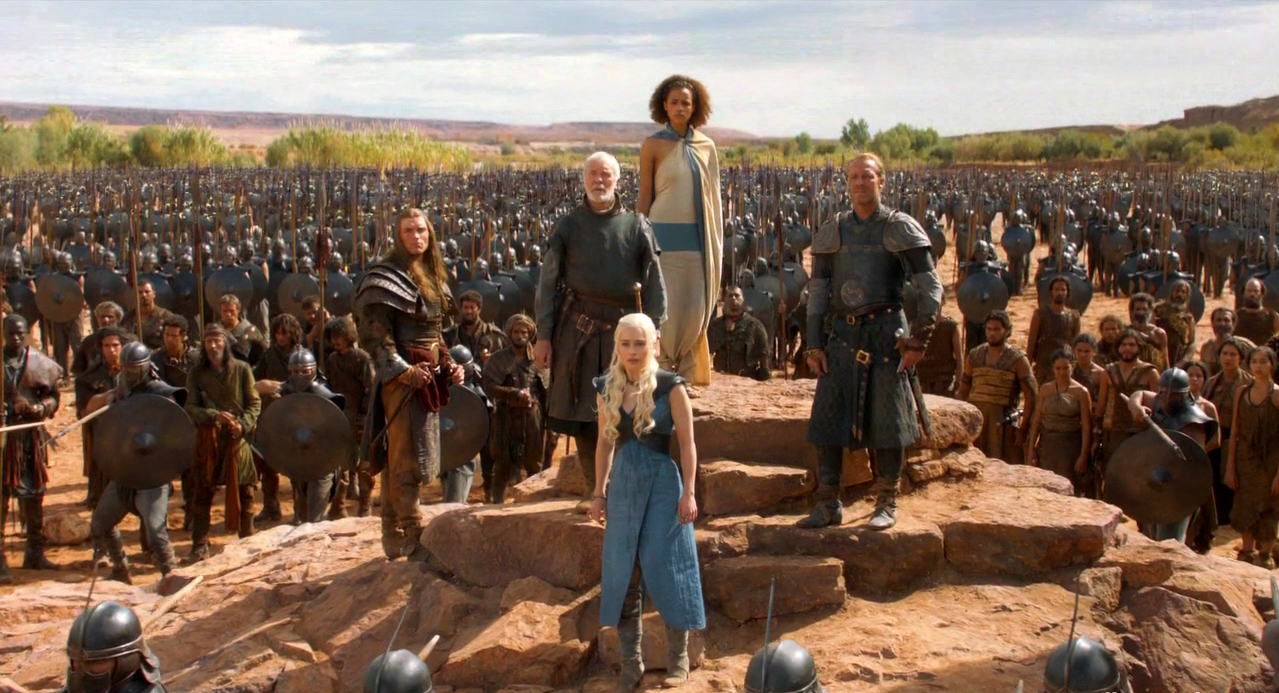
But first, Daenerys’s predicament: the descendant of overthrown rulers who is forced by an overbearing and power-hungry brother into a political marriage to the leader of a very, very foreign culture, she comes to rule in her own right after her husband dies. And her goal is to rid the world of slavery. Daenerys travels the Seven Kingdoms of the fantastical, medievalizing world she inhabits (created by novelist George R.R. Martin in his Song of Ice and Fire series). With the aid of the dragons she hatched from the eggs given to her as an engagement gift by her late husband, she goes about abolishing slavery in each of the cities she conquers. This wins her the loyalty of the multitude and allows her to amass a truly impressive and dedicated army. Wide shots of her forces show an infantry that seems infinite in number.

It is when she decides to settle down for a while, in order to learn to be a ruler and not only a conqueror, that Daenerys’s real problems begin, and that her situation begins to look like that of the earliest ruler of Haiti after its revolution. Shortly after she conquers the city of Meereen, located all too aptly in a region called Slaver’s Bay, she hears that her prior conquest, the city of Yunkai, is experiencing a resurgence of slavery in her absence. It is a most sensible decision for her to stay and rule her latest and greatest conquest.

In Meereen, she faces a question likely as old as slavery: what does one do with one’s enemies once they are conquered? In the case of colonization, Machiavelli tells us, it is easy to pacify most of the conquered people (who have not suffered losses directly) and to oppress those who have suffered directly, those whose lands and homes one has had to take in order to support one’s colonizing forces: “those who are injured, remaining poor and scattered, can never do any harm….”[1] In the case of conquering a land formerly ruled by a single sovereign, “nothing else is to be feared except the family of the prince, and if this is extinguished, there is no longer any one to be feared.”[2] In short, one must read one’s situation in order decide whether to oppress or kill those who were formerly in power in the lands that one has conquered. And if the latter, one must be sure to kill them all. This is the decision that Daenerys Targaryen faces in Meereen: but she is an extraordinarily ethical ruler, and she chooses neither to oppress the former masters nor to kill them. Instead, she tries to set up a society in which former masters and slaves live and work side by side as equals.

Game of Thrones forces its viewers to deal with the magnitude of the question of the relationship between past injustices, their perpetrators, and a society’s future well-being when in Season 5, episode 9 [aired June 7, 2015] the former masters attempt to assassinate Daenerys during a long-awaited tournament. The masked masters viciously attack from every side, and Daenerys is saved only by the unyielding bravery of her retinue. When it seems all hope is lost, Daenerys closes her eyes and lifts her head toward the heavens. The regular viewer knows that she is summoning Drogon, the only one of her dragon children who roams free. With a roar and an aura of flame, he triumphantly enters the arena and spews fire against the attackers who surround his mother. He battles fiercely, but there are too many masters. The spears they hurl at him find their mark and begin to take their toll. Daenerys approaches her dragon child—carefully, he is not the predictable ugly-cute dragon baby he once was—and, using all her strength, she starts to remove the spears one by one. She surveys the scene and realizes Drogon will never leave her in danger, and he will die fighting if he stays. Cautiously, fearfully, but without another choice, she climbs up onto his back. She whispers in his ear, “Fly.” She hangs on as he charges through the mêlée, gains speed, and obtains lift. Daenerys and her dragon spiral up and out of the arena while everyone below, friend and foe, looks on in awe. The show suggests, at least at this point, that she should have killed all the masters while she had the chance. They were not to be trusted; the moral peaceful society of Daenerys’s imagination will not come to fruition from kind leadership. Violence seems necessary.


Now to real-life Dessalines. The Haitian Revolution began in 1791, when the enslaved of the French colony of Saint-Domingue rose up and demanded their freedom. After two years of bloody struggle, administrators in the colony abolished slavery. Paris soon followed suit and the institution was eliminated in all French colonies in 1794. France still often prides itself on being the first colonial power to abolish slavery. But, just as Daenerys’s fictional story grips millions of modern viewers each week with its cliffhangers and messily intertwined storylines, Dessalines’s true story also refuses to conclude neatly.

At the end of the 18th century, Napoleon came to power and decided to reestablish slavery. After all, Saint-Domingue had been the most profitable colony in the world. The whole of the land sold in the Louisiana Purchase was not as valuable to him as were his island territories. The largest French military expedition ever sent over such a long distance, led by Napoleon’s brother-in-law, set out to reclaim this money-making colony. The newly crowned emperor hoped that the masters would rise again.

And they did—in more ways than one. France reestablished slavery in its colony of Guadeloupe in 1802. Haitians saw an example of what their future might be if the masters were not defeated. The Haitian leader Toussaint Louverture (1743-1803), who negotiated with the French, was captured and died in a cell in the Jura Mountains of France, a secret prisoner of the state. In his absence, Dessalines, a former slave, rose to power in what would soon be Haiti. What would Dessalines do in the face of slavery’s return? The masters had proven themselves unworthy of trust.

After defeating the French at the Battle of Vertières in November 1803, Haitians declared their independence from their former colonizers and masters. At this point, slavery had been abolished for nearly a decade, but had reared its ugly head again. Those who had believed in France’s promise of “liberty, equality, and fraternity” had had their hopes dashed. Dessalines had been witness to the hollowness of the masters’ promises over and over again. His solution was to create an independent nation in the hopes that putting a national barrier between Haiti and France might ensure that the masters never returned to power.

Dessalines invited the masters to “tremble” as they neared their former colony. If “the memory of those cruelties they perpetrated” was not enough to make them tremble, then the threat of death would do (Declaration of Independence). As head of state, Dessalines ordered the massacre of the remaining planters and their families in the very first years of Haiti’s independence. To go along with our comparison, think of it this way: Unlike Daenerys, he murdered the masters. And this has colored the way that Haiti is viewed, even today. As historian Laurent Dubois writes, “There were always those who painted Louverture, and indeed all black leaders in Haiti, as little more than dangerous savages. Yet Dessalines incited a kind of representational fury in many that went beyond what was directed at Louverture. The vision of Dessalines as a violent leader, one bent on revenge and carnage, emerged in the 1790s, solidified in the 1800s, and in many ways is still with us—both in Haiti and outside it.”[3]

The similarities between Daenerys’s and Dessalines’s positions are many. What makes us wish on Sunday nights that fictional Daenerys had indeed murdered the masters? We want retribution for past injustice. We fear that Daenerys might be too moral to lead effectively. We are ready, even eager, to recognize that ending slavery is no easy task, and that violence might be helpful, even necessary. Now, let’s think about real-life Haiti. What might make us recoil at the actions of real-life Dessalines? Sure, Daenerys is more beautiful; her world is enjoyably imaginary; and she’s blond and fair to boot. There is, however, a lesson in Daenerys’s story that can change our modern outlook on Haiti, and, more broadly, on slavery’s reality and its continued impact. There are lessons in the comparison between Daenerys and Dessalines that put into perspective contradictory reactions to their methods: it goes beyond her beauty and fictiveness, and it goes beyond his blackness and reality.

Slavery troubles our sense of morality, and it cuts across our sense of time. In a world heavily dependent on slave labor, as was that of Dessalines, an anti-slavery leader was not considered a person of high moral standing, as we moderns now see Daenerys. The world was shocked, horrified even, to learn of an independent nation dedicated to the abolition of slavery—one led by the formerly enslaved! The magnitude of this sea-change has contributed to the interpretation of the Haitian Revolution, along with the French Revolution, as a harbinger of modernity: the world really would never be the same. Indeed, slavery has been called ‘medieval’ by more than one black thinker on slavery and race in the Americas. At the same time, we know that slavery, in forms ranging from global sex-trafficking to the racial inequalities rampant in the American justice system, has not ceased to be in our supposed modernity.

When the question of what to do with the former masters pervades a historical event that is widely considered to usher in modernity and displace pre-modernity and it also pervades a very modern, very popular filmic text that fantasizes about the Middle Ages, perhaps we should ask ourselves if the divide between the Middle Ages and modernity is really all that stable or even all that relevant. When slavery troubles our sense of morality, as it does with both Daenerys and Dessalines, it also troubles our sense of time. Nevertheless, when we watch Game of Thrones from our modern perches, it is all too easy to consider medieval Daenerys moral and progressive, a woman ahead of her time, modern like us.

Dessalines’s efforts were not widely considered moral. And what’s more, they didn’t really stop the masters from their oppressive ways. The French sent envoys to negotiate retaking the former colony and they maintained financial control in the form of an indemnity agreed upon in 1825. From 1838 to 1947, former slaves and their descendants paid former masters and their descendants billions upon billions of dollars. The money has never been returned. Haitians paid in blood and capital for their fragile freedom.

If there’s a message in this comparison for us moderns, for us Game of Thrones fans, for those of us fortunate enough to be entertained by a story of slavery’s refusal to die, it is that this transition, either real or fictive, has never been an easy one. Daenerys is at a loss. The moral highroad leads her into a chaotic mêlée that she barely escapes with her life. Dessalines, on the other hand, took revenge and didn’t escape with his life. He could not, however, kill all his enemies, as Machiavelli advises—maybe he should have never tried. Or, maybe it was the only choice. As we cheer on Daenerys, might we find new sympathy for Dessalines? for Haiti? We hope so, especially since Dessalines had no dragon.


[1] Niccolò Machiavelli, The Prince, trans. L. Ricci (London: Grant Richards, 1903), 8.
[2] Machiavelli, 15.
[3] William and Mary Quarterly, July 2012, 543.

Thursday, June 11, 2015

Posthuman Environs 2: Woof

by J J Cohen

["Tsupu," part one in this series is here]

Woof (A Posthuman Ecology Transcends No Violence)

Follow the noise of the dogs, their howls that reverberate into language, the warp and woof of shelter and story. To disgrace a neighbor who has given birth to twin sons, a noblewoman declares that no one becomes pregnant with two children without having had sex with two men. Not long thereafter the woman herself delivers twin girls. This is a story about telling stories, and the communities these narratives enable or taint. Her slander redounding upon her, the new mother contemplates infanticide. To preserve the new life her maid offers to bear an infant away before the household realizes the double birth. Departing at nightfall, the maid follows an unknown road through thick forest. At long last animal sounds announce the proximity of human settlement:
Then, far off to the right, she heard
dogs barking and cocks crowing [chiens abaier e coks chanter];
she knew she would be able to find a town over there.
Quickly she went in the direction
of the barking. [la noise des chiens] (“Le Fresne” 144-48)
Roosters and baying dogs lead the young woman and the child she is saving to the edge of a village. She sees a great ash tree before an abbey and places the infant within its protective boughs. A porter discovers the abandoned bundle the next day and delivers the baby to fostering by the abbey’s nuns, the community that planted the tree many years ago in the hope of future shade. In honor of the place of her discovery the girl is christened Fresne (“Ash”).

Thus the opening of a lay composed by the poet Marie de France in the twelfth-century. Fresne’s twin sister, raised in an aristocratic household, is named after a valued tree: cordre, the hazelnut. Unremarkable, uncultivated, yielding neither fruit nor nuts, the ash nonetheless generates the story that carries its name. “Le Fresne” bears nothing yet proves ceaselessly productive of shelter. The intertwining of the sylvan and the human (Fresne is like her namesake ceaselessly productive of shelter) underscores an ecology like the Ecuadorian rain forest described by Eduardo Kohn, always more than human. Dogs, roosters, silk, stories, households, twins and trees are the agents through which the plot unfolds. This enmeshment is foregrounded by the shared name of the poem, its heroine, and a tree that seems below regard. Like most words, fresne is not onomatopoeic, sounding nothing like what a tree does. Signification is arbitrary. But not wholly arbitrary, for in French and English the tree possesses an etymology that encodes larger relations: “ash” (Old English æsc) and “fresne” (Latin fraxinus) derive from unrelated words for spear, transporting a story about the shape of leaves and the making of weapons into these nouns. Against this martial etymology, the lay “Le Fresne” offers a counter-narrative of ecological tendering, a future forged in the midst of peril. The story enmeshes through the word fresne a woman nearly murdered as an infant who finds herself in danger of narrative obliteration later in the story (Fresne becomes mistress to a young count, her life nearly erased when he accedes to his household’s demand to marry Cordre and father legitimate heirs); a tree too much taken for granted that reveals itself as fecund in possibilities of sanctuary, altered trajectories, and compassionate conclusions; and the act of poetry making, the poesis that results in the lay itself. “Le Fresne” is a story about environmental webs, community making, and the altering of climates.

The mingling of dense forest, noisy dogs, stone for echoes and hearths, and a tree for refuge quietly opens a wide world that intermixes the organic and inorganic into soundscape and ecotone. In this poem that interleaves the lives of humans, trees, and animals, movement is aided by trans-species alliances. The maid who carries the unwanted infant through the woods knows that the baying dogs signal nearness of human settlement. Dogs, not wolves: intimates, creatures of settlement and habitation. Wouaf or voff or bow-wow bounce from buildings to announce a living together that is a general story of humans and hounds, community and commensality. Most languages have an onomatopoeic term for what a dog sounds like, capturing canine communication diversely: hau-hau (Arabic), haff-haff (Czech), voff-voff (Icelandic), amh-amh (Irish), wan-wan (Japanese), aw-aw (Tagalog). Some distinguish the noise of small dogs, or demarcate the purpose and tone of the growl, yelp, yip, grrrr, or howl. Every language hears dogs slightly differently, even if when aggregated these words hold some uncanny similarities. That woof may be passed along with such variation emphasizes the differences and heterogeneity with the same animal impress, and the inherent imperfection of sonic capture and retransmittal.

Collating animal sounds also possesses a long history, suggesting the enduring human fascination with communication across species. The Latin genre of voces variae animantium (“Voices of Various Animated Things”) stretches far back into manuscript history, with one of the most famous lists having been composed at St Gall between 760-797. This Latin compilation collates animal noises (“the sheep bleats, the dog barks”) with the gurgling of brooks and the crackling of fire. Jonathan Hsy describes such lists as offering a “human/animal interface” that offers a mode of trans-species translation or bilingualism. Whether the baying of the dog is caught in Latin, English or French, though, the sound become word is never exact, never wholly successful, unmediated, or completely transparent. Yet something of the animal (or the water or the fire) resonates within the onomatopoeic term. Linguistic devices of capture and conveyance vary, just as there is no singular of “the animal,” only differences collected into insufficient category. Derrida’s animal-word (l’animot) emphasizes a plurality that resists totalization or synthesis. But what all these renderings of the noise dogs make as they howl their stories have in common is sonic communion embedded in a linguistic archive between dogs and humans, an inscription at the level of word that conveys shared environmentality.

Marie uses the verb abaier to capture this canine resonance. Intimate to our modern word bay, the Old French verb is mimetic, an attempt like tsupu to transmit a sonic event from the nonhuman world by making it vibrate anew. A dog bays and an unwanted child finds sanctuary. It’s almost a medieval version of Lassie: follow the sound of the agitated hound and know dedication to human community. Or know, perhaps, that inhabitance comes about at least in part through human-canine relation. As Donna Haraway has pointed out, domestication has been a cross-species affair. The dogs that bark in the night must therefore not be rendered symbols (they do not exist for the maid, or the baby), but acknowledged as fully embodied creatures, even when they bay their way into a fictive narrative. Canines are companion species and mess mates, animals without which we could not have become ourselves. Haraway writes:
Dogs, in their historical complexity, matter here. Dogs are not an alibi for other themes; dogs are fleshly material semiotic presences ... Dogs are not surrogates for theory; they are not just here to think with. They are here to live with. (Companion Species Manifesto)
And, as Marie de France makes clear, they are animals here to follow. But not everywhere the animal leads is human, or humane. As poets have long known, onomatopoeia is an invitation to play. As hunters have long known, onomatopoeia can also be a trap, a lure, a weapon. Susan Crane has built upon the work of Haraway and Derrida to elaborate the trans-corporeal communication and cooperation upon which hunting in the Middle Ages depended. The aristocratic hunt is a “human-hound partnership” that contains no room for “egalitarian thinking about cross-species relations” (Animal Encounters). The hunt declares and consolidates human dominion over other animals. Dogs are scolded and whipped into submission just like servants, so that maintaining social and species difference are revealed as analogues of the same disciplinary system, a hierarchy enforced through blows. The aristocratic hunt unites dogs and humans into a machine of violence. Hunting is intimacy and companionship in the dispensing of bloody death: tsupu is after all in Kohn’s example the noise a wounded peccary makes.

The hunting assemblage as call to cross-species alliance within forceful domination is vividly materialized in a book now held in the Folger Shakespeare Library in Washington DC, an edition of George Gascoigne’s Noble Arte of Venerie or Hunting. In the nineteenth century the manual’s owner rebound the book in stag fur and affixed decorative metal bucks with large antlers. The book is now clasped by the skin of the creature that its text instructs readers how to pursue, trap, and dismember. Depending on how you feel about hunting, the Folger’s edition of Gascoigne’s Noble Arte of Venerie will seem repulsive or beautiful (or, most likely, both). Hidebound in the product of its practice, the volume is anything but inert. When placed in front of you its cover offers rough brown fur impossible not to stroke – a summons to material encounter, a call to touch that arrives too late after the call to still. The book is dead plant matter (paper and ink) bound in dead animal matter (stag skin and leather), ornamented with inert metals. The language it holds is also dead, or at least moribund: Early Modern English is no doubt going the way of Old English and Middle English, receding from swift contemporary comprehension and becoming a specialty subject for the well-trained specialist. Dead matter, dead language, dead binding: in the face of all this lifelessness, it is entirely possible that the desire to touch the book, like the desire to read its contents, is a wholly individual and eccentric experience that has nothing to do with its insistent materiality. Perhaps we have entered a realm where only psychology and human subjectivity hold explanatory force.

Yet I am not convinced the volume’s invitation to touch can be fully captured through humanizing reference to fantasy and a frustrated desire to possess. I have seen the volume in action too many times, and have witnessed the community of contact its presence repeatedly triggers. The book makes tangible the violence against animals that is its subject matter, and refuses to disentangle its allure from its love of domination. Jesse Oak Taylor has argued that hunting is frequently dismissed as an “exercise in hyper-masculine domination and sadism in ways that gloss over the affective complexity, and even trauma, of killing.” The stories that reside in hunting are often entwined in difficult tales of conservation that resist domesticating animals into the cute and cuddly, resist extinguishing “something much darker, fraught with terror,” resist the impulse to disregard violence or tame wildness. As an object the book materially manifests a brutal-beautiful entwining of deer and hunter, not just as trophy but as complicated narrative. It also offers the possibility of animal communication beyond animal death. The regal buck that adorns its cover and the floral buttons that pin the fur in place announce in lasting silver the possibility (no matter how unlikely) of endurance and memorialization over ephemeral consumption and final endings. The book wants something more than filing away in the Folger Library vault, wants to be read and stroked, wants to reactivate the historical contexts from which it has become divorced, to touch with its stories and its matter, its worlds and lives now lost, an effusive ecology of affect and force and blood. Enclosed in an animal become art that remains all the same an animal, the book proffers a hazard, a chance, insistent because of the violence it materializes. Perhaps the book wants to kill again. But maybe the object also activates an alternative story, a tale without so lethal or so final a denouement.

Gascoigne’s hunting manual closes with two leaves containing musical notation for bugle calls. By transmitting set sounds in precise sequences, the bugle instructs a baying pack on their next course of action. Similar treatises, medieval and early modern, also contain hunting cries, like this one for assisting hounds who have gone off track to realize that another dog in the pack has picked up the proper scent: “Ta ça ta ça ta ho ta ho!” Words break into reverberating syllables, sonic particles that communicate through shape and force. Aristocratic hunting is a cross-ontological alliance that unites dogs, humans, horses, knives, whips, bugles, books, landscape, and sonic emissions into a fatal machine. Through horn blasts, the baying of dogs, and the transformation of language into intensities of sound this assemblage opens a temporary space of interpenetration and admixture, a hazardous intermezzo of enmeshed agency and interspecies alliance that contrasts starkly with its bloody culmination.

Not every story that unfolds within posthumanism environs ends well. Yet as Marie de France insists, violence that unfolds within more-than-human ecosystems deserves the same scrutiny as the happy endings that sometimes occur. Perhaps narratives are best read as if they were open ended, without regard to their endings, since closure is always provisional, a shifting of attention rather than true cessation of story. The aristocratic hunt both a space of duress and the precipitation of what Susan Crane calls “persistent, intimate contact” with animals that demands critical attending (Animal Encounters 119). That the interminglings of the hunt in action should be limned by and culminate in animal brutality underscores that human identity is typically asserted at the expense of other creatures, even when they are companions. Karl Steel writes that “human domination of what it calls animal” is sustained through the exertion of force the separation of these fragile categories. Yet domination seldom fully silences. Tobias Menely has recently focused on sensibility as way to move discussion of animal presence away from linguistic constructivism and the symbolic order, focusing instead on “an unintegrated origin and never fully actualized surplus of meaning” conveyed by the “impassioned voice” of human or animal, a voice that resonates even when “vocal and bodily expression” finds itself captured into text, story, print. This creaturely community, Menely argues, is best captured by poetry, which imbues the experience of mortality, suffering and loss with “collective meaning” and creates “a common world out of the shared experience of corporeal finiteness" (Animal Claim).

Menely’s work is a needed corrective to a long critical tendency to equate communication and meaning-making with linguistic signification: animals and humans alike are responsible to the signs and voices of others. Describing children’s books that connect animals to their “signature vocalizations” (woof, meow, moo), however, Menely observes that such “echolalia” ushers young audiences into the symbolic order, “the domain of customary meanings” (The Animal Claim 19). An animal voice that can sound with “creaturely affinity” is to be sought elsewhere, in “vocal and gestural expressions” that address the world but do not function linguistically. I wonder, though, if the spoken word of the human and the “creaturely voice” are not already cohabitating in resonant juvenilia. Do not onomatopoeic terms like meow, neigh, baa, cocorico, cackle, kerplunk, caw, boom, whippoorwill, trill, chitter, tweet, and bay resound with such affinity while enlarging what we might group within the category “creaturely”?

Posthumanism possesses a deeply utopian bent. Its practitioners sometimes proceed as if the breaching of ontological categories were in itself affirmative or transcendent. Yet violence is omnipresent, part of the world’s fabric, the provenance of plants, animals and materiality itself. Storied matter possesses many genres, including horror. Ethics resides in the choice not to be resigned to this violence, in the choice not to make another copy of the stag-fur bound hunting manual by Gascoigne – and in the choice not to consign that brutal-beautiful volume to the flame or to the vault. The book binds together matter that solicits lingering. Perhaps in one of its tales the baying of the hounds leads somewhere other than to the flaying of the deer. Posthumanism must not be blind to terror and tumult, to the blood that flows when some cyborgs and assemblages are composed. Wildness is not always affirmative, and nature really can be red in tooth, in claw, in unwanted enmeshments. Yet posthuman environs also offer those proximities that may shelter possibilities for a more complicated world, for a future at once less human and less natural (what could be more natural than hunting and eating?), for a refusal of denouements generated through an excess of suffering and death.

Animal capture is noisy conveyance into story, and a sonic disruption of the human that no incorporation into language or identity can still. Follow the noise of the dogs, their howls that reverberate into language, follow too the bugle that blasts and the voice made instrument of sound not words: warp and woof of shelter and story, even when difficult to hear above the violence of its din. Bugle blasts and hunting cries are haptic modes of interspecies communication, mimetic and multisensory. To co-inhabit a dog’s world means heightening the senses of smell and sound, allowing meager human olfaction and hearing to be overwhelmed, reoriented. In an essay on medieval compilations of animal sounds – lists that stage a kind of “animal-human bilingualism” -- Jonathan Hsy notes that “much interspecies communication is non-verbal and also non-sonic – facial expressions, somatic mimicry, physical contact (aggressive or playful), biting, motion (e.g. blocking one’s path), sniffing (and emitting pheromones), leaving excrement or other internal fluids.” The world is wide, and to a canine nose its smells are precise messages. To the proper eyes the vibrancy of its colors overwhelms, as does the radiance of objects at night. To attentive ears a dog announcing community may be discerned in abaier, wouaf, bay. Maybe now we should also notice that it is not just the howling hounds that signaled in Marie de France’s lay the approach to a place of communal dwelling. Roosters were singing [chanter] to announce the nearing day: a song of animal communication, avian response, territorialization, co-dwelling, and rising sun. A posthuman ecology is an interpenetrative cacophony – and not every sound the human mouth emits amounts to language. Not every human body from which such sounds escape is equally marked, valued, legible. The violence of the hunt: whip and words are deployed to discipline dogs and servants. “Human” is false universal, a category that punishes and excludes.

A noisy tale inheres here as well.


[Next post is the conclusion, "Fnorteth."]

Wednesday, June 10, 2015

Posthuman Environs I: Tsupu

flow of sun through glass and onto stone, Geneva
by J J Cohen

Here, as promised, is the first part of the project that I presented in a less writerly form at the Geneva Posthumanisms conference last week. Let me know what you think. Two (shorter) parts to follow.


Sovereign is he who declares the Anthropocene.

Carbon embedded in geological strata is our newest mode of autobiography, the latest means through which we fashion an enduring ode to our dwelling on earth. We have crafted the word “Anthropocene” to name this lithic record of our domination over time and matter, to demarcate an era altered through our bustle. But the term also conveys the human love of making things with rocks and words. We imbue stone and language with meaning, both thereby becoming signifiers in the grandiloquent stories we tell about ourselves. Yet what if neither word nor world is so passive an archive? What if language is an ecological interface, resounding with nonhuman activity? What if rock refuses the stillness of being rendered a recording device, makes its own impress, exerts its own force? Serenella Iovino and Serpil Oppermann write that all matter is storied, “a material mesh of meanings, properties, and processes, in which human and nonhuman players are interlocked in networks that produce undeniable signifying forces,” rich in inhuman agency and ceaselessly productive of narrative. Let’s push this insight farther and wonder: might ecomateriality enter word as well as plot? Might “storied matter” pulse in fundamental units -- nouns, verbs, morphemes? What if the nonhuman implants lingering presences deep within “our” linguistic archives, traces that never become inert? What if language, supposedly the most human of tools, sometimes pulses with environmentality, conveying the force of the more-than-human even as we incise our stories into substances like stone? Might matter be inscribing us, rendering humans the record of a Disanthropocene that unfolds regardless of what epochs we declare?

As far as stories go, the Anthropocene is not all that well plotted. Perilous assumptions attend its formulation. Our melancholic exultation in having become geological derives from imagining the Human as unified and solitary, an incorporeal force powerful enough to imprint foundational matter. To universalize and abstract the human is to reinscribe a historically specific vision that declares itself unbeholden to time and place, to the misery of those who find themselves on the margins of this white, European, masculine entity that will not speak its originary exclusions. Not all humans have ever been allowed to be equally human. As Stacy Alaimo has shown, the Anthropocene narrative of men and rocks neglects the creatures and things obliterated as we herald this epoch of our own production, an era in which the seas are acidifying and becoming desolate. To figure humanity as a disembodied force is to forget the lessons of feminism, posthumanism, and environmental justice, and thereby to fail to consider the heterogeneous, unevenly distributed violence (swift and slow) that climate change engenders. We suppose all things a resource for use, abuse, and transformation -- and thereby blind ourselves to matter’s vibrancy. Yet we remain corporeal beings within a shared world that at every level exceeds us. Offering a counter-narrative to our lonely petric tales, stories that arrive from posthuman environs disperse without disembodying, a change of climate for thinking ecological terms.

Catastrophe’s archive brims with narratives that unfold along timescales far exceeding the familiar, long arcs of impress and translation, generation and grapple. These tales are often glimpsed through etymology, the geology of language. We inherit in the strata of our words histories of composition and companionship that exceed the human, an epochal poesis. Although it will become in English the word “poetry,” poesis in classical Greek is quite simply a making, as when humans build a boat and climb aboard with animal companions to weather a flood. Or when a rock or pig enters water and the sound ripples into a word: swash, slosh, plash. As these sonorous examples suggest, I am especially interesting in following an intensely environmental form of poesis with disanthropocentric force. Literally a “name-making,” onomatopoeia is a movement into language of acoustical vibrations from alien realms. The material world has always imprinted itself upon us, with us, despite us. If we tarry for a moment over longer histories we might recognize they already inhabit us, sometimes as narratives, sometimes in strangely communicative sounds that intermix matter and meaning. Language sometimes carries within its sonority nonhuman presence and force. Onomatopoeia and its allied modes of wordsmithing thrum with an impulse to mimesis, intensification and alliance; desires for capture and companionship; creative acts of environmental apprehension; communication with sound more than signification; an impress from a nonhuman elsewhere. Although typically associated with animal noise, onomatopoeia is also the transport of ecological phenomena like hissing wind, rumbling stone and crackling fire, a veering of language into posthuman environs.

In this project I explore this entering into cognition and speech that opens noisy possibility. I follow some onomatopoeic words that transport beyond a singular Anthropocene, that suggest a path out of its hubris and anthropocentricity without losing sight of the specific violences that unfold along its fraught terrain. These words amplify and convey the elemental and the animal, no matter how imprecisely, no matter how mediated the form in which they arrive. Human collaboration with the nonhuman, onomatopoeia allies affective and material intensities.

My three eco-sonorous terms for posthuman environs are tsupu, woof, and fnorteth.


1. Tsupu (The World is Wide)

Although you are likely never to have heard the lowland Ecuadorian Quichua word tsupu, according to the anthropologist Eduardo Kohn when you learn what the term conveys your reaction should be “a sudden feel for its meaning,” a recognition that its sound materially communicates. So here goes. Tsupu designates “an entity as it makes contact with and then penetrates a body of water.” Tsupu is the sonorous ripple into language of slap and swash, linguistic propulsion of the meeting of water and falling body. Kohn illustrates the word’s signifying ambit with two examples: “a big stone heaved into a pond or the compact mass of a wounded peccary plunging into a river’s pool.” Something slips into water. Tsupu. Does that word feel wet, like spray from a rippled spring, the splash of pig in pond? Does tsupu echo in your ears and cling to your skin? Does it slip into cognition like pebble or peccary into liquid depths?

Building upon the material semiology of Charles Peirce, Kohn argues that “iconic” words like tsupu carry a palpable impress of thing and event. As “sonic images” they re-present what they designate (How Forests Think 30). Like Peirce before him, Kohn discerns a power in onomatopoeia that critics of a poststructuralist bent often deny. Hugh Bredin influentially argued that an onomatopoeic word will inevitably fail to mimic precisely what it signifies. The number of phonemes available within a given language offer formal constraints, and human vocalizations can only approximate natural sounds. Onomatopoeia must therefore be as conventional as any other kind of language. According to Bredin we learn to associate certain words with animal or industrial sounds and only thereafter believe we sense inherent relation. Because “we want language to be onomatopoeic,” he writes, we imagine that we hear within some words sounds that suggest movement, a retroactive positing rather than a recognition deriving from something the word conveys (560). Yet neither Kohn nor Peirce would argue that iconic or onomatopoeic words are not highly mediated. Neither would side with Plato’s Cratylus to argue that language arises through finding the right sound for the right object, as if all words had natural affinities to the things they designate, as if communication could ever be anything but fraught. Kohn insists however that iconic words signify differently from others, forcefully conveying the phenomena for which they stand, bearing resonant traces of the nonhuman world that cannot be wholly eradicated by invoking the arbitrariness of linguistic signification. In Kohn’s example a rock or animal tumbling into water purls into a word that “somehow feels like a pig plunging” (28), capturing as well as conveying the greater than human communicative web within which its action unfolds. A monkey may as easily as a human recognize that this sudden splash signals the nearing of danger or opportunity. Tsupu relays shared worldedness, a forest lost in thought, word and pig as transport devices that disperse signals, receptions and reactions across the wood wide web. Human speakers and auditors are only some of the multifarious nodes in this meaning-making assemblage, this sonorous and material machine for climatic, localized, and communal cognition.

Kohn glosses tsupu as any entity entering water, the movement of rock or pig. Yet only the peccary is part of the sylvan community that he describes. Only the animal participates in how forests think. Stone in his account slips into the river and vanishes, surfacing again only to be excluded from what Kohn calls the “ecology of selves.” Forming a biosemiotic web through which forests become sites of shared cognition, plants and animals possess an animacy that can alter human perspectives and disrupt the equation of being with being human. Rocks possess no such power. A capacious category for Kohn, life in a rain forest includes humans, dogs, jaguars, fish, birds, ghosts, trees: “life thinks; stones don’t” (100). His ecology of selves emerges as and through possibilities barred to stone. In Kohn’s estimation the best inorganic matter can accomplish is to impede, and — despite Jane Bennett’s insistence to the contrary — “resistance is not the same as agency,” nor does materiality in itself confer vitality (92). Yet isn’t recalcitrance a kind of doing? Is it not also perspectival? The rock that to a human is impedimental may be to a tree an essential ally, an anchor to embrace so that a stream does not wash away its trunk. Nor should every scale of being remain implicitly human, so that actors are recognized as such only when they possess a size or tempo easily perceived. Jamie Lorimer has listed as eco-critical challenges to such perspectival bias the idea of supra-organisms (systems where humans and animals form actual parts of larger organisms), the flourishing of the microbiome, and “the mineral foundations of all life and the ways in which the bio and geo are entangled throughout interdependent webs of biochemical exchange.” Within its native temporality the geological is just as restless as the arboreal.

Tsupu is the sound of a rock moving through the world. Stones plunk into water when pulled by gravity, pushed by human hands, discarded by otters, kicked by deer, or propelled by rainwashed landslide. To stone belongs a fleeting archive continually reconstituted, generating knots of matter and mattering. Semiotic materiality functions over varied time scales, arising as easily from the lithic as from porcine motion or human mouth. Rosi Braidotti has argued eloquently for a “post-anthropocentric posthumanism” that attends to the “possible ethics” of a world in which familiar ontologies fail to hold. The project of posthumanism is to attend to animal, water, stone, forest, and world – and not to deny force, thought, agency, emergence or thriving to any of these entities, all of which act, all of which are story-producing. Attentiveness to nonorganic things like rocks, wind, water, and fire is not easy to cultivate. Unlike peccaries or plants, the elements do not necessarily exist within a familiar tempo or easily apprehensible spatiality: too fast, slow, vast, minute. Their pressing upon human feeling, thinking, speaking and narrating, however, remains heavy even when unseen. Tsupu is the plunge of rock into water into language into thought, the coming into story of companionships we deny when we declare the solitary and anthropocentric Anthropocene.

Even as we engrave our presence onto geological strata, ecomateriality has already left resonant traces upon our bodies and our words. Posthuman environs offer a wide world that excludes little. Ecotheorists are fond of pointing out that the oikos in ecology is the Greek word for house. This noisy home swings its doors and windows open, bolt them as we may. A fire blazes and the roof leaks. Its hearth, foundation and lintel are fashioned of stone. A dog wanders in and out, woofing for companionship, barking to announce this human space a shared and co-created territory.

Or perhaps the dog bays at the new risen moon, a story indifferent to feeble human ears.


Tuesday, June 09, 2015

Just published: Susan Signe Morrison's The Literature of Waste

by J J Cohen

Just out from Palgrave Macmillan is Susan Signe Morrison's The Literature of Waste: Material Ecopoetics and Ethical Matter. It's a wonderful book: you may read the blurb I composed for it (as well as those of many others) if you follow the link in the previous sentence and scroll down. You can also read the introduction at the Palgrave Macmillan website. And you can read some earlier work by Morrison right here on the blog.

The Literature of Waste is an important book, and I love to see a medievalist writing for an audience that will include so many non-medievalists. I wish that Palgrave Macmillan would rethink their pricing though: the book is ninety dollars for a print on demand volume. Yup, POD for $90. I find that price and that method of printing especially frustrating because I do believe a book like this could easily be read by a general public interested in the topic. Morrison's writing is smart and accessible throughout.

Monday, June 08, 2015

Posthuman Geneva

by J J Cohen
[please contribute to this lively post about doing writing!]

I'm just back from a rich conference on Approaching Posthumanism and the Posthuman at the University of Geneva. I was one of four guest speakers. Two friends (Cary Wolfe and Margrit Shildrick) also presented, as did Stefan Herbrechter, whose work I admire and have always wanted to meet. Of the speakers I was the only one whose archive is premodern -- and I was very pleased to see the inroads that medieval and early modern studies have made to a topic that is too often associated only with contemporary film literature and art. It helps that some of the field's luminaries have insisted that work that goes under the name "posthuman" must recognize the importance of a "prehumanist" past: Cary, for example, has been an excellent collaborator and his Posthumanities series at UMP is actively seeking earlier historical work. Stacy Alaimo, Jane Bennett, and Tim Morton are longtime allies of those with a premodern focus. Karen Raber, an early modernist (who was an invaluable presence at the conference and so much fun to hang out with in Geneva), oversees the Routledge series Perspectives on the Non-Human in Literature and Culture. Medievalist Eileen Joy runs punctum books, whose commitment to making the posthuman past accessible is extraordinary. And so on.

doctoral workshop
The conference focused especially on fostering and intensifying the work of students in the midst of pursuing their doctorate. Every guest speaker therefore also lead a workshop that gave these students time to question vigorously and intimately (each workshop was about 20 people) one of the conference themes. Socializing was built into the flow of the three days, so that ample time was given for mingling over coffee, sharing lunches and a celebratory dinner, and staying up late at cafés drinking wine and waiting for the nocturnal breezes to disperse the day's heat. Deborah Madsen, Manuela Rossini, Kimberly Frohreich, and Bryn Skibo-Birney did an inspirational job of organizing the conference and have my deep thanks. I especially appreciate that Kimberly and Bryn are graduate students who worked tirelessly to make this thing work so well -- and who made so many opportunities available internationally to other doctoral students. They also found the best cockatil bar in all of Geneva, and I think that's really saying something.

eating well
Geneva is an interesting city in which to have held the conference, both because it's the birthplace of Frankenstein's Creature and the city in which Saussure through his lectures on linguistics engendered much of the critical theory that birthed posthumanism. A city of bankers and commodities, Geneva is also enamored of its affluence and influence. It's not an easy place to be a vegetarian (which so often was understood to mean that you will eat only a little meat). And it was extraordinarily warm (almost 90 each day). But here are the ample positives: the enclosing Alps radiate grandeur; Lac Léman with its deep blue, glacial waters is breathtaking (to overcome jet lag I took a boat to the village of Yvoire the first day); public transportation is terrific, and free to visitors; the city loves running, so ample paths trace the shores of the lake (and how this love of running can coexist with a love of smoking is beyond my comprehension); the French spoken here is slow, almost without accent, and quite formal. If you want to practice French as learned in a French class, here is your city: no syllables get swallowed. And the expectation that you will treat each transaction, even the purchasing of chocolate, as if the very fabric of Western civilization has been woven to enable that moment makes such interchanges strangely easy rather than fraught, even when jet lag is making you flub your French: you know exactly what is expected, from the opening bonjour to the departing je vous souhaite une bonne journée (and there is no possibility of anything but vous here). I did find a lone vegan restaurant at the edge of the city, and it was excellent (I wanted to reward my doctoral student Alan Monstroso for presenting so excellent a paper at the conference) -- but for the most part I was very happy that I eat cheese, since the fondue is extraordinary. And nearly a religious ritual, culminating in the scraping of the crusty cheese off the bottom of the pot, adding an egg, and eating la religieuse (as it is called) on a final slice of crusty bread. Fondue is also the perfect meal to share with a group of new friends late at night in a medieval square as thunderstorms boom in the mountains.

inhuman oikos
My lecture was on the ecological impress that propels onomatopoeic words -- and an attempt to open poesis itself to the nonhuman. I tried to choreograph carefully a rumination over three words that arrive from posthuman environs (tsupu, woof, fnorteth) with the projection of some terms behind me that are less anthropocentric than we think. Something about speaking about such themes in the company of Frankenstein's Creature, who first learned the language of the world through the groaning ice on Mont Blanc, and Ferdinand de Saussure, who unhooked words from things maybe too well, seemed right. I'll post the talk later this week (and I understand that a it was video recorded as well and will eventually be accessible to all interested).

(images by Bryn Skibo-Birney and taken from the conference FB site)