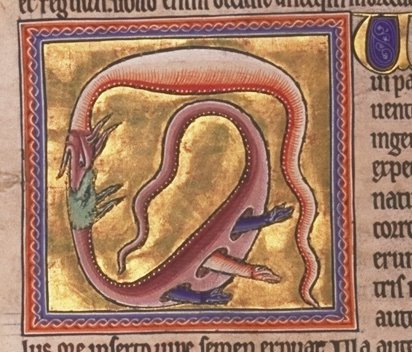
Showing posts sorted by relevance for query erotic animals. Sort by date Show all posts

Friday, January 27, 2006

Erotic Animals


The following is a draft for an entry I'm composing for the Encyclopedia of Sex and Gender , to be published by Macmillan next year. Comments welcomed -- it's still pretty rough.

If you found this page via Google, I have the feeling you will be very disappointed.

Animals, sexual symbolism of

Humans have always shared their worlds with other animals, feral and domesticated. As predator, prey, and companion, animals have been made to serve a variety of human purposes: source of food, provider of clothing, assistant in hunting or herding, spectacle and amusement, docile laborer. Some of the earliest human attempts at representational art center around beasts, portrayed in cave paintings as part of vigorous hunt scenes. Every culture has its favored animals, fauna that seem suspended between the human and the diabolical or divine: Egyptians cats, jackals, and beetles; the biblical Leviathan; Cretan bulls; Hindu cows, monkeys, elephants; early Christian fish and lambs; American Indian buffalo or deer; Inuit whales and seals.

The animals that most haunt the imagination are what might be called "intimate aliens": familiar, but at the same time intransigently strange. Even if they seem vaguely anthropomorphic, such beasts remain in the end inhuman, residents of a liminal state that seems only to increase their allure. This intimacy coupled to otherness is typically found in those animals that have within specific cultures been given a sexual charge. Though certain creatures like snakes possess a seemingly universal ability to attract a sexual aura to themselves, whether or not any given animal will be employed as an erotic sign is culturally specific, and depends greatly upon what animals populate a given geography. This expanse is as imaginative as it is physical: dragons and unicorns can co-exist inside such spaces with dogs, horses, serpents, and hares.

As erotic figures animals boast an ancient and enduring history, from stone-age artworks to contemporary internet sites devoted to zoophilia and zoomorphism. During the Bronze Age (1800-500 BCE), for example, some unknown residents of what is now the northern Bohuslän district of Sweden carved illustrations of men, women and fauna into the local rocks. Many of these figures seem to be engaged in fertility rites. One scene depicts a man with an enormous phallus copulating with a cow, a union of human and animal that was likely motivated by a desire to ensure a productive year. Roughly contemporary carvings in Italy depict one man engaged in coitus with a donkey, and another attempting to mate with an elk (Aubrey Burl, Prehistoric Avebury 243). Representations of humans sexually conjoined with beasts make cultural sense in some pastoral societies, where survival depended upon the increase and multiplication of flocks. The mutual dependence of human and herd is underscored by mutual ardor and life-giving union. Depictions of bestiality can also be found among peoples whose way of living was mainly agrarian, since the sexuality of plowing oxen was intimately related at a symbolic level with the sexuality of the farmer guiding them, and to the fecundity of the fields. In both cases the erotic charge of the animal is in some ways utilitarian, motivated by the very human desire to exert control over an unpredictable world.

Yet cultural use-value or attempts at asserting human dominion over indifferent nature cannot be the whole of the story. Because they combine haunting similarity with perturbing difference, proximity with otherness, animals have long been the vehicles through which humans explore their own identities. Through the beast humans fantasize new possibilities, and enact forbidden desires. No wonder, then, that one of the most ancient functions of the animal is as an erotic symbol. In ways both positive and negative, humans have always realized that amatory desire is -- like other bodily drives -- a passion homo sapiens share with other animals. The rooster was a familiar Greek erotic symbol, forming the animal counterpart to the god Priapus. A bronze Corinthian mirror illustrates Eros grasping a cock in front of his crotch, while numerous vase paintings survive on which the active lover in a homosexual tryst holds a rooster, symbol of his victory in love over his partner (Jean-Pierre Darmon, "The Classical Greek Bestiary"131). Classical myth depicts many unions of mortals with animals, though in most cases the beast turns out to be a god in disguise. Zeus impersonates a swan fleeing an eagle to be admitted into Leda's protective embrace. He has his way with her, and their union produces twin progeny. The maiden Europa Zeus seduces while shaped like a bull. In punishment for her husband's offense of admiring a beautiful white bull too much to sacrifice it to Poseidon, queen Pasiphae of Crete is made to fall in love with the animal. Their amorous conjoining is enabled by a special device fashioned by the inventor Daedalus, and the son thereby conceived is the Minotaur. This creature forever suspended between the human and the bestial well embodies the animal as erotic symbol, for no beast can symbolize human sexuality or activate human desire until it has been partially (but only partially) anthropomorphized.

Writers in ancient Greece and Rome exhibited what seems to be a timeless male penchant to speak of the penis as if it were possessed of an existence and personality distinct from the body to which it was attached. The male member was described variously as a snake, lizard, or bird that follows its own inclinations. (J. N. Adams, The Latin Sexual Vocabulary 29-30). Of these three animals the snake has the most cross-cultural currency as a phallic symbol, probably for reasons of analogy. Animal doppelgängers for the vagina in classical sources are less frequently attested, though porcus [piglet] is one, apparently used in the Roman nursery (Adams 82). The psychoanalyst Sigmund Freud described the snake-headed Medusa as figure for the female genitals, but it is unclear if Greek and Roman mythographers saw the same fearful image there. Though Medusa heads are familiar icons on Greek vases and in Roman mosaics, and though the writhing serpents that form her tresses often have an undeniable sexual charge to their undulations, what is significant about the Medusa in both classical literature and art is her stunning beauty, her animal-enabled allure. This attractiveness does not seem all that different from what remains in the mortal love-objects of the gods once the goddesses have transfigured them out of human shape. Io, formerly a priestess of Hera adored by Zeus and later a snow-white heifer, remains radiant in either form.

The playful connections between genitals and animals found in classical sources have a medieval analogue in the fabliaux, short stories that often revolve around sexual or scatological themes. Sex organs could there be described by such animal epithets as "ferret" and "horsy" for the penis, "little hare" for the vagina. Fabliaux are unusual among extant medieval texts for their frank celebration of the erotic. Building on a vocabulary developed by the Church fathers, authors in the Middle Ages more typically employed animals to abject bodiliness. Thus as early as the Life of St Anthony, a desert-dwelling hermit who has renounced sexual relations is haunted in his loneliness by his own lust. This return of sexual desire takes the form in his visions sometimes of women, sometimes of beasts. In Jerome's Life of Saint Hilarion (late fourth century), when the aspiring ascetic is tormented by the onset of puberty, he beats his body back into submission. Hilarion describes his flesh as an ass in need of brutal domestication, articulating a logic that will hold true in much medieval thinking about beasts: animals are carnal, lascivious, and do not hesitate to act upon their lusts; humans are affected by the same desires, but what sets humans – and especially the holiest of humans – apart is their ability to triumph over their own animal-like flesh. Medieval rhetoric connected sexuality with bestiality so often that the connection between lust and animals was a commonplace.

A compendium of allegory and lore called the Physiologus was among the most influential texts on animals to have been bequeathed to the Middle Ages. Composed originally in Greek, perhaps at Alexandria, this widely extant text circulated by the close of the fourth century. Its entries combine science and folklore that derive from Egyptian, Roman, Greek, Jewish, and Indian sources. Early translations of the book into Ethiopian, Syrian, Armenian, and Latin survive; later versions include Old English, Old High German, Icelandic, Flemish, Russian, and Provençal (Curley, Physiologus xvi-xxix). The work remained popular in Europe through the early modern period. The appeal of the Physiologus was in part its transformation of animals and natural phenomena into biblical truths. The owl, for example, figured the Jews, who had refusal to see the light of Christ's truth had doomed them to perpetual night. The Phoenix, reborn from his own ashes, was a type for Jesus, similarly returned from the dead. Several of the animals described are noted for their sexual habits. The female viper, for example, is said to possess a human form from the face to the navel, and a crocodile's body thereafter. Because she does not possess genitals, the viper must have oral sex with her partner (who, we are told, possesses a male's face as well as – we are led to assume – a penis). After drinking the semen of her lover, she castrates and kills him. Because she has no vagina, however, the young vipers engendered through this bizarre mating must rip their way through her belly, ending her life. The entry concludes by describing the viper as – what else? – a figure for the Jews, who cannot think symbolically, but only in literal terms. They practice circumcision on their flesh, for example, rather than seeing this ritual of covenant with God as an act to be undertaken only spiritually (that is, metaphorically). The viper thereby assists in the work of articulating Christian identity by distinguishing it from the Judaism from which it emerged.

The weasel is similarly said to copulate orally, though she gives birth through her ears (right for the boys, left for girls). Weasels, we are told, are a figure for those who allow wicked sayings to enter their minds and engender sin. The beautiful unicorn cannot be captured by hunters, but should a chaste maiden offer her lap he is happy to lay his head there; lest the image become suggestive, however, we are immediately told that the unicorn is Christ, the virgin is Mary, and there is (by implication) nothing sexual about this strange equine's ardor for placing his long horn in maidenly laps. The Physiologus, like much early Christian writing, stresses the value of chastity and the dangers of desire. One of its animals is even most notable for its complete absence of amorous feeling. The elephant and his wife symbolize Adam and Eve, who before the snake led them into temptation never desired each other and possessed no knowledge of coitus. Elephants, Physiologus asserts, mate only out of necessity, and even then would not be able to copulate without the use of an aphrodisiac, mandrake root. Elephants are in this way the purest of animals and an inspiration to abstinence.

Yet it is hard not to wonder if the eroticism of animals like the viper, weasel, and unicorn can be displaced so easily through allegorization. Surely one of the appeals of the Physiologus is its narration of fellatio, hermaphroditism, and homosexuality among beasts -- even as it transforms these stories into tidy Christian morals. Thus the fascinating story of the hyena, repeated almost obsessively in most medieval bestiaries. A creature of two natures, this desert-dwelling animal sometimes acts the part of a male and sometimes that of a female. According to Clement of Alexandria (d. ca. 215) and many later writers, the lewd hyena possesses the sexual organs of both genders and employs them promiscuously (Boswell, Christianity, Social Tolerance, and Homosexuality 356). The hyena may simply, as the Latin Physiologus asserts, be a figure for the inconstant Jews, who once worshiped the true God but have now turned away. Perhaps the double-gendered beast is likewise simply a representation of the synagogue, metaphorically an unclean animal. But perhaps also the hyena as erotic animal grants something not otherwise available within circumscriptive systems of allegory and abnegation: a figure through which can be dreamt potentialities and desires not otherwise easy to express. Sexuality is what brings humans outside of themselves; it is the surrender to a loss of individuality. Animals as erotic symbols in the Middle Ages often represent the anxieties that accompany such potential loss, but they also convey a certain inventiveness, a certain promise of possibilities beyond the small limits of the merely human.

The twelfth-century writer Marie de France knew this libratory potential of the animal well. In a narrative poem she called Yonec, the heroine is imprisoned for seven lonely years by an elderly husband whom she cannot love. After wistfully declaring that she wishes the world as depicted in romances were true, a regal hawk flutters into her room, and transforms itself into a knight. The hawk was an aristocratic bird, as revered as the warhorse and the greyhound; it makes a perfect animal counterpart to the lady's new love, mixing as it does hints of danger (the hawk is, after all, a raptor) and desire (the bird is meant to be adored; the use of spikes by the lady's husband to kill the hawk is the ultimate proof of his exclusion from the story's erotic world). The ethnographer and apologist for the English invasion of Ireland Gerald of Wales, another twelfth-century author, employed animals as sexual symbols in a way that bears little resemblance to the sheer aesthetic pleasure attached to the hawk in Yonec. Eager to depict the Irish as a degenerate people in need of the English imprint of civilization, Gerald wrote that bestiality was their favorite vice. The sin was practiced most often, he asserted in the History and Topography of Ireland, against cattle – a particularly low blow for Gerald to have launched, considering that the Irish were at this time a society that reckoned wealth and status not according to a monetary economy as in England but rather according to the number of cows possessed. Gerald sexualizes this bond between the Irish and their culturally revered beasts, insisting that through coitus with their livestock Irishmen had engendered numerous man-animal hybrids, Hibernian minotaurs. A cleric who had much at stake in maintaining the supremacy of a celibate identity, Gerald also wrote of a woman who had sex with a lion and another who lay with a goat. So great was his distaste for the subject that he even illustrated the bestial encounters in prurient detail. The goat and the lion serve as sexual symbols for Gerald, but rejected ones; then again in both cases so do the women. All four are part of a world denied to him, and therefore to be denounced as not desirable anyway.

Rock carvings of couplings with oxen, Greek roosters, Pasiphae's ardor for the white bull, Gerald's fantasies about indigenous Irish sexual practice all have this in common: when the animal serves as an erotic symbol, it erodes the boundary between species, sometimes through joyful commingling, sometimes accompanied by horror mixed with fascination. As intimate aliens, animals embody a very human ambivalence. Because the encounter with the erotic is the encounter with the other, they remind us of the inhuman within and of the human without. They suggest the insufficiency of using other animals as creatures to define humanity against and of the insufficiency of humans to control completely the meanings of the animal world. By bringing us out of our own proper, individualized identities, by bringing embodiment to its limit, they open a glimpse of a less anthroprocentric and thereby more unpredictable world.

Monday, November 17, 2008

Erotic Animals II: Adam in Paradise

by Karl Steel

Please enjoy and comment on the continuing journey of Jeffrey's Mandeville paper below, but, if you like, also enjoy what follows as a kind of hors d'oeuvre.

One of our very first posts, and (unsurprisingly?) an all-time (and I trust disappointing) hit among the pages that draw people (?) into ITM, was Jeffrey's "Erotic Animals" entry for the Encycopedia of Sex and Gender. Consider this post its descendant (and not, exactly, a descendant of my several posts on necrobestiality).

I stress a pedigree with the staid genre of the Encyclopedia to underscore a claim not to be (self-consciously) outré in my critical interests. I deny this for a lot of obvious reasons. It's usual to "push the boundaries" by studying "outsiders" (e.g.), but of course this critical practice:
1) cements the various outsiders--Jews, Lepers, Sodomites, Freemasons, Nazis, Furries, Sciopods, &c.--into a structural position as outsider and thus marks the critical interest as a subset of tourism of the bizarre (the analog might be the white American salaryman who cuts loose on a Caribbean vacation, before returning home into a sublated version of his salaried existence);

2) upholds the "cultural center" as a site without systemic antagonism, as a place that cannot be dissolved without an infestation from the outside.
It's been said many times before, but, well, to quote from a comment I wrote on a student's paper:
My own tendency in doing queer theory has been to argue for the queerness at the heart of what has otherwise been thought normal, to refuse to exclude the purportedly 'straight' from the queer, to disengage queer theory from its exclusive focus on samesex desires/acts, and ALSO to argue, as my friend Eileen Joy does, that all sex is hetero, in the sense that there is never an erotics of the same, of the homo (maybe), because we are never same to ourselves or to the social roles into which we've been thrust by our gender &c. This is not to say, however, that there's nothing politically efficacious in a focus on gays but I think there's also much work that can done in overturning straight confidence in its own straightness.

With that hypertrophied introduction, or apologia, I want to share with you a nugget from a great article I discovered yesterday, Eric Lawee's "The Reception of Rashi's Commentary on the Torah In Spain: The Case of Adam's Mating with the Animals," Jewish Quarterly Review 97.1 (2007): 33-66.

Genesis 2:19-23 runs:
19 And the Lord God having formed out of the ground all the beasts of the earth, and all the fowls of the air, brought them to Adam to see what he would call them: for whatsoever Adam called any living creature the same is its name. 20 And Adam called all the beasts by their names, and all the fowls of the air, and all the cattle of the field: but for Adam there was not found a helper like himself.

21 Then the Lord God cast a deep sleep upon Adam: and when he was fast asleep, he took one of his ribs, and filled up flesh for it. 22 And the Lord God built the rib which he took from Adam into a woman: and brought her to Adam. 23 And Adam said: This now is bone of my bones, and flesh of my flesh; she shall be called woman, because she was taken out of man.
We've several problems here, perhaps chiefly the opening clause of 2:23, zot ha-pa'am, "this now": does this mean that God had provided a previous unsatisfactory Eve? That Adam was disatisfied in some way with what had happened before and thus that there was dissension in Eden from the very beginning?

Following earlier commentators, and to solve these problems, Rashi wrote "this time'—it teaches that Adam mated with (she-ba' adam) every [species of] domesticated animal (behemah) and wild animal (ḥayah) but his appetite was not assuaged (lo' nitkarerah da'ato) by them" (qtd Lawee 50). Unsurprisingly (?), this was a controversial interpretation. Lawee tracks several Iberian commentaries on Rashi's Commentary on the Torah that mysticize, deny, or strenuously ignore Rashi's reading; 13th- and 14th-century Jewish converts like Nicholas Donin used this interpretation against their former coreligionists. So it is recorded that in the Talmud disputation of 1240 in Paris, one of the Jews "concessit quod adam coiit cum omnibus bestiis et hoc in paradiso" (confessed that Adam had sex with all the beasts in paradise), and no doubt this confession helped justify St. Louis's Talmud-burning.

The question at this stage is: what can I do with this? Note that the interpretation disgusted both Christian and Jewish exegetes. One semi-sympathetic response suggested that bestiality was an important step in Adam's emotional and mental paideia. While this is at once sympathetic AND patronizing to Adam, it's hardly sympathetic to the animals. From Lawee, n.84:
Commenting on Gn 8.19, an anonymous Rabbanite Byzantine writer who may predate Rashi prolonged the period of human-animal sexual interaction until after the flood: "they [the animals] left the ark 'in their families'—indicating that until then humans mated with beasts." See Nicholas de Lange, Greek Jewish Texts from the Cairo Genizah (Tübingen, 1996), 86. This same writer also posited an element of coercion in the primordial human-animal relationship ("humans mated with beasts and made the beasts mate with them"), thereby raising moral issues (like lack of consent on the part of the animals) that figure in modern discussions of bestiality's moral status.
We have disgust, a dissatisfied Adam, and yet another abjection of animals on the path to adulthood. This doesn't give us much to work with. But it still might be possible to play with this strange sex, to discover in it, prior to the interruption by the arrival of Eve, an almost effaced site of lost possibilities (cf. what I do with Gowther). This obviously connects with Jeffrey's "Inventing with Animals in the Middle Ages," where he suggests that the yena might be understood as "an invitation to explore a spacious corporeality beyond the specious boundaries of the human, to invent through alliances with possible bodies a monstrous kind of becoming that carries history within but which is not reducible to historical allegory" (55). We might even see in Adam's bestiality a possibility for an anti-narcissistic relation to the other, a desire that does not seek satisfaction in "bone of my bones and flesh of my flesh."

Likely having exhausted your patience, I can only ask what might you do with Genesis 2:19-23? What (else) can we do with it that desubliminates the 'normal' or puts it in motion? What else can we do that is not drawn to Adam's bestiality only because of its sauciness?

UPDATE Thanks very much for the link from Michael Pitkowsky's blog for directing me to Gil Student's excellent summary of the various exegetical responses to Rashi's bestiality comment.

Monday, February 06, 2006

Inventing with Animals

Over the next week or so I'll post a few excerpts from an essay in progress, "Inventing with Animals in the Middle Ages." Delivered initially as a lecture last year, part of a series sponsored by the Center for Medieval and Renaissance Studies at Ohio State University, I'm reshaping now for an edited collection that gathers these talks for publication. You'll see that this essay has much in common with the entry I composed for Erotic Animals a while back (see archive).

Here's the introduction, which tries to stay a bit informal.


The last few years have seen an outpouring of work on the interrelation of humans and animals. This scholarship mainly explores the precariousness of the divide which humans imagine separates them from other living things. My own pre-occupation with the animals of the Middle Ages comes in part from this critical efflorescence, but also from the fact that I have two children. At nineteen months old, my daughter Katherine self-identifies more strongly with monkeys than with homo sapiens. Her nursery is a rainbow-colored menagerie; her picture books burst with fantastic zoos. She resides in a hyperactive world of fauna. As the Disney megacorporation realized long ago, and Katherine is realizing just now, animals teach children how to become human. They also provide kids with a temporary, imaginative escape from that burden.

Over the past few years I've also been reading my eight-year-old son Alexander a nightly installment of the Redwall series by Brian Jacques. The novels feature abbots and abbesses, armored warriors, perilous weapons, feasts, foundlings, tapestries, stained glass – the very substance of the medieval world. Yet the characters in these tales are mice, shrews, hawks, stoats, badgers, weasels. Even if the Redwall novels create an alternate universe where animals enact medieval dramas, through their speech and through their actions it is clear that these beasts inhabit a nostalgic fantasy of the lost British Empire. The Middle Ages becomes an imaginative space where the problems of a complex world can be simplified, where good and evil are as self-evident as the kind of animal flesh one dwells inside. For all its talking beasts, the Redwall books are ultimately populated by humans. Animals supply the fantasy bodies through which dreams of a better world are enabled.

In this essay I examine how animals offered such "possible bodies" to the dreamers of the Middle Ages, bodies as dynamic and disruptive as they are fantastic. In animal flesh were realized some potentialities for identity that escaped the constricting limits of contemporary race and sexuality. In a closing section I will ask if it was possible, at least implicitly, for medieval authors and artists to approach the animal non-anthropomorphically, to see in the beast not a mere semblance of the human, nor to dismiss it as fully and wholly other, but to grant to the animal its status as intimate alien.

Saturday, February 24, 2007

The Child Gives Himself to the Wolf

A few months back, I heard Peter Travis give a talk, “Aesop’s Animots,” on a fable in which Aesop feeds a group of philosophers ox tongues. Along the way, Travis discussed The Silence of the Lambs, Aesop’s ugliness and muteness, the latter of which he overcame only in middle age, and the prevalence of corporeal punishment as a pedagogical technique. He also briefly gave his attention to a fable by Caxton in which a nurse threatens a crying child with being thrown to a wolf:
Men ought not to byleue on al maner spyrytes / As reherceth this fable of an old woman / which said to her child bicause that it wept / certeynly if thou wepst ony more / I shal make the to be ete of the wulf / & the wulf heryng this old woman / abode styll to fore the yate / & supposed to haue eten the old womans child / & by cause that the wulf had soo longe taryed there that he was hongry / he retorned and went ageyne in to the wood / And the shewulf demaunded of hym / why hast thow not brought to me some mete / And the wulf ansuerd / by cause / that the old woman hath begyled me / the whiche had promysed to me to gyue to me her child for to haue ete hym / And at the laste I hadde hit not /
And therfore men ought in no wyse to truste the woman / And he is wel a fole that setteth his hope and truste in a woman / And therfore truste them not / and thow shalt doo as the sage and wyse.


Our blog has considered children and animals before. JJC wrote:
As the Disney megacorporation realized long ago, and Katherine [kid #2] is realizing just now, animals teach children how to become human. They also provide kids with a temporary, imaginative escape from that burden.

Children readily identify with, sympathize with, and think through animals, especially talking animals: I grew up with Narnia, Watership Down, Mrs. Frisby and the Rats of Nimh, The Mouse and the Motorcycle, 101 Dalmations, The Rescuers, Charlotte's Web, Peter Rabbit, and The Wind in the Willows. Assuming that this ready identification is transhistorical, fables no doubt worked so well for early education—Travis observed that fables were the second text children read, right after the Distichs of Cato—precisely because children want so much to listen to talking animals.

The fable of the nurse, the child, and the wolf is the first tale in Avianus's collection, which was enormously popular in the Middle Ages (“Rustica [note this difference] deflenti parvo iuraverat olim, / ni tacaet, rapido quod foret esca lupo”); it ends with the same misogynist moral. Naturally enough, the collection of fables opens, as any classroom should, with a plea for silence. The crying child clearly stands in for a crying, complaining child, an uncompliant student who must calm down before he (likely a he) learns anything. By heeding the nurse, he's heeding the analog for his teacher. But by doing so, he's heeding someone whose gender--and/or class, if she's a "rustica"--makes her untrustworthy (and besides, he's imagining his teacher as a woman). Untrustworthy for whom? Not for the child, but for the (male) wolf, clearly the figure at whom the fable directs its moral: don't trust women. If the child places himself in a position to receive the moral, he imagines himself as an animal. Not a problem, sort of, since this is what child should do with fables in order to allow them to work their pedagogical magic. But in identifying with the wolf, he imagines himself as something that wants to eat him.

The child can identify with the child and obey the "ni tacaet" of the nurse/rustica/teacher, even though this is what the moral tells him he shouldn't do, or he can identify with (one of) the animal(s), which he must do to hear morality of fables as his, but in so doing, he imagines himself edible, desirable. He might even imagine himself an erotic object, if the male wolf is imagined as a frustrated suitor and the nurse as a common figure from the fabliaux, the star of a certain nasty Beatles song (on my mind only because my bedtime reading has been the Robbins translation of Cent Nouvelles Nouvelles: but, given the wolfwife, I'm pushing a bit too hard here). I had once thought that the collection started here to frustrate the child's cathexis with animals to teach the child not to identify with animals so readily. Clearly not satisfactory. Here's a interpretative knot, which I humbly present to you, blog-readers, for unraveling. Lend me your hands.

==

* A related question. Fables were a very popular medieval genre. We have major collections not only in the pseudonymous Ysopet tradition and the Avianus collection, but also collections by Babrius and Phaedrus (also pseudonymous?), Odo of Cheriton, Marie de France, Berechiah ha-Nakden, Walter of England, Lydgate, Robert Henryson, and no doubt some others I'm forgetting. There are also beast epics, like Ecbasis Captivi, Ysengrimus, and (amoral?) animals tales, like Ramon Llull's Book of Beasts and the many Raynard the Fox stories. There's also Chaucer's Nun's Priest's Tale, which either participates in this tradition or sends it up or both. I can't imagine this huge body of medieval animal literature was meant only for children. Certainly no child, and few adults, could read Ysengrimus's very difficult Latin. Yet at some point adults stopped telling animal stories to each other. When and why? Is this an actual break between the medievals and moderns (barring La Fontaine)? Certainly fables still get told between adults. Not often, but sometimes. Nonetheless, it strikes me that modern adult fabulists--Thurber, for instance--are putting us on, and part of the pleasure in reading Thurber comes in being in on the joke: the moral's there, Thurber's earnest (particularly in his anti-McCarthy fables, like "The Very Proper Gander") but it's almost as if he's disavowing that earnestness. There's also Animal Farm. I don't want to offer up the medievals--excepting Chaucer as always--as unselfconscious (childlike?) consumers of fables, but perhaps that's what I'm leading myself to do. So, again, when and why? Any suggestions short of, you know, finally reading Jan Ziolkowski and/or Annabel Patterson's Fables of Power or returning to R. Howard Bloch's chapters on Marie's fables?

Texts
Ysopet-Avionnet: The Latin and French Texts. Kenneth McKenzie and William A. Oldfather, eds. University of Illinois Studies in Language and Literature 5. Urbana: University of Illinois, 1919.
Minimus the Mouse

Saturday, January 26, 2013

Blogging and Social Media: My GW DH Talk


by J J Cohen

The two day fiesta of digitizing, annotating, tweeting, performing, theorizing, practicing, envisioning, developing, collaborating, skyping, interrogating and hobnobbing that was the GW Digital Humanities Symposium has come to its end (some background also here). So many good things need to be said about the event -- and fortunately most of them have were said as the conference unfolded via Twitter. But for the record, one more time: I am so in awe of my colleague Alexa Huang, who gathered the funding from many sources to make the symposium happen and did much of its behind the scenes work (intellectual and otherwise); my colleagues Jonathan Hsy and Daniel DeWispelare, who planned and executed the conference with Alexa so flawlessly; and Em Russel, a GW graduate student who ensured the whole thing ran beautifully, with all the labor that entails. All four of them are visionaries and I'm very proud to work with them.

For a small-ish conference, the symposium had a fairly extensive Twitter and Facebook presence, as we had hoped. We ran into some bumps, though, and Ryan Cordell's post on the matter should be required reading for anyone interested in social media and community (if you are reading this blog, that includes you!). His Principles of Conference Tweeting apply just as much, I think, to blogs, Facebook and other forums.

When I delivered my own talk I had the livestream of the Twitter feed projected around me and encouraged the audience (as well as anyone listening in remotely) to tweet reactions to what they were hearing. I knew that I was risking being tweet bombed, but that didn't bother me. Though I knew it would be distracting to have the feed scrolling along as I spoke, my hope was that this larger than life broadcasting would achieve three important things: make those in the audience not on Twitter (the majority of those in attendance) realize that they were missing some discussions that add depth and fun to the symposium; stress that social media forms communities that can be ephemeral but that are also powerful modes of conducting scholarship and partially archiving that work as well; and emphasize for those who were tweeting the proceedings that our community is not gated, but part of a larger public whose participation is often invisible but still counts.

My presentation is below. As usual I ended up ad libbing and this isn't exactly what I said, but it's close. Let me know what you think.

---

Presenting on blogging to a crowd like this one makes me feel like I’ve been released for the afternoon from the assisted living center to speak about how life changed when they switched my stories from radio format to picture versions. Blogs are old news, so 2005: an unremarkable part of the scholarly landscape rather than the innovative digital forum they once were.

Maybe. But perhaps, now that blogs have been assimilated into our habitual critical practice, it’s worth pausing to make a few observations about their achievements, current status and future promise. Warning: much of what I say in the short time allotted to me will be common sensical and based on personal experience. That’s why I’m hoping we can have a vigorous discussion when my fellow presenters and I conclude.

I have been blogging since January 2006, when I founded the site that became the group blog In the Middle. Back in that ancient past, humanities blogs were not a novelty, but they did seem to populate a frontier. It was a time of invention, and agonizing over the professional status of such modes of scholarly endeavor. (A large portion of this “agonizing,” I want to stress, was on the part of non-bloggers, exhibiting thinly disguised assertion of privilege, as well as worry over the fact that blogs give to the academic precariat a strong voice.) My inspiration came from reading many blogs -- but the ones that stand out were those of four female medievalists, all at a risky stage in their career when they started, all with a feminist bent, all demonstrating in their writing a generosity of spirit, an inventiveness and a playfulness.

 Of course, not every blogger espouses such a companionable ethos. Writers in various internet forums, moreover, have sometimes transported into a new arena a business as usual mode of academic praxis, sometimes with an eye towards policing those who challenge the styles of legacy scholarship. This criticism is usually disseminated under the guise of keeping the Academy precise, worthy, superlative – but such adjectives tend to be code for scholarship practiced in a way consonant with orthodox training and a love of one’s own authority. If in 2013 you do not realize why open access publication is essential; why the current for-profit journal and book publication model is broken, and especially poisonous to the young in the field; why digital modes of conducting, creating and disseminating work are the most future-oriented; and why we need always to think scholarship as a communal endeavor that challenges at every point the walls of a university system that -- demonstrating neither heart nor brain -- exploits adjunct labor and excludes some of our very best intellectuals from full access to its resources and from its ability to enable collective thriving – well, if you don’t realize these things, open your eyes, read a little, or maybe retire.

But, blogs. “In the Middle” did not start auspiciously. Despite my interest in the liveliness of blogs, I instigated mine as if it were an updatable but static webpage: a single-author, professionally focused way to provide information published conventionally elsewhere. Sometimes these early posts were pre-prints, and sometimes they were a bare form of open access, enabling material locked on library shelves to roam the internet. The first post I published was a cut and paste piece on “Race” written for the supplement to the Dictionary of the Middle Ages. I’m certain many more people have read the entry on the web than have glanced at its printed version, incarcerated in a volume that weighs ten pounds and costs $200 used. Next came encyclopedia entries for “Postcolonial Theory” and “Erotic Animals” (the latter is among most popular posts ever at In the Middle; I can only imagine the disappointment of those who arrive at the “Erotic Animals” page and find a scholarly analysis instead of whatever they thought those terms would yield through Google). A draft of the introduction to my book Hybridity, Identity and Monstrosity in Medieval Britain joined them. Something extraordinary happened at this point: the blog’s first comments.

Submitted by an anonymous reader, comment number one stated simply “I disagree.” Fifteen more followed. Several were silly, speculating what the musical based upon the book might be entitled, or the possibilities of a pop-up version of Beowulf featuring a Grendel who loses his arm, with real ripping action. Other comments were serious, especially those by my eventual co-blogger Karl Steel, who pushed me to think about some assertions I’d made rather glibly. I threw myself into the discussion, and the blog’s infancy was cut remarkably short. A conversation unfolded, and it became clear to me that community-building and knowledge dissemination had to be unified endeavors. Eileen Joy and Mary Kate Hurley were early members of the commenting community. I invited them to be guest bloggers and then co-bloggers. My GW colleague Jonathan Hsy joined as a blogger last year. Together we cover a diversity of academic life stages, from senior faculty to the precariat.

Seven years later, In the Middle has obtained a substantial, dedicated readership. The blog has also become extensively networked. We’ve integrated with a fan page on Facebook (740 likes) that distributes links to blog posts and some unique content as well. Each of the five bloggers generally share the blog posts with their own Facebook friends, forming a web of cross-commentary. All five of us are to varying degrees active on Twitter, where we will typically link to the blog and catalyze discussion about material related to its ambit. In the Middle is also by association and through use essential to several communal projects and organizations: the BABEL Working Group, the GW Medieval and Early Modern Studies Group, the open access press punctum books, the journal postmedieval. To give a recent example, two ongoing discussions at In the Middle became conference sessions sponsored by BABEL and MEMSI. The presentations will soon become essays in an edited collection jointly published by punctum books and Oliphaunt, the open access publishing arm of MEMSI. These partnerships are mutually sustaining, and atypical of the scholarly landscape of even a few years ago.

I’d really like to emphasize this networked modality: no vibrant blog exists by itself but stretches across multiple sites, Twitter, Facebook, live events like conferences and symposia, open access and traditional publishing, and (to various degrees, depending on the topic), email discussion lists, YouTube, Pinterest, Flickr, Academia.edu, MLA Commons, and so on. And you know, you could substitute “vibrant intellectual presence” for “blog” in what I just said and get at the mission of the scholar in the post-digital humanities. I truly believe that part of our calling is to create as many publics as possible. If the humanities are important enough for us to dedicate our lives to their study, then we need to share our work, our play, and our wit in proliferating contexts. The days of locking research in an expensive book in a members-only library should be part of the scholarly past.

Different audiences interact with “In the Middle” within each forum, with Facebook and Twitter often generating more discussion than the blog site. The downside to this relocation of the commentariat, especially into the ineptly gated community of Facebook and away from a more accessible space is that much of the conversation unfolds literally among friends. The vast majority of blog readers do so in silence, a non-interactive consumption that I do not understand but that characterizes how most users approach social media. That’s fine: I realize that seemingly nonparticipating readers do in fact interact with what is published through the blog and with the discussions that unfold across its networks. It’s just that these interactions are largely invisible because their effects include impacts on thinking and relocation of some of the material to more traditional scholarly settings like essays published in journals and books. I know that this mode of participation proceeds because I often receive appreciative emails telling me so, and occasionally read citations of blog discussions in print. Everyone participates differently. Social media is, shall we say, differently social for many of its participants than for the loquacious minority who propel it.

I began my talk with the “blogging is dead” topos: I repeated it because the form does seem to have lost any radical edge it once possessed -- partly through assimilation, partly through mainstream acceptance, and partly through social media diffusiveness. I devote a great deal of time to the study of monsters, though, and I can tell you with confidence that nothing has really begun to live until after it is declared dead. Blogs continue to perform important work, even if much of what they achieve doesn’t get noticed or discoursed about as back in the days of their novelty. Let me put this another way: blogs continue quietly to reconfigure the academic landscape, sometimes in ways so profound that the restructuring isn’t apparent until after its accomplishment. This potential has been demonstrated, for example, over the past few years by the philosophical approach to materialism that goes by the names of speculative realism and object oriented ontology. In an infamous interview the philosopher Ray Brassier declared of the movement:
The ‘speculative realist movement’ exists only in the imaginations of a group of bloggers ... I don’t believe the internet is an appropriate medium for serious philosophical debate; nor do I believe it is acceptable to try to concoct a philosophical movement online by using blogs to exploit the misguided enthusiasm of impressionable graduate students … I see little philosophical merit in a ‘movement’ whose most signal achievement thus far is to have generated an online orgy of stupidity.
Several points deserve remark here. First, everything Brassier says is wrong. Serious philosophical debate flourished across a constellation of blogs during speculative realism’s genesis. By the time Brassier gave this interview in 2011, the crossover from blogs to multiple modes of dissemination had taken place. Now, much publishing on the topic happens through mainly open access presses, but not before the hashing out of ideas on blogs, Facebook and Twitter. Though controversial, object oriented philosophy has already had a profound impact upon disciplines as diverse as art, architecture, medieval studies, computer programming, game theory, literary criticism, and ecotheory. Many of its elaborators lack (or once lacked) the pulpit of a prestige university and venerable university press. Without blogs the movement could not have burgeoned into such life.

I also want to point out the slide that Brassier makes from blogs to easily exploited and “impressionable” members of the profession. It’s almost as if Dr. Fredric Wertham has returned, only he isn’t attacking 1950s comic books; this time the seduction of the innocent involves misguidedly enthusiastic graduate students. Brassier’s pronouncement manifests a disdain for the young in the field that I find repugnant. The problem is not that graduate students are too impressionable or too enthusiastic; it’s that they tend to be more cognitively flexible than their mentors, and when they see an intellectual project worth pursuing, they will pursue it with energy, rigor, and creativity. The access to ideas that blogs grant enable that pursuit to occur and increase – and that is why the audience and authorship of blogs often skews towards the young in the field and those without secure place in the academy. (I don’t want to get too utopian; as blogger Mary Beard has recently made clear, blogs can also organize micro-communities that foster the most rancid hatred and misogyny – though they can also be called out publicly for that fact, as she has done. I’ve had to cope with a blog stalker whose animus was not confined to virtual spaces).

Academia loves its hierarchies. The humanities are an overburdened, underpaid, and sometimes unpleasant field of scholarly endeavor. Anything anyone can do to make the discipline less inhospitable, less rigid, and more congenial ought to be done. I never understand the tendency to haze, bully, and intimidate those young in the field and other members of the precariat, or why those with tenure track jobs can speak of “the adjunct problem” as if adjuncts were the problem, rather than adjunctification itself. Embracing a nonhierarchical and wall breaching nomadism assisted by social media’s tools may help to make scholarship more gregarious, less solitary, less cold – and strengthen the friendships among those within the university, those who have forged careers within alternative academic modes, and those who are building a future of increasing importance, the para-academy. Social media is the means by which we can collaborate on what we will do together next.

Monday, January 26, 2009

Two enduringly popular posts about animals

by J J Cohen

A small piece of trivia for your Monday morning: among the ITM posts that Google steers hapless typists towards most frequently are this one on naming pets with medieval monikers, and this one on erotic animals. Still waiting for that search query that will combine both into "erotic medieval pet names" -- you know, like, um, "Chauceratrix" or ...

Friday, February 24, 2006

Reality, Television and the Middle Ages


Ah, the leisure laden life of a professor on sabbatical ... matinees, long bike rides, ceaseless hours of bad television.

If only.

Having finished the "Erotic Animals" piece, proofed the galleys and indexed my forthcoming book, and having just sent off "Inventing with Animals in the Middle Ages," I can now turn to the afterword I promised to the book referenced in my title above. It's edited by Eileen Joy, Myra Seaman, Mary Ramsey, and Kimberly Bell, and will be published in Palgrave's New Middle Ages series.

At least it does involve television: one of my favorite essays in this unusual volume is entitled “Outwit, Outplay, Outlast: Moral Lessons from Handlyng Synne and Survivor.” In the medieval version of the show, by the way, Chaucer forms an early alliance with Gower but is quickly betrayed, making him the first castaway voted off the island.

Check out the abstract for Reality, Television and the Middle Ages and let me know if you have any thoughts. I'll be happy to cite you in my piece.

Saturday, February 22, 2014

Susan Crane, Animal Encounters

by J J Cohen

A highlight of this year's MLA Convention in Chicago was being included in a session on Susan Crane's new book Animal Encounters: Contacts and Concepts in Medieval Britain. The panel was jointly sponsored by two divisions, "Medieval French" and "Middle English excluding Chaucer." Sarah Kay presided, and the panelists also included Peggy McCracken and Robert Mills. Susan Crane responded to our papers and a lively conversation followed, with lively audience participation.

Here's my piece. Let me know what you think.


             The allegorization of animals is deeply medieval. Bestiaries, romances and even scientific works transform them into human foibles, Christian virtues, and pedagogical injunctions. Susan Crane’s Animal Encounters refuses to discern in the beasts of medieval texts only anthropomorphism, only tropes for human stories. In the bestiary account of the stag (cervus), we are offered a potent sign for the good Christian. But Crane also demonstrates how we likewise behold the trace of a living deer that makes its way through dense woods, instructs its children, and retreats into its own wondrous world. She describes such moments of encounter and enmeshment as “embodied scenes of imaginative production" (1). Aside from brief glimpses of modern analogues and the anchoring of her argument in critical animal studies, her project is not explicitly tied to present-day concerns -- yet within the human-animal intimacies she investigates inhere new ways of forging relations between ecologies past and present. I taught Susan’s book alongside Mick Smith’s Against Ecological Sovereignty this fall in a graduate seminar on “Contact Ecologies,” and that juxtaposition emphasized for me how much the project of Animal Encounters, even if directed towards the medieval past, intimates new modes of environmental enmeshment and a densely cross-temporal ethics of encounter.
            The texts and topics examined in this capacious book include: the ravens, cats and wolves of early saints’ lives and monastic lyric as experiments in environmental cohabitation; Marie de France's charismatic werewolf Bisclavret as indeterminate creature, a challenging compound of wonder and adventure, extending an invitation to follow the animal to new realms; the taxonomic ardor of the bestiary tradition as a method of making knowable the spiritual unity of creation that also reveals continuities among its collected creatures, discovering in foxes, apes, and dogs qualities which are supposed to distinguish humans but instead render them humanely adjacent; hunting manuals for an aristocratic audience that simultaneously buttress the privilege of a select group of humans and sonically intermix them with the hounds they accompany through the woods; kindness capable of crossing the species barrier in Chaucer's Squires Tale, enabling a princess and a bird to construct, however contingently, a mode of compassionate co-dwelling; and the mutuality of relation between knight and horse in chivalric romance. Animal Encounters is learned, lucid, and cogent, yet another contribution to rethinking the Middle Ages from a scholar renowned for her ability to analyze polyglot and diverse materials in ways that profoundly change their critical estimation. This book opens up possibilities, and deserves enthusiastic celebration – prolonged, and with lots of champagne.
            Among the volume’s strengths is its insistence that Christianity is not monolithic, that the medieval theological record is diverse (too many scholars collapse medieval theology into a harmonized version of the Patrologia Latina). The materials examined here are in Latin, Old Irish, Middle English and medieval French, emphasizing the complicated multilingualism of the British archipelago (a polyglot world that extends in the book through hunting cries even to animal companions). What would the “Medieval Britain” of the book’s subtitle become, though, if the implicitly Christian ambit of its “Medieval” were widened? How might cohabitation change by following the pigs, owls, and hyenas that trace a liminal region between the book’s Christian authors and Jews, their English urban neighbors from just after the Norman Conquest until the Expulsion of 1290? As Karl Steel has shown, thinking the Jew and thinking the animal often went hand in hand. What would the subtitle’s “Britain” become if “Celtic” peoples were granted coevalness with the book’s late as well as early English materials? Could the Welsh and the Irish who appear in the first chapter as monks and saints also appear as late medieval writers? The tales collected as the Mabinogion are full of animals, sparse in monks, and with their Anglo-Norman traces certainly part of the contact zone that was medieval Britain. The twelfth-century discourse of race was also a discourse of species. We’re not talking abstract figuration here, but “embodied scenes of imaginative production.” To push this farther: what happens to taxonomy when humans and animals mate, engendering viable offspring? Gerald of Wales is provocative on this topic, especially as he describes the people of Ireland cross-breeding with their own cattle. He also asks questions like: what happens when a monkey mates with a dog? And we could add: what, outside of Augustine’s simplification of the issue, is the function of the species-blurring monster?
Not all humans were equally human, nor will what constitutes an animal always be clear. Some animals hovered between the organic and the inorganic, such as coral and oysters (the bestiaries describe oysters as “living rocks”). Many bestiaries are bound with lapidaries, and it is not difficult to see why: the rocks of the lapidary tradition, romance, and travel narrative are as lively and assertive as anything contained in zoological compendia. The travel narrative published under the name of John Mandeville describes diamonds that come in two forms, male and female. Erotic inclination brings the gems into union. Diamonds undertake slow lithic coitus that within its own geologic time creates ever more glistening and libidinous rocks, little baby diamonds:
They grow together male and female and they feed on the dew from Heaven, and they conceive and beget and make their little children beside them that multiply and grow every year. I have many times demonstrated that if they are kept with a little of the rock, and not separated from their root, and wet often with May dew, they grow visibly every year, and small ones become quite big.[i]
These gems that grow and multiply, eat and thrive, are also susceptible to human domestication, true pet rocks. The Mandeville narrative quietly suggests that these gems are creaturely, that they belong with organisms that prowl the world, reproduce, ingest, desire.
Many bestiaries contain an entry for lapides igniferi [fire-bearing stones], defined as “igneous rocks of the masculine and feminine gender.” Kept at a distance the two forms remain inert. Should the male rock approach the female, however, “fire breaks forth and consumes all.” These combustive stones appear in the good company of the phoenix, elephants, panthers, beavers, dragons. In the Aberdeen Bestiary (one of the second-family bestiaries, the manuscript group examined by Susan Crane), the firestones are fully humanizedas a nude man and woman, aflame in a garden perhaps meant to recall Eden (93v); since humans are also made from earth and water, such representations make good biblical sense.[ii] Yet this bestiary balances its lithic representations. Upon flipping the page the reader is met by a depiction of a lone rock atop a still, green hill (f 94r). This stone is adamas, the diamond, most impenetrable of materials, its solitariness a rebuke to the blazing gregariousness of its siblings. On a placid summit, removed from story and from time, the Aberdeen adamas dwells indifferent to human relation and fiery futurity.[iii]
Depictions of fire rocks are almost never content to leave stone to seclusion, to add nothing of human story. Yet a surprisingly nonanthropomorphic, nonnarrative representation appears in the bestiary of Harley 3244 (at f. 60). Igneous red mixed with blazing orange, these five stones shine like embers on a grassy mountain slope. They are uniformly partitioned from each other, serene in their glow.[iv] The Harley fire rocks glimmer with vitality, but they have not yet ignited into cataclysmic story, unperturbed in their vibrant materiality. They hold themselves off from encounter (even while participating in visual contact). Other depictions of fire rocks are jarringly hybrid. Another bestiary [Gonville and Caius College] illustrates firestones as two dark rocks, petal-like extensions framing the human faces at their centers, uneasily eying each other. They seem keenly to apprehend that something is about to arrive, but do not know enough to regard that fatal advent with anything but puzzlement.
Rock is anthropomorphized not to become more knowable, not to be assimilated into the human or the creaturely, but to remove stone from that constrictive familiarity which prevents full realization of its challenge, even queerness. What might such animated objects have to say to the kinds of encounter and contact Susan Crane explores in their medieval diversity? What happens to “creaturely relationship constituted in compassion” (Animal Encounters 170) when the creature involved is not “the living animal” (171), but a lively thing, a stone? Might the “problem of animality” (4) be related more widely to problems of environmentality, including “how bodies, minds, and affects interpenetrate” not only “within and across species,” (9) but within and across ecomaterialities? What happens when animal encounter becomes environmental encounter, and grows to include the vastness of the material world with all its forces, organic and inorganic?
            Reading Susan Crane’s rich book provoked many such questions, and deeply inspired my own writing and research. What better gift can a volume bestow than the catalysis of new work, new thought? Animal Encounters is Susan Crane at her best, and that is really saying something.   


[i] I quote from the lively translation of Ian McLeod Higgins, 99. For the French see Jean de Mandeville, Les Livre des Merveilles du Monde, ed. Christiane Deluz 306. The Latin commandment from Genesis will be quoted on the island of Lamory, 332.
[ii] Kellie Robertson acutely observes “These anthropomorphizing accounts of fire-producing stones suggest a natural world motivated by recognizably human desires and behaviors. The habit of moralizing rocks in this way seems to reduce the inanimate object to a screen on which the human is projected in grainy but recognizable form” (‘Exemplary Rocks” 93). Robertson argues against such reductive reading (rocks are more than humans in “petric drag”) by pointing out that “this allegorized world is one of mutual, rather than unidirectional, influence” (94): both rocks and humans are changed by their proximity and relations.
[iii] Adamas introduces a lapidary bound with the bestiary. Vellum quality changes at this point and the lapidary section is not well illustrated. The adamas portrait may be unfinished.
[iv] Debra Hassig describes the peaceful illustration as almost a landscape portrait: Medieval Bestiaries 117.

Friday, February 02, 2007

Happy birthday dear blog, happy birthday to you


Though the day passed without fanfare, In the Middle tottered into toddlerhood on January 18. They grow up so quickly, these blogs.

Hard to believe that a year ago the only posts in this space were a dictionary entry on medieval race that had already been published elsewhere; an encyclopedia entry on postcolonial theory that had been published elsewhere; the draft of the introduction to my latest book, destined to be published elsewhere. As time went on, though, the posts loosened up, the comments section began to flourish, and the blog slowly took on a life of its own. Today it is a group blog rather than the egomaniacal creation it started as. Personally I've found it wonderful to have such amazing co-writers. Thank you, Eileen and Karl!

On an average day In the Middle entertains about 200 visits. Most of these pilgrims are propelled hither by Google searches. Some examples from today, linked to the pages where the hapless searcher actually landed:
In the Middle is proud to offer its information services to these legions of odd poetry lovers, zoophiles, and people of inscrutable intent. More importantly, however, it is heartening to see how many regular readers this blog has attracted. According to the ActiveMeter reader I installed a long time ago [not that Site Meter / borg cube you see at the bottom of this page], on a given day the blog experiences between fifty and ninety returning visitors. The meter is set not to record repeat visitors, so this isn't all me, Eileen and Karl.

To the reader in St Paul, MN who has searched for "jeffrey jerome cohen blog" each day every day without fail since May of 2006, I'd like to take this opportunity to say HELLO. Also, you may want to look into these things they call bookmarks and RSS readers.

Happy Birthday, In the Middle. May you continue to morph into strange new forms.

Question for the weekend: what have we not done on this blog yet that you would like to see?

Sunday, November 22, 2009

Blogging the Middle Ages: A Brief and Personal History of In the Middle


by  J J Cohen

[An installation in a noncomprehensive series on the history of medieval-focused blogs. I invite you to leave your ruminations on this history in the comments, especially if you experienced ITM's development differently. I also invite my co-blogges to leave their own accounts, or add to my own.]
 
During my last sabbatical, I accidentally wrote two books and started a blog. Too much time on my hands.

In the Middle began as jjcohen.blogspot.com on Wednesday January 18 2006. During these somewhat early days of the e-frontier, I had been enjoying reading some blogs medieval in focus (Quod She, Ancrene Wiseass, Blogenspiel, Old English in New York, Unlocked Wordhoard, among others), and some that were not (Michael Berube, University Diaries, Bitch PhD, Dean Dad, Savage Minds, again among others). The sabbatical came at a good time. I'd received my terminal promotion, I did not yet know I was going to be forced at gunpoint to become the next chair of my department, the rest of my life stretched before me without objective or goal. I had a whole semester with no class to teach and no one to advise, so I thought, why not try something new.

Blogger made setting up a new site easy. At first I did little more than cut and paste some obscure publications, hoping to offer them to a wider audience: the blog as Open Access delivery system. Early posts therefore include dictionary and encyclopedia entries as well as fragments from books. My most popular post ever was a work in progress on erotic animals. To this day that piece drives more disappointed Googlers to ITM than any other. Looking back on them now, I don't discern much personality in the posts. They are simply scholarly publications pushed into the world through a novel mechanism, but without a significant change of voice or mode.

But then the comments started.

One of the first people to respond to my posts was Karl Steel, then writing as "Karl the Grouchy Medievalist." He mentioned my infant blog at Quod She, prompting the generous Dr Virago to send many readers my way. My blog took off from there: having people respond, even via pseudonym, to what I e-published prompted me to write more, and to take more risks with what I was disseminating. I quickly christened the blog with its current name to ensure that the focus was on the discussion as much as the posts: it was not my desire to make the site all about me, but to use electronic communication to help envision and maybe even bring into being new kinds of scholarly community. I was especially interested in fostering an interdisciplinary space where hierarchies (grad student versus professor versus interested member of the public) and other sortings endemic to the profession (institutional prestige, geographic location, rank, number of publications in peer reviewed journals) were simply beside the point.

What I posted at ITM continued to be fairly professional in focus and tone. Works in progress were my staple, but every now and then I placed something that contained a shard of biography with its scholarship. On February 8 2006 I mentioned my son Alex for the first time, though not by name. Mostly I focused on what he was reading. Soon, though, fragments of his own writing appeared, and he was joined by his pink-obsessed sister. Though ephemeral, these posts remain among the most important to me. The tone of ITM has changed over the years, becoming a good deal more professional again, so I have moved much of the personal material over to Future Lost Archive and Facebook. But I still enjoy writing about -- and am obsessed with -- the moment of interpretation and those carried in its wake. That is, ficto-criticism.

I was uneasy at first about bringing much that is supposed to be segregated into private life onto ITM. To a degree the weblog form demands it; scholars do not live in disembodied isolation; my friends and my family are my constant collaborators, whether they know that or not; and for reasons I have a hard time articulating, exploring the relation between scholarly practice and lived experience is simply important to me, and a blog offers the ideal form for such exploration.

Eileen Joy made her first appearance on Feb. 24, but only because I was writing an essay for a book she was editing. This afterword turned out to be the first essay I ever composed via the blog. Many other such essays would follow (e.g. here and here). In 2006 many academics were worried that blogs were a distraction from the real work of scholarship. A month after starting to blog I knew that the form could be a catalyst to productivity, as well as a new mode of doing engaged work. I was hooked.

I have worried repeatedly, even tediously, about ITM becoming just another stodgy arm of the discipline.

I've never felt a strong sense of ownership over ITM -- meaning that, I have always wanted it to offer a communal space. That's one reason we've had so many guest bloggers: Daniel Kline, Michael O'Rourke, Greg Carrier, Justin Brent, Geoffrey Chaucer. Three of these guests became co-bloggers: Karl Steel, Eileen Joy and Mary Kate Hurley (four, if you count the Tiny Shriner). Working with these three conspirators and friends has been one of the best results of founding ITM. Together we've experimented with what the blog can accomplish: book reviews, syllabi, conference reviews, book clubs, advance notices of publications, accounts of the profession, ephemera, fun links, manifestos, rants, raves, appreciations of lives well lived...

It's been pleasing as well to watch ITM's readership steadily grow. At the moment we have 228 subscribers via Google Reader alone, 51 fans via Facebook, 434 additional visits to the blog each day ... In the Middle reaches many more people than any book or essay I could ever compose.

Not all the sailing has been smooth. Sometimes someone googles himself and doesn't like what he sees. Sometimes having to face the author I am speaking about makes me realize my own failings, especially in tone (I rewrote a snarky part of this essay after an email exchange). From time to time I've taken a post down because it misfired so badly (that doesn't bother me: my mantra is that if you don't sometimes fail, you are playing too safely -- and what is gained by such circumspection?). Longtime readers of In the Middle know that I have had a recurring problem with a commenter. The best I can say is that these troubles resulted in some statements of belief that were good for me to write. Yet I considered ceasing to blog. I'm happy I didn't, but the experience continues to trouble me, even if it seems to have come to its end.

I don't want to end on a negative note. I'd like to think that what I've learned through the blog I've put into practice in the other communities where I've found myself in a leadership position: as chair of my department, as director of MEMSI. I have often stated that much of my pre-blog scholarship has been a series a letters written to unknown receivers. That's a lonely position from which to write. What I love about In the Middle is that the blog reminds me every day of the community for whom I compose, a community of which I am proud to be a member.