Friday, June 22, 2012

Grey (A Zombie Ecology)

by J J Cohen

Below you will find version three of a project that has been with me for quite some time, investigating the overlap among zombies, ecotheory and object oriented philosophy.

A pop culture oriented version will appear next year in the Journal of the Fantastic in the Arts (it was my Guest Scolar lecture at ICFA). The redaction below is substantially different, containing an extended meditation on color and ecology and a rather more theoretical framing. I composed the talk that became this essay for the Sensualising Deformity conference in Edinburgh (yes, I did more than contemplate rocks there). After some editing (it is too long), "Grey" will appear in a collection I'm putting together for the University of Minnesota Press, Prismatic Ecologies: Ecotheory Beyond Green.

Let me know what you think.

---------------------

Grey 
For Michael O’Rourke

I spent an afternoon in a silver grey wood, a dead wood on the banks of the Mississippi. Its lunar atmosphere a premonition. Nature morte. Lunatic. What colour is the hole in the ozone layer? A grey area?
                                                                                                                                                Derek Jarman, Chroma

Grey is the fate of color at twilight. As the sun’s radiance dwindles, objects receive less light to scatter and absorb. They yield to the world a diminishing energy, so that the vibrancy of orange, indigo and red dull to dusky hues. A grey ecology might therefore seem a moribund realm, an expanse of slow loss, wanness and withdrawal, a graveyard space of mourning. Perhaps with such muted steps the apocalypse arrives, not with a bang but a dimming. Or maybe ashen grey is all that remains after the fires of the world’s end have extinguished themselves, when nothing remains unburnt.
Yet this affective disposition in which greying signals depletion and lifelessness reveals only the stubborn embedment of our anthropocentricity: as if the earth greys to mourn with us, to lament the absence of our tread. Grey is a moment of mesopic vision, when the colors constituting the small portion of the spectrum humanly apprehensible recede, but they do not take the world’s vitality with them. The grey hour is liminal, a turning point at which owls, mosquitoes, monsters and the wind thrive, when stone cools for a while and continues its epochal process of becoming dust, when animals and elements continue indifferent to our proclivity to think that an evening’s color drain is a metaphor for human impermanence, a cosmic acknowledgment of our little fits of melancholy. Grey includes exhaustion, even death, but also reminds that mortality is a burgeoning of life by other means. Grey is unimpressed by fantasies of disaster and finality. We are too enamored of the red and blue of catastrophe – of a world destroyed in flame and flood – and of the etiolation that follows. We like to imagine our own end, and assume at our demise the world likewise terminates (fade to black) or that planet Gaia returns to the balance it possessed before apes became profligate humans (fade to deepest green). The apocalyptic imagination has difficulty discerning the vibrancy of grey. The gloaming is a place of life, but not necessarily in those sublime forms we expect life to assume. Despite our indolent habit of aligning dusk and evening with the deathly and the still, neither are terminal. Grey mornings inevitably arrive, with roiling fogs and air restlessly astir.
A sensual grey ecology is inhuman, but that does not render it misanthropic, disembodied or wholly foreign. Inhuman signifies “not human,” of course, and therefore includes a world of forces, objects, and nonhuman beings. But in-human also indicates the alien within (any human body is an ecosystem filled with strange organisms; any human collective is an ecosystem filled with strange objects), and requires as well a consideration of the violently inhumane.[1] Grey, polychrome hue of the in-between and the uncertain, a miscellaneous zone, is not easily circumscribed. Like a cloudbank, a grey ecology teems with varying densities of matter and shifting velocities: stormy thicknesses as well as serenely heterogeneous clumps (cloud after all comes from the same word as “clot” and “clod”), composites and microclimates. Grey rolls, thins, inspissates, comes on little cat feet. It’s an open aesthetic.
If an ecology is an oikos, a dwelling or a home, it must also include the one who writes about grey materiality while sitting at a laptop on a particularly fine morning just at the border of Washington DC, listening to traffic and birdsong through an open door. I know that nature is not outside with the melodies of trucks and finches, but resides also within this house (a structure built of trees, after all: birds are not the only architects of arboreal habitations), a home shared with a spiny tailed lizard named Spike and a basil plant and dust mites and a ridiculous number of small rocks I’ve brought indoors. This porous and fragile dwelling is built upon both life and death, and not just because its foundational soil is a seething expanse of decay and renewal, a necropolis of vitality. This field become a yard was at some point worked by enslaved people. Not far from here is the church attended by those transported into hard lives they did not choose, the ruins of the segregated school built for their descendants, the remains of a burial ground. When this little house was erected quickly in 1940, one of many hundreds for an influx of wartime workers, the neighborhood’s covenant declared what skin color and what religion would bar potential owners from possession. As I was reminded by a neighbor when we moved here, Jews like us were not allowed.
A grey ecology will not forget this difficult past, limned by exclusions and brutality. A community comes into being through a boundary. Forces, beings and things left outside dwell in an unsettled, “inexcluded” space. This liminal expanse marks the habitation of unfinished business. The story it conveys includes histories of injustice, trauma, violence. Grey is the realm of the monster, that which appears at the perilous limit between what we know and what we do not wish to apprehend, what we are and what we must not be, what we fear and what we desire. Like the monster, a grey ecology will often take anthropomorphic form. Our perceptions of the world are irremediably shaped by our humanity, and although we can attempt to discern what it is like to be a thing, “one can never entirely escape the recession into one’s own centrism.”[2] Grey is an expanse for what might be called disanthropocentric anthropomorphisms: a sweep in which an environmental justice may flourish, with its attention to lived human existence, as well as the vibrant matter, dark ecologies, and object orientations that are so much a part of the new materialism. In grey – a process more than a color -- can be discerned the inhumanity through which dominating notions of the human come into being, hegemonies that emerge through the sorting of who and what gets to dwell in the house and own a proper life, who and what will be excluded. Grey reveals the inhuman as a thriving of life in other forms, a liveliness even in death that demonstrates how the nonhuman is already inside, cohabitating and continuing. Grey is the human in the microbe and the stone as well as the virus and the rock in the human. It propels us beyond our own finitude, opens us to alien scales of both being (the micro and the macro) and time (the effervescent, barely glimpsed; the geologic, in which life proceeds at a billion year pace).[3] A grey ecology is an expanse of monsters, but that isn’t in the end such a dark place to dwell.
            Grey is the tint our flesh acquires as cells deprived of nutrients become energy for other creatures, for whom our demise is a flourishing. At this mortal boundary grey is undead – that strangely evocative word, the negative of a noun that is already a kind of ultimate negative. Undead names the zone of restless and perplexing activity from which monsters arrive, a sensual as well as epistemic threshold at which the familiar loses certainty. Un-dead marks a kind of contact zone between the human and the nonhuman, in which the human reveals the monster always already enfolded in whatever dispersed amalgamation we are.
A green ecology judges a culture by its regard for nature, where “nature” is typically regarded as an external entity, culture’s other. A grey ecology refuses such separations, and believes that the haunting of monsters reveal communal values, shared aspirations and lived ethics (the anthropomorphic) as well as the coinhabitance and alien thriving of the nonhuman (the disanthropocentric). Changes in the dominant monster manifest the restless processes of transformation. The undead with the most enduring history of haunting are no doubt ghosts: sublime, frighteningly aesthetic creatures with cerebral narratives and noble pedigrees, tracing their descent from Vergil, Shakespeare, James, Marx, Lacan and Derrida. The specters haunting Europe and its former colonies have a deep history and a long postcolonial reach. Yet these intangible spirits have yielded over the last decade to a relentlessly corporeal zombie onslaught. The discarnate enigma of The Turn of the Screw seems anemic compared to the harrowing eyewitness accounts of zombie apocalypse in Max Brook’s World War Z (2006), modeled on an oral history of the Second World War.[4] Our monsters are no longer ethereal and philosophical specters, but shambling, putrefying corpses. Existential riddles, ghosts and the vampires that followed them sought to challenge our minds. Now the undead just want to eat our brains. What’s at stake in this material turn, this movement from cognition to consumption, from subjectivity to grey matter, from ectoplasm to ashen flesh, to the human as yet another object in an object-filled world?
Whereas a ghost is a “soul without a body,” the zombie (according to Zora Neale Hurston in her seminal account of folklore in Haiti) is a body deprived of soul.[5] A corpse unearthed from the cemetery, the zombie is reanimated without possession of its personhood and forced into interminable labor on a Caribbean plantation. Zombies are therefore intimates of colonial history and the burgeoning of capitalism. Hurston published her research in 1938, and although zombies enjoyed a brief vogue in contemporary film they did not so thoroughly saturate pop culture until the last decade or so. Their Haitian origin has mainly been forgotten as the animated dead have migrated from film into novels, video games, and advertisements. With tiresome repetition the future now promises a zombie apocalypse, an end to all hope of righting an unjust world. Our inevitable fate is to become zombies ourselves, or to end within their insatiable stomachs.
Because they possess a subjectivity that makes them seem like us, a ghost or a vampire is a monster to which a connection is easily felt. Not so the zombie. Despite its human form, these undead are far less anthropocentric. Their barrier to desire is evident in the love poems in the recent collection Aim for the Head: An Anthology of Zombie Poetry, replete with ironic lines like “gazing deep into your glazed eyes / you make me feel so vaguely alive.”[6] In variations like “I love you for your brains,” tongue in cheek effusions that replace soul with mere body are the best intimacies that zombie verses muster. Grey ecology, it seems, a space of foundering attachment, of withdrawal rather than collaborative composition. Yet to write poetry about zombies, to dress as them during “Zombie Runs” and to imagine at such great literary lengths their depredations enacts a kind of desire, indicating their monstrous pull. Ugly, gauche, and anything but ethereal, zombies possess a shadowy but undeniable magnetism. Like vampires they are embodied monsters; unlike their debonair cousins, zombies are nothing but their bodies. Whereas many familiar monsters are singular and alluring characters, zombies are a collective, a herd, a swarm. They do not own individualizing stories. They do not have personalities. They eat. They kill. They shamble. They suffer and they cause suffering. They are dirty, stinking and poorly dressed. They are indifferent to their own decay. They bring about the end of the world. They are the perfect monster for a human world more enamored of objects than subjects, in which corporations are people and people are things.
The notion of an impending zombie apocalypse is so widespread that a bestselling handbook instructs readers on the supplies, shelter and proper selfish behaviors necessary to survive the event. Over a million copies have been sold of Max Brooks’ The Zombie Survival GuideComplete Protection from the Living Dead.[7] Its ardor for a doomsday when the earth is so catastrophically unbalanced that humans forfeit their dominion is a translation into a monstrous register of the vibrant genre of eco-catastrophe, what James Lovelock gloomily calls The Revenge of Gaia.[8] Inspired perhaps by the success of Brooks’s book as well as the triumph in the United States of a secular apocalyptic imagination (the intoxication of imagining all things coming to their catastrophic end), the Centers for Disease Control in Atlanta recently published the graphic novel Preparedness 101: Zombie Pandemic. The book is described as “a fun new way of teaching about emergency preparedness.”[9] The CDC also offer a tongue in cheek webpage devoted to the management of virally induced zombie plagues, where the following announcement appears:
If zombies did start roaming the streets, CDC would conduct an investigation much like any other disease outbreak. CDC would provide technical assistance to cities, states, or international partners dealing with a zombie infestation … CDC and other federal agencies would send medical teams and first responders to help those in affected areas.[10]
Viewers of the AMC series The Walking Dead and readers of the graphic novels on which it is loosely based know that the CDC will not live up to any of these promises. In Season One episode six of the television series, the Atlanta headquarters of the CDC is self-incinerated after its last remaining scientist fails to identify any means of combating the agent reanimating the brain stems of the dead. To the survivors seeking its refuge, the Centers for Disease Control promise knowledge and safe harbor. The institution delivers neither. Stealing a topos from Richard Matheson’s vampiric zombie novel I Am Legend (1954), the lone scientist who mans the abandoned headquarters has been traumatized by the death and subsequent reanimation of his wife. His experiments have demonstrated that whatever agent causes corpses to become ravenous zombies has already infected the living. To be human means to inhabit the zombie’s juvenile form. The scientist can see no escape from the future’s bleakness, despite his frantic efforts to restore the past. He blasts the CDC to fiery pieces, perishing in the explosion. The scene is typical of the zombie’s doom-laden domain, an out of kilter ecology which systematically robs family, neighborhood, city and nation of protective power. Grey, the ashen shade that colors Atlanta after the blast vaporizing the CDC, is the color that moves the earth towards its ecological destiny as The World Without Us.[11]
The zombie menaces the integrity of our systems of belonging, both metaphorical (the nation, the family) and literal (the body). Like the meteors, plagues, floods, alien invaders, and personified earth that also populate the apocalyptic imagination, the advent of the zombie heralds the termination of human hegemony. The sleepers of The Walking Dead and 28 Days Later awaken to a reconfigured world, a history that is literally post-human. They are tasked with navigating a landscape of catastrophe, but do so without much hope. They suffer so that their audience will not have to. Such narratives are not alarmist, but instead are excellent at inculcating passivity. The world we know may well be coming to its horrible and human-caused close. It is perversely reassuring to be told that there is not much we can do about this grey ecological advent besides spectate and carry on.
Because the word zombie migrated from Africa to Haiti to the United States and thence to Europe, zombies might seem transnational and epochal, but that does not mean they are not historicizable. George Romero’s ghouls in Night of the Living Dead, for example, offered “an allegorical condemnation of the atrocities of Vietnam, violent racism, and the opposition to the civil rights movement.”[12] Like all monsters, zombies are metaphors for that which disquiets their generative times. But while it is clear that images of the violence in Vietnam resonated with the early viewers of Romero’s film, few who watch today will associate that war with the movie’s profaned bodies. Yet Night of the Living Dead remains powerful forty-four years later. No single interpretation can capture a monstrous totality, no matter how persuasive that analysis might be. Monsters are more than the contexts that attended their births: they move through spaces even more potent than their own bodies. A monster is best understood as an extension of and collaboration with the unsettled ecology in which it dwells.
Zombies seem wholly natural: they are “just” dead human bodies, after all. Yet their haunting is the product of prosthetics, special effects, and digital enhancement: they are among the most industrially mediated of monsters. Multiple technologies have aided the exponential growth of the zombie population. Anyone with a smart phone, friends, and inexpensive make-up can create a zombie video for You Tube. Zombies are the perfect fodder for munitions-centric action films and video games (and sometimes, as with the Resident Evil series, it is impossible to tell the two apart). While social media can enable us to be more connected, more affiliated, more humane, the callous culture of the internet can also trigger a profound affective disconnect. Zombies are its perfect monster. They are human beings against whom the most horrendous violence may be ethically perpetrated. They are to be shot through the head, and such execution is never a war crime. Offering the possibility of a murder that doesn’t count, the zombie is the perfect monster for guilt free slaughter. They are also relentless. Video games require enemies that turn us into zombies, pounding away at the FIRE button without cessation and without remorse. Maybe that’s why games used to be marketed as enjoyable, but now they simply announce themselves as addictive.[13]
Our dreams used to be bucolic, pastoral, green. Now we fantasize the past in shades of violent crimson. The Gaia Hypothesis in its many guises offers either an agrarian or georgic reverie of subsistence. We do not imagine the past in such pacific frames anymore: now prehistory is a space for eating meat, running, and having our genes inalterably set to propel us towards destructive choices (evolutionary biology in its pop forms is the best thing to ever happen for white male privilege, because what used to be horrendous can now be naturalized as a response to environmental conditioning). Zombies are proliferating at the same time as our reigning fad diet is the Paleolithic, extolling the consumption of raw foods.[14] Meat loving and contemptuous of grains, the Paleo Diet renounces agricultural humanity for a fantasy of primitive hunter-gatherers who devoured what they killed or snatched with their own hands, a primal masculine ecology. Everyone was supposedly healthier when they resembled Bear Grylls, despite the fact that most hunter-gatherers probably lived very short lives that terminated in the stomachs of predators. Like the “Born to Run” movement, which insists that human bodies were designed on the savanna to run long distances without shoes, this diet is propelled by a fantasy that the past was a better space, and that the current imperfections of our bodies were in distant history its flawless adaptations. The Paleo Diet, like the Zombie Diet, imagines that it is best to consume without adding culture to your food (do not process what you devour), and that what we eat should arrive through no intermediary (nature offers bounty enough). We might even be tempted to label both the Paleo and Zombie diets green: what could be more natural, more eco-friendly, than a culinary regime that leaves so small an environmental footprint? In the end, however, zombie diets are actually the more sustainable, since humans are the most neglected meat in a flesh-loving culture. Zombies know that deer, horses, and humans all make good eating, and they were early practitioners of snout to tail dining. A grey ecology has very little waste – or, rather, that which would be waste is revealed as intimate to life in another form.
Environmental justice is a mode of analysis that urges close attention to the populations paying the highest price for the comfortable modes of living enjoyed by elites. In Stacy Alaimo’s words, “environmental justice insists upon the material interconnections between specific bodies and specific places, especially the peoples and areas that have been literally dumped upon” (Bodily Natures 28). These are the poor and the underserved: those who live downstream from toxic chemical spills, those whose drinking water has been poisoned, those whom economic necessity compels to mine toxic substances without proper protective gear. Racism is as environmental as it is social (Bodily Natures 28). The undead as another category of “unthought” share much with such victims, most of whom suffer in their bodies for ecological devastation. The state of undeath is frequently triggered by environmental hazards: radiation, toxic chemical spills, viruses. Racism is intimately entwined within monsterization, and so it is perhaps not surprising to discover that the zombie offers a racialized body. Never individualized, zombies present the single human collective about whom we can without hesitation speak in terms of determinative mental traits, communal bodily designators, and stereotyped characteristics. Zombies offer a permissible groupthinking of the other, the slough where we find ourselves besmirched by modes of thinking we claim to have surpassed. We feel no shame in declaring their bodies repulsive. They eat disgusting food. They possess no coherent language; it all sounds like grunts and moans. They desire everything we possess. They are a danger from without that is already within. We need to erect walls, secure borders, build fortresses, and amass guns against their surging tide. Applied to any other group, such homogenizing reduction and obsession with physicality, communal menace and fantastic consumption would be intolerable. But the zombie is a body from which the person has departed, so we can talk about them without worrying about bigotry.
The word zombie came into English by way of Haiti, where it arrived from Africa along with that island’s population of enslaved peoples.[15] The folkloric zombie is a reduction of person to body: an utterly dehumanized laborer, compelled relentlessly to toil, brutally subjugated even in death. Old tropes gain new life in the contemporary zombie’s body: regardless of its skin color, we speak of the undead in terms inherited from racialist discourse.  This undeath of some fairly ugly rhetoric suggests that, despite the fervent assertions of some political commentators, the United States is nowhere near post-racial. As The Walking Dead TV series made clear in an episode entitled “Vatos” (1.4), featuring a Latino “gang” whose bluster hides the fact that they are caring for the elderly in abandoned nursing home, life after the zombie apocalypse does not mark a radical break for everyone. Guillermo, the leader of the group and the nursing home’s former custodian, declares that things didn’t really change all that much once the zombies appeared. Survival has always been difficult.
Jacques Derrida obliquely predicted the zombie advent (where zombies convey real human suffering) when he published a ghostly book, Specters of Marx, critiquing the triumphalism that attended the fall of the Berlin Wall. Before we start celebrating the end of history or ideology, Derrida wrote, we should recall
Never have violence, inequality, exclusion, famine, and thus economic oppression affected as many human beings in the history of the earth and of humanity … instead of celebrating the ‘end of ideologies’ and the end of the great emancipatory discourses, let us never neglect this obvious macroscopic fact, made up of innumerable singular sites of suffering: no degree of progress allows one to ignore that never before, in absolute figures, have so many men, women and children been subjugated, starved or exterminated on the earth.[16]
These words have become only more true since Derrida composed them in 1993. Our exultant self-satisfaction at communism’s end – our very love of things coming to ends – blinds us to abiding, proliferating human suffering. From specter to zombie: is it any wonder that an ardor for the end of history has been swept along by an apocalypse that involves “violence, inequality, exclusion, famine … innumerable singular sites of suffering”? The zombie figures the return of the injustices we quietly practice against people we prefer to keep dim in a twilight that marks a willed blindness.
In its limbo of body enduring beyond death, the zombie offers a vision of an afterlife that we have decided is otherwise impossible. Imagine there’s no heaven, no hell below us, and we get the endless twilight of the zombie apocalypse, a place indifferent to good and evil, a hereafter without gods. Yet the Walking Dead are also very much of this world. We are haunted by zombies because we experience embodiment as a drag against the internet-induced fantasy of incorporeality.Perhaps we no longer dream of ghosts because we have become them. We disidentify with zombies by slaughtering them en masse, allowing us to sustain our desire for an electronic realm where we are freed from fleshly restraint. Battling zombies is a wild liberation -- or at least a powerful vehicle for our fantasy that we can escape our own embodiedness and become high-speed avatars, quick souls divorced from slow flesh, from our own worldedness.[17] Paradoxically, however, a bond of desire continues to entwine us with the zombie we murder. During a television interview to promote Land of the Dead (2005), George Romero asserted that should zombies actually appear he would offer himself to be bitten so that he could live forever. As Sarah Juliet Lauro and Karen Embry observe in “A Zombie Manifesto”: “The irony is that while the statement prompts us to ask what kind of life that would be, it reveals that our fascination with the zombie is, in part, a celebration of its immortality and a recognition of ourselves as enslaved to our bodies.”[18] And lovers of the world we inhabit as well: we will stay here forever even if the price is undeath.
Zombies are a kind of ultimate enemy, because they are so utterly inhuman … and yet we the living always turn out to be worse than the zombies we fight. We form our collectives in order to do battle with these monsters, and then we turn on each other and display a zombie-like aggression against what should be our community. In Night of the Living Dead, the “hero” Ben participates in but survives the violence practiced within the besieged farmhouse. Emerging from the place the next day he is shot by the police. The Walking Dead series seethes with brutality perpetrated by the living against each other, offering a sustained meditation on southern US racism and class enmity. Its cast of traumatized men also expose as a lie the idea that zombies have no feelings. Men in the narrative have trouble articulating needs, desires, and emotions; when they do, disaster ensues. The zombies meanwhile are not emotionally dead; they are unremittingly expressive -- of anger, of insatiable hunger, of trauma. They are raw. The zombies embody what the men feel.
To return to the “Vatos” episode of The Walking Dead and its ecology askew: though sometimes too saccharine, the narrative of the Latino “gang” brilliantly juxtaposed a fortress-like industrial building where the elderly had been placed to spend their last days with the transformed streets of Atlanta, an urban space made strange because traversed by nonnormative bodies. The zombies crowding the city blocks offered the corporeal forms communities typically render invisible, now released from their warehousing in assisted living centers, group homes, mental hospitals, and hospices to fill spaces once purged of all signs of non-ablebodiedness. We live in a disability-fearing, youth-loving, death-phobic culture. We reduce people to bodies and exile this flesh from our sight. When the elderly and the disabled are institutionalized to dwell secluded from public view, when cognitive and physical disability are conflated first with mere corporeality and then with the moribund, when we associate the end of life with the smell of disinfectant and the scrubbed walls of a hospital, when bodies simply vanish after the person inside perishes, quietly carted away by people paid a trifling wage to ensure that we do not have to stand in the presence of a corpse, to stand in the presence of our own mortality, then the zombie offers a chance to behold our bodily future. What lies ahead for most of us is disability, and for all of us is death. The zombie is the perishable carnality that we hide from ourselves, the declaration of our own thingly existence.
The zombie’s decay is not an indication of its deadness. The zombie is our window to the visceral world to which we have always belonged and into which we are ultimately absorbed as food for growth. It’s a world we close off from ourselves and yet yearn to see. We know that we are something more and something less than human, yet we hide that knowledge from ourselves. Surrounded by injunctions to conceal, costume and enjoy, we outsource the corpse to morticians, health care personnel, hospice workers and custodians. The zombie vividly exhibits the indifference of our materiality to the supposed superiority or control or beauty of the subjectivity that is supposed to reside within, grey life in death. Decomposition is the flourishing of bacteria, the autonomy of the world, an unyielding demonstration of the inhuman agency that resides in the pieces and substances that we totalize for a while into a body we call ours. Decay is a process of transformation. It seems final, fatal, and terminal, but this activity is future directed, creative and uninterested in our mourning.
Such inhuman indifference finds its human parallel in our propensity to regard others in ways patently inhumane, a withdrawal of ethical relation. As I compose this essay the news has been full of stories of cannibalism labeled, tongue in cheek, as signs of the advent of the zombie apocalypse. A man in Miami high on bath salts was shot by the police while chewing the face from a homeless man. The event illustrates some profound human failures: of a social safety net that should ensure a world where indigent people do not have to sleep under bridges, of a health care system in crisis. To say that a mentally ill substance abuser and a person without a home should be omens of a zombie apocalypse is to guard ourselves from knowledge we possess but prefer to dismiss: that we are a class riven society, that ablebodiedness is impossible to maintain, that we are in the end too selfish to care adequately for the elderly, the impoverished, the disabled. There are no monsters visible at such horrific encounters, at such foundering of our sympathy, only us.
Humans ought never be reduced to the bare life of an object. Yet our inclination to imagine that things have no agency, vitality or autonomy also deserve interrogation. Thingly existence is very different from existence reduced to inert thingness. What if the world is not passive? What if objects are livelier than we suppose? In the zombie’s ongoing putrefaction, in its inability to remain still long, in its status as animated body indifferent to human subjectivity is evident what has been called an Object Oriented Ontology (OOO). Graham Harman defines this thing-centric mode of philosophical analysis as one in which “individual entities of various different scales … are the ultimate stuff of the cosmos” and “these entities are never exhausted by any of their relations or even by their sum of all possible relations.”[19] OOO is a nonanthropocentric philosophy in which things possess agency, autonomy, and ultimate mystery. The walking dead offer what might be called a ZOO, a zombie oriented ontology which makes evident the objectal status of the body as a heterogeneous concatenation of parts, working in harmonious relation, or exerting their own will, or entropically vanishing into an ecology of other forces, other things. The zombie becomes organs without a body, an assemblage of autonomous zones without a necessary totality. The zombie is the inhuman reality of the body, our composition by volitional objects that sometimes work together and sometimes do not, as well as the dependence of this composing process upon an agentic, active nonhuman world. We don’t like to behold our own viscerality, our own material composition, and the zombie is therefore repugnant. Obscure, worldly, challenging and embodied, the zombie’s grey is also strangely beautiful.
Like dragons and giants, the walking dead are transcultural monsters, haunting nearly every geography and history. Our hope and our fear that death is not the end of life amount to same thing, yielding gods who rise from the dead to redeem us as well as humans who rise from the dead to feed upon us. Yet the world is seldom so small as this anthropocentric feeding and believing cycle would posit. A vigorous tradition of animated corpses unfolds (for example) in medieval Icelandic texts, where the sagas speak of a revenant called the draugr or aptrgangr who once interred will not remain still. In Grettir’s saga, we learn of Glam, a pagan from Sweden hired by a farmer to tend sheep on a haunted mountainside.[20] Glam refuses participation within the farmhouse community, and will not attend Christmas services or even fast before the holy day.[21] He is murdered by an unseen monster during a snowstorm, and his employer finds it impossible to bring the corpse to Christian burial. Once interred in a cairn – beneath a heft of stones that cannot hold him down -- Glam begins haunting the farm, riding atop its roof at night and descending to smash to pieces the bones of any animal or human foolish enough to slumber nearby. The young warrior Grettir offers to rid the farm of thisaptrgangr, this “again walker.” In life Glam had been “extremely large … a strange appearance, with wide-open blue eyes and wolf-grey hair” (32), and in death “large and horribly deformed, with strange oversized features” (35): an intimacy of the pre- and postmortem. Grettir wrestles with this monster furiously, destroying parts of the house and then tumbling through the door:
Glam, now off balance, came crashing out of the house with Grettir on top of him. Outside it was bright in the moonlight, with gaps here and there in the cloud cover. On and off, the moon shone through. Just as Glam fell the clouds moved, revealing the moon. Glam stared up at the light, and Grettir later said that this sight was the only one that ever scared him. (35)
At this moment when Grettir himself seems undead (“he lay between life and death”), Glam curses his foe, declaring that he will never reach more than half his strength, that he will forever fear the dark. Grettir recovers, decapitates Glam, and places the head against the buttocks, ensuring the monster will not return. Glam’s prediction will, however, hold true. Grettir forever fears darkness and isolation. His death will unfold as a result.
            Glam is clearly the walking dead, but not exactly a zombie in the contemporary sense. He murders, but not for food; after death his personhood endures within his body. Yet the episode well illustrates something lurking within but often hidden by modern zombie narratives: the twilight environmental aesthetic of the undead. Zombies are creatures who have no need of shelter. They do not build. They exist in an uncultured state. Perhaps they incarnate our fantasies of nature as an exterior and inimical force, our ecophobia.[22] They are also in the end too separate from their worlds, too solitarily human. Zombies never break anthropomorphism. Humans living and undead continue to inhabit a shared and limited ambit. Even if they sometimes devour animals, zombies generally eat only live human beings, not each other, never plants. Their limited diet is evidence enough of how circumscribed their monstrosity remains. Creatures of relation, found only in herds, their insistent human connection also constitutes a silent sociality, one that disallows the invention of wider modes of worldly inhabitance. Unlike some of the lonely bodies described by Object Oriented Philosophy – dim, rogue and dark objects, things that recede infinitely from relation, objects that cannot ever directly touch – zombies are unremittingly gregarious.[23] They do not thrive in solitude but seek others with whom to compose their vagrant herd. A zombie is a body in insistent relation, but only with other human bodies.
Zombies could learn much from their forebears. Frankenstein’s Creature, who apprehends the language of the earth through the groaning of glaciers in the Alps, who is spotted most often in resplendent, icy spaces, knows as undead Glam does that a continuity binds body and world. Glam could have taught our modern monsters the potency of lunar radiance, of dwelling at margins, of trackless snow. The love of icescapes shared by Frankenstein’s Creature and Glam, expanses where the movement of the earth is constant, suggests that their undeath is perhaps the same as the animation of that which was never supposed to have held life. They are undead as the world is undead – which is to say, that the world is differently alive. Monster, human and world are trans-coporeal. I take that term from Stacy Alaimo, who coins it to designate the “entangled territories of material and discursive, natural and cultural, biological and textual” (Bodily Natures 3), where “concern and wonder converge” in a material ethics that involves “the emergent, ultimately unmappable landscapes of interacting biological, climatic, economic, and political forces,” where “human corporeality” intermeshes with the “more-than-human” (2).
And so Glam’s power is not fully exerted until he is outdoors, in those wild spaces that during his life as a shepherd he dwelled. His curse is delivered only when clouds cease to obscure the moon, when the cold night is bathed in a radiance that makes Glam’s eyes glisten. A being of lunar luminescence, broken stones, and blizzards, Glam in his undeath is that against which we build our houses, the excluded as well as the inhuman. The aptrgangr, the again-walker is a monster whose life in death makes us realize the precariousness of our own dwellings, of our lives: the weakness of our doors and roofs, the penetrative power of the moon, storms and night. This inhuman ecology is a part of our Zombie Oriented Ontology, one in which we realize it is not simply the human body that is an assemblage of discordant, agential and envitalized objects, but the earth itself. “Undead” means “differently alive.” The very ground we walk upon, our future tomb, is alive in its supposed inertness, forever on the move, a foundation as well as our ruin, the undead material from which we construct our worlds. No wonder our zombies revive through the agency of inhuman but fully mundane agents like radiation and viruses.
            A kakosmos of flowing crimson and grey body parts autonomously alive, the zombie aesthetic is disturbing, and thereby fruitful to think with.[24] Yet in the end I wish we could have our zombies without desiring so ardently an apocalypse to accompany them. Apocalypse is ultimately a failure of the imagination, a giving up on the future instead of a commitment to the difficult work of composing a better present. Those who dream of the purgation of our problems rather than deliver themselves to the labor of repair choose an easier path. No wonder the zombies devour them. To be undead might mean something more than to inhabit a terminal world, a vastness reduced to the grey of an earthbound despair. Zombies without apocalypse might offer a future in which we recognize the suffering, the possibilities, the potency and the dignity of our fellow humans and our fellow nonhumans alike: grey as the color of unexpected life.


Epigraph taken from Derek Jarman, Chroma: A Book of Color (Minneapolis: University of Minnesota Press, 2010). I would like to thank the audiences in Orlando and Edinburgh who gave me valuable feedback on this essay, as well as China Miéville and Kamillea Aghtan for their critical responses.
[1] I will quietly argue throughout this essay that a grey ecology is consonant with scholarly work being conducted under the rubrics “object oriented” and “flat” ontology, and cannot exclude a consideration of ethics, especially in the form of environmental justice. Profoundly helpful in framing this invesitigation have been Stacy Alaimo, Bodily Natures: Science, Environment and the Material Self (Bloomington: Indiana University Press, 2010) and Jane Bennett, Vibrant Matter: A Political Ecology of Things (Durham: Duke University Press, 2010).
[2] Ian Bogost, Alien Phenomenology, or What It’s Like to Be a Thing (Minneapolis: University of Minnesota Press, 2012) 80. On the unavoidability of anthropocentrism see also 64. Bogost’s work, like that of Graham Harman, Timothy Morton, Levi Bryant and the other writers associated with object oriented philosophy, is often carelessly accused of possessing no evident ethics or politics. Yet thickening human understanding of the inhuman world and interrogating relations to it is an ethical practice (and in the case of Morton and Bryant, one conducted within an explicitly ethical mode). See especially Tim Morton, The Ecological Thought (Cambridge: Harvard University Press, 2010) and Levi Bryant, The Democracy of Objects (Ann Arbor: Open Humanities Press, 2011). I am attempting in this essay a humane account of a subject ethically, ontologically and phenomenologically messy, as Jane Bennett accomplishes through her refusal to pathologize hoarding in her essay “Powers of the Hoard: Further Notes on Material Agency” in Animal, Vegetable, Mineral: Ethics and Objects, ed. Jeffrey Jerome Cohen (New York: Oliphaunt Books / punctum, 2012) 237-69.
[3] In writing these lines I am thinking both of Quentin Meillassoux, After Finitude: An Essay on the Necessity of Contingency (London: Continuum, 2008), especially his disruptive notion of the arche-fossil; and, conversely, Paul Virilio, Grey Ecology, trans. Drew Burk (New York: Atropos Press, 2009) about the scale and the power of finitude, as well as the necessity of rethinking progress narratives.
[4] World War Z: An Oral History of the Zombie War (New York: Random House, 2006).
[5] “The stereotypical zombie is essentially the opposite of such a ‘ghost’: it is a soulless body, rather than a disembodied soul.” In Peter Dendle, “Zombie Movies and the ‘Millennial Generation,” Better Off Dead: The Evolution of the Zombie as Post-Human, ed. Deborah Christie and Sarah Juliet Lauro (New York: Fordham University Press, 2011) 175-86, at 177. For the zombie as body without soul, see Zora Neale Hurston, Tell My Horse: Voodoo and Life in Haiti and Jamaica (New York: Harper and Row, 1938) 179.
[6] Sean O’Neil, “Visceral Love” in Aim for the Head: An Anthology of Zombie Poetry, ed. Rob ‘Ratpack Slim,’ Sturma (Long Beach, CA: Write Bloody Publishing, 2011) 46.
[7] The Zombie Survival GuideComplete Protection from the Living Dead (New York: Three Rivers Press, 2003).
[8] James Lovelock, The Revenge of Gaia : Why the Earth Is Fighting Back - And How We Can Still Save Humanity (New York: Basic Books, 2006)
[9] Downloadable at: http://www.cdc.gov/phpr/zombies_novella.htm
[10] http://www.bt.cdc.gov/socialmedia/zombies_blog.asp
[11] The World Without Us is the title of a best selling book by Alan Weisman (NewYork: St Martin’s Press, 2007) that imagines life on the planet should its human population vanish: a delirium of buildings falling apart, forests eagerly expanding, subways aflood with cleansing water, farms that had been sustained by chemical interventions reverting to wilds, human traces reduced to thin lines in the geological strata and some lingering synthetic molecules.
[12] Kyle William Bishop, American Zombie Gothic: The Rise and Fall (and Rise) of the Walking Dead in Popular Culture (Jefferson, NC: McFarland and Company, 2010) 14.
[13] Karl Steel made that point to me via Twitter and it seems exactly right.
[14] See the multimedia spectacle of website at http://thepaleodiet.com/
[15] For the Haitian context of the zombie see Franck Degoul, “’We are the Mirror of your Fears’: Haitian Identity and Zombification,” trans. Elisabeth M. Lore inBetter off Dead: The Evolution of the Zombie as Post-Human (New York: Fordham University Press, 2011) 24-38.
[16] Specters of Marx: The State of the Debt, the Work of Mourning & the New International, trans. Peggy Kamuf (New York: Routledge, 2004) 85.
[17] Peter Dendle maps the “relationship between history’s least energetic monster and history’s most energetic generation” in “Zombie Movies and the ‘Millennial Generation.’” Quotation at 181.
[18] Lauro, Sarah Juliet and Karen Embry, “A Zombie Manifesto: The Nonhuman Condition in the Era of Advanced Capitalism,” boundary 2 (2008):88.
[19] http://doctorzamalek2.wordpress.com/2010/07/23/brief-srooo-tutorial/ A fuller discussion of OOO may be found in the second half of Harman’s recent bookPrince of Networks: Bruno Latour and Metaphysics (Melbourne: re.press, 2009) and Towards Speculative Realism: Essays and Lectures (Winchester, UK: Zero Books, 2010), as well as the collection The Speculative Turn: Continental Materialism and Realism, ed. Levi Bryant, Nick Srnicek and Graham Harman (Melbourne: re.press, 2011).
[20] Grettir’s saga, ed. Örnólfur Thorrson (Rekyavik, Mál og menning, 2004); trans. Jesse Byock, Jesse (Oxford: Oxford University Press, 2009). References by chapter number.
[21] “I liked the customs better when men were called heathens,” Glam declares, “and I want my food without tricks” (32). References to Grettir’s saga are by chapter number in Byock’s translation.
[22] “Ecophobia” is David Sobel’s coinage in Beyond Ecophobia: Reclaiming the Heart in Nature Education (Great Barrington, MA: The Orion Society, 1996).
[23] This taxonomy of bodies according to their luminescence and relation-making (a list also includes “bright”) is taken from Levi Bryant, who uses it throughout his work. For an especially lucid explication see his blog post here: http://larvalsubjects.wordpress.com/2012/04/22/a-brief-observation-on-relation-language-and-logic/
[24] “Kakosmos” is Bruno Latour’s wonderfully messy term in Politics of Nature: How to Bring the Sciences into Democracy (Cambridge: Harvard University Press, 2004) 99.


Tuesday, June 19, 2012

Geologic in Scotland

by J J Cohen

Prologue
Yesterday I returned from Edinburgh, where I gave a paper with little stone in it.

On the long plane ride home I read David Abram's Becoming Animal: An Earthly Cosmology. The book has problems: the cliche of the educated Western man who comes to a better sense of mindfulness via journey through enchanted Nepal; a proclivity to speak of the wisdom of indigenous peoples, as if their earthiness were universal and uniformly affirmative; a disdain for technology, which becomes flattening and estranging (I read Abram through the technology of a book, on a plane where if I flipped a button the screen embedded in the seat in front of me displayed three camera views of the exterior through which I became an intimate of transatlantic clouds). Yet Abram argues for an active ecological materiality that has much in common with the new material feminisms as well as object oriented philosophy. He arrives at his conclusions through a different road (a little Deleuze, a lot of phenomenology), but what he writes is consonant. And beautiful.

I found myself haunted by some lines which unintentionally resonate with some words from Derrida I'd been thinking about:
But what if meaningful speech is not an exclusively human possession? ... What if thought is not born within the human skull, but is a creativity proper to the body as a whole, arising spontaneously from the slippage between an organism and the folding terrain that it wanders? What if the curious curve of thought is engendered by the difficult eros and tension between our flesh and the flesh of the earth? (4)
This language of inhuman being, Abram writes, possesses not words but rhythm, movement, animation; not representations but participations, dances, presencings (11). If stone tells a story, I am certain it speaks in such a tongue.


1
Taxi from the airport and I am trying to remember Edinburgh. Jamie narrates as he drives: the idiocy of politicians and their betrayals; the prodigality of the queen, who keeps an estate to visit once a year; the construction of a tram he does not want; bleak futures for the young. When he speaks of those who have too much love for immigrants I observe that Africa alone possesses indigenes. He laughs.


2
Hiking to Arthur's Seat to battle jet lag. The sun settles in its late northern way, smearing clashes of orange and violet across a dusk strangely blue. A cold wind rises at the peak, where a silver disc marks arrival. I am thinking of the silliness of calling the mountain after Arthur, beloved of the Welsh and English, but this is the queen's park after all. The last of the sun is deepening final purples across the Firth of Forth. As I sit on a rock that Arthur never sat upon, the water's other name comes to me: Linne Foirthe. I remember only because like Firth of Forth the words resound.

Twenty years and more ago I sat at the same peak: in the morning, with a crowd, owning a short past and small prospect. At this dusk I'm alone. In hiking I'd feared the cloy of personal history, feared seeing that younger me for whom I don't possess enough compassion, but the wind from the Firth is brisk, deeper, yielding geologic thoughts. The chill of this stone on this night is also the epochal cool of 350 million years. Arthur's Seat is an extinct volcano, a remnant from Scotland's childhood as land of rocky fire. Here the local physician James Hutton observed igneous expanses that were once magma, and saw they had been thrust through oceanic sedimentary stone. In this intercut (stone from fire, stone on land from the sea) Hutton discerned the logic of the earth, a lithic writing or geographesis in which he glimpsed deep time. Hutton was one of many scientists to discern in the earth its native temporality, its persisting but slow liveliness. On the way to the Seat I passed a sweep of the Salisbury Crags now called "Hutton's Section," a space at which when this eighteenth-century physician attended to the inhuman time of their record the rocks imparted a story. Arthur's Seat is the gift of slow uplift and erosion: formed in the seabed, penetrated by volcanic energies, scraped to a craggy mound by the sandpaper of glaciers. When Hutton hiked Arthur's Seat he beheld a world of sea and stone, heaviness and inestimable force, a restless world in which humans and gods are upstarts, unreadable in geology's archive.


3
The National Museum of Scotland narrates its earliest history through confederation with stone. The basement level is dedicated to "Beginnings" and "Early People," collections arranged around a record simultaneously petric and human, profound in its temporality and yet embodied, immediate. James Hutton adorns a placard announcing "Geologic Time." Its chronology advances in thick segments of hundreds of millions, with humans at the tiny flatness of "0 Million Years Ago." That this past is not  indifferent to the creatures curating its vastness is suggested at the exhibit announcing "Scotland's History Starts Here." A boulder marbled white, black, grey forms the totality of the beautiful display. Everyone who walks by touches the stone: a needed reassurance once they learn that it has been transported from an outcropping in the country's northwest whose stones originate about two and a half billion years ago. These are the oldest rocks in Europe, and among the eldest of the world. Yet the signage also announces that "In the rocks called the Lewisian Gneiss, Scotland's history emerges from the depths of time." The stones were already the bedrock of Scotland, even though the Precambrian life forms coeval with them were microbes, and any supercontinent to which they clung predates Pangaea by three or four iterations.

As I watched short documentaries on geologic and glacial Scotland, I was struck by how their narration of Scotland's lithic prehistory offers the same kind of very human stories that nations like to tell themselves about their continuity and primal coherence, especially in the face of briskly heterogeneous realities. I loved the repeated emphasis on Scotland as a portion of Britain that arrived from elsewhere. During the Silurian period the Scottish portion of the island was pushed by wandering Laurentia into the rest of Europe. Its meeting with what was to become England was not easy: a violent fusing that thrust up mountain ranges, that was protested by the molten fire of a multitude of volcanoes. Scotland drifted with its new companion to the equator as part of Pangaea, becoming a desert; and then northward with Eurasia to cool and flood. The rising sea ensured that Britain (as this conjoined twin would now be called) would seem an isolated entity, that Scotland's primal affinities with lands having nothing to do with the unwanted expanses to its south could be forgotten. But geology speaks the truth of history. Though Scotland has been scoured by glaciers, its primal life wiped from its stone under the weight of frozen water and then the force of floods, its stones hold the story of its endurance.


4
Although it does feature some bones, clothing, and even a Viking grave, the "Early People" exhibit continues the composite petric-human narrative instigated in "Beginnings." Material culture like brooches, buckles, pendants and pins are displayed in anthropomorphic cases that resemble copper robots walking across the museum floor. Incised stone slabs offer most of the stories. A placard entitled "Knowing Stone" speaks of stone's cross-cultural as well as specifically Scottish use in "every human activity ... from making fire to making an impression." Homes, weapons, domestic tools, items, religious objects and jewellery were all created from stone. Scotland's geologic diversity enabled a sophisticated stone knowledge through which the properties of various types of rock were activated and allied with to create objects specific to their abilities. Exotic stones were meanwhile imported and treasured.

Stone's archiving power is continually activated, especially to inscribe stories. Through that repeated and sensuous contact between durable rock and desiring hand narratives were incised and bequeathed. Sometimes these stories remain loquacious after centuries. Latin engraved on a sarcophagus speaks in a language we can still comprehend; a cross speaks the penetration of a religion still practiced; an engraving of a boar or sheep is a pleasant reminder of how long these animals have companioned us. Other narratives are more reticent. The Papil Stone is cut with images of monks, a cross, and a lion that is likely Saint Mark. But it also displays anthropomorphic bodies with animal visages, and two long beaked avian creatures pecking at what looks to be a severed human head. Many stones feature Pictish symbols that reassure with their beauty, intrigue with their inscrutability, and seem to be part of this geologic story of Scotland as well as a challenge to its certainty.

Interlude
"The imperfect and improvisational character of all earthborn beings ... is a character also present in stone ... There's an affinity between my body and the sensible presences that surround me, an old solidarity that pays scant heed to our distinction between animate and inanimate matter ... It unfolds in an utterly silent dimension, in that mute layer of bare existence that this material body shares with the hunkered mountains ... with gushing streams and dry riverbeds and even the small stone - pink schist laced with mica - that catches my eye in one such riverbed, inducing me to clasp it between my fingers. The friendship between my hand and this stone enacts an ancient and irrefutable eros, the kindredness of matter with itself." (David Abtram, Becoming Animal 29)

5
By the time "Early People" is ending, stone has yielded to wood. Visitors walk through houses, glance at the remains of boats, examine textiles, and perceive that the historical archive brims where it once was as sparse as a coil engraved on stone. Andrew Goldsworthy's installation "Hearth" (1998) is its terminal point, the connection to the "Kingdom of the Scots" exhibit that comes next, with its narratives of struggle, assimilation, pride, war. "Hearth" is semi-circle of wooden fragments scrounged from the construction site of the museum. They are jagged but in their moodily lit unity beautiful. A perfectly round black disc has burnt into the center, suggesting the place where a vanished fire once flared, a circle of gathering for community and tales. The affirmative power of this installation is undeniable. Yet its wood and its absent flame seemed insubstantial to me after so many stories of stone.


6
An easy critique of the museum's curators: they anthropomorphize stone. Lithic stories become national stories. They discern in rocky and indifferent substance their own vitality, their own history, because they place it there themselves. They are like Alexander Duff, who looked at the Hilton of Cadboll Stone and beheld not its Pictish specificity but a pretty background to carve a story about him and his three wives, as if the world cares; or even worse, like those who left the Stone languishing upside down in a chapel, or employed it as a garden ornament.

Perhaps. But what if all an observer discerned in the Hilton of Cadboll Stone was a local type of sandstone formed by eons of alluvial sedimentation? What if its only story was its similarity to the rocky material out of which much of the National Museum of Scotland is constructed? Would that not miss the point that something generative, something more than a stone or human story, unfolds when we are drawn to such a specific sandstone by our stone knowledge -- which is really just our love for stone, as well as our recognition that we are lithic intimates?


It could also be said that the curators perceive in stone something that those who dismiss its materiality as indifferent or inert do not. The rocks that dot, subtend, texture, and continue slowly to convey the expanse of land we are calling for a while Scotland are as active, hybrid, shifting and astir as its peoples. Stone is animated and self-organizing. It speaks, when we stop insisting that communication requires words and representation rather than participation is how meaning unfolds. "Knowing Stone" is the encounter through which groups form alliances with various kinds of geologic materials -- not because they are cold and recalcitrant, but because they are metamorphic. They outlast human durations -- sometimes, like the Lewisian Gneiss, by years extending into numbers so vast as to defy real comprehension. But let's not be ageist. The temporal alterity of stone does not make the lithic any less our companion. Stories of stone are inhuman only if humans are not the world's intimates. It is not so much that we project ourselves into rock and trick ourselves into discovering tales of our implanting (although I do not deny that we often undertake such projects). More surprising is that despite having dwelt on the earth for a brief time (but then again, stones have dwelt in the cosmos only a brief time), the stories in which we participate, stories in which we may not be the protagonists or conclusions we once dreamt, are nonetheless in part about us. We matter as they matter.

James Hutton ascended Arthur's Seat and read in its shifting composite of fire-stone and ocean-stone a story that is disanthropocentric. In its length the narrative legible there makes our arrogance reel, but that movement away from our own small center is all to the good. The world may not offer its expanses for us, may rebuke us for having ever thought we culminate its processes rather than ride them for a while, but our worldedness (our mundane companionship, our material interbeing) becomes something extraordinary: a sentience that extends beyond us, into the inhuman; our lives become rather like the life, say, of granite; our dreary history of reducing matter to its use value might at last yield to an ethic of embeddedness, artistry and care.


7
I brought home for myself a single souvenir of my sojourn to Edinburgh: a small chip of volcanic stone, clasped near the summit of Arthur's Seat, carried with me for days and after three thousand aerial miles near me as I write these words.

Sunday, June 17, 2012

Edinburgh

by J J Cohen The rain it raineth. Steady patter of water at the window and a ceaseless procession of bright raincoats and dark umbrellas. The day promised sun but has offered only low clouds and bursts of rain. The abiding grey doesn't annoy me. I've been walking Edinburgh, and its dark stones are livelier wet. A cafe, a museum, a cafeteria called The Mosque gave me windows to watch the city's Sunday progress. I'm back at the hotel now, packing and musing, feeling a need to write. I'm a little homesick. I miss Katherine and Alex on Father's Day. I missed calling my dad: the first year I've sent him an email for today. Home tomorrow, I know, if I'm able to make my tight connection at Charles de Gaulle. For now I'm thinking about movement, process, community, travel, rain. 'Sensualising Deformity,' the conference I came to Edinburgh to attend, was the kind of event that leaves a long wake. The sessions blended monster theory, disability studies, cultural criticism, and art. Its population of presenters was diverse, and young. It was one of those events that gives you the sense that something important is emerging, something shared and now better recognized. I don't think this emergence will be easy: because so many of the attendees were UK graduate students and post docs, there were numerous stories about the impact of budget cuts on being able to sustain a program of study, and tales as well about the unkindness of established scholars to those with precarious job situations. I frequently found myself wondering at the conference why so many academics are so ungenerous to the next generation, the future of their own field. I'll be thinking about the conversations that unfolded here for a long time. I made many new friends -- and finally got to meet Margrit Shildrick, whose work I've long admired. Two friends of long aquaintance made the event special: Rosemarie Garland-Thomson, with whom I was in a Body Theory Reading Group in the late 1990s and who has inspired both my work and my thinking about the public responsibilities of the intellectual; and Michael O'Rourke, whom I've known for maybe eight years and who through his being cross with me at just the right moment, his never losing faith, and his own brilliant example ensured that my scholarship didn't take a lonely and historicist swerve c.2005. Having both Rosemarie and MOR at the same conference made me think of debts owed to friends. I was one of the keynotes at the conference (as was Rosemarie) because, in part, as a pioneer in disability studies she helped me to understand our intellectual obligation to speak outside our fields at every opportunity and to imagine as wide a community as possible coming into being through the work we undertake. MOR turned me on to Quentin Meillassoux, and then Graham Harman and Object Oriented Philosophy and Speculative Realism. My keynote was an ecocritical account of the grey ecology that zombies inhabit and figure -- and it wouldn't have happened had he not been the angel attending its birth. Many years have passed since I have been to Edinburgh. The last time I passed through the city I was backpacking. I'd just come from Skye and Inverness; I was headed to York and Whitby next. That was the summer between completing my BA at the University of Rochester and starting my PhD at Harvard. In that solitude of wandering I'd like to say I grew up, but I don't think that was really the case. I was afraid of encountering that earlier self as I walked through Edinburgh today. The streets were vaguely familiar, the Royal Mile exactly as I thought it would be again, the castle still stately. But I also went to some sites I hadn't seen before, such as the National Museum: wonderfully, the prehistory of Scotland is told there mostly through stone, a kind of geonarrative of the restless earth. Even the glaciers the exhibit features were rocky, scraping across the mountains like sandpaper and leaving gifts like erratics stranded on transformed landscapes. And speaking of rocks, as on my first visit I hiked the extinct volcano known as Arthur's Seat. The steep little mountain looms over one of the University of Edinburgh dorms. Since the sun sets so late here, I hiked along the crags and up to the peak on my first night, watching the last rays from the top. A cold wind was blowing, the hills were green and waving with pink and yellow wild flowers. A density of primal lava, the Seat has not eroded like the surrounding area, making its dark rock seem eternal. It isn't. My visit to the museum reminded me that Scotland wandered away from Greenland to bump against England long ago, and that volcanos like this one are the remnant of that collision. The weight of glaciers made Scotland's middle sink; their melting scoured its landscape. Everything changes, nothing endures. I was thinking about the rocks with Pictish and early Christian symbols carved into them I saw at the museum. Some are vivid. Others have faded to merest indentations. None of their messages are easy to comprehend. I hiked to the top of an extinct volcano and I wondered if I would see or feel anything of the self who hiked that same slope more than two decades ago. If there were traces of his passing to be discerned, I wasn't able to recognize them. That seems to me OK. And now, off to dinner with MOR and some of the conference organizers. Tomorrow at 4 am, the trek begins towards home.

Thursday, June 14, 2012

REMINDER: Michael Camille Essay Prize Deadline: June 30th

Figure 1. Michael Camille in Paris avec the Chimera of Notre Dame [photo taken by Stuart Michaels]

by EILEEN JOY

Just a reminder that the deadline for the first Biennial Michael Camille Essay Prize, jointly sponsored by postmedieval, Palgrave Macmillan, and the BABEL Working Group, is looming: JUNE 30th. To recap:

The competition is open to early career researchers: those currently in M.A./Ph.D. programs or within 5 years of having received the Ph.D. (that will include those graduating in 2007 or later). Essays in all disciplines are encouraged. The prize is for the best short essay (4,000-6,000 words), the 2012 thee for which, inspired by Camille’s last book on the gargoyles of Notre Dame, is: Medievalism and the Monsters of Modernity (conceptualized and imagined in any way the author sees fit). The award for 2012 will include: publication in postmedieval, 250 dollars, and one year’s free print and online subscription to the journal.

The prize is named after Michael Camille (1958-2002), the brilliant art historian whose work on medieval art exemplified playfulness, a felicitous interdisciplinary reach, a restless imagination, and a passion to bring the medieval and modern into vibrant, dialogic encounter. In addition, we wish to honor Camille for his attention to the fringes of medieval society, to the liminal, excluded, ‘subjugated rabble,’ and disenfranchised, and to the socially subversive powers of medieval artists who worked on and in the margins. The prize is also named after Camille because his work was often invested in exploring ‘the prism of modernity through which the Middle Ages is constructed’ and because, as his colleague at the University of Chicago Linda Seidel said shortly after his death, he had ‘a mind like shooting stars.’

Submissions will be judged by a panel of scholars selected from postmedieval’s Editorial Board, and the winner will be announced at the 2nd Biennial Meeting of the BABEL Working Group, to be held September 20-22, 2012 at Northeastern University in Boston, Massachusetts. Please send submissions (as a Word document, formatted according to Chicago Manual, author-date format with endnotes + list of references at end) to the editors, Eileen Joy and Myra Seaman, at postmedievaljournal@gmail.com. 

Wednesday, June 13, 2012

GOT YOUR NOSE: Bisclavret defaces his wife

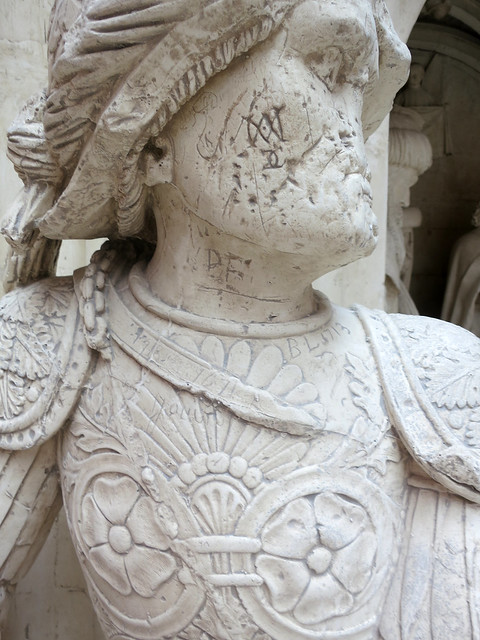
Plaster cast from the Palais de Chaillot
by KARL STEEL

First, join us in wishing Jeffrey safe travels.

Then, lest it be said that my promises or threats aren't worth the nose they're printed on, here, for your use, is my monumental post on the noselessness of Bisclavret's wife.

Recall that towards the end of Marie's lai, Mr. B's wife shows up at court, only to be attacked by her lupine husband:
Oiez cum il s'est bien vengiez!
Le nes li esracha del vis.
Que li peüst il faire pis? (Bisclavret 234-36)
"Just hear how successfully he took his revenge. He tore the nose right off her face. What worse punishment could he have inflicted on her?" (translation by Gallagher. My own translation would go like this: "Listen to how well he avenged himself! He tore her nose off her face. What worse could he have done to her?") 
The loss of the nose has long been a rich interpretative site in Bisclavret criticism. We can divide the readings into several groups:

  • psychoanalytic ones, which pun on vis [face] and vit [penis]: e.g., Bloch, Labbie, and Dolores Warwick Frese, "The Marriage of Woman and Werewolf: Poetics of Estrangement in Marie de France's 'Bisclavret'" in A. N. Doane's and Carol Braun Pasternack's anthology Vox Intexta: Orality And Textuality in the Middle Ages, rooted, I believe, in Jean-Charles Huchet, "Nom de femme et ecriture feminine au Moyen Age: Les Lais de Marie de France," Poetique 48 (1981): 407-30. Essentially, Ms. B had illegitimately taken on the phallic function and has it torn from her. This helps explain why only her female descendants are noseless; 
  • claims that nose-removal was a common torture in the Middle Ages, which I think is a wild exaggeration: I'm looking forward to seeing Larissa Tracy's further contextualization: I believe she's arguing that the court of Henry II, being antipathetic to torture, would have found the scene repugnant;  
  • claims that the nose-removal makes the wife more bestial: for reasons I'll explain (far) below, I disagree; I'm more in the neighborhood (less in the same block than on the same bus line) as Laurence M. Porter's proposal in Women's Vision In Western Literature: The Empathic Community that "Wolves have prominent muzzles and the missing nose makes Bisclavret's wife's face resemble a human skull more than a wolf's head, suggesting the skull underneath the skin, the illusoriness and transcience of sexual delight";
  • interconnections with many, many stories of Roman virgins and, in particular, virgin saints, who cut off their noses to make themselves unattractive to the Barbarian invaders [see Claude Thomasset, 'La femme sans nez', Littérature et médecine II, ed. Jean-Louis Cabanès, Eidolôn, 55 (Bourdeaux: Université Michel de Montaigne, Bourdeaux III, 2000), 57-52 and Jane Tibbetts, 'The Heroics of Virginity: Brides of Christ and Sacrificial Mutilation," Women in the Middle Ages and the Renaissance: Literary and Historical Perspectives Ed. Mary Beth Rose. Syracuse: Syracuse UP, 1986]: implicitly, then, Bisclavret's assaulting his wife's attractiveness; 
  • and finally, most influentially, a great many claims that losing the nose [or losing the nose and ears] was a punishment for an adulterous wife. See Stith Thompson Q451.5.1, Nose cut off as punishment for adultery. This requires a lot of detail.
Stith Thompson's most frequent citations here are to the Kathasaritsagara, "The Ocean of the Stream of Stories," an enormous 11th-century Sanskrit tale collection in which adulterous wives often lose their noses (or their noses and ears), sometimes while embracing the reanimated (and bitey) corpses of their executed lovers. Anna Kłosowska suggested to me that the stories could have made their way to Latin Europe: I want to know more about this: perhaps via Iberia or Norman Sicily?

Saxo Grammaticus tells the story of Hjalte, who's with a ladyfriend while his king's being betrayed. When Hjalte hears the sound of battle, he decides to leave her to rescue his lord. His ladyfriend asks him "si ipso careat, cuius aetatis viro nubere debeat," if she should lose him, how old a man ought she to marry? He answers her by cutting off her nose.

Robert Stanton directed me to the laws of Cnut, which punish a female adulterer with the loss of her nose and ears. Frederick II of Sicily (1194-1250) commanded that an adulterous woman's nose be amputated, unless her husband didn't want this: otherwise, she would just be flogged ("adultera convicta de adulterio traditur viro, ut in recompensationem thori violati, truncetur ei nasus, & si maritus ei truncare non vult, fustigabitur"; h/t Shulamith Shahar The Fourth Estate for this reference).

Still earlier law codes might be referenced, with increasingly remote chances of relevance: Ezekiel 23:25 hints at the loss of nose and ears for adultery: medieval Biblical commentaries might profitably be consulted; the Byzantine Ecloga of 726 punishes adulterers of both sexes with nose-slitting; and  Diodorus of Sicily's 1st c. BC universal history says that in Egypt, "In case of adultery, the man was to have a thousand lashes with rods, and the woman her nose cut off. For it was looked upon very fit, that the adulteress that tricked up herself to allure men to wantonness, should be punished in that part where her charms chiefly lay" (thanks to Sharon Kinoshita for proposing the web search that led me to these sources).

Looking ahead, Valentine Groebner Valentin Gröbner 'Losing Face, Saving Face: Noses and Honour in the Late Medieval Town," trans. Pamela Selwyn History Workshop Journal 40 (1995): 1-15 (in work that I expect appears in some form in her his 2009 Defaced: The Visual Culture of Violence in the Late Middle Ages) talks about a 1479 case in Nuremberg in which a certain Fritz Schreppler tried to cut off his wife's nose in the marketplace. We have several others like this from the same period, including multiple instances in which a husband and wife teamed up to cut off still another woman's nose. 

Groebner Gröbner also records fourteenth-century denasatio punishments against prostitutes in Augsburg, and then, finally, she he cites evidence of pan-medieval texts that link the loss of a nose to public humiliation and punishment for sexual crimes: there's Du Cange, where "the examples under the adjective denasatus alone fill an entire column," and Aenied VI.496-7, where Deiphobus's terribly mutilated in his face, perhaps for the crime of sleeping with Helen of Troy. And, finally, the Knight of La Tour Landry speaks of a husband who breaks his disobedient wife's nose and "all her lyff after she had her nose croked, the whiche shent and dysfigured her uisage after, that she might not for shame shewe her uisage, it was so foule blemisshed."

We might also look to the witness of medieval translations and adaptations of "Bisclavret." In Biclarel [warning: pdf], Mr. B just mutilates his wife's face (373-74), with no specific reference to her nose, and then she's walled up, presumably to be crushed or to starve to death (454-5). In the Icelandic version, he tears off her clothes and nose, and in the Old Norse version, "Bisclaret," he tears off his wife's clothes, but her female descendants are still born noseless. Incidentally, "Bisclaret" ends in a tantalizing way for werewolf scholars: "Nothing that happens now is more true than this adventure we have told you about, for many strange things happened in olden times that no one hears mentioned now. He who translated this book into Norse saw in his childhood a wealthy farmer who shifted his shape. At times he was a man, at other times in wolf's shape, and he told everything that wolves did in the meantime. But there is no more to be said about him. The Bretons made a lai, 'Bisclaret', of this story which you now have heard" (translation by Robert Cook and Mattias Tveitane).

And that would seem to be that: Ms. B loses her nose as a sign of her marital infidelity, or to humiliate her, or to disfigure her. Absent legal or (other) narrative evidence particularly from the court of Henry II, we don't have firm ground for these explanations, but we probably have enough to make our claims with sufficient confidence, and to say, as well, that any further interpretation would just be fanciful, evidence only of our critical ingenuity in this ongoing professional party game we call "producing a reading."

But I can't help myself: I have to propose one more possibility. Recall how my previous Bisclavret post takes the lai's opening as structurally analogous to a bestiary. From that, I'm led to illustrations in the bestiaries of Adam naming the animals:
Aberdeen Bestiary f 5r, detail
I know I'm stretching things, but I'm struck by the protuberance of the animal faces in this and other medieval illustrations of Adam before the animals, and by Adam's comparatively flat face. Had the deer, or even the round-faced lions lost their noses, they would have a face that more resembled Adam's than that of any other animal. That is, as Laurence M. Porter observes, the loss of a nose doesn't make Ms. B more "bestial" (despite what's commonly said in the criticism) but rather less bestial. Porter takes the injury as making her face more skull-like, turning her into a kind of vanity figure somewhat avant la lettre. However, I take the injury as one that traps her in being only human, denying her the freedom of movement, and of the freedom of ontological (or, for that matter, ethical) positions enjoyed by her husband and by the masculine court to which he belongs.

She had been afraid of a husband able to shift from man to wolf; she wanted to be married only to a human, and nothing more; and for that, she's punished with nothing less that an inescapable humanity. In a lai, it's hard to imagine a worse punishment! She and her daughters, barred from the dangerous fun of men, have been made...well, boring.

More to come, perhaps, if you think this is worth developing.

Off to Edinburgh

by J J Cohen

.... and the "Sensualising Deformity" conference, where I will be presenting some version of this.

I'm very much looking forward to the event, not only because I get to see old friends (Michael O'Rourke! Rosemarie Garland-Thompson!) and make some new ones, but also because I haven't been to Edinburgh since the summer between finishing my BA and starting graduate school. I wandered for a few months around the UK, not carrying much more than some books and a backpack. Edinburgh was one of my stops. I climbed Arthur's Seat, took a haunted pub tour, wandered the streets. It was Fringe Festival, so the place was crowded -- and I'd been spending a great deal of time alone in these peregrinations, so the city's vitality was a bit overwhelming. But I saw Equus performed (naked and outdoors), heard some good music, was impressed by the beauty of the place ... it will be good to be back.

Monday, June 11, 2012

The Grey of a Zombie Ecology

by J J Cohen

My Big Project this summer -- and main way of ensuring that I never complete the book about the liveliness of stone I received fellowship funding to write, and will thereby end my career in misery and disgrace -- is an edited collection Prismatic Ecologies: Ecotheory Beyond Green (University of Minnesota Press). Mostly, Prismatic been a good experience: the majority of the contributors have been on time and at the peak of their creativity, amenable to the edits I've made to their essays and eager to have this collaboration succeed. Some of its most prolific contributors (Graham Harman, Tim Morton) have also been its swiftest -- no doubt there is a correlation there. I've had a few stragglers, and some essayists who required more prodding than I would have liked. The essay on "Red" had to be replaced this spring, but I love the piece that I now have. I recently lost both "Silver" and "Grey" -- and to ensure that something in that shade appears, I've been reworking my zombie project (which always had an ecological bent) to widen its scope into a grey [undead] ecology.

So far I'm pleased with the result. I'll be giving the essay a trial run in Edinburgh this week, where I'm a speaker at this conference. I paste its opening below; let me know what you think.

---------------

Grey is the fate of color at twilight. As the sun’s radiance dwindles, objects receive less light to scatter and absorb. They yield to the world a diminishing energy, so that the vibrancy of orange, indigo and red dull to dusky hues. A grey ecology, then, might seem a moribund realm, an expanse of slow loss, wanness and withdrawal, a graveyard space of mourning: no sensual bodies here, only perished flesh. Perhaps with such muted steps the apocalypse arrives, not with a bang but a dimming. Or maybe ashen grey is all that remains after the fires of the world’s end have extinguished themselves, when nothing remains to burn.

Yet this affective disposition in which greying signals depletion and lifelessness reveals only the stubborn embedment of our anthropocentricity. The colors which constitute the small portion of the spectrum humanly apprehensible recede, but they do not take the world’s vitality with them. The grey hour is liminal, a turning point at which owls, mosquitoes, vampires and the wind thrive, when stone cools for a while and continues its epochal process of becoming dust, when animals and elements continue indifferent to our proclivity to think that an evening’s color drain is a metaphor for human impermanence, or a cosmic acknowledgment of our little fits of melancholy. Grey includes death, but reminds that human mortality is a continuation of life by other means. We are too enamored of the red and blue of catastrophe – of a world destroyed in flame and flood. We like to imagine our own end, and assume at the demise of our race the world likewise terminates (fade to black) or that planet Gaia returns to the balance it possessed before apes became profligate humans (fade to deepest green).

Either way, the apocalyptic imagination has difficulty discerning the vivaciousness of grey. The gloaming is a place of life, but not necessarily in those sublime forms that we expect life to assume. A sensual grey ecology (and the grey aesthetics that accompany its exploration) is inhuman, but that does not render it misanthropic, disembodied or outside the human. Inhuman means "not human," of course, and therefore includes a world of forces, objects, and nonhuman beings. But in-human also indicates the alien within (a human body is an ecosystem filled with strange organisms; a human collective is an ecosystem filled strange objects), and requires as well a consideration of the violently inhumane. Grey, the nightfall hue of the in-between and the uncertain, a tint of many shades, is not easily circumscribed. It's an open aesthetic.

Yet a community comes into being through boundary. Forces, beings and things supposedly left outside dwell in an extimate or medial space, the unsettled oikos of dusk's fade. This liminal expanse marks the habitation of unfinished business, of traumas and exclusions. The story it conveys includes histories of injustice and violence. Grey is therefore the realm of the monster, that which appears at the perilous limit between what we know and what we do not wish to apprehend, what we are and what we must not be, what we fear and what we desire. Like the monster who conveys its force, a grey aesthetics will often take anthropomorphic form: our perceptions of the world are irremediably shaped by our humanity, and although we can attempt to discern what it is like to be a nonhuman thing, “one can never entirely escape the recession into one’s own centrism.”[1] Yet in grey – a process more than a color -- can be discerned (not clearly, but as if it twilight) the inhumanity through which dominating notions of the human come into being, notions that emerge through the sorting of who and what gets to dwell in the house and own a proper life, who and what will be excluded from both. Grey reveals the inhuman as a thriving of life in other modes, a vitality even in death that demonstrates how the nonhuman is already inside, cohabitating and, long after we perish, continuing. Grey is the human in the microbe and the stone as well as the virus and the rock in the human.

A grey ecology is an expanse of monsters, but that isn’t in the end such a dim place to dwell.


[1] Ian Bogost, Alien Phenomenology, or What It’s Like to Be a Thing (Minneapolis: University of Minnesota Press, 2012) 80. On the unavoidability of anthropocentrism see also 64.

Friday, June 08, 2012

ITM Moderation Policy

by J J Cohen

It has been a while since we have spoken about the blog's comment moderation policy, so I thought it would be useful to remind readers of how it works.

In the Middle is a moderated blog that encourages comments from readers. We publish the vast majority of comments submitted to the blog. Anonymous advertisements and other kinds of spam are never published. We are always happy to feature notices of new books in the field, to promote conferences, and to help our readership garner contributions or attention for their projects; do not hesitate to approach any of the blog co-authors for assistance. The comment threads thrive on generosity and respectful disagreement. We do not publish ad hominem attacks, and we do our best to ensure that tone remains civil -- ideally, as it would be at the Q&A of a vigorous conference session. We do not abet trolling. Moderation is not the same as eliminating disagreement. The internet too often fosters drive-by snide and brief but dismissive remarks; check out the comment threads of any major newspaper (or even Inside Higher Ed, or The Chronicle of Higher Education) and you will witness ample, succinct disdain. ITM is a space for thoughtful commentary that advances conversation. Comments aimed at shutting conversation down, that make accusations rather than advance dialogue, or that stubbornly repeat points already made without elaboration are unlikely to be published. Very few such comments are in fact submitted, but we have found them to be stultifying if published. Each of the blog's four co-authors has the power to decide not to allow a comment (though we typically confer before making a decision). We also recognize that there will often be readers who will disagree with our judgments.

We did not come to the decision to moderate capriciously. Fortunately the internet is wide and offers many, many spaces for conversations of various kinds. We cherish the community that you as a reader have helped us to build here at ITM, and we are dedicated to its continued thriving.

Tuesday, June 05, 2012

Two Language Links of Great Use

by J J Cohen

Via Irina Dumitrescu, two valuable resources for ITM readers. 

1. Digitized versions of the 245 Loeb classical volumes that have passed into the public domain are available for download here:
http://ryanfb.github.com/loebolus/

2. Under the clever name of Liberation Philology, Ross Arthur's language drill software is now available for iPad and iPod. Four languages have been released so far: Latin, Ancient Greek, Old English and Occitan. I haven't had the chance to evaluate the programs yet but intend to. If you've tried them out, please post in the comments below and let us know how you found them. The iPads of the world need more Latin, Ancient Greek, Old English and Occitan upon them.

Friday, June 01, 2012

Bisclavret's (Secret) Diet


by Karl Steel

Our readers likely remember how Marie de France's "Bisclavret" begins, because it's one of our favorite stories:
Quant de lais faire m'entremet
ne voil ubliër Bisclavret.
Bisclavret a nun en Bretan,
Garwalf l'apelant li Norman.
Jadis le poeit hum oïr
e sovent suleit avenir,
hume plusur garwalf devindrent
e es boscages maisun tindrent.
Garwalf, ceo est beste salvage;
tant cum il est en cele rage,
humes devure, grant mal fait,
es granz forez converse e vait.
Cest afere les or ester:
del bisclavret vus voil cunter. (Bisclavret, 1-14)
[In my effort to compose lays I do not wish to omit Bisclavret--for such is its name in Breton, while the Normans call it Garwaf. In days gone by one could hear tell, and indeed it often used to happen, that many men turned into werewolves and went to live in the woods. A werewolf is a ferocious beast which, when possessed by this madness, devours men, causes great damage, and dwells in vast forests. I leave such matters for the moment, for I wish to tell you about Bisclavret" (translation by Gallagher)].
Frightening, no? Well, no, not really, since we never see our werewolf hero [hereafter Mr. B] eat anyone. Or really, anything (barring, perhaps, his estranged wife's nose). When Mr. B's wife wheedles him into giving up his secret, lupine life, he confesses that when he becomes bisclavret he goes into the great forest, into the deepest part of the woodland, and there lives on prey and plunder ("vif de preie e de ravine").

This is violent language, but there's nothing here about his explicitly eating humans. At least not so far as he tells his wife, or us, for that matter. Jeffrey will remark on the vagueness of Mr B's account of his diet in a forthcoming piece in Studies in the Age of Chaucer; Burgwinkle's talked about it too ("As he ceases to be dangerous – no devouring of men that we know of – his wife appears ever more treacherous" (166); no doubt there's more: I don't have Bynum's discussion on hand, for example (although I don't think McCracken and Kinoshita discuss this matter in their recent critical companion to Marie).

Readers of my AVMEO essay would expect me to suspect Mr. B of anthropophagy: wolves like to eat people, and Marie's already told us werewolves eat people. Only special pleading could get Mr. B off the hook: maybe, some might say, Mr. B would be unlikely to find many humans to eat in the deepest part of the forest. That's not much of a defense. It's easier to accuse Mr. B of hiding the nastiest truth from his wife, who nonetheless proves that she understands him perfectly well by immediately plotting to get rid of him. More sympathetically, we might even suspect Mr. B not of being duplicitous, but of being too self-deluded to admit, even to himself, what he's really doing.

Maybe we can suspect worse. For while there's something marvelous about not being confined by the armor of an alienating (human) identity, there's also something horrific (to us) about letting the human frame slip. Again following the path laid by my AVMEO essay, I suggest that Mr. B's own vagueness hints at the consequences of giving up on human supremacy, namely, that once human supremacy doesn't matter, humans fall under the general category of "prey and plunder." There's no need for Mr. B to conceal anthropophagy, but neither does he need to disguise it with a euphemism, because, for him, human flesh is just like other fleshes. There's violence here; there's a wrong being done, to someone or something; but it's not a particular violence, or a violence that quite knows what it's injuring, unless it's the particular violence through which a nobleman sustains his position within the state of exception.

The dehumanized point of view isn't the only stance the lai takes, however. Its opening doesn't forget about the specificity of human flesh, not at all. I propose that we read the opening lines as modeled on a bestiary, not at all an inconsequential genre for the late twelfth-century England in which Marie wrote. See the Aberdeen Bestiary's entry on the wolf, for example. Like Marie's lai, we have an initial discussion of names, followed by a summary of behavior. To be sure, I may be over-reading the resemblance, but I suggest it to call attention to the generic difference between the lai's narrative and the lai's opening. Marie opens with what we might call a scientific and humanist voice, maybe like a bestiary, maybe not. Whatever the voice, it's knowledgeable, distant, one that looks out at the nonhuman world, always thinking of how it might help or hurt people. To this voice, a werewolf, like wolves in general, can only be a threat.

(Monday edit: I really do need to say, here, that Susan Crane's Animal Encounters will be doing interesting stuff with bestiaries and Bisclavret in ways that will be enormously important to my own developing Bisclavret argument)

The narrative voice, on the other hand, doesn't care so much about human supremacy. For this point, in the next few months, look for Cohen and, as well, Susan Crane's Animal Encounters; also see McCracken on translation and movement. The narrative voice concerns itself with gender and sexuality (see Burgwinkle and Tovi Bibring), and with feudal loyalties, but not with humanity, except to observe how it's slipped. Note that when the King meets (the) bisclavret, he declares, first, that "ele [i.e., this beast] a sen d'ume" [154; this beast has human intelligence], and then revises himself three lines later: "ceste beste a entente e sen" [157; this beast has understanding and intelligence]. Beasts, he realizes, have their own intelligence, not a wan imitation of human reason, but rather their own. When anthropocentrism collapses, what dangers follow?

We might therefore hear Mr. B's "preie e ravine" as at once being aware of the violence of appetite and unaware of the specificity of human flesh as compared to the flesh of deer, or pigs, or sheep. Mr. B may be hiding something from his wife; or he might just have forgotten, like most eaters, that what he eats has any significance apart from how it benefits him. After all, he's concerned mainly with his own safety, not hers, and not with--it seems--ours.

Or he might be observing that eating means subjecting someone or something to prey and plunder; that it means taking someone's "better part" (again, my AVMEO essay), regardless of what that thing is. This is a lai, in other words, that knows what it is to eat in a world without the comforts of a naturalized, absolute human privilege.

Next-Day Edit: that should read "without the comforts of a naturalized, absolute privilege, human or otherwise." For some recent discussions of posthuman ethics, relevant to my post, see Levi Bryant and Scu at Critical Animal. I think Scu gets it exactly right when he says "Ethics is not a pathway for innocence. Rather, it is about how to live after innocence, how to exist in a fully post-lapsarian world." I think that "Bisclavret" might answer Levi's statement that he's "not even sure what a non-anthropocentric ethical theory would look like." Well, here's one, and it's lycanthropocentric. It's not a flat ontology (edit of the edit: or rather, not a flat ethics), because--as Bogost reminds us--there's no escaping -centrism, of whatever sort. But to eat from the perspective of the wolf (as I suggest the Wolf-Child of Hesse does) or the werewolf (as Mr. B does), is certainly to be non-anthropocentric. Edit of the edit: although I may be speaking far above my pay grade, and certainly far outside my expertise, while we might be able to conceive of a flat ontology, I'm not sure we, or anything else, can conceive of a flat ethics.

And one more next-day edit: I know that going into the deep woods to "vif de preie e de ravine" essentially describes the life of a poacher, which matters, of course, in late twelfth-century England, given the rising importance of royal forest privileges. But I just don't see that observation leading to an interesting reading. I'm willing to be convinced otherwise.

That's all I have for now, though I have notes on hand for talking about the eaten nose. Those who looked at my book two proposal might suspect (correctly) that this material will probably form the introductory section to second chapter, leading up--of course--into my Wolf Child of Hesse discussion. Time, and effort, will tell. For now, though, I'm planning to learn what the latest issue of postmedieval has to say about about lepers.

 (video from Emilie Mercier's animated Bisclavret)