by J J Cohen
... at Medieval News. Remarkably the Facebook group now has 4,304 members. If you haven't yet, sign the petition (4896 signatures!) and send a letter. Also keep in mind that these are not the only cuts to be made at King's, nor at British universities in general (an astonishing £915 million over three years has been announced).
We at ITM are happy to pass along any information from our UK friends and help in whatever way we can.
Saturday, February 06, 2010


snow day, encore
 |
| Snowmaggedon |
You may have heard that Washington DC has been hit by a little storm. We'll be shoveling our way out of this one for quite some time. My own prediction is that we'll attain a thaw sometime around the Cherry Blossom Festival.
Fortunately for my family we haven't lost power, unlike many in this area. We've stockpiled food. The Tiny Shriner is missing, but that has happened so many times the tale is tedious to relate. For those who are interested, I offer a glimpse of our own little neighborhood in NW DC, transformed by inches of white. Follow the link at the top.
Friday, February 05, 2010
Strange Beauty, Alf Siewers, and Ecocritical Medieval Studies

by J J Cohen
Quite a storm is descending upon DC, mighty enough to provoke terse poetry. Trending now on Twitter are snowpocalypse, snowmaggedon, snOMG (often with a #2 appended, since this storm is the second substantial incursion of Ullr* into the DC area). The GW campus is closing soon, my kids are already enjoying their early release from school, we Cohens are cozy in our house with its view of the gridlock that is Wisconsin Avenue. We have enough food to last at least another day or two. The flakes have been quietly tumbling for about an hour. Beauty, so far, with the danger yet to come.
The behavior of all DC's residents seems to have been profoundly altered by knowledge of impending storm. So on this day of nearing winds and mounting snow it is difficult not to think about the environment's impingement upon human subjectivity.
Readers of this blog know I've long been a fan of the work of Alf Siewers. I've taught his work in my graduate seminars. I've suggested his work be anthologized (read Eileen's comment at the bottom of the link). I happily blurbed his book Strange Beauty: Ecocritical Approaches to Early Medieval Landscape:
“Strange Beauty is an outstanding addition to medieval cultural studies. The volume combines philological rigor, meticulous research, an engaging writing style, a fascinating set of questions, and a theory-savvy, innovative line of research. Siewers' book will put environmental approaches to medieval literature and culture on the critical agenda. The geographic and temporal dynamism that it allows its texts is inspirational. Well-chosen as well is the emphasis upon the Otherworld, the perfect imagined geography through which to think the project’s cluster of questions. Strange Beauty is, in a word, brilliant.”That's a start, but it doesn't get at everything I like about the book. Some other contributions Strange Beauty makes to medieval studies:
- an engagement not just with ecocriticism, but with theorists like Deleuze and Foucault who, though not typically included as ecocritics, have much to say to the movement
- a generally anti-nostalgic attitude: this isn't a book that praises some lost Eden or invests itself in mythic Celts
- a complicated take on temporality, especially as the Otherworld is described as a place where nonhuman temporalities (those of plants, animals, rocks, angels) obtain
- portals to the Otherworld (neolithic tombs, mounds, watery spaces) become wormholes through which other times and places may be accessed. I love that SF metaphor.
- an emphasis on the environment as actor, as a coconstituative element, part of a network and a flow
- close attention to history and context, without allowing either to be full determinants of meaning
- linguistic facility with Irish, Welsh, Latin
- a humane and generous regard for previous scholarship
A confluence of cultures spreads physically physically below the bluffs, a confluence of temporalities and of flows in human, geological, and ecological networks that entwine and articulate themselves reciprocally, a confluence that is physical yet also narrative and imaginative … Such a sense of environmental confluence is largely unrecognized and unsung in current global narrative art, iconography, landscape, and history … But this confluence, figuratively and topographically, remains a type of geography of desire, a landscape emanating connective narratives of a region that link the bodily and the textual, akin in these respects to the ancient and largely lost Celtic Otherworld.That Siewers can make the Otherworld palpable at a contemporary river as well as in the pages of a book is the best indication of his achievement here. Ecocriticism has been long in coming to medieval studies: always on the horizon, it never seemed to have arrived ... until Strange Beauty came along.
*reputed Norse god of snow, and patron of obscure allusions on blogs
Wednesday, February 03, 2010
snow day

We knew from the weather forecast last night that school would be canceled today for both offspring. When I woke up early, there it was in my Twitter feed, the announcement that the public schools were closed due to the three inches of snow (!). So the kids got to sleep late. The spouse left for work, since the roads were fine and I do not teach on Wednesdays. I did some email, read some blogs, and waited for the noise to start.
Which it did at 7:25, when Katherine came pounding down the stairs demanding pancakes. Alex followed shortly thereafter, annoyed that the samurai game his sister and I had been playing was not exactly quiet morning fun. We had breakfast, walked to the store and bought craft supplies, walked to another store and secured some food for lunch and dinner, came home and decorated our rental house for Valentine's Day. Our four year old neighbor William joined us for the scissoring, gluing, taping, and sticker adhesioning: he spends a lot of time staring into our house, since his kitchen window peers into our dining room. We've been living with him for four months, so I figured it was about time he came inside and hung out with us. For lunch we made crepes with nutella, strawberries, blood orange marmalade, apple butter (we were a little late for le jour des crêpes, I admit, but it tasted better for the delay).
.jpg)
A nearly perfect day. And I was thinking that what made this day so much better than, say, the snow days we had last year, or the year before that, or the year before that, is my no longer being chair of my department. My phone doesn't ring to deliver problems from campus. My email has dwindled. My mind isn't constantly struggling to stay within the moment I am living. The ceaseless tug of that administrative job's gravity is a force I do not miss. Yes, I have plenty to keep me occupied, especially the publishing and speaking commitments that I've take upon myself, as well as GW MEMSI. But the freedom to have one day in which I could be with my kids and not worry about the price I would pay the following day is precious, and seems new.
ADDENDUM: I wouldn't want any ITM reader to take this post as an argument against doing administrative work. My philosophy has always been that those who refuse to undertake such responsibilities forfeit the right to complain when someone else does, when their departmental/university/professional culture isn't what they want it to be. The last four years have been exhausting, but I am happy that I did chair my department. It was immensely rewarding. I'd do it again in the (distant) future. But this year has been a trying one, familywise: we have been living in a rental house as we renovate our home (a renovation that uncovered a litany of problems with the 70 year old structure), Alex's bar mitzvah is nearing, my wife and I have had much going on in our respective families, yada yada yada. The time was right for the job to come to its end.
Another reason to come to DC: Seminar on Orienting Europe 2/12

It's a snow day, I've plugged the kids into the TV for a moment, and now I will plug this event that we at GW have been working on for Friday Feb. 12: a seminar on Orienting Europe, followed by Michelle Warren's Gateway Lecture on"The Postcolonial Past." If you live in the DC area, consider this your gilded invitation. All GW MEMSI events are free and welcome all who would like to attend.
I was going to work on my York 1190 paper, but now it looks like a day of sledding, being attacked by snowballs, and (my daughter's idea) decorating the house for Valentine's Day. I will try to resist my usual urge to make human looking hearts that drip blood as my contribution.
Monday, February 01, 2010
Palaeography at King's College London
by J J Cohen
By now most ITM readers will have heard about the proposed elimination of palaeography at King's College London. Mary Beard blogged about it last week, and since she gets to the heart of what is at stake I will quote her:
If you care about this issue -- and if you read ITM, you should care about this issue -- please write to:
Model letters may be found at the Facebook site, and are worth reading there should you need any further convincing.
By now most ITM readers will have heard about the proposed elimination of palaeography at King's College London. Mary Beard blogged about it last week, and since she gets to the heart of what is at stake I will quote her:
Palaeographers may be a quirky crowd. But King's has the only established chair in the subject in the country, and a tradition of tremendous research in the subject (recently exemplified by Julian Brown and Tilly de la Mare) going back decades. The only way that we can hope to understand books and manuscripts of the past (not just how to read them, but also to work out why they were as the were.. and what difference it makes) is to keep the study of palaeography alive. It is the underpinning of history and pre-modern English literature and has crucial links with Classics and the transmission of classical texts. This point was made firmly in the last round of university cuts -- where the King's provision was explicitly singled out as distinguished. All we can do is write to the Principal of King's and make a plea for preserving the infra-structure of intellectual culture. Once these skills disappear, you never get them back.A Facebook group has been formed to help save the program, and at the time I am composing this has an astounding 1,462 members.
If you care about this issue -- and if you read ITM, you should care about this issue -- please write to:
Professor Rick Trainor,
The Principal, King's College
The Strand, London WC2R 2LS
The Principal, King's College
The Strand, London WC2R 2LS
(suggested copy to Professor Jan Palmowski, Head of the Humanities School)
Model letters may be found at the Facebook site, and are worth reading there should you need any further convincing.
Friday, January 29, 2010
Thursday, January 28, 2010
If you are in DC or want to be: Gateway Lectures 2010
by J J Cohen

Also of interest: GW MEMSI will sponsor a symposium entitled "Race?" on Friday, March 5 at 2 PM. The event will feature Ayanna Thompson (Arizona State University), whose work on Shakespeare, early modern culture, and race is widely acclaimed. She will be joined by a panel of GW faculty: Jennifer James, Antonio Lopez, Thomas Guglielmo, Andrew Zimmerman. Marvin Center Amphitheatre, 800 21st Street, NW.
A complete calendar of events can always be found at the GW MEMSI website.

The Gateway Lectures introduce their audience to an important field or topic within medieval and early modern studies. The lectures are designed to be a substantial contribution to research and intellectual community -- while remaining engaging to a general audience. They are delivered by renowned scholars who attempt to make their work accessible and inspirational.
- January 29: Alf Siewers (Bucknell University), "Ecocriticism." Marvin Center Amphitheatre, 800 21st Street, NW, 4 PM.
- February 12: Michelle Warren (Dartmouth College), "The Postcolonial Past." Marvin Center Elliott Room 310, 800 21st Street, NW, 4 PM.
- March 26: Marissa Greenberg (University of New Mexico), "Writing and Space." Rome Hall (Academic Center) 771, 4 PM.
All Gateway lectures are free and welcome all who wish to attend.
A complete calendar of events can always be found at the GW MEMSI website.
Saturday, January 23, 2010
David Bell's Wholly Animals: A Book of Beastly Tales
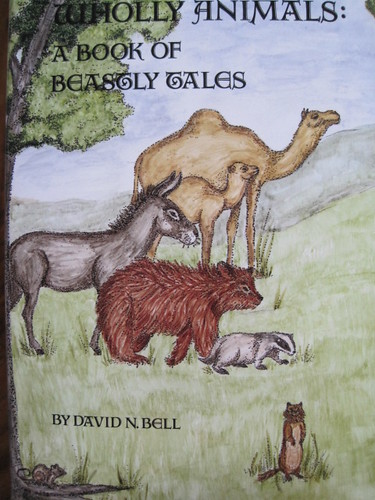 by KARL STEEL
Despite Bell's claims not to be writing an academic book, this anthology is a work of astonishing erudition, at least to this scholar, whose language skills fall well short of where he wants them: for Bell ecumenically collects and translates stories from the Latin, Greek, Coptic, Arabic, Yiddish, and perhaps from the Old Irish. Freed from the obligatory (and illusions of) objectivity imposed by the reasonable, scholarly pose, Bell lambastes the human species for its cruelty and stupidity, Bernard of Clairvaux for his overrated intellect and religious bigotry, crusaders for being "brutal, barbarian, crude, uncivilized, evil-living, savage, and blood-stained," but somehow--wonderfully--finds a place in his heart for the great Egyptian father Shenoute, who once beat an acolyte to death for violating a small monastic rule.
Shenoute's animal moment? He rebukes a camel for rejecting her foal and nurtures it himself. In this, at least, Shenoute models a non-anthropocentric stance towards the right, the law, and life, in which what matters is not species but proper behavior. Most of the other animals in Bell's anthology, however, are treated as animals, which is to say, as fundamentally of less value than humans. They are thus often servants, recalling--as David Salter stresses--the animal obedience in Eden or the peaceful kingdom promised in Isaiah's eschatology; or apt targets of charity, whose natural degradation before humans all the better sets off the saint's great love (we have, then, yet another reminder that charity impedes a structural critique of resource allocation and what Zizek terms "objective violence"); or thieves, having to suppress their appetites before human agriculture, criminal for eating fruit, grain, sheep, piglets, or animal skins (that is, parchment) territorially marked by humans; or, finally, pets, singularly loved in an act of what Cary Wolfe calls "exquisite bad faith." Animals hunted and sheltered, dragons rescued from Arthur's heroism, cows resurrected when stolen for a lord's table: these are resources in political boundary disputes, which is, as Dominic Alexander argues, how most stories of animals and saints should be understood.
But neither the human production of itself as human by degrading animal being, nor the animal as a chit in political struggles, nor the animal as a symbol in some political struggle are all that these animal stories offer us. Shenoute's story is sufficient evidence of that. As Bell remarks, a wicked animal or an animal that could be excommunicated is an animal with responsibility and choice, or indeed an animal belonging in some way to the community of believers.
And what of the animal characteristics, their merely bodily existence and their irrationality? A great many stories describe animals as behaving "as if" (presumably sicut in the Latin originals) they had human reason, which recalls the "aussi com" of the Wild Herdsman's suppliant, battered oxen. Barring animals from language by confining them to bodies capable only of inauthentically imitating reason is the paradigmatic act of carnophallogocentrism. Yet Bartholomew of Farne rescues a duckling whose mother begged help in her specifically anatine manner; Benedict of Nursia and a cawing, circling raven struggle to communicate with each other; and a thieving raven hopes for Cuthbert's forgiveness:
one of a pair returned and found the servant of Christ digging. Then, with its feathers lamentably ruffled and its head bowed down to its feet, with humble claws and using whatever signs it could, it begged forgiveness. The venerable father understood this and gave it permission to come back.By speaking with and through their bodies, these animals rebuke the carnophallogocentric (or indeed the outmoded AI) conceit that authentic language and community require disembodiment. This, far more than the charitable resurrection of animals--that, at any rate, will eventually die again, abandoned as immortal humans ascend to paradise or descend to hell--and far more than the frequent condemnation of carnivores for eating what they must, challenges the disembodiment sought after by Western metaphysics and the regime of the human this quest sustains. In an anthology assembled by a scholar himself so emotionally and bodily present to us (he complains, for example, of being unable to excommunicate pests from his garden), this may be the proper, best lesson.
On Celts and Celticness
by J J Cohen
I've taught and used the work of Simon James in the past. His challenge to rethinking prehistory is vigorous. James argues that the Celts are a modern invention, and that by projecting their supposed unity back upon the Iron Age we flatten prehistory so that it supports current identities. He writes of his own approach:
I've taught and used the work of Simon James in the past. His challenge to rethinking prehistory is vigorous. James argues that the Celts are a modern invention, and that by projecting their supposed unity back upon the Iron Age we flatten prehistory so that it supports current identities. He writes of his own approach:
The roots of the new approach are to be found, I believe, in the post-colonial emphasis on multiculturalism, and the celebration of difference between cultures. This makes it possible to consider the Iron Age peoples of Britain, for instance, not as generic Celts, but as a mosaic of distinct societies, each with their own traditions and histories.(You can see what James's approach has in common with the "Acts of Separation" chapter of Hybridity, Identity and Monstrosity as well as the "Infinite Realms" section of Cultural Diversity in the British Middle Ages). The quotation reproduced above is from his fascinating website, which gives an overview of the conventional history of the Celts as well as his own archaeologist's take on that history. I found it via
Robin Hood and Friar Tuck: Zombie Killers, or, The Monk's Second Tale
by J J Cohen
Chaucer travels. Not just into Farsi, not just into the present, not just into the apocalypse, but now into zombie fiction. From my morning email:
Chaucer travels. Not just into Farsi, not just into the present, not just into the apocalypse, but now into zombie fiction. From my morning email:
Dear Jeffrey Cohen
I’m Paul A. Freeman, a British writer, and I’m working on a ‘new’ Canterbury Tales project. My aim is to promote interest in Chaucer amongst both students and scholars of ‘The Father of English Poetry’.
My work chronicles the pilgrims’ return journey from Canterbury, and so far I’ve completed seven Tales, all in different genres, and varying in topic from fable to chick lit to crime / mystery.
‘The Monk’s Second Tale’, a horror ‘Canterbury Tale’, was published by Coscom Entertainment (a publisher of zombie horror) in November last year. It is currently being marketed to horror fans under the title ‘Robin Hood and Friar Tuck: Zombie Killers – A Canterbury Tale by Paul A. Freeman’:
The three ‘Canterbury Tales’ pages of my website, beginning with www.paulfreeman.weebly.com/canterbury-tales-1.html give details of my Chaucer project, as well as including excerpts from the ‘return leg’ tales of the Squire, the Shipman, the Wife of Bath, the Doctor of Physic, the Knight, the Miller and the Monk. By glancing through these excerpts, you’ll discover that my ‘Canterbury Tales’ project is a serious undertaking.
Please feel free to share my website with your students (especially the ones more reluctant to tackle Chaucer), other Chaucerians, and anyone else you feel may enjoy or benefit from it. If you feel that your university / college library might wish to stock a copy or two of ‘Robin Hood and Friar Tuck: Zombie Killers – A Canterbury Tale by Paul A. Freeman’, please feel free share this email with your librarians.
The goal of my project is to make Chaucer’s Canterbury Tales universally accessible, and to again popularize the tradition of storytelling through narrative poetry.
‘The Monk’s Second Tale’ is already available from Coscom Entertainment through Amazon, and at the end of the year my ‘Miller’s Second Tale’ will be published in an anthology of neo-medieval creative writing by Brepols Publishers, an academic publishing house based in Belgium.
I look forward to hearing from you, and hope you or some of your students will be encouraged to consider ordering ‘The Monk’s Second Tale’, aka ‘Robin Hood and Friar Tuck: Zombie Killers – A Canterbury Tale by Paul A. Freeman’.
All the Chaucerian best

Paul A. Freeman (www.paulfreeman.weebly.com)
Thursday, January 21, 2010
3 items involving David Wallace
by J J Cohen
- David Wallace was kind enough to send me an offprint of his recent article "Problematics of European Literary History, 1348-1400," just out in The Construction of Textual Identity in Medieval and Early Modern Literature, ed. Indira Ghose and Denis Renevey. Those of you who read the GW MEMSI blog may remember that he gave a version of the piece as a talk here in DC last year. The essay is a challenging meditation on thinking literary history outside the constraints of nation, proposing an itinerary-based approach. Well worth checking out. There is a marvelous website in progress for the project here on which the journeys may be plotted and the stopping points mapped. The Guggenheim Foundation has supported this ongoing, massive project through a grant.
- I'd left the offprint of David's essay on the dining room table and found my twelve year old son reading it as he ate his morning bowl of cereal. "I have nothing to read!" he stated, giving me an accusing look for not having purchased more novels from the Dragonlance series for him. "Look what I'm reduced to!" Before I could formulate a smart reply, he did add, "It's pretty good, actually."
- David also sent me the news that Prof. Alireza Mahdipour of Urmia University in Iran has translated some of Chaucer's Canterbury Tales into Farsi. They have been published by Cheshmeh Publishers of Tehran. Professor Mahdipour writes that they are "in two volumes of bilingual edition, and in verse form, Mathnavi, which is nearer to heroic couplet." Fascinating how Chaucer travels. I have PDFs of some of these translations; please email me if you would like to see them.
Wednesday, January 20, 2010
You should go to Berlin

I'll be there. So will Roderick Ferguson, Judith Halberstam, José Esteban Muñoz and Susan Stryker. You should come too.
It's not a medievalist conference, but it is a conference in need of medievalists. Aren't we all about affect, space and temporality?
CFP is below.
--------------
Queer Again? Power, Politics and Ethics
23.-25. September 2010
International Conference of the Department of English and American Studies and the
Research Training Group “Gender as a Category of Knowledge”
Research Training Group “Gender as a Category of Knowledge”
The concept of queer is volatile and, at times, difficult to grasp. As a result, we need a continuous review of the fields and debates within Queer Theory. In his 2004 study No Future: Queer Theory and the Death Drive, Lee Edelman manoeuvred queer theory into a kind of aporia and thus deep crisis that persists to this day. Subscription to an “ethics of futility”, as Edelman suggests, signals that the borders of ethical thinking have been reached. However, in debates following the publication of Edelman’s book (as for instance, in the Social Text issue of 2005 with the programmatic title What’s Queer About Queer Studies Now?) the ethical impetus of queer criticism confronted and challenged the dominance of the so-called antisocial thesis. This ongoing debate and the regular recurrence of the antisocial thesis in its different manifestations reveals a pressing need to reflect anew the relationship between queer and theory, art, ethics, and politics.
Taking this as a starting point for the conference, we want to take up the iterative moment that seems inherent in the concept of queer: queer is regularly in a state of crisis that needs to be made productive, and in this way it can be continuously reworked and reshaped. We want to provide a space to further the debate about sexuality and gender and their multiple interconnections in fields of power.
The panels will be organised along two thematic strands. The first, Affect, Space and Temporality, is concerned with the ethical and political potential of queer and the different political conceptions of queer that arise as a result.
Possible topics to be addressed include:
- queer strategies and practices in art/visual culture and literature
- conditions and possibilities of political activism
- normativity, citizenship and recognition
- queer utopias/imagination
- political and ethical implications of sexual dissidence
- rethinking concepts of temporality and space, generation or community
- varying meanings of queer in different geographical and temporal contexts
The second strand, Limits and Boundary Crossings, takes up current theoretical debates with regard to disciplinary and other boundaries and crossings of these boundaries.
Possible questions to be discussed include:
- Which limits and/or transgressions of these limits occur when different theoretical fields interact (e.g. queer theory and transgender theory or postcolonial theory or crip theory/disability studies)?
- What are the limitations of queer? What are the inclusions and queer produces in specific contexts that demand new critical/queer interventions?
- How can queer theory be situated in current academic and activist spheres?
- What does the focus on interdependent relationships (of sexuality, gender, race, ethnicity, class, age, (dis)ability etc.) mean for the formation of a queer ethics?
Keynote speakers include
Jeffrey Jerome Cohen,
Roderick Ferguson,
Judith Halberstam,
José Esteban Muñoz
and Susan Stryker.
We invite abstracts for 20-minute papers. Abstracts should be in English and not exceed 500 words. They should be accompanied by a short biographical sketch of about 250 words and sent to queer.conference[at]hu-berlin.de by March 31st 2010.
The conference language will be English. The conference location is wheelchair accessible. We will try to provide sign language interpreters as well as child care in case of need. We kindly ask participants to let us know about applicable requirements or other special needs by April 30th 2010.
Please note that travel funds can only be granted in exceptional cases and we ask participants to apply in time for travel funding at their home institutions.
Contact:
queer.conference[at]hu-berlin.de
Organisation:
| Eveline Kilian | Maja Figge | Vojin Saša Vukadinovic |
| Jens Borcherding | Elahe Haschemi Yekani | |
| Adrian De Silva | Beatrice Michaelis |
What Not to Wear ... on Crusade
by J J Cohen
I am slowly working my way, again, through William of Newburgh's Historia rerum Anglicarum [History of English Affairs]. I kind of have a big lecture on Billy Newby (as I call him) looming, and I haven't quite written it yet. William is part of the great 12th century efflorescence of history writing in England. He's quite thorough, occassionally wacky, sometimes dyspeptic. His Latin is usually straightforward, too: most of his poetry tends to be accidental.
My main focus is on William's narration of the massacre in York in 1190, but I want to read that narrative within the larger frame of how he treats his assorted cultural others: Turks, Scots, the Welsh, the Irish, Eastern Christians, rustics/pagans, alien intruders from Other Worlds.
Right now I'm on the Henry II portion of the History, the section with the widest geographical ambit. When Jerusalem becomes the possession of Saladin, Pope Gregory VIII calls for crusade via an epistle making some familiar promises. All those who die will zoom right to heaven; personal property of crusaders will be protected until return or death; crusaders are released from all usurious obligations; and so on. The usual stuff. Gregory ends his epistle, though, by noting that crusaders may not bring dogs or birds with them, nor "wear precious raiment." This is a penitence parade, he stresses, not a demonstration of "vain glory." The kings of France and England are more explicit in the letter they circulate to drum up support, noting for those who sign up:
I am slowly working my way, again, through William of Newburgh's Historia rerum Anglicarum [History of English Affairs]. I kind of have a big lecture on Billy Newby (as I call him) looming, and I haven't quite written it yet. William is part of the great 12th century efflorescence of history writing in England. He's quite thorough, occassionally wacky, sometimes dyspeptic. His Latin is usually straightforward, too: most of his poetry tends to be accidental.
My main focus is on William's narration of the massacre in York in 1190, but I want to read that narrative within the larger frame of how he treats his assorted cultural others: Turks, Scots, the Welsh, the Irish, Eastern Christians, rustics/pagans, alien intruders from Other Worlds.
Right now I'm on the Henry II portion of the History, the section with the widest geographical ambit. When Jerusalem becomes the possession of Saladin, Pope Gregory VIII calls for crusade via an epistle making some familiar promises. All those who die will zoom right to heaven; personal property of crusaders will be protected until return or death; crusaders are released from all usurious obligations; and so on. The usual stuff. Gregory ends his epistle, though, by noting that crusaders may not bring dogs or birds with them, nor "wear precious raiment." This is a penitence parade, he stresses, not a demonstration of "vain glory." The kings of France and England are more explicit in the letter they circulate to drum up support, noting for those who sign up:
It is ordained that no man shall swear great oaths, and that no man shall play at hazard or dice, and that no man shall wear minever [stoat fur], or vair [dyed squirrel fur], or sable [marten fur], or scarlet ... and that no man shall take any woman with him on this pilgrimage, excepting a laundress, who goes on foot, and of whom no suspicion can be entertained; and that no man have clothes that are slashed or laced. (3.23)As I read the passage several thoughts occurred to me:
- Interesting that regulation of crusader bodies focuses so much on the sartorial.
- These directives reveal their class bias (only nobility would have the possibility of bringing sumptuous furs like these; what about the ordinary people who would have been the majority of the army? Do they bring everyday dress? Are they simply below notice?).
- It seems to be unthinkable that men might clean their own clothing.
- The poor laundresses, trudging on foot and resting only to wash sweaty haberdashery.
- At least these stinky garments don't require the special care of, say, fluffing up the squirrel fur, combing the martin skins, or pressing all the slashes so they won't look so crumply.
Saturday, January 16, 2010
Medieval Sex: A Syllabus
 by EILEEN JOY
"How is it that in a society like ours, sexuality is not simply a means of reproducing the species, the family, the individual? Not simply a means to obtain pleasure and enjoyment? How has sexuality come to be considered the privileged place where our deepest 'truth' is read and expressed? For that is the essential fact: since Christianity, the Western world has never ceased saying, To know who you are, know what your sexuality is. Sex has always been the forum where both the future of our species and our 'truth' as human subjects are decided." (Michel Foucault, 1977 interview)
This semester I am wading into new territory, teaching-wise, with an M.A.-level seminar on sex and sexuality in the Middle Ages. Although I have, for a while now, been doing an awful lot of reading and research in contemporary queer and critical sexuality studies and some reading in critical medieval sexuality studies [primarily, Carolyn Dinshaw, Glenn Burger, Anna Klosowska, Karma Lochrie, James Schultz, Cary Howie, Michael Camille, Jeffrey, Clare Lees, Lara Farina, Tison Pugh], when doing further research for this syllabus, I realized how much scholarship I am not familiar with, and so, this seminar will partly be a crash course in the subject for myself as well as for my students. The syllabus was both fun but also frustrating to put together--for example, why do we not have more scholarship on sex and sexuality in the lais of Marie de France? But then again, what might be missing on my syllabus that I simply don't know about? I've tried to cover different cultural traditions [Anglo-Saxon, Anglo-Norman, French, and German] and I've left things out, like Heloise and Abelard, which I am sure many will find strange [but as the Ur-couple of the Middle Ages, they also seem, in my mind, to be "done to death" on syllabi such as these], and also Roman de la rose [partly because I am just not prepared this semester to teach too many texts that would be too new for me]. It was difficult to decide which Chaucer tales to include--the "Wife of Bath's Prologue" and "Tale" is the obvious pick, and I did include her, but I have also included the "Man of Law's Tale" as that makes a nice parallel story with the Old English translation of "Apollonius of Tyre," which is where I begin the course. Overall, the the syllabus felt unwieldy to me [and I did a lot of cutting, in the end, that pained me, but I have to be realistic about how much students can read in a week, of course], partly because I am trying to offer "samplings" of four inter-related things, as it were, in this seminar: 1) how sex and sexuality are treated in medieval texts (literary and otherwise), in both "official" and more subversive registers; 2) how sex and sexuality in the Middle Ages are analyzed in contemporary medieval scholarship; 3) how sex and sexuality are historicized in contemporary critical sexuality studies; and 4) how sexuality and sexual identity have been taken up by some contemporary artists [in ways that highlight the complex inter-relations of past and present], such as in the films of Lars von Trier and Pedro Almodovar and also in Jeffrey Eugenides's novel Middlesex. I'm likely trying to do too much, but I thought I would share the syllabus here with everyone, and any critical comments you might have for me would be greatly appreciated. Have I overlooked something important or interesting, either primary or secondary text-wise? [Since I'll teach this course again, I'll be more than happy to make major adjustments to the syllabus next time I offer it.] I'm including here, also, a link to the working bibliography for the course, and if there's something I've not included there that you think is important, please let me know and I'll add it.
ENG505 Seminar in Medieval Literature: Medieval Sex
ENG505 Seminar in Medieval Literature: Working Bibliography
Subscribe to:
Posts (Atom)