Wednesday, August 11, 2010

More thoughts about the MAA in AZ, or why I'm not quitting

by J J Cohen

The topic of the Medieval Academy of America holding its annual meeting in Tempe, Arizona, has been well covered here at ITM. You'll also find eloquent pieces about the controversy at Blogenspiel and Quod She. When the decision was announced, I composed as measured a reaction as I could for IHE (but was unable to email it in time for their deadline). It ran simply:
While I am pleased that the MAA deliberated over the possibility of canceling the meeting, I am personally disappointed at both the decision to hold the conference in Arizona and the email that was distributed to announce that decision. Although the email mentioned fiduciary responsibility, membership opinions, and so forth, at no point did it state why a large percentage of the MAA membership is distressed at holding the meeting in Arizona: that the law passed by the legislature is racist and wrong. The MAA email was careful, it was factual, and it lacked moral courage.

Not everyone will agree with me that a professional organization should take a political stand, but for me this is a straightforward question of ethics. I won't cancel my membership in the MAA, because I'd like to see the organization change. But I am embarrassed that the leadership of this association that is supposed to represent me apparently does not feel the outrage that the Arizona situation demands.
Yesterday the MAA emailed an updated call for papers for the Tempe conference. The letter opens with these lines:
As you probably know, the fate of the annual meeting of the Medieval Academy of America for 2011, scheduled to be held in Arizona, was in question because of Arizona's recently passed immigration law, SB1070, which many across the country found to be morally and legally deeply flawed.  On August 3, the Executive Committee of the Academy voted to hold the meeting as planned for reasons that the Committee explained in the statement posted on the Academy's website.  Because of this decision, we are extending the deadline for submissions of papers to October 15.  The Executive Committee and the local Program Committee are working to ensure that the program of the meeting reflects and relates to similar issues at stake in Arizona and in medieval society, including such topics as race, ethnicity, immigration, tolerance, treatment of minority groups, protest against governmental policies judged unjust, and standards of judicial and legislative morality. 
I suspect this email did not change any minds among those who are angry with the tone and content of the initial MAA announcement -- an email that, as I pointed out, made no reference to the reason why so many of us do not want the conference held in the state. The CFP does acknowledge those reasons ("immigration law, SB1070, which many across the country found to be morally and legally deeply flawed") while itself remaining noncommittal about the moral and legal status of that law. The email doesn't give wide enough context (many of us also object to the legislature's animus towards ethnic studies, an intolerable intrusion into academic freedom), the CFP doesn't render a judgment, it just states that many people take issue with the legislation.

Would I prefer that the MAA label and condemn racism for what it is? Yes. But I do appreciate that we have in this second email something about the moral flaws of SB1070. I am grateful for the next sentence, stating straightforwardly that "the local Program Committee are working to ensure that the program of the meeting reflects and relates to similar issues at stake in Arizona and in medieval society" and listing the very issues that many of us have been speaking about in relation to the AZ meeting ("race, ethnicity, immigration, tolerance, treatment of minority groups, protest against governmental policies judged unjust, and standards of judicial and legislative morality"). Those last two phrases strike me as apt and well formulated, even if -- again -- they are ultimately noncommittal about what is actually unfolding in the state. There is something here that needs to be acknowledged, evidence that the MAA leadership is in fact listening to the discussion that has unfolded and reacting in a way that makes such audition evident.

No, the CFP email still isn't what I want. Not nearly so. It is tempting to condemn the MAA reaction to the controversy and declare, OK, that is it for the MAA and me. We're through. Yet what has been evident to me throughout this controversy's unfolding is that the Executive Committee is riven, that there has been a decision but not unanimity, that clearly some committee members have no intention of setting foot at the conference itself. In other words, I'm not yet ready to give up on the MAA even if I am profoundly disappointed with some of the choices and statements that have been made.

Don't get me wrong: I am not stating that all is well and that having the MAA in AZ is fine. I believe as strongly as ever that the meeting ought to have been moved to another state in order to protest Arizona's unjust and racist legislative acts. I believe that no person is illegal; that ethnic studies are of great value; that a disgusting amount of xenophobia is patent in the immigration and "who gets to belong" debate.

I'll provide something personal, but I want to emphasize that this issue isn't merely a personal one for me. The demonizing of Hispanic peoples reminds me in a chilling way of how my own Jewish and Irish ancestors were spoken of, and why they fled to this country in the last century, and what they experienced once they arrived. Racist contempt must never be made licit. I do not want what is happening in Arizona to be revealed in hindsight to have been our American Kristallnacht (you will say that is over the top, we're not there yet, the challenges are too deep and passionate; I want it to always seem that way). I want my kids, my students, anyone younger than me to live in a better world than the one we now inhabit. Immigration is not the problem, and dreaming a purified police state is not the solution. The problem is global poverty, and its patent if extraordinarily difficult solution is through alliances and cooperation that reach beyond the pettiness of our own self interests, beyond the mere borders of nations.

So, yes, to me in this case the MAA failed. But they did not fail by wholly closing down and refusing to listen to their membership: I do believe that the open letter was taken seriously, even if the decision to hold the meeting was not in accord with its spirit. To be honest, the letter has been honored quite literally: we who signed it did not demand that Arizona be boycotted, but that moving the conference be seriously considered outside of financial concerns, and that panels focused upon the issues at stake be added to the program no matter where the meeting was held. We got some of what we were looking for. It isn't enough, for me. But I'm not resigning from the MAA.

There's too much work to be done.

Tuesday, August 10, 2010

Medievalists di moda: Fashionline Siena

by J J Cohen

The Cohen family is back, at least for a week, from their peregrinations round the Atlantic and into the Mediterranean. I hope to post something of some substance about the MAA and AZ when jet lag abates, but meanwhile: for your entertainment, a guest post written by someone who saw you and judged you at NCS Siena. Ah, Italy, land of fashion and elegance. Just look at these two movie star quality medievalists resplendent in the sun of San Gimignano. We can't all be Stephanie Trigg and Myra Seaman, but now don't you wish that your socks had at least matched, that you'd pressed that shirt, that the pasta splotch on your shoulder hadn't been quite so visible? I know I do.

I've sworn to keep our guest poster anonymous due to fear of reprisal, but before you start believing that it was me let me point out my numerous faux pas in Siena, including the wearing of a plaid shirt (albeit a crisp purple one) and a T shirt (albeit one with an alchemical equation upon it). Also my wearing of shorts was an attempt to instigate a Sexy Legged Medievalist Contest, not a symptom of the heat.

Without further ado ...

--------------

Fashionline Siena
by Gloria Lechelle

NCS Siena, 15-20 July 2010, was possibly the most stylish conference for medievalists in recent memory. (Lamentably, putting “stylish” and “medievalist” in the same sentence has been an oxymoron of late.) The exquisite Italian setting, fabulous cuisine, and enticing shops were unparalleled. Medievalists arrived in droves each evening on Il Campo, in places like the Palio Bar, where people-watching (and being watched) became a spectator sport. As the nights lingered on, more and more of the Sienese came out to enjoy the cool temperatures. Their footwear, among other features of their attire, made the confusion between natives and i turisti absolutely impossible. But against this background, it soon became unavoidable to notice the more stylish, more fashionably savvy members of the NCS—as well as some of our more fashion-challenged colleagues. It is our hope that the Siena conference will set some trends and raise the bar, even, for all medievalists, who appear (from reports from Kalamazoo) to have become too comfortably frumpy in their apparel of late.
 
Here we offer the TOP TEN highlights from NCS Siena in the hopes that future Congresses may see something of a fashion renovatio:

7-10: The baseline of style was kept by a strong showing in crisp linen: George Edmondson, Claire Waters, Jeffrey Cohen, and David Lawton always looked cool, crisp, and un-crumpled, even at the end of the day. Cohen gets extra points too for wearing shorts in a never unprofessional way. Well done.

6: Sarah Kay—we all lamented Sarah’s absence from the closing plenary, where we also missed her neat skirts and fun blouses, a chic French style not to be daunted by the Siense heat.

5: Matthew Goldie—made me reconsider my rule against t-shirts at the closing banquet. A neat, plain black shirt, coupled with pale pink trousers took Villa-banquet style to new places. Points for originality without sacrificing neatness.

4: Ruth Evans—knows how to ACCESORIZE. Famous for her shoes (showcased on her Facebook page), Ruth never lets us forget medievalists have style too. She’d regularly be misrecognized as a Romance language scholar at the MLA Convention. We love her for keeping us on our toes.

3: Cord Whitaker—did anyone miss Cord’s white slip on shoes, his white collared and cuffed shirts or those cuff links sported in Siena? Well, if so, you just weren’t paying attention (and I don’t want to know what you were wearing)! Freshly pressed every day from breakfast to dinner, Cord has set a new style trend for NCS men. One can only hope for imitators.

2: Kellie Robertson—Whether on her own or en famille, Kellie gives classic style a new twist, adding vintage accessories to a plain, neat linen trouser and blouse. Never with a hair out of place, Kellie looked as comfortable on the podium as on Il Campo.

1: As is only fitting, our new NCS President once again shows herself off as an NCS trendsetter. With as many smart dresses as there were days in the sun, Carolyn Dinshaw made her mark as she splashed fashion sense all over the NCS presidency. We can only hope to see the entirety of the next congress in such sophisticated attire. It can only reflect well on our collective self-possession.

Some trends to avoid were also observed. Here are some fashion lessons to take to our next congress:

1. Men certainly have a harder time in the heat. No cute sundress is going to get them through Italy neatly. Matthew Goldie not withstanding, t-shirts were a big no-no. It’s hard to be taken seriously when you are wearing what looks like sleepwear.

2. Plaid is almost universally deadly unless monochromatic (and generally very small), so as not to look like plaid. This is a fashion faux-pas to be avoided at all costs, particularly if it’s crinkly. Never to be worn by women. NEVER.

3. Cargo anything is OUT. It’s hard to look neat, chic, or serious if you are covered in pockets. Worse if anything is actually in those pockets! Neatness gives way to saggy. Best to avoid entirely.

4. Black. Too hot in the heat, too severe for the day, black can be worn only by the young and really, only at night. Lighter colors worked much better, especially against pale skins accustomed to much work in dimly-lit libraries and unaccustomed to the Tuscan sun. And finally, nothing really beats some nice navy linen pants—as Kellie showed. Never underestimate the value of a good blue (or grey) suit.

Monday, August 09, 2010

Speculative Medievalisms: A Laboratory-Atelier @ King's College London: PROGRAM NOW ONLINE

Figure 1. Opicinus de Canistris (1296–ca. 1354), Diagram with Zodiac Symbols, folio 24r, Avignon, France, 1335–50 (Biblioteca Apostolica Vaticana, Vatican City, Pal. Lat. 1993)

by EILEEN JOY

Enter the speculative metaphysics of the philosophers , Quentin Meillasoux, Graham Harman, and Ray Braisser, and also the speculative turn that a post-human literary history might take, following the passage of things themselves through human discourse, charting the networks or associations that form as things travel from hand to hand, in and out of texts, between and among different spheres of reference, describing a kind of Brownian motion of persons and things, each remaking the other as they are put to use, reanimating aesthetics as a contact zone in which the presence of things is understood to manifest via the installed thoughts and feelings of their human screens.
--Julian Yates, “It's (for) You; or, The Tele-t/r/opical Post-Human,” postmedieval: a journal of medieval cultural studies 1.1/2 (Spring/Summer 2010)

I'm thrilled to announce that the first event in the newly-unveiled SPECULATIVE MEDIEVALISMS project [a co-production of Urbanomic, the BABEL Working Group, and the Petropunk Collective: Nicola Masciandaro, Michael O'Rourke, Anna Klosowska, and Eileen Joy], "Speculative Medievalisms: A Laboratory-Atelier," will be held at the Anatomy Theatre & Museum @ King's College London on Friday, 14 January 2011, and the full program schedule [with links to .pdfs of "specimen" papers] can be found here:

Speculative Medievalisms: A Laboratory-Atelier

The background to and vision statement for the project can be found HERE. And you can follow us on Facebook HERE. We will have a registration page up and running by the end of August for those who are interested in attending the event.

Stay tuned for a second "mirror" event, still to be scheduled in New York City in Fall 2011, and featuring Graham Harman, Kellie Robertson, Jeffrey Cohen, and others.

Saturday, August 07, 2010

The Plateau of the Middle and the New Irrationalists: Get Ready for the Confraternity of Neoflagellants

Figure 1. Ewan Sinclair and Emma Tolmie, Modified Knights: Crusaders of the Cosmic Forge (AVALON Exhibit, Edinburgh, 2010)

by EILEEN JOY

Our pasts live in us now; we cannot address the historicity of our present moment without understanding the pastness in that historicity, the deadness in our living, the ineluctable retrospection of our desire, just as "our" past is not ours, but was inevitably also the past of others. . . . No engagement of otherness will preserve either the subject or the other in an identity which should already have been theorized as unstable in the first place; but by that very token, we know, precisely, that the other "has been" encountered. Of this we can be sure; indeed it is a species of arrogance to think otherwise. . . . Insofar as history is always and inevitably retrospectively constituted, insofar as the work of signification is inseparable from memory and desire, insofar as the passional and the technical coincide in the register of our jouissance, we could not, even if we wanted to, stop creating, or more properly re-creating, new prostheses of memory.
--L. Aranye Fradenburg, " 'So That We May Speak of Them': Enjoying the Middle Ages"

Not too long ago, I was contacted by Norman James Hogg [recent M.A. in Visual Culture, Univ. of Edinburgh], Simon O'Sullivan [Senior Lecturer in the Dept. of Visual Cultures at Goldsmiths, Univ. of London], and Neil Mulholland [Assoc. Head, School of Art, Univ. of Edinburgh], who have recently created a visual artists collective, "The Confraternity of Neoflagellants" [as their own literature puts it: "The Confraternity of Neoflagellants was founded in 2009 by Serjeant-At-Law Norman Hogg and joined by Keeper of the Wardrobe Neil Mulholland. It is a secular and equal opportunities confraternity bound by chirograph."]. They have a dead-serious [and delightfully ludic] set of interests in investigating neomedievalisms and what they call "premodern futures." As Neil puts it on his Academia.edu website:
"The relentless association, from the Renaissance onwards, of the Middle Ages with the ‘hypereconomy’ of the gift, with whatever exceeds calculation or rationality, for good or for ill, has made the Middle Ages a marker of fantasy and excess." The Confraternity of Neoflagellants are lay peoples dedicated to the ascetic application, dissemination and treatment of neomedievalism in contemporary culture. They are attuned to the scent of medieval analogies relating to the (creative) commons, the folkmote/folksonomy, the plateau of middle, post-post-industrialism (Goth, silvercasting, experience economies) and to geopolitical debates in the current era of ‘zombie capitalism’ and the ‘new irrationalism’.

Our premodern futures have particular resonance with what Howard Rheingold once prophesied as ‘the virtual community’. The Confraternity want to make these connections explicit by engaging with online culture both in the content of the work we are examining (which includes ambient technoculture and the ludic spaces of video gaming) and in the form that it manifests itself.
They recently staged an art installation @ Embassy Gallery, Roxy Art House, in Edinburgh, "Avalon," which ran under an epigraph from Aranye Fradenburg [the first sentence/quotation in the two quoted paragraphs above], and you can see images from that installation HERE and HERE [also: click on the poster at left to read the fine print and note the resonances between many subjects dear to ITM and the Confraternity!]. As the Confraternity describes the exhibit:
‘Avalon’ is the first curatorial investigation into premodern futurity by The Confraternity of Neoflagellants – lay peoples dedicated to the ascetic application, dissemination and treatment of neomedievalism in contemporary culture. Borne of the ‘new irrationalism’ of ‘zombie capitalism’, they are attuned to the scent of medieval in the creative commons, in the folkmote, and the plateau of middle in the unbundled territory of post-post-industrialism.

Neomedievalism embraces the spectral traces or ‘uncertain knowledges’ of its historical past as part of an ever-morphing, force-feedback simulation, (or permanent rehearsal) of coming events. The longing for a future assembled from a bricolage of pre-modern components embeds itself deeper with every advance in the technologies of representation. The fantasy must become ever closer to reality.
Now, this weekend, as part of the 2010 Edinburgh Art Festival Expo Commission, they are staging a Zombie Walk and reception, tonight, August 7th:

This involves a mash-up of Robert Burns' Tam O'Shanter, The Party (starring Peter Sellers) (1968), Night of the Living Dead (1985) and The Fall's Live at the Witch Trials (1979). A secret party is being held in the honour of Edinburgh's 'ghosts', the living dead who wear historical costume for their work.

At 11:00pm this Confraternity of Neoflagellants will assemble at the Scott Monument and walk through the City of Edinburgh, arriving at an undisclosed location before the midnight hour. Once there, they will cross the Styx to a wake. The after party will feature music and DJ sets as well as projections by artists currently exhibiting in 'Avalon' at The Embassy gallery in the Roxy Art House, Edinburgh.

On this coming Monday, August 9th, there will be a 1-day symposium on "Investigating Premodern Futures," and Bettina Bildhauer [Univ. of St Andrews] will be there, representing the BABEL Working Group and postmedieval, and presenting on the panel, "Return of the Long Now." You can see the whole program by following the link above. The main event of the day will be a featured talk by Howard Rheingold, the author of Smart Mobs (2002), among many many other publications.

I'll be sending a BABEL/postmedieval "post-card," via podcast, for the symposium, if I can get my act together later today or tomorrow. And here is hoping to a BABEL/postmedieval/Confraternity mash-up in the near future. Cheers to everyone in Edinburgh. Thank you for your playfulness, your provocations, your neomedievalisms, and your artistry!

Friday, August 06, 2010

Nineteenth Century Studies Association Writes Better Letters

by EILEEN JOY

In relation to my recent post "Regarding My Dismay with the Medieval Academy of America," it might interest some to know that the Nineteenth-Century Studies Association [NCSA] also had to recently ponder moving its annual meeting out of Tempe, and they did so [they will be meeting in Sante Fe, NM instead], and not without some of the same deliberative pains undergone by the MAA. In the final analysis, they write a better letter explaining why:

A Message From the President of the NCSA

My thanks to Maria Bachman (Coastal Carolina Univ.), Newsletter Editor for the NCSA and a great friend and colleague, for bringing this to my attention.

Thursday, August 05, 2010

Regarding My Dismay with the Medieval Academy of America

by EILEEN JOY

So, somewhat atypically for me, the further away I get from the announcement by the Medieval Academy of America regarding their decision to keep their annual meeting in Tempe, Arizona next spring, the more upset I feel I am becoming. More typically, my initial reaction to particular events, issues, etc. is to overreact, and then I calm down, listen to what other people have to say, and bit my bit, I modify and temper my initial reaction [while hopefully having some principles I don't want to nor will compromise--I do believe there are such things, and every now and then, real bodies and minds are at stake in relation to the principles we are willing to articulate and try to put into material practice, or not].

The more I re-read the MAA letter, the more its [painfully neutral] tone and refusal to address or even acknowledge the actual ethical and political concerns at stake really just . . . saddens me. First, before saying anything else, I want to thank John Sebastian for commenting on the IHE article and explaining how he himself, as one in the 46% majority of MAA members who voted not to move the meeting, made his decision and why he felt actually going to Arizona would do more good than staying out of Arizona. He also wanted us to [I think] not vilify out of hand those MAA members who voted to stay in Arizona nor paint them all with the same ideological brush. Fair enough. But I've given this a lot of thought, and if we hesitate to condemn, or to strongly disagree with, this decision of the MAA's on the principle that there are members of the MAA who are good and decent [and heterogeneously opinionated] people and brilliant, admirable scholars, then we'll all just have to shut up and go home. No one--least of all me--means to impugn the persons of the membership of the MAA in the 46% majority nor in the executive leadership of the organization. But do I condemn the final decision and am I dismayed by the rhetoric and palpable silences of the letter? Yes, I do, and I am. It strikes me as somewhat stunning that the letter itself indicates a certain level of discomfort with the "appropriateness [or lack thereof] of making collective political statements," and then, by democratic default, they made one--and a disappointing one at that--anyway. Because refusing to make a statement is a statement, and I learned that from history.

Second, before continuing, I want to also address Aunt Pansy's comment in the ITM post "Medieval Academy--Yes on Tempe" that "it seems rather churlish to condemn the prose of a committee working by email." I do not think it is churlish to critique and call into question the prose of a committee made up of specialists in literary and historical studies and who communicate via writing and speech for a living. The situation called for a delicate, well-worded [and one could hope, ethically-engaged] response, and we had a right to expect that from our esteemed colleagues, whose work and thought and writing we have long admired. In a situation such as this one, I should not have to guess at the motives--scholarly, political, ethical, or otherwise--behind such a letter. I should be able to expect, and I did expect, a clear, articulate explanation, or rationale, for the final decision that would pay sensitive heed to the ethical qualms involved on the part of the whole MAA membership [pro- and con-staying in Arizona]. I expect the finest writing imaginable from those who teach writing and practice it for a living. I expect as well a deep, humane attention to the very vulnerably human [and even post-human] aspects of the situation in Arizona [to those who are most vulnerable, there and elsewhere] from those who till daily in this field we call the humanities and who pride themselves on their historical erudition. Yes, I expect that.

This morning I awoke with something else in the letter [that I didn't really pay too much attention to yesterday] really nettling me--to whit, that the MAA and the Programming Committee at the Arizona Center for Medieval and Renaissance Studies would work
to ensure that the program of the meeting reflects and relates to similar issues at stake in medieval society, including such topics as race, ethnicity, immigration, tolerance, treatment of minority groups, protest against governmental policies judged unjust, and standards of judicial and legislative morality.
While I know many are and will be pleased that the the program of the MAA meeting in Tempe will work to ensure that its sessions reflect "similar issues at stake," the key phrase here is "in medieval society." I will be accused of churlish nit-picking [and so be it], but it seems that, just as with its laundry list of the "wide range of issues" that the MAA stated affected its final decision, they seem to be at pains here to assert their purview [scholarly, ethical, and otherwise] as being limited to the so-called Middle Ages themselves, or more generally, to "medieval society," and however cautiously phrased, an artificial line separating the past from the present is ever so carefully re-placed. My hope for this meeting, now that it will go forward as planned, is that some of the papers submitted and accepted for presentation will acknowledge and elucidate that there is no neat line [temporal or otherwise] separating the past from the present, and that what is happening in Arizona now, legal proposition- and otherwise [vis-a-vis "illegal" immigration, racial profiling, labor, the so-called drug wars, etc.], is one of many outcomes of all of the ways in which our deepest pasts [medieval and otherwise] continue to structure and haunt the present, and in various, often uncanny ways. As Aranye Fradenburg put it in her recent essay, "(Dis)continuity: A History of Dreaming" [contributed to Elizabeth Scala's and Sylvia Frederico's The Post-Historical Middle Ages], more eloquently than I ever could,
On the whole we seal ourselves off from . . . the modernity of the Middle Ages. Despite the difference Charles Muscatine made, it remained surprisingly hard for us to sustain focus on the prominence of political disturbance during the Middle Ages, at least until Steven Justice took up the baton. This focus is confusing: we fear Whiggish over-identification with our forbears' struggles for freedom. If, however, the Magna Carta people were just a bunch of brutal warlords who didn't want the monarchy messing with them, freedoms were what they wanted, and their signifiers lived on to be taken up again (and again) in later (and different) times. There is also little to console us in a long history of the struggle for social justice. What makes such a history most difficult to enjoy is that we don't want to know how fragile our own achievements in democracy might be. But we can't ignore this fragility, this vulnerability to return, in an age that has launched assault after assault on civil liberties in the pursuit of a new "crusade." A genealogical understanding of our attempts to explore the unknown--our history of seeking, which includes seeking better lives--requires that we renegotiate these splits. [p. 99]
It is to be hoped that the organizers and members of the programming committee of the MAA meeting in Tempe next spring will keep these words of Frandeburg's in mind, and that they will labor to encourage and to accept papers that seek to understand the "issues" and human rights concerns at stake in Arizona as part of longer histories that do not belong only to the medieval period, or only to modernity. It is to be hoped that some of the medievalists who travel to Arizona next spring might do so with a desire to "renegotiate" the "splits" between "then" and "now," across which, like the mis-firing of neuron synapses, ideas rise and fall back and rise again in different, sometimes unrecognizable forms, but with palpable material results nevertheless. One hopes that some of those who travel to Arizona next spring will do so with a desire to better understand what I would call the creatureliness and self-estrangement that defines all historical actors, past and present, and entwines us inexorably with those who, today, are actually scared to be in Arizona, and perhaps, have nowhere else to be. And that this should be the concern of medieval studies is beautifully explained by George Edmondson in his essay "Naked Chaucer" [also contributed to Scala and Frederico's The Post-Historical Middle Ages] , where he writes,
Adapting Auerbach [on the "creatural" aspects of late-medieval art in Mimesis], we might say that modernity's investment in bipolitics has put us back in touch with a late-medieval theory of universalism: the creatural as the sign of "the equality of all men." In other words, we find ourselves aligned with the medieval other at the point where we catch, in the other's creaturely state, an anamorphic glimpse of our own self-estrangement, our own dislocation. [p. 157]
This calls up as well the question of the neighbor and neighborliness--another great medieval theme. In the biopolitical order overseen by a sovereign, which is both the medieval and our own own time, we might use the occasion of the Arizona meeting as a critical site for reflecting upon the subjection of bodies to that order--ours as well as those of the co-called "illegals" who are not so much saved or redeemed by history, but remain intractably subject to it, as are we. I will not go to Arizona and never intended to, even before the MAA's decision. But I believe that wherever medievalists gather, they signify a community, for better or worse, that includes all of us, present or not. I would simply ask that they not consider the current events of Arizona politics outside the purview of our scholarly concerns. If anything, our knowledges and expertise could not be more necessary to the situation and perhaps could even be consoling to those who, at this time, are most in need of consolation. That is my hope.

Tuesday, August 03, 2010

Medieval Academy: Yes on Tempe

by KARL STEEL
Full text of the email sent out to MAA members (I'll provide a link to the message on the MAA page when it gets posted):
On behalf of the Council, the Executive Committee wishes to thank the many members of the Academy and the medieval community for their active engagement with the question of holding the Academy's Annual Meeting next April in Tempe. As you know, the Council asked the Executive Committee to make a final decision concerning this question on 3 August 2010. We are writing to inform you of our decision, and are also posting this message on the Academy's website.

The results of the advisory poll of the membership held by the Council was divided. The poll was sent to 3881 members, of whom 1025 responded. Of the respondents, 431 voted against holding the meeting in Tempe (42%), 477 (46.5%) voted to hold it as planned, and 110 (10.7%) expressed no opinion. Seven responses [<1%] were invalid. Only 32.7% of the respondents said they were prepared to contribute towards offsetting the cost of canceling the meeting, whereas 65 % declared their unwillingness to do so. Of the 477 voting against canceling, 186 included comments; of the 431 voting to cancel, 111 wrote comments; of the 110 expressing no preference, 18 added a message.

In reaching its decision the Executive Committee discussed at great length a wide range of issues, including its fiduciary responsibility for the Academy's endowment, the appropriateness of making collective political statements, the precedents that would be set if the Academy canceled the meeting, the scholarly effects of canceling the annual meeting, the work done by the Arizona programming committee, the difficulty of finding any alternative meeting place, the timing of cancellation, and the possibility of legal challenge to Arizona's legislation (which in fact occurred on 28 July).

After weighing all these issues, the Executive Committee has voted to hold the meeting, as planned, in Tempe. The Committee is working with Robert Bjork and the Progam Committee to ensure that the program of the meeting reflects and relates to similar issues at stake in medieval society, including such topics as race, ethnicity, immigration, tolerance, treatment of minority groups, protest against governmental policies judged unjust, and standards of judicial and legislative morality. We are delighted that the Episcopal bishop of Arizona, Kirk Smith, who has been deeply involved in the immigration legislation debate (and whose doctoral dissertation Brian Tierney directed), has agreed to speak to us.

Elizabeth A.R. Brown, President
Alice-Mary Talbot, First Vice-President
Maryanne Kowaleski, Second Vice-President
Constance Berman
Peggy McCracken
Brian Patrick McGuire
Danuta Shanzer
Comments?

Thursday, July 29, 2010

Briefly, on the Animal Sacer: Curse anyone who cares

by KARL STEEL

First, BON VOYAGE, to Jeffrey and all the Cohens.

Second, important news, perhaps, on the Arizona front (if you're not sure why this is significant to this blog, see here, here, and here): A US District Judge has put a hold on some of the most odious portions of the Arizona's recent immigration law. The hold is, of course, being appealed. Make of that what you will (note that this NY Times' article, being less concerned with merely political ramifications, is perhaps more useful than the Washington Post's).

Now, to my post itself, whose interconnections with national self-conceptions I leave for you to map :
Take a red Cock that is not too olde, and beate him to death, and when he is dead, fley him and quarter him in small peeces, and bruse the bones everye one of them.
So says (notoriously) the late sixteenth-century Book of Cookyre, which elsewhere, just as (apparently) cruelly, calls for a pig to be whipped to death so that it might taste like wild boar. I had these and other such recipes in mind at the NCS during Bob Mills' excellent consideration, in his "Judicial Violence, Biopolitics, and the Bare Life of Animals, which engaged with--and apologies for my failing memory and poor notes and, why not, Jeffrey's lost notebook--a scene from Havelock the Dane (2493-503) in which the wicked Godrich suffers flaying and hanging, about which the poem declares "Datheit hwo recke: he was fals!" (Curse anyone who cares [takes notice of, considers, for "recchen" encompasses both "noticing" and "caring"]! He was false!; 2511).

Curse anyone who cares. What happens when we care incorrectly? When the autoimmunity of community goes awry? When care [say, that of biopolitics] is indistinguishable from cruelty? (and here I think of Eileen's paper on Breaking the Waves and The Clerk's Tale--about which I'm sure we'll hear more soon--as well as a great question on communities and autoimmune disorders by George Edmondson)

I won't presume to elaborate on Mills' argument, in large part because I don't know which of my notes are his words and which are my own (who said: "extirmation [sic!] and protection part of the same structure in biopolitics"? me? Bob?). Instead, I'm taking this opportunity to present material I cut from my forthcoming Ohio State UP book, How to Make a Human: Violence and Animals in the Middle Ages (look for it next August!).

Did I announce I have a book coming out next year? It's true. I do.

I cut the material below out of my uncertainty about Agamben, but I'm not too bashful to present this work on the blog. Its arguments will be more than familiar to those who have been reading In the Middle since I joined it. So be it: familiar, perhaps insufficiently thought out, let this work be immolated here rather than in print! Further context: this belonged to a larger discussion that violence requires recognition as violence, as cruelty, and so forth, to count as violence, that, in a critical sense, what the cock being beaten suffers is not violence, and that, finally, community formation as it typically operates founds itself on such inexclusions from consideration: this point I took a largely from Zizek but also from Judith Butler's Precarious Life and Frames of War.

No further ado:
Domestic pigs were sometimes slaughtered only after being “baited,” that is, harassed by biting dogs, as in the paraphrase of Jesus's parable of the wedding feast (Matthew 12:1-14; Luke 14:16-24) in the Middle English Cleanness, where the rich man proclaims “My boles and my bores arn bayted and slayne” (55; my bulls and my boars are baited and slain). All of these techniques suggest that humans are particularly interested in being violent against animals, that, in other words, the cruelty was itself the point, and thus that animal suffering was present in itself in the human system.

On the contrary: at least in these quotidian techniques, the violence the animals suffered was not understood as remarkable.[1] Notably, in Cleanness, boar-baiting is not a main event, or even, so to speak, an event at all; since the guests arrive only later, the baiting is, here at least, significantly not an entertainment, significantly insignificant. At the same time, it's narrated, but narrated as if it did not deserve to narrated in itself [and see "datheit hwo recke," above, which calls upon us on to read and, at the same time, not to pay heed to what we read]. This significant insignificance witnesses to the clearing of space for the animal sacer within the human structure, where, inasmuch as violence against animals is insignificant, the human exists.[2]
For nothing illustrates more vividly the status of the “merely animal,” and thus the existence with it of the human--which always exists as a kind of echo of the category "animal"--than such unnarratable deaths. Animals suffer this “objective violence” as zōē, or rather, they suffer it to manufacture zōē as bare life distinct from what they also produce, through their unrecognizable suffering, as the particularly political life of bios. [3] Animals are life that can be killed without the death being classified as either sacrifice or murder. Understanding why the so-called “reduction” to mere life and the manufacture of the category animal should have such violent consequences, and understanding why “animalization” should be so terrible a fate, requires understanding why and how the human system makes what it calls animal available to itself, how, in brief, this “denegation of murder,” as Derrida termed it, is linked “to the violent institution of the 'who' [rather than an animal 'that'] as subject” [Derrida, “Eating Well,” 283].

It also requires recognizing that the invisible violence against animals does not simply remove them from moral consideration, because its very invisibility is necessary to the formation of the human. Violence against animals therefore occupies the very heart of the human community as a constitutive exclusion through which the animal sacer, both structurally and in its necessity, operates within the human community as the homo sacer does within the political community.[4]


1. Note the comparison of baiting as cooking to baiting as entertainment remains, so far as I know, a desideratum: for entertainment, see among others, Lisa J. Kiser, “Animals in Medieval Sports, Entertainment, and Menageries,” in Resl, ed., A Cultural History of Animals, 103-26.

2. As an aside, I would have expected that "animal sacer" would have been picked up by the criticism by now. Not so. Ten minutes' research gets me only an obscure Lacanian article by Alfredo Zenoni, which gestures, so far as I can tell from this brief quotation, at the lines between animal sacer and God and homo sacer and people, but not, as I do, at the lines between animal sacer and the human itself.

3.These irreducibly indistinct terms were indistinct from their very inception: see Derrida, Beast and the Sovereign, 315-17, 324-33]

4. See Giorgio Agamben, Homo sacer, 7-11, and 85, which observes that the certain sanctioned killings, which are neither punishments nor sacrifice, constitute “the originary exception in which a human life is included in the political order in being exposed to an unconditional capacity to be killed,” and that this “originary exception” is foundational for the political order as such: for my purposes, for "political order" read "human order."

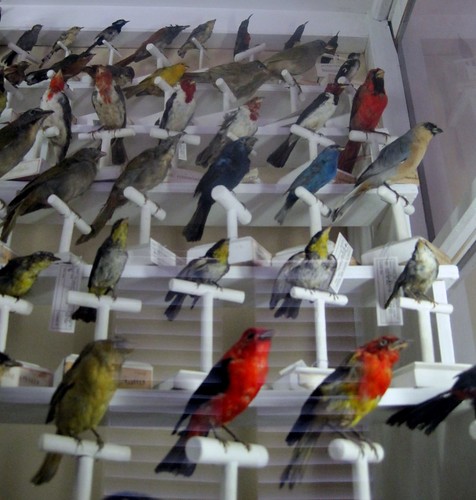
(image by me from Siena Natural History Museum)

Wednesday, July 28, 2010

Offward and overward

by J J Cohen

2010 is a momentous year in the Cohen family life cycle: twenty years of nuptial connubuliaty accomplished in June; a becoming bar mitzvah in April; a turning six years old that same month. We have much to celebrate ... so two years ago, looking forward to these days, we booked a vacation that will take us by plane to London and by ship across the channel, along the coasts of France, Spain, Portugal, and into the Mediterranean for disembarkation in Barcelona. A once in a lifetime voyage, to be sure.

But don't worry, there is plenty for you to read while I'm gone: the discussion at Karl's post on Erkenwald and Muslims is worth your time; more thoughts on NCS are welcome; and Kathy Rowe has promised a guest post on the experiment in peer review that she carried out via SQ. So, carry on without me. I don't mind.

Tuesday, July 27, 2010

About that promised post ...

by J J Cohen

Perhaps you heard that a rather large storm passed through the DC area on Sunday? I was at our neighborhood pool with the kids when the thunder came, and I've never seen anything like it: trees snapping, power lines crashing, downpours and relentless wind. Running for the house was like starring in a special-effects heavy disaster film.

We've been without electrical power since the storm blasted through, and have no great hope of restoration before we leave for a family vacation tomorrow (we're flying to London, then taking a big boat from Dover to Barcelona). You'll understand, I hope, why the promised post on the blogger panel has failed to appear.

Meanwhile, I can't say life in a home without electricity has been all bad. The storm front brought a change in the weather, so the humidity and 102 degree temperatures are gone. We sleep with the windows open and awake to birdsong. The moon has been enormous, beautiful, and living by the warm yellow of candles has charm. Yes, we've lost all our refrigerated and frozen food; but we are about to depart for two weeks anyway.

And ... on the first night of the blackout, as the sun set and light was fading from the rooms, I asked Katherine and Alex each to create a song on the piano that might tell the story of the storm. Partly my request was to fill an anxious time with activity: distraction through art. But I've also been inspired by Stephanie's stories about the enthusiasm her son has for musical invention. I realize K & A mostly play songs by the book.

Katherine's spontaneous piece was sweet: little bits of the small songs she knows interrupted by deep clangs of low key thunder. Alex's invention was something I've never heard flow from his fingers before: a soft melody of water and play that broke into sheets of rain, thunderbolts, and downed trees, then calmed into melodies that hung in the air for a long time after he finished. No dissonance, not even the storm, all one long flow. Alex has never really improvised at the piano before. In the song of the storm he found his musical voice.

Monday, July 26, 2010

Erkenwald and the Muslims

by KARL STEEL

For thoughts on NCS, please continue reading Jeffrey's post below, late edit, Derrick Pitard at "Gladly Wolde He" for late medieval devotion at NCS, and, as well, Miglior Acque, who writes:
the highlight of the conference, and certainly among the conference's most important papers, was one that was never mentioned again. This is most curious considering how much time we spent talking about manuscripts, theorizing about manuscripts, salivating over manuscript illuminations. Estelle Stubbs gave a paper on the morning of the first day in which she identified the famous 'Scribe D' as John Marchant. The importance of this scribe in copying work by Chaucer has always been recognized, but his identification now allows us to place this copying in a much more specific context (and Stubbs threw the Guildhall into relief in this respect). It was a groundbreaking piece of work, compellingly and elegantly presented, and should have been the talk of the conference.
Now, back to me.

If you were up at 9am on a Siena Monday, and decided to head out to the train station, you might have heard the latest work on my continuing Erkenwald project (earlier versions here and here). The paper? "The Past as Past is its Disappearance: Erkenwald and the Jews": the interested may look for the whole paper elsewhere, but my argument, in essence, was to assert that the past Erkenwald creates (and erases) is not only pagan but also (what it figures as) Jewish, and that it figures this Jewish past as past (which is to say static and ultimately untouchable by the 'present'). I offered only an implicit connection to the "Touching the Past" theme. To elaborate more, briefly: it's Erkenwald v. Faulkner.

Some evidence:
  • Erkenwald's opening explodes with multiple temporalities, which it just as quickly resolves into two times: the past (time of law) and present (time of grace), as if the poem explicitly illustrates how to condense the heterogeneity of time into coherent temporal polities;
  • Among the "pagan" temples the poem converts to Christianity is "Þe Synagoge of þe Sonne," which is "sett to oure Lady" (21): since Gollancz the criticism has ignored the "Synagogue" or apprehended it as yet another pagan temple. I read it, however, as signaling a particular building, a synagogue taken by King Henry in 1243, given to the Brethren of Saint Anthony [paranoiacs will suspect a porcine insult in this dedication] and rededicated as a chapel of Mary (Close Rolls Henry III, 1242-47, 142), an event recalled in the sixteenth and seventeenth centuries and perhaps also in the intervening centuries (follow the link above to the paper itself for a tendentious sophisticated exegesis of the "Synagogue" being off-kilter from the central site of the poem, the demolished [not converted] temple where St Paul's would be built);
  • As Erkenwald criticism knows, the closest analogue for its unbaptized righteous judge appears in the Trajan material of either Piers Plowman B.XII.270-95 (Schmidt ed.) and C.XIV.194-217 (Pearsall ed.), or, more exactly, commentaries on Purgatorio 10.73-75, either by an Anonymous Lombard (1325) or by Iacobo della Lanna. Trajan's righteousness? He has his own son executed for murdering a widow's son. Trajan includes himself wholly within the law, utterly committed to following it even if doing so means destroying his own progeny. He is therefore at once a figure and victim of merciless justice, of law that offers only destruction, no expiation. Erkenwald's judge is likewise a figure of justice without grace, exit, or future: the substitution of pagan emperor for pagan judge thus intensifies judicial elements already present in the original story or indeed in Pauline doctrine as it tended to be understood by medieval Christianity (key texts: Romans 4:14 and Galatians 5:4-5);
  • Finally, because honestly I could go on, Harley 2250 (made in 1477), a miscellany of exempla, clerical guides, and saints' lives (partial listing here; thanks to Alan Stewart for sending me a more complete list), where our sole surviving copy of the poem resides, contains little or no reference to England's pagan past, barring its Alban legend (I think the same as Laud 108 South English Legendary version), of interest no doubt because it is an English martyrdom. It does, however, include (at least) three works concerned with Jews: one on the conversion of the Jews of Beirut, another on a Jew robbed between Bristol and Wilton, saved by the virgin, who converts, and another, notably, on the Jews' vain attempts to rebuild their temple. No doubt I will talk more about this at the 2011 MLA Convention in an Erkenwald session organized by Philip Schwyzer and starring Seeta Chaganti, Naomi Howell (U of Exeter), and me, your most humble of sinners.
Read on for the Muslim question!

The converted temples of Erkenwald's opening also include these: "Þat ere was of Appolyn is now of Saynt Petre, / Mahoun to Saynt Margrete oþir Maudelayne" (19-20, that which was dedicated to Apollyon [or Appolo] is now dedicated to Saint Peter, and Mohammed to either Saint Margaret or Magdalene).

I'm asking you, blog readers, lurkers and otherwise, to weigh in. As Sarah Salih asked (and I paraphrase: apologies for memory slips), in Erkenwald's grand narrative of past and present, of creating the past and separating it from what it wants to be present/presence, what do we make of the continuing present of Islam, this most recent of world faiths, situated here in the distant past of London as it is situated in the now of Christianity? What to make of these, given my arguments about the "past as past"? No doubt Mary Kate's paper on Chaucer and the Anglo-Saxons could help here.

My answer was, I have to say, a bit weak. I had read "Synagoge" closely, so in all fairness I couldn't just read past the Mohammed reference. So: I answered by speaking of the poem's "Islamic idol" as further figuring the inability to close off the past as past; more simply, the Mohammed reference might suggest the resolution of all non-Christian faiths into one homogeneous glob: pagans, Jews, and Muslims are all equally lost; alternately alternately, we might understand that Erkenwald grants Islam an antiquity medieval Christianity tended to deny it, thus undercutting one of the key arguments against Islam, namely, its newfangledness.

Surely, though, there's more that could be done?

(postscript: for the image, above: I read Erkenwald as medieval kindred to John Stow's early modern account of a discovery made during repairs to Ludgate in 1586: here, mixed in with the supposed remnant of London's legendary foundation by the pagan King Lud, workers discover a stone “grauen in Hebrewe caracters,” the very image of what Christianity understood to be its foundational, superseded past.)

Sunday, July 25, 2010

post ncs post

by J J Cohen

Thank goodness I have Google Voice and can make two cent per minute calls to the UK. Otherwise I wouldn't have been able to endure the 35 minute wait time to determine that my Heathrow-abandoned notebook is not yet recovered, and not likely ever to be so. RIP small black notebook that substituted for neural encoding.

The conference is already becoming a blur
That places me at a disadvantage for narrating the conference, since my archive has vanished and I'm left with mendacious and reconfabulated recollections -- and as I've just demonstrated, my memory is eager to make things up, like the word reconfabulated. So take the following cum grano salis. Or an entire shaker full. You won't get anything as comprehensive or truthful as my NCS Swansea posts, or the NYC overview. You may as well stop reading now.

Some memory fragments in search of a larger narrative:
  • On our tour of San Gimignano, our guide -- histrionic in a lovable way -- declared that because Siena had no water, it had banks. She meant that in the absence of the trade a riverway brings, financial enterprises had to flourish; and indeed I did notice that Siena now has a remarkable number of ATMs per square mile. The guide later declared that medieval people had no perspective in their paintings because the church had forbidden direct representation of truth. We medievalists make careers of undermining blanket statements about our time period like these. Yet a truth in what she said stayed with me long after the tour, and I would express it this way: because Siena has no water (no river cutting the town, no conduit of waters running its walls), it seems self-enclosed, and lacks perspective. I stayed near the university, and traversed the entire town to reach a friend at the Hotel Athena before I realized the beauty of the surrounding countryside, with its olive trees and cypress and azure skies: only at the city walls does this undulating geography come to view. In the absence of a map, walking Siennese streets demands navigation via landmark. The pathways are narrow; blue is visible above, but the effect is of trodding an unspooling maze. You know a larger swathe of sky is somewhere near the middle (the Campo, the living room of the city), and yet you can't always locate yourself well enough in relation to that space to find it without knowing something of what tunnel-like street leads to its airiness. At conference end Stephanie Trigg and I traveled to Florence, bisected by the flow of the Arno, and in retrospect I realized how constricting a space Siena yields. Siena lacks perspective was the phrase I wrote in my notebook. I didn't mean the dictum negatively: more that when you are there, you are in middle space, a geography that will not yield itself easily to a god's eye view. Such spaces have their strengths, their virtues, but often demand departure before a frame coalesces.
  • The NCS Siena program was arranged into multiple thematic threads. Though nearly impossible to follow any single one from inception to conclusion, many of us did choose a strand and arrange our conference by its panels. The effect was to offer a series of micro-conferences in search of a larger perspective. My NCS was mostly about animals, since that's the thread to which I was faithful. I'm pleased I chose it, since so many of the presentations were good and spurred enthusiastic discussions. Especial standouts for me were Bob Mills' first steps towards a larger project on biopolitics and animality; Sarah Elliott Novacich's breathtaking reading of Noah's ark as archive; Sarah Stanbury on Derrida's cat and Jerome's lion; Carolyn Dinshaw on the Green Man and the Green Movement; Bruce Holsinger's intentionally riling piece on vellum ethics; and Susan Crane on the creaturely, the technological, and dispersed embodiment.
  • From other sessions I attended, some papers that even with my notes lost have left an enduring impression: Aisling Byrne on otherworlds as invitations; L. O. Aranye Fradenburg (the Biennial Chaucer Lecturer) on intersubjectivity, affective companionship, life and play and becoming; Holly Crocker on ethics, performance, and Chaucer as conduct literature; David Wallace's awesomely performative, sometimes even liturgical piece on Jephtha's daughter; the blogger panel; and of course the six presentations that constituted "Touching the Past."
  • If I could make a suggestion to the planning committee for the next meeting of NCS (Oregon, 2012), it'd be the following: email session moderators a month beforehand asking them to contact the presenters on their panels and remind them of the time allotted for each paper. The reminder should be positive: the reason to keep papers within their limits is so that the audience can have a conversation about the session. These discussions are the lifeblood of the conference; going over one's allotted time and thereby reducing the participation of the twenty or thirty in the room who have come to talk to the panel is ungenerous. Moderators shouldn't be shy about gently reminding those who go long to move to their conclusion: again, such actions are done not to be cruel to the person who has reached the 25 minute mark when the paper should be 20, but to advocate on behalf of the audience, who shouldn't be consigned to passive audition.
  • Maybe keeping on time is my hobbyhorse; it's possible that on this issue, as in too many in life, I'm simply uptight. For the sessions I arranged, I asked each of the speakers to hold forth for no longer than 15-18 minutes, and threatened to start interpretive dancing to any portion of the paper that went longer. It's immodest of me to say this, I know, but because we had about 45 minutes for discussion in each of these sessions, we had some  intense conversations in which twelve to fifteen audience members were able to participate. Their questions were serious, and terrific; the sessions would have been impoverished without them. (Shout-out to George Edmondson: his questions were especially provocative).
  • Tom Prendergast gave a much-talked about paper on the subjectivity of place that I wish I had seen. I've convinced him to email me the piece, though I wish I had witnessed its performance: I don't think anyone's paper was mentioned as frequently as his. I had a memorable last dinner in Siena with Tom and his family. His son is Alex's age and possesses the same interest in quirky fantasy novels. It was also my second time eating pici cacio e pepe, my favorite local dish.
  • The Saturday conference dinner was held on the roof of the Enoteca Italiana, a sixteenth-century fortress within the city. The evening was warm, the terrace lit by candlelight. Wine flowed, the food was excellent (except for the White Plate that constituted the vegetarian main course): a convivial evening that reminded me once more of why consuming food together is an integral part of forming community.
  • No conference is without its interpersonal tensions, its misunderstandings, conflicts, sniping. These things existed at NCS Siena, I will not lie. But I will always remember the conference not for its inevitable, all too human undercurrent of mixed emotional responses, but for its joy: meeting many, many new people; learning so much; celebrating simply being together each night as we drank prosecco in groups of six or twelve or eighteen or twenty-five on the Campo.
  • OK, I got up at 5:30 to begin this post, and I can hear one of my kids moving above me so my time is running out. I am departing for London on Wednesday, but hope at least to write about the blogger panel before then. Please add your own impressions of the conference in the comments below.

Saturday, July 24, 2010

Small Loss

blue sky and forgetfulness, Siena
by J J Cohen

I'd like to compose a post about New Chaucer Society and Siena. I have much to report. Yet this morning in a quiet house -- children late asleep, spouse on business in Quebec -- I'm preoccupied with small loss.

The first leg of my return, Pisa to London, had been delayed an hour. The air controllers of France were on strike, constricting the flight of northbound aircraft to crowded channels through Switzerland and Germany. A small fact, almost insignificant, but as I sat in the plane it preoccupied me. An hour on the tarmac would likely stretch to ninety minutues, maybe more. At Heathrow I had been allotted only two hours five minutes between arrival from Pisa and departure for Washington. I know Terminal 5 intimately enough to foresee lethargic security queues, indifferent officials. Ready to return home from what had been a superb Italian sojourn, I realized a good chance now existed that I would miss that last flight of the day to DC, and could well be returning the next morning instead.

In the Cosmic Scales of Divine Merit, the ones that determine (if you have the faith) whether you'll be singing hymns with Dante and Beatrice in Il Paradiso or chomping on your neighbor's head in hell, this event, this delay of less than a single day, means nothing. It's so trivial it cannot even be consigned to Il Limbo, that place where they make you dance with a stick for having been a virtuous pagan. But seated on the plane and anticipating the embraces at journey's end, I was yearning to be home. So when we touched down at LHR I rushed from the plane, sprinted with my suitcase from one end of the long terminal to its other ... and arrived at the next aircraft with perhaps five minutes before the closing of the gate. The tug truck pulled us from the terminal and promptly broke down, still attached to our aircraft, leaving us in what the pilot repeatedly described as a rather absurd position. We could neither return to the gate nor get to the runway. I didn't care; I was happy to catch my breath, and whoever had been assigned the seat next to me hadn't made the flight, so I had some room to stretch. I was happy simply to be on the plane, even if we'd be in a rather absurd position for an hour before we left.

rocky shore with invisible storm, Ogunquit, August 2009
I reached into my laptop bag to remove the little notebook I've carried with me for the past year. This would be a good moment to write some reflections upon NCS Siena, after all. I could read the notes I'd scribbled at each panel I'd attended, ruminate on the conference's Bigger Picture and perhaps create the skeleton of an ITM post. This black notebook is jammed with quotations, observations, jokes, sketches, aphorisms. Its pages contain not just the record of a year of conferencing (Kalamazoo, York, GW MEMSI events), not just the outline of the postmediaval issue on ecomaterialism I'm co-editing, not just the words corresponding to the abecedarium I'm creating, but the sketch I made one October evening of the gabled house across the street from us while we were living in a rental home; the little picture I drew of my daughter's pink Nintendo DS when she urged me to record its glory; phrases, dicta and axioms that had come to me while I showered or during morning runs. Future projects and reflections on work accomplished mingled with notes composed for no one in particular.

You are a savvy reader. You will have guessed from my conditional become past tense that the notebook was no longer in my possession on that Washington bound plane. I'd placed it in the seat pocket before my flight from Pisa to London, anticipating skyborne reflection. The news of the delay into Heathrow had taken my mind elsewhere, though, and I wasn't feeling contemplative. I read and marked up Suzanne Conklin Akbari's Idols in the East. That volume possessed the heft to ensure that I returned it to my bag before landing. The little black notebook, on the other hand, was abandoned in its seat pocket. I sprinted towards my gate, towards my home, and left it.

I am making this little black pad sound like one of DaVinci's notebooks. Nothing of value inhered in its pages. It contained roadmaps for destinations no one but me would ever want to travel. Fragments of an unimportant life, one life among the billions of a crowded world. I'm sure the cleaning crew saw its shabby cover in the seat pocket, looked at the thing briefly, judged it a recyclable, possessing the same merit as an abandoned magazine. They couldn't have known that I bought the notebook in a shop in Ogunquit, Maine, on a rainy afternoon during last year's family vacation. They couldn't have known that its first passages were composed on rocks pummeled by a distant hurricane, a storm so far at sea that only its surge made its power visible. The notebook's pages (cream colored, unlined) contained pieces of what became my New Critical Modes posts here at ITM. The notebook became in time the record of year that matters to no one but me.

I've placed a request with the company that handles lost goods in the aircraft that use Terminal 5 to track my notebook's fate, but they seem indifferent to an item that costs $20 to replace. When I accidentally left the pad on my seat at Kalamazoo in May, Anna Klosowska spotted its battered cover and ensured that it was mine again. I realized then that I should take its pages to a copy machine and create a record against future loss. Like all good and sane ideas involving the archiving of a past to be retained, it remained a good and sane idea rather than an executed action.

I tell myself that a liberation exists in rethinking my abecedarium, in recreating my roadmaps of future work, on exchanging determinations for possibilities. There is freedom in being released from these transfixed desires, from the set ideas of a year or six months or three months ago.

And yet I want my notebook back. I feel like I've lost a small part of myself, of the history that I always try too hard and in vain to hold.

Friday, July 23, 2010

Initial NCS Thoughts: Squirrels, Animals, and the Flood

by KARL STEEL

Expect a flood of NCS posts over the next week. Some brief comments to begin:

Italy: why no squirrels? My wife claims she saw a squirrel; I saw none. The Siena natural history museum tells me they are general throughout Italy, barring Sardinia and Sicily, but they must be fibbing, or describing what now has only a historical reality, or perhaps they have no idea how dense a population of squirrels must be to qualify as "common." I welcome the physici of Siena to visit my Brooklyn backyard.

I have convinced myself of two things: that the Italian squirrel can be found only in Genoa, and that Catherine of Siena must somehow be responsible. Patrick drove the snakes out of Ireland; Italy lacks flying pigs because of Paulinus of Nola; but by the time Catherine of Siena arrived, there was little left to expel but squirrels. This was no small miracle. Those who keep a garden know the annoyance of sciurus vulgaris or carolinensis. They would be wise to offer Catherine a prayer of thanks lest they also be driven from their home to satisfy the convenience of others. Ireland, beware, for one day the snakes will find their own saint!

I attended all but one of the Animals sessions at NCS: I was grumpy not to be cited once, but found the lack of citation a nice, humbling counterweight to claims of blog triumphalism; I was happy to hear Jeffrey cited so many times; and annoyed, deeply, that Susan Crane, who has written and continues to write so perceptively on animals, was cited barely at all. The field feels itself to be barely finding its feet (or hooves), but the field should recognize that much has happened in medieval animal studies since Salisbury and Yamamoto!

I want to recall here, briefly, a very fine paper I saw at the first Animals session: in "Uxor Noe and Animal Inventory," Sarah Elliott Novacich, a graduate student in English at Yale, discussed the ark as archive (through, in part, the mnemotechnics and glossing in Hugh of St Victor's writing on the ark), the language of penning and herding for bringing Mrs Noah (see here for a brief discussion of some of her 103 names) and how Mrs Noah refuses to be caught up in this memory practice. If I remember this argument aright.

As often happens with good papers, my mind was led to wonder again at a text I thought I knew well, in this case, one I've known since I was knee-high to a flood, Genesis 6, 7, and 8. Mrs Noah's refusal to join the party might be read as resistance to what Noah wants, and by extension to what God wants, and by further extension to what men or the dominant in general want. She is a site of resistance.

But the Genesis account is muddled, and not only because it's obviously a poorly edited amalgamation of two separate accounts (does Noah bring 7 pairs of clean and 2 pairs of unclean animals on board; or just 2 pairs of everything? Cf. Genesis 7:2-3 to Genesis 7:8-9). It's muddled because God's desires themselves are muddled. Being sophisticates, we know God is not the Big Other, the one supposed to know, the one out there who's impossibly whole; we know that such unity, when sought, will never arrive, and that it never can have existed. We know God is a split subject too.

But we don't expect to find such knowledge so obviously given in an ancient text without being made available through some manner of paranoid extraction. But it is obvious here. In the Noah story, we see that God at once wants to destroy the world and to preserve it, to start again and to keep something afloat. As so often in Genesis, He regrets almost as soon as he decides to act (Genesis 7:6-8). The Mrs Noah of the Middle English drama, far from being (only) a site of resistance, is a further witness to God's split desires, to his inability to act simply, to his ever being able to do just one thing. She is indeed outside the archive, then, attesting to the multiplicity even in this most monolithic of Others.

Thanks Sarah for your excellent paper!