Showing posts with label violence. Show all posts

Wednesday, June 08, 2016

NO FILTER: Suffering, Finitude, and other supposed truths about animals

by KARL STEEL

Three times (!) in the last week, I've had people raise their eyebrows at me when I said I recently missed a deadline. Let me assure you that this isn't my first time at the tardy rodeo. This one (June 1) I missed  because - I'm claiming - I've been so hard at work, and because I found myself writing things I shouldn't. My essay on "Animals and Violence" for the Routledge Handbook for Animal-Human History has transmuted from a rather dull Frankenstein's monster of old blog posts and précis of previously published stuff into an overambitious reconsideration of the problem of the "medieval" in accounts of violence and animality. Of course I want to share a bit with you, but perversely, I'm not giving you part I (on animality, the medieval, and the politics of time), nor the next part of part II (on Margery Kempe's vegetarianism), but rather this not very medieval bit, which ultimately breaks up a little with a bit of Derrida that I've long loved. Boohoo.

Thanks to all the contributors to my Facebook thread asking for bibliography on violence, thanks to John Protevi for some behind-the-scenes discussion, thanks to Steven Bruso for sending me his bibliography on the same, and thanks to Jared Rodríguez for some last-minute, very welcome PDF help. Enormously helpful.

And here's the chapter section:

Sauprellen, anon c. 1720, detail; from the Jagdschloss Grunewald (see also)
It is not uncommonly said that habitats generated by internal combustion engines and electronics lack the crowds of animals common to what are often called “premodern,” “preindustrial,” or “developing” habitats. It is supposed that medieval people were therefore “more in touch with” animals than their modern counterparts. The standard argument continues in this way: because medieval people relied on animal labor, traveled on animals, and because they could not have misunderstood where meat came from, they did not need to compensate for their “unnatural” separation from animals by surrounding themselves, for example, with overbred, useless pets. Their relationship to animal life was truer than ours, where "ours" equals that group of people most likely to be reading this chapter.
The faults of the argument stem first from its implicit narrative of a fall and decadence, as if the real came first, followed by a long slide towards our antiseptic present. This nostalgia for the origin and its attendant belief in the truth of first things can and has been traced from, for example, Plato and his Ideal Forms to present-day postapocalyptic literature (with its survivalist belief in the final return to the “underlying” – a favored spatial metaphor -- reality of nature). The idea that people have a primary connection to animals as a whole (say, as children), that socialization as such is the culprit, that subrational “lived experience” is distinct from and more authentic than cultural practice, that getting before "modern civilization" is somehow going to save us and others, and so on, belongs to the precritical fantasy of origins and the fantasy of the superiority of an imagined unmediated contact.
In an animal rights context, the argument has been that industrialized production of meat somehow separates us from our "real" engagement with its real source in animal life and animal death. Supermarket culture is particularly to blame for shielding meat-eaters from the violence that feeds them. The shock of butchery, of getting past the hypocrisies of industrialized carnivorousness, is key to Sue Coe’s slaughterhouse art, or in the grand reveal, not without sexual violence, of the [I recommend not clicking on the link] industrial, cannibalistic dismemberment of female clones in Cloud Atlas. This argument follows the standard logic of ideology critique, insofar as it claims that only by coming face-to-face with the "reality" of the modes of production can we finally surmount the cruelty of our polyannish relationship to work and consumption. As has been demonstrated repeatedly in a variety of contexts, such claims are overblown: there may be some value in revealing what goes on in industrial farming - the very reluctance of these operations to open their doors to scrutiny is evidence enough of that - but what may be far more difficult to change is the consumer’s certainty that, in the end, their needs are worth it all, regardless.
Maggie Nelson’s The Art of Cruelty: A Reckoning lambastes the “Messianic approach to art-making,” which holds that being “ambushed” by with the “truth” is an essential or even desirable goal of art. Nelson argues that truth, good action, knowledge, and least of all good art may not require revelation, surprise, horror, or destruction. Revelations of cruelty may be little more than revelings in cruelty. They might produce nothing but sensations of disgust, alienation, self-loathing, and guilt, or the self-aggrandizement of feeling that one feels more intensely or just more honestly than others, or that one has been exiled from bourgeois comforts (or that one has discovered some new way to épate them for their supposed hypocrisy). Revelations of cruelty might lead to still worse, titillation and enjoyment and from there to the desire for more cruelty, not because cruelty treats others as things, but because it recognizes that others can suffer in ways that things cannot.
Dominick LaCapra’s History and its Limits arrives at similar ends through its assault on conjunctions of the sublime, the transcendent, and sacralized violence, and on generalized, antihistorical obsessions with wretchedness, particularly as practiced in the work of Agamben, Bataille, and Žižek. When Lacapra turns his attention to one of Coetzee’s fictional creations, the animal rights activist and writer Elizabeth Costello, he joins Nelson in arguing against the notion that identification necessarily leads to empathy, and empathy necessarily to kindness. Coetzee’s Costello analogizes the death of animals to the Holocaust, accusing those who kill animals of being like the camp guards, whose fault, she insists, was that "the killers refused to think themselves into the place of their victims." Lacapra observes that while this may be so, Costello's argument that this cruelty can be blamed on a failure of identification can hardly account for sadomasochistic projection: no doubt, some killers and other villains can and do perceive their victims as like themselves, vulnerable and dependent, and therefore, for those very reasons, suitable targets of cruelty.
With all this in mind, we are now in a position to reconsider one of the most philosophically challenging, influential demands for an identification with nonhuman suffering. This is Derrida’s statement on the English philosopher Jeremy Bentham. As Derrida observes in his The Animal that therefore I am (L'animal que donc je suis), when Bentham proposes that the important question about nonhuman animals is not whether they can speak or have reason, but whether they can suffer, this "changes everything" [change tout]. To a large degree, Derrida is correct. Where philosophers have traditionally excluded or included nonhumans within the human community of rights on the basis of positive capacities – for example, the capacity to make tools, form family relations, exhibit a theory of mind, or various forms of "lack" in Lacan, Heidegger, and their epigones – Derrida focuses on a shared non-capacity, what he calls a "nonpower at the heart of power," the ineluctable, general exposure of animals and humans alike to discomfort, injury, and death. If thinking about animals and humans begins not with abilities, language in particular, but with a shared vulnerability, certainties about agency and freedom all happily collapse.
Derrida's recentering of the animal question on suffering still has two problems: the first is that it raises the possibility that animals may be killed ethically so long as their suffering is eliminated. This would be "humane killing," which comes as such a surprise that an animal has no time to experience fear or pain: this is the goal of the slaughterhouse design championed by Temple Grandin, developed through her identification with nonhuman sensory worlds. The second issue is that identification with the "nonpower at the heart of power" need not necessarily result in less cruelty or more kindness. An awareness of suffering need not necessarily result in the desire to end it.
These objections are perhaps too practical. Derrida's concern is less with animal welfare than with philosophy. He is led to his logical endpoint by his approach to language, in which having language, this supposed distinguishing capacity of humans, is itself not a capacity, but an entanglement in an always shifting, preexisting, limitless network. At the furthest end of this "nonpower" lies the figure of the animal, preserved in Derrida's analytic, despite his attempts to do otherwise, as a homogeneous figuration of abyssal mystery.
More to the point for my analysis is that Derrida arrives at this problem by aiming at "the most radical means of thinking the finitude that we share with animals, the mortality that belongs to the very finitude of life" [la façon la plus radicale de penser la finitude que nous partageons avec les animaux, la mortalité qui appartient à la finitude même de la vie]. The truth of things may be an aporia, and therefore necessarily, anti/foundationally unreachable, but what it is not is in the middle of things. One has to follow things through to their end to find this truth of absence. Toril Moi's championing of ordinary language philosophy identifies many of the problems in this, not least of all the fact that "Derrida's deconstructive concepts at once enact and deconstruct such ideality," thus requiring that concepts meet the demands of a presumably philosophical purity so that deconstructive analysis has something to disprove. 
The purity in its most intense form, as an absence, Derrida discovers in death, suffering, and inability, all of which lie on the other side, at the before (the radical, from the Latin radix, root) and at the after (the finitude, from the Latin finis, a close or conclusion). The "nonpower at the heart of power" locates truth, even if that truth is a void, in suffering, vulnerability, violence, death, across borders, and at least implicitly across temporal limits. Whatever its dedication to upsetting pretensions to unmediated experience, nostalgia for origin, and all other myths of purity, it also needs these myths in order to preserve the grounds for deconstructive analysis. 
All this is not to demand that human and animal difference should be conceptualized around differences in ability. I welcome a focus on nonpower, among other things, even if, as Dominic Lacapra observes, this focus goes rather "too far in acknowledging human disempowerment" in relation to nonhumans. It is rather to question both the centrality of suffering in Derrida's analysis and the accompanying centrality of finitude, and the presentation of all of this as authenticity: Herbert Marcuse's "Ideology of Death" should make us suspicious about any elevation of "a brute biological fact..into an existential privilege" (for introducing me to this essay, thank you to Aranye Fradenburg's superb Sacrifice Your Love).
Nor am I denying the actual practice of cruelty. Animals can and do suffer, generally not just like people, but nonetheless in their own ways. Recognizing this suffering is no small matter. Furthermore, to say that revelations of cruelty may not necessarily lead to an end to cruelty is not to say that such revelations are valueless: possible results may range from individual kindness to wholesale assaults on an otherwise indifferent or worse social order. Or they may lead to anti-Semitic and Islamophobic assaults on (certain forms) of animal slaughter: good for some animals, bad for some people. I am challenging notions that center right action on the discovery of suffering, especially when this discovery of suffering is elevated into being a central truth – as it can be, strangely enough, for thinkers as antithetical as Bataille and Derrida --- and on those that insist that the route to that truth is through the discovery of cruelty where it was otherwise unsuspected or unfelt.

Wednesday, March 30, 2016

Feral Founders, make way for Feral Foundlings

Jusepe de Ribera, Adoration of the Shepherds (1650)
by KARL STEEL

“The more strange it was to read in a previously-mentioned article by Huxley the following paraphrase of a well-known sentence of Rousseau: ‘The first man who substituted mutual peace for that of mutual war – whatever the motive which impelled them to take that step – created society’)….Society has not been created by man; it is anterior to man.” Kropotkin, Mutual Aid: A Factor in Evolution, 54 n1.
"What we usually call society in common speech is only a particular case of [a] general law. A being, whether social or not, is never absolute, indivisible; but essentially comparative and multiple, resulting from the action of a number of forces converging on one point." Leon Metchnikoff, "Revolution and Evolution," 415.
I. The Feral Founder
Dating to between the fourteenth and eighth centuries BCE, the Akkadian story of Sargon is one of the earliest, if not the earliest, written accounts of a child abandoned to the wilderness who grows up to become a great leader. Its narrative elements are famous for what they share with the story of Moses: the woven, waterproofed basket (Exodus 2:3), and the patriarch who orders the baby killed because he fears being supplanted (Exodus 1:9).
Evidence of a story of animals sheltering such an abandoned child appears first in Herodotus’s story of the childhood of Cyrus of Persia: his caregivers, two enslaved cowherds, are named Mitradates and Spako, whose name, Herodotus explains, comes from the Median name for dog, “Spax” (Persian Wars I.110). Later accounts indicate that this woman’s name simply rationalizes a nurturing animal that Herodotus or his sources understood as embarrassingly mythic: see, for example, Peter Comestor’s twelfth-century Historia Scholastica, “When the shepherd returned to [Cyrus], he found a dog offered him her teat, and defended him from wild beasts and birds” Pl 198: 1471a). Whether first nurtured by a dog or a woman “coincidentally” sharing a dog’s name, Cyrus grows up, becomes the natural, even bullying leader of his playmates, and eventually supplants the bad father figure and reclaims, and even expands, his birthright. In this, we have all the common features of the later abandoned child stories: the patriarch who fears being overcome or killed by his child, the child threatened with death, abandoned, and yet preserved, the nurturing animal, the foster parents (typically humble, with Moses as the outlier), and the emergence from enforced obscurity into a demagogic adolescence and heroic adulthood as savior, lawgiver, civic founder, and so on.
Cyrus’s career is most famous as a probable basis for a much better known story. The lost history of Fabius Pictor (second-century BCE), along with a crowd of other histories, passed along a story told by Dionysius of Helicarnassus and Livy (late first-century BCE), Pliny’s Natural History, Lucius Annaeus Florus’s Epitome of Roman Histories, Plutarch, and certainly a heap of coinssculptures (also), vases, metalwork, epigraphy, and whatever else can’t be found with a straightforward search in the Loeb Classical Library. While the story isn’t quite ubiquitous - Cicero’s Republic refers only to a “silvestris beluae” (a wild forest beast), and Appian nor Diodorus of Sicily’s Roman histories say nothing at all about nurturing animals – the story of Romulus and Remus and the wolf that saved them is sufficiently widespread to be called Rome’s founding myth, and the paradigm of subsequent stories of culture heroes first succored by an animal. Here the wicked paternal figure is an uncle, Amulius; the mother herself, variously named Ilia, Rhea, or Rhea Silva, is a temple priestess like Sargon’s mother, and here tends to vanish quickly from the story; the boys’ father is himself is either Mars, an unnamed suitor, or even Amulius, disguised as a god. Rationalizations rush in here as well: Livy, among others, writes that some hold that the story’s lupa (female wolf) is really just slang for a prostitute or loose woman (“Sunt qui Larentiam vulgato corpore lupam inter pastores vocatam putent”).
It has taken nothing but dogged research to pack this story with others of wild founding fathers who draw their outsized potency from the teats of some convenient canid. These stories in turn join with a swath of rampaging männerbunder from Central Asia to Ireland, from the Dacians, Scythians, and Thracians, to the Anatolians to the Lombards to the Guelphs, groups renowned for young men who don the names of wolves or wolf masks or who are styled in narrative, war propaganda, or narrative, as cynocephali or werewolves.
The Langobards moreover, when they beheld the great forces of their enemies, did not dare engage them on account of the smallness of their army, and while they were deciding what they ought to do, necessity at length hit upon a plan. They pretend that they have in their camps Cynocephali, that is, men with dogs' heads. They spread the rumor among the enemy that these men wage war obstinately, drink human blood and quaff their own gore if they cannot reach the foe. (Paul the Deacon, History of the Lombards I.xi)
These stories, and often the scholarship too, imagine the canid as at once the figure of authority and its enemy, incarnations of wildness, power, cruelty, bravery, and even a kind of rough justice, mostly inimicable to women.
Agamben’s discussion of Marie de France’s werewolf lai, “Bisclavret,” is probably the most famous treatment of this theme outside medievalist circles. Medievalists themselves are surely also familiar, to cite a handful of many possible examples, of the eponymous hero of the Wolfdietrich Saga, the illegitimate child of a princess and a passing (and cross-dressed) nobleman: Wolfdietrich acquires his name because once he is cast out as an infant, a wolf scurries this baby away to her den to try to feed him to her pups, who are either too fussy or too friendly to eat him. Old Icelandic law and literature, like the Volsung Saga, famously uses the word vargr, “wolf,” to describe outlaws, resulting in frightening portmanteaux like morðvargr (murder wolf), and in modern Icelandic, the brennuvargur (burning wolf, that is, an arsonist). Ancient and medieval Ireland offers up the lupine characteristics of thieving young men who, until they came into their property, ravaged the countryside, like wolves (as in the anonymous lai of Melion). Here too we also find local versions of a myth dating at least to ancient Greece, of the hero who defeats, and then takes on the characteristics, of his supernatural enemy’s guardian dog: the classic example is the hero whose victory christens him with the name of the very animal he killed, Cú Chulainn, Culain’s Hound (see Kim McCone for more). A final example, William Chester Jordan writes about Count Robert of Artois – justly slain at the Battle of the Golden Spurs – and his pet wolf, which incarnated his “awesome nobility” (407), and which he festooned with bells (while laughing, Jordan imagines) to apprise neighboring peasants of its approach, so they could hurry their livestock off to safety.
The wild founder’s function as a figure of origin isolates him from mundane interconnection with both the people he rules and even from the cultures he establishes. He is not to be just married off, and while he might make laws, he is not himself governed by them. Functionally, he is kin to the giant children that spring parthenogenetically from Albina and her sisters, imperial children exiled because of they had refused to marry beneath themselves: their monstrous progeny are the fruit of a nobility that refuses to abase itself with any genealogical intermingling with its lessers. The wolf child is kin as well to the children of Melusine, the half-serpent and naturally legendary progenitrix of the great crusading dynasty of Lusignan. Her children are monsters, but also great successes – wealthy rulers, implacable conquerors, the rescuers of threatened women and otherwise helpless neighboring kings – while their merely pedestrian father, unwilling to live with such a wild creature, breaks his vow not to look into her background too carefully, thereby dooming her to become fully, irreparably dragon. True, reliable, potent nobility must come from the outside.
For the law at its heart is a wolf; it does what it wants. The wild founder follows none of the petty rules binding petty people. The sovereign is therefore also the outlaw, the figure who neither needs the law’s rules (because he decides what the law is) nor its protections (same). Notably, Romulus – the victorious, city-founding twin – recruits his first citizens from outcasts, bandits, and escaped slaves, as clear a demonstration that the wild founder is an analog to the outlaw, the homo sacer, hounded by the law and the hound of the law. Revolutionaries and the ordinary dispossessed already know this as well as cynics claim to, while academics tend to get the idea at greater length from Derrida’s “Mystical Foundation of Authority” or from the Giorgio Agamben, who alternately despairs and hopes for some Messianic overcoming of the persistently, inevitably cruel relations between the sovereign and his subjects, between law and life.
II. Foundling
This story is what we get if we fall in wholly with the myth of the canid’s wild carnivorousness and all that follows. The tangle of fascinations includes the dog being only partly domesticated, the wolf being Europe’s most feared carnivore, bands of young men as packs of dogs, the Oedipal rivalry between father and son over desire (incarnated by the mother), where the field of battle is mastery of a paternal law that will never empty itself of its obscene core. A supposedly “disruptive” retelling of this story, with these actors, no matter how suspiciously it recasts the primal horde of Totem and Taboo/Moses and Monotheism, ends up reinforcing rather than undoing the centrality of sovereignty and the law and its violence. Telling this story is a good way to stir up a keen sense of justice, or to don a hairshirt of cynicism (whose etymology I trust you know). It’s a good way to assume a tone of anguished disapproval and “anxiety,” but not good for getting us something other than yet another “discovery” of the omnipresence of the beast of the law.
As you might imagine by now, this is not the way I want my story to go. Not anymore. We can first stress that Cyrus of Persia, like Romulus and Remus, like Wolfdietrich, like Ailbe, and so on, represent only one set of spurned children nursed by animals. Wolves are good to think with, but they’re not all there is. Other animals, more commonly exploited for their milk, come crowding in: goats suckle the abandoned Attis, Asclepius, and both Daphnis and Chloe; cows suckle Aeolus and Boeotus; a mare suckles Hyginus. We also have Telephus, nursed by a deer, Cybele, by leopards, Paris of Troy and Atalanta by bears; Semiramis, fed by birds; and finally, wonderfully, Hieron, in Justin’s Universal History, gets his help from bees. The list can be further expanded with examples from India, or from medieval Europe, like Tristan de Nanteuil, that bizarre romance so well studied by Peggy McCracken. Wolves might be common, but goats are commoner, and remembering them, and the bees too, transforms the story of the wild founder into a story of the wild foundling. The commonality is not the canid, with all its supposed wildness and danger, but rather the need to be fed, and its satisfaction.
In short, we can dissolve the arrogance and grandeur of the wild founder by doing more to remember them as happy babies. Almost always, they are taken care of. The servant commanded to kill the children never quite does it: sometimes it is rank incompetence –Romulus and Remus are saved from drowning because the swollen Tiber has flooded its banks, providing ample opportunity for the bank to catch their floating basked in its mud – but more often the killers fear repercussions from the children’s mother is she should come into power, or they are reminded of their own children, or they are struck by the child’s beauty, or its need:
And with that the cowherd uncovered [the child] and showed it. But when the woman saw how fine and fair the child was, she fell a-weeping and laid hold of the man's knees and entreated him by no means to expose him. (Herodotus The Persian Wars I.112)
If we start the story here, not with the competition between father and son, and not with a boy’s alliance with the presumptive unruled beast that intimates the sovereign or männerbund, the story becomes one about care, sympathy, and weakness, but not about helplessness, except insofar as everything is helpless in itself, without some kind support: I have deliberately omitted the “of,” and kind should be heard in its Middle English register as meaning something like “suitable for a particular way of existence”: kind support for a rock is not kind support for a human, yet both need it.
The child is not helpless; it needs help, and it gets it, just as anything that is gets some manner of help, no matter how minimal. We aren’t without help. 
If we start the story here, then, we can go somewhere other than thinking the problem of life as “time after time articulated and divided into bios and zoè, politically qualified life and bare life, public life and private life” (Agamben’s useful summary of his analytic, here taken from Adam Kotsko’s just-published translation of The Use of Bodies). I am not saying that we need not worry any more about the “zone of indistinction” where the sovereign outlaw lurks, or the messianic hope of the friar, whose form of life collapses that distinction cruel division of bios from zoe (Kotsko translation here too).
Rather, I think we can surprise ourselves more if we come at the problem from another angle. I am also stressing that I am simply not done with Derrida’s interest in the “nonpower at the heart of power” (The Animal that Therefore). To remind you, in response to Betham’s observation that the question is not whether animals can reason or talk, but whether they can suffer, Derrida writes:
‘‘Can they suffer?’’ amounts to asking “Can they not be able?’’ And what of this inability [impouvoir]? What of the vulnerability felt on the basis of this inability? What is this nonpower at the heart of power? What is its quality or modality? How should one take it into account? What right should be accorded it? To what extent does it concern us? Being able to suffer is no longer a power; it is a possibility without power, a possibility of the impossible. Mortality resides there, as the most radical means of thinking the finitude that we share with animals, the mortality that belongs to the very finitude of life, to the experience of compassion, to the possibility of sharing the possibility of this nonpower, the possibility of this impossibility, the anguish of this vulnerability, and the vulnerability of this anguish. (28)
This formulation has its own problems of course, which I am handling in my oyster chapter. Its other problem is thinking primarily in terms of victimhood and compassion, which has its limited advantages, but which also tends to put violence at the center of our analysis, with all the assumed anguished gravity that follows. I’m putting the baby at the center instead, and with it, one hopes, the communities of care that come to cluster.
Not long ago, I was struck by the nose of a cow. Maybe a bull. Jusepe de Ribera's Adoration of the Shepherds (1650) is yet another painting about just that, but poking its way past the adoration, barely visible, is a bovine snout. This animal also wants to adore this beautiful child. Our bovine may be drawn by the child’s awesome majesty – after all, this is the Creator Himself – but this is an adoration painting, not one of the transfiguration, Harrowing of Hell, or any of the more spectacular miracles (walking on water, and so on). The painting hints unnervingly enough at sacrifice (note the trussed sheep below the cradle) but gives itself over to a child, helpless, probably hungry, but also lovely. Here’s another child with animals, not to attest to the superhuman power drawn from the “wild,” but to attest to the primary need for care, which can draw even a cow in.
For a cluster of anarchist ecologists and geographers, such mutual aid, such society, is the natural law we should be thinking with, not the Malthusian “struggle of all against all.” It’s possible you already know the names Reclus, Metchnikoff, and Kropotkin (I knew only the last, from a high school flirtation with anarchism, abandoned too quickly). I found them in Kristen Ross’s Communal Luxury: The Political Imaginary of the Paris Commune (Verso, 2015), which I bought and started reading on March 18, the Commune’s 145th anniversary, because I’m in Paris, and it’s what one does. Ross’s book follows the intellectual work that led to the commune, and that followed it into exile and dispersal, surviving the tens of thousands of Parisian workers massacred by their fellow citizens, "the extraordinary attempt to eliminate, one by one and en bloc, one's class enemy" (Ross), still only minimally recognized by Paris’s crowd of historical placards. The experience of the communal government, of cooperation, however short lived, and even if only second hand, produced a massive, and happy, transformation in a host of thinkers, Elisabeth Dmitrieff, Karl Marx, Louise Michel, William Morris, and, of course, Metchnikoff and Kropotkin, whose words I quote above and – barring their misguided material about “savages” – recommend, along with Ross's recent book.
The law of all against all explains the wild men, founders and lawbreakers, enjoying the unregulated pleasures from which they issue their regulations. And if this is all one wants to explain, it works. But this law hardly accounts for the babies found and rescued, denied the society of the patriarch, yet still finding succor in the supposed wilderness. This is not the Lacanian baby, dangling at the cusp of a law and identity it can never satisfy; it is not even the Butlerian baby, perhaps to-be-mourned-for, hailed as a member of the community by our anticipating its social vulnerability and future death; it is a baby found and helped, the baby whose entanglement in community attests to law of mutual aid that, understood well, has the power to revive the Commune of blessed memory.
---
Thanks for research help to ProQuest (!!) and these dissertations:
Lewis, Brian (NYU, 1976). The Legend of Sargon: A Study of the Akkadian Text and the Tale of the Hero who was Exposed at Birth.
Kershaw, P. K. (Cornell, 1997). The One-Eyed God: Odin and the (Indo-) Germanic Maennerbuende.

Tuesday, November 25, 2014

Talking Ferguson in a Medieval Classroom

by KARL STEEL

Capture
Continue reading Mary Kate Hurley below, and join the conversation in the comments.
This evening's master's course was supposed to discuss Geraldine Heng, Richard Cole (on Jews in Old Norse Lit), and Jeffrey J Cohen. We were supposed to mop-up last week's Mandeville class by returning to his geographic imagination and "spherical ethics," with references to Walter of Metz (eg) and this fascinating medieval map from a Carthusian Mandeville epitome. But, as we're a course on race and representation, I proposed that we start with 10 minutes close reading of Darren Wilson's testimony, drawing out the connections we could make to other readings over the semester. I got the idea from David Perry, who, along with Rick Godden, developed an excellent and very welcome framework for discussing Ferguson.
Perry writes:
There are serious questions about the believability of [Wilson's] testimony, but that’s not my expertise. I’m interested in language and power. Wilson uses the following words in his testimony, describing his perceptions of Brown. He calls him a “demon,” repeatedly emphasizes his size, compares himself to a “5-year-old” against “Hulk Hogan.” At one point, he uses “it” in a way that arguably refers to Brown. He claims that a third punch “could be fatal.” Throughout, he endows Brown with terrifying size, speed, and strength, charging, even after he had been shot the first time, unstoppable, superhuman.
I used this as my model, having in mind Godden's comments on Dr Jekyll and Mr Hyde [next day edit: see Rick Godden's write up here and for still more on demons, see here, by Maryam Monalisa Gharavi at The New Inquiry]. I directed them to particular pages (212, 214, and 225). No surprise, 10 minutes turned into 45, easily, especially as students started supplying other passages from their own extracurricular reading of Wilson's testimony (have I told you recently how great it is to teach at Brooklyn College?). I let the students run the discussion as much as I could, though I did observe that I'd seen what happens to a face when it's punched at full force twice. This was when I was 16 and rescued from a mugging on a city bus. The rescuer smashed my mugger's face, transforming it with two great blows from a face-shape into a quasisolid mass of mucous, blood, and spit. The brokenness and swelling endured for ages, long enough for me to spot him -- a fellow student! -- at my high school several days later. So let's just say that in my experience Wilson's face doesn't look like the face of someone who was punched hard twice by a giant.
Students focused on the "demoniac" and animalized Muslims of the Song of Roland; they talked about how they mocked Gerald of Wales and Mandeville for their superstitions, and how they then found themselves gaping at Wilson's comparison of Brown to a grunting "demon," wondering what the future might say about 2014; brilliantly, they compared the 6'4" Wilson's grotesque self-infantalization to the Prioress's own (But as a child of twelf month oold, or lesse, / That kan unnethes any word expresse), which we then connected to the "child" as a grotesque core form of the "normative body," at once innocent, helpless, perfect, and useless, the opposite of the excessive giant body. In this body politics, we wondered where there could be space for an adult body, the full subject of rights, obligations, and care all at once?
One student referenced the following passage from Heng:
Medieval time, on the wrong side of rupture, is thus shunted aside as the detritus of a pre-Symbolic era falling outside the signifying systems issued by modernity, and reduced to the role of a historical trace undergirding the recitation of modernity’s arrival.
Thus fictionalized as a politically unintelligible time, because it lacks the signifying apparatus expressive of, and witnessing, modernity, medieval time is then absolved of the errors and atrocities of the modern, while its own errors and atrocities are shunted aside as essentially non-significative, without modern meaning, because occurring outside the conditions structuring intelligible discourse on, and participation in, modernity and its cultures. (263)
Linking this to other comments about time and the medieval over the course of the semester, she observed that recently (even today?), she had been told she belonged "in the Middle Ages" because she wears a head-scarf. I then built this into the way that religion -- a "racial" category in the Middle Ages -- continues to be raced, with many people unable or unwilling or uninterested in distinguishing between Arabs and Muslims, as if they were one and the same. I remembered how I've heard some people render the title of my colleague Moustafa Bayoumi's book as On Being Young and Muslim in America.
Perry writes:
One of my beliefs about public engagement is that the process of becoming an academic, as both a scholar and a teacher, creates habits of mind that we can bring to bear on topics far outside our subjects. Academe teaches us to be narrow, to state “that’s not my field” when questioned. That caution, while understandable, has contributed to the sense of isolation of academe from public discourse. In moments like the reaction to Brown’s death, we need more engagement, not less, and each of us has something to offer.
My students -- many of them teachers themselves -- jumped at the chance to talk about this in class. I know yours will too, and I can only hope the conversation goes as well. I made a point of thanking them for talking about it with me, and loved how this turned into an inadvertent, and melancholy, review of the course readings. Highly recommended.

Thursday, July 29, 2010

Briefly, on the Animal Sacer: Curse anyone who cares

by KARL STEEL

First, BON VOYAGE, to Jeffrey and all the Cohens.

Second, important news, perhaps, on the Arizona front (if you're not sure why this is significant to this blog, see here, here, and here): A US District Judge has put a hold on some of the most odious portions of the Arizona's recent immigration law. The hold is, of course, being appealed. Make of that what you will (note that this NY Times' article, being less concerned with merely political ramifications, is perhaps more useful than the Washington Post's).

Now, to my post itself, whose interconnections with national self-conceptions I leave for you to map :
Take a red Cock that is not too olde, and beate him to death, and when he is dead, fley him and quarter him in small peeces, and bruse the bones everye one of them.
So says (notoriously) the late sixteenth-century Book of Cookyre, which elsewhere, just as (apparently) cruelly, calls for a pig to be whipped to death so that it might taste like wild boar. I had these and other such recipes in mind at the NCS during Bob Mills' excellent consideration, in his "Judicial Violence, Biopolitics, and the Bare Life of Animals, which engaged with--and apologies for my failing memory and poor notes and, why not, Jeffrey's lost notebook--a scene from Havelock the Dane (2493-503) in which the wicked Godrich suffers flaying and hanging, about which the poem declares "Datheit hwo recke: he was fals!" (Curse anyone who cares [takes notice of, considers, for "recchen" encompasses both "noticing" and "caring"]! He was false!; 2511).

Curse anyone who cares. What happens when we care incorrectly? When the autoimmunity of community goes awry? When care [say, that of biopolitics] is indistinguishable from cruelty? (and here I think of Eileen's paper on Breaking the Waves and The Clerk's Tale--about which I'm sure we'll hear more soon--as well as a great question on communities and autoimmune disorders by George Edmondson)

I won't presume to elaborate on Mills' argument, in large part because I don't know which of my notes are his words and which are my own (who said: "extirmation [sic!] and protection part of the same structure in biopolitics"? me? Bob?). Instead, I'm taking this opportunity to present material I cut from my forthcoming Ohio State UP book, How to Make a Human: Violence and Animals in the Middle Ages (look for it next August!).

Did I announce I have a book coming out next year? It's true. I do.

I cut the material below out of my uncertainty about Agamben, but I'm not too bashful to present this work on the blog. Its arguments will be more than familiar to those who have been reading In the Middle since I joined it. So be it: familiar, perhaps insufficiently thought out, let this work be immolated here rather than in print! Further context: this belonged to a larger discussion that violence requires recognition as violence, as cruelty, and so forth, to count as violence, that, in a critical sense, what the cock being beaten suffers is not violence, and that, finally, community formation as it typically operates founds itself on such inexclusions from consideration: this point I took a largely from Zizek but also from Judith Butler's Precarious Life and Frames of War.

No further ado:
Domestic pigs were sometimes slaughtered only after being “baited,” that is, harassed by biting dogs, as in the paraphrase of Jesus's parable of the wedding feast (Matthew 12:1-14; Luke 14:16-24) in the Middle English Cleanness, where the rich man proclaims “My boles and my bores arn bayted and slayne” (55; my bulls and my boars are baited and slain). All of these techniques suggest that humans are particularly interested in being violent against animals, that, in other words, the cruelty was itself the point, and thus that animal suffering was present in itself in the human system.

On the contrary: at least in these quotidian techniques, the violence the animals suffered was not understood as remarkable.[1] Notably, in Cleanness, boar-baiting is not a main event, or even, so to speak, an event at all; since the guests arrive only later, the baiting is, here at least, significantly not an entertainment, significantly insignificant. At the same time, it's narrated, but narrated as if it did not deserve to narrated in itself [and see "datheit hwo recke," above, which calls upon us on to read and, at the same time, not to pay heed to what we read]. This significant insignificance witnesses to the clearing of space for the animal sacer within the human structure, where, inasmuch as violence against animals is insignificant, the human exists.[2]
For nothing illustrates more vividly the status of the “merely animal,” and thus the existence with it of the human--which always exists as a kind of echo of the category "animal"--than such unnarratable deaths. Animals suffer this “objective violence” as zōē, or rather, they suffer it to manufacture zōē as bare life distinct from what they also produce, through their unrecognizable suffering, as the particularly political life of bios. [3] Animals are life that can be killed without the death being classified as either sacrifice or murder. Understanding why the so-called “reduction” to mere life and the manufacture of the category animal should have such violent consequences, and understanding why “animalization” should be so terrible a fate, requires understanding why and how the human system makes what it calls animal available to itself, how, in brief, this “denegation of murder,” as Derrida termed it, is linked “to the violent institution of the 'who' [rather than an animal 'that'] as subject” [Derrida, “Eating Well,” 283].

It also requires recognizing that the invisible violence against animals does not simply remove them from moral consideration, because its very invisibility is necessary to the formation of the human. Violence against animals therefore occupies the very heart of the human community as a constitutive exclusion through which the animal sacer, both structurally and in its necessity, operates within the human community as the homo sacer does within the political community.[4]


1. Note the comparison of baiting as cooking to baiting as entertainment remains, so far as I know, a desideratum: for entertainment, see among others, Lisa J. Kiser, “Animals in Medieval Sports, Entertainment, and Menageries,” in Resl, ed., A Cultural History of Animals, 103-26.

2. As an aside, I would have expected that "animal sacer" would have been picked up by the criticism by now. Not so. Ten minutes' research gets me only an obscure Lacanian article by Alfredo Zenoni, which gestures, so far as I can tell from this brief quotation, at the lines between animal sacer and God and homo sacer and people, but not, as I do, at the lines between animal sacer and the human itself.

3.These irreducibly indistinct terms were indistinct from their very inception: see Derrida, Beast and the Sovereign, 315-17, 324-33]

4. See Giorgio Agamben, Homo sacer, 7-11, and 85, which observes that the certain sanctioned killings, which are neither punishments nor sacrifice, constitute “the originary exception in which a human life is included in the political order in being exposed to an unconditional capacity to be killed,” and that this “originary exception” is foundational for the political order as such: for my purposes, for "political order" read "human order."

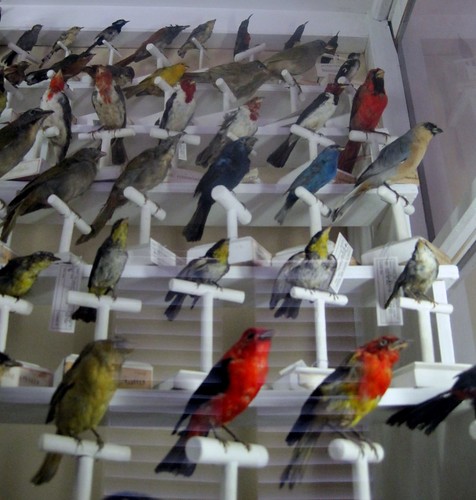
(image by me from Siena Natural History Museum)

Saturday, December 01, 2007

The Disavowed Pleasures of Gowther

It's the end of the semester: classes to conclude! meetings to attend! papers to grade! exams to compose! deadlines to miss! All of us academics are nearing exhaustion.

Agreed! Agreed! And articles to proof! And write! And grants to write! But lord knows it's not as bad as adjuncting. Lord knows it's not bad at all.

Yesterday one of my students observed that "everyone thinks everyone in the Middle Ages was dirty and stupid, but you make it seem like they were just like us." My response: "Yeah...stupid." Thankfully she got the (perhaps ill-advised) joke, and I hope she gets what drove it: another attempt to drive out any sense of temporal superiority or, for that matter, nostalgia.

Strangely enough, her comment came after a class on Sir Gowther, in which I went after the familiar strange mixture of titillation and sanctimoniousness in its opening stanzas. It starts:
God, that art of myghtis most,
Fader and Sone and Holy Gost,
That bought man on Rode so dere,
Shilde us from the fowle fende,
That is about mannys sowle to shende
All tymes of the yere!
More below!

I observed that the lines looks like any of the usual invocations for a Middle English narrative (cf The Avowyng of Arthur and Emaré), but they're not in fact, at least not yet, calling down a blessing on its audience. Rather they throw up a barrier against demonic forces, whose ability to "shende" the human soul is in fact a direct result of the infernal thoughts this very poem inspires. See Neil Cartlidge, at 136, which observes that the opening stanzas problematize
the whole business of tale-telling by implicitly raising the question of discursive responsibility: for if it is accepted that describing the Devil's activities in any sense invites them [a point Cartlidge had already established], then the author's decision to tell the story of Sir Gowther has to be morally questionable.
Not only morally questionable, then, but also an invitation to bodily injury or erotic sin: for the primary demonic threat in Gowther is not to the soul: "Sumtyme the fende hadde postee / For to dele with ladies free" or, as it explains later on, demons "sarvyd never of odyr thyng / But for to tempe wemen yon." By casting its protective net over the readers, the prayer implicitly interpellates them, and its orator, the collective "us," as women-about-to-have-sex-with-(or -be-raped-by-) demons. This is, after all, what demons do, at least within the confines of this poem.

The flirtation of these newly hailed women with--or their perilous proximity to (so much depends on how we understand the demonic sex!)--infernal forces occurs simply because of the telling, and the desire for, this poem, which, according to the poem's own self-promotion, is a "ferly" or "selcowgh" thing to hear. What have we, the listeners, gotten ourselves into? Something--what, I don't quite know yet--much more than the "schame" from which the narrative voice hopes to be shielded. Something terrifying, wonderful, strange, uncanny, monstrous, something in which cupidity and fear and disavowed desire, surely the seed of shame, are inextricably intermingled.

In the most straightforward reading, that shame ("As Cryst fro schame me schyld") is the shame of relating the particular details of how demons, despite lacking bodies of their own, impregnate women. The shame here may also be the shame of lacking a proper explanation for the events of the poem: according to a scholarly consensus (see Aquinas (reply obj 6), who agrees with Augustine), demons do not impregnate women themselves, but rather artificially inseminate women with stolen semen, and thus "the person born is not the child of a demon, but of a man." Because the demonchild Gowther, in other words, should not actually be a demonchild, the shame here is in part the shame of getting the doctrine wrong and then cheekily ascribing the (willfully mistaken!) notion to the misunderstood scholars ("Therof seyus clerkus, y wotte how"). Mostly, however, I think the shame is the shame of wanting to hear this story, despite or indeed because of its dangers, a story of women suffering macerated breasts, friars thrown off cliffs, parsons hung on hooks, nuns (at least in one of the manuscripts) raped and burned to death in their own convent, a story, that is, crowded with the grand guignol of hagiography.
Jesu Cryst, that barne blythe,
Gyff hom joy, that lovus to lythe
Of ferlys that befell.
And that's the beginning of the introduction's final stanza. Give us joy indeed, and give us, but not too much, protection from the shame of our own joy. Although Robert Mills' Suspended Animation: Pain, Pleasure and Punishment in Medieval Culture is only on my shelf, not yet read, I felt certain enough to wind things up by linking the desire for Gowther and the hagiographic pendulation between imitatio and admiratio with the purportedly pious obsession in hagiography with mutilated erogenous zones: faces, breasts, skin, genitals, the beautiful naked bodies of men and women, boys and girls, virgins mostly, made to live out, and die for, fantasies badly veiled by sanctimoniousness.

It's this reading that led to the student remarking on the medievals being just like us. Of course I've just committed a post hoc ergo propter hoc fallacy, but I'd be lying if I said I didn't want to believe that my student, and by extension all my students, found themselves implicated, caught up, in Gowther's pious titillation of torture.

Gowther Recommended Bibliography

Blamires, Alcuin, "The twin demons of aristocratic society in Sir Gowther" Pulp Fictions of Medieval England: Essays in Popular Romance. Ed. Nicola McDonald. Manchester UP. (2004), 45-62


Cartlidge, Neil. "'Therof Seyus Clerkus': Slander, Rape and Sir Gowther", in Corinne Saunders, ed., Cultural Encounters in the Romance of Medieval England. D. S. Brewer, 2005, 135-47


(our own) Cohen, Jeffrey Jerome, "The Body Hybrid: Giants, Dog-Men, and Becoming Inhuman," in Of Giants: Sex, Monsters, and the Middle Ages. Minnesota UP, 1999, 119-141.


Gilbert, Jane, "Unnatural mothers and monstrous children in The King of Tars and Sir Gowther." Medieval Women: Texts and Contexts in Late Medieval Britain. Essays for Felicity Riddy. Ed. Jocelyn Wogan Browne, et al. Brepols, 2000, 329-344


McGregor, Francine, "The Paternal Function in Sir Gowther." Essays in Medieval Studies 16 (1999):67-78


Saunders, Corinne J., "Symtyme the fende". Questions of rape in Sir Gowther." Studies in English Language and Literature: "Doubt wisely". Papers in honour of E.G. Stanley. Ed. M.J. Toswell and E.M. Tyler. Routledge, 1996, 286-303


Uebel, Michael. "The Foreigner Within: The Subject of Abjection in Sir Gowther." Meeting the Foreigner in the Middle Ages. Ed. Albrecht Classen. Routledge, 2002, 96-118.

Friday, July 06, 2007

Cynocephali, Animal Savagery, and Terror

Don't miss the vibrant tools discussion below. Go there first if you haven't already, and then, if you like, enjoy this long post for/over the weekend.

Sometime before 865, Ratramnus of Corbie wrote his Epistola de Cynocephalis, a teratologic work remarkable for focusing on only a single type of creature and for eschewing moralization. In essence, its concern is whether Cynocephali merit evangelization, not whether they, for example, represent backbiting. Following the Augustinian criteria of City of God XVI.8, the letter asserts that the Cynocephali are descended from Adam and hence human, but it doesn't stop here. The rest of letter compiles a Cynocephalic ethnography, muses in an Isidoran fashion on portents, and, finally, demonstrates incontrovertibly that these creatures possess reason.

Understandably, Ratramnus first handles the Cynocephalic voice and form:
forma capitis et latratus canum non hominibus, sed bestiis similes ostendit. Hominum denique est rotundo vertice caelum conspicere, canum vero longo capite rostroque deducto terram intueri, et homines loquuntur, canes vero latrant. (155: 24-27)

the form of their heads and their canine barking shows that they are similar not to humans but to animals. In fact, the heads of humans are on top and round in order for them to see the heavens, while those of dogs are long and drawn out in a snout so that they can look at the ground. And humans speak, while dogs bark.
But he raises these points only to counter them with a list of behaviors that argue for Cynocephalic humanity. That the Cynocephali live together in towns and engage in agriculture, that they evidence modesty by wearing clothing, and that they live together under a law, “Haec enim omnia rationalem quodammodo testificari videntur eis inesse animam” (155: 34-35; all these things seem to demonstrate that some kind of rational soul is in them). Ratramnus also observes that, “Homo vero a bestiis ratione tantummodo discernitur. Quae quod videtur inesse his de quibus loquimur, homines potius quam bestiae deputandi videntur” (156: 13-14; humans can be distinguished from beasts only by reason. From these things, a rational soul would seem to be in those of which we speak; they would seem to be regarded as humans rather than beasts). Ratramnus asserts that anyone who doubts the link between these behaviors and reason must himself lack reason (156: 9).

Ratramnus can't seem, however, to convince himself. Uncertainty pervades his letter, perhaps most evidently in its frequent use of videri (to seem): “videntur eis inesse animam,” “videtur inesse his,” “homines...videntur.” At this stage of his letter all Ratramnus allows, and that tentatively, is the possibility of Cynocephalic humanity, but neither the behavior he has cited nor the teratologic traditions of Christopher and monstrous births to which he next refers provide him with any definitive conclusions. It is only with his final point that Ratramnus at last transforms the uncertain videri to the active, confident videre (to consider or to see):
Accedit ad haec, quod scripta vestra testantur, domesticorum omne genus animalium, quae nostris in regionibus habentur, apud illos haberi. Hoc vero fieri posse, si bestialem et non rationalem animam haberent, nequaquam video; siquidem homini animantia terrae fuisse divinitus subjecta Geneseos lectione cognoscimus. Ut vero bestiae alterius a se generis animantia, et maxime domestici generis, curent et eis diligentiam adhibeant suisque cogant imperiis subjacere et usibus parere, sicut nec auditum ita nec creditum cognoscitur. (157: 10-15, my emphasis)

It is added to these things to which your letter bears witness that all the kinds of domesticated animals that are managed in our regions are managed among them. I consider that this could not be if they had a bestial and not a rational soul, since the living things of the earth were subjected to men by heaven, as we know from having read Genesis. But it has never been heard or believed that animals of one kind can by themselves take care of other animals, especially those of a domestic kind, keep them, compel them to submit to their rule, and follow regular routines.
Ratramnus takes three steps to establish these creatures as human and thus worthy of a missionary effort or, at least, to make them signal the necessary breadth of missionary activity: he silently eliminates their anthropophagy (a usual trait in the teratologic tradition on Cynocephali); he gives them agriculture, shame, clothing, and other human cultural characteristics; above all, he makes them keepers of domestic animals. Ratramnus defines the subjugation of these animals with a clause, “suis cogant imperiis subjacere,” crammed with three synonyms for command. It is this total assurance that confers humanity upon its actors: humans must monopolize dominion over animals if they are to claim human identity through it. With such a reckoning, Ratramnus has no need to account for the partially animal bodies of Cynocephali or their barking: his determination of the Cynocephalic relationship to animals dissipates any counterargument.

Something nevertheless continues to trouble Ratramnus. He adds that, “At vero Cenocephali, cum domesticorum animalium dicuntur habere multitudinem, eis minime convenit bestialis feritas, quorum animalia domestica lenitate mansuefiunt” (157: 15-18; but since the Cynocephali are said to possess a multitude of domestic animals, then animal savagery does not fit them because they tame their domestic animals gently). In characterizing the violence in which the Cynocephali supposedly do not engage with two words meaning “beast,” Ratramnus evokes a moral tradition that associated ferocity with animals: for example, Ambrose’s Hexaemeron VI.3.10 cautions, “If you revel in ferocity, the dominant trait of savage beasts for which reason they are slain, see that you, too, may not become a victim of your own atrocious cruelty.” The moral context cannot, however, exhaust the significance of Cynocephalic gentleness. It must be recognized that bestiae are, in a way, only animalia that refuse the humiliation of domestication, and that domestication cannot be enacted without some kind of subjugation. Nor, given the evidence of Ratramnus’s letter, can the subjugation of the Cynocephali be readily understood as gentle: the Cynocephali wear hides (presumably animal), and the excessiveness of the clause “suis cogant imperiis subjacere” strongly suggests that the Cynocephali master their animals at least through a monopolization of violence. It may be said that they dominate their animals gently, but no animal could ever resist their gentle regime. Ratramnus has not, then, purged his Cynocephali of violence: he has preserved its aspects of mastery for his newly born humans while imperfectly displacing the violence away from its enactors and onto its victims.

Today, I found myself reading Žižek in my study's hideous chair, where I ran across a passage that inspired me to repurpose more of my material on Cynocephali in what, I have to warn you, is going to be more of the same compounded by low-rent Žižekianism. In another discussion on "obscene enjoyment," this time in The Parallax View, Žižek characterizes the torture at Abu Ghraib as "a clash between anonymous brutal torture [i.e., that of S. Hussein's government] and torture as a mediatic spectacle in which the victims' bodies serve as the anonymous background for the stupidly smiling 'innocent American' faces of the torturers themselves" (372) through which the Iraqi victims become initiated into American culture in all its obscene excess; they simultaneously experienced American personal freedom and the outsourcing of torment that sustains it. Towards the end of the discussion, Žižek contrasts the Cold War to the War on Terror (and let's put aside whether his historical contrast works: I'm not so sure it does), where he observes, "The power which presents itself as being under threat all the time, living in mortal danger, and thus merely defending itself, is the most dangerous kind of power, the very model of Nietzchean ressentiment and moralistic hypocrisy" (373).

We have seen the response to the terrorist threat from enemies portrayed as religious fanatics, misogynists, and torturers; the appropriate response, at least so far as the Right is concerned, is to become religiously fanatic, misogynist, and to torture (a common point, available in many places, for example here; there's also Amanda Marcotte's observation that "When conservatives say, 'Freedom isn’t free,' they seem to mean that it exacts a price, but perhaps a more accurate translation would be, 'Freedom is slavery'). As you might expect me to do (and by anticipating your anticipation, I of course promise my secret possession of more thought on the matter than you see here: in other words, "as you might expect me to do" is a profoundly dishonest thing to say, and if I go any further, I won't get out)...okay, as you might expect me to do, I observe that the Cynocephali, despite Ratramnus's testimony, themselves must engage in animal savagery to keep their animals domesticated. They must, because animals are, now per Ratramnus's testimony, by their nature savage. One can hardly blame the Cynocephali, then, for what they must do (although Ratramnus implicitly blames them by declaring that they in fact don't do what we know they must do).

The low-rent Žižekianism follows. In this sense, then, the Cynocephalic body is the image of the constitutive excess of humanity, the 'bestial' acts--subjugation, carnivorousness--in which it must engage to distinguish itself from animals. Simply because of their bodies, the Cynocephali cannot help but act bestially; but they should not be thought other because of this. They are rather the desublimated form of the conflict internal to human identity. At least so long as it's a humanity defined by difference to animals (and I'm becoming increasingly uncertain that that's the only way to do it), there is no way to be human without being bestial.

I think I've hit the end of my tether, at least so long as I'm starting from where I do. I'm ready to try something different or, at least, to push Ratramnus and the Cynocephali to do something different (at least so long as we don't lose animality by reading them as disguised Saracens, which is the usual--and I should say productive--way to study Cynocephali): but I've no idea where to take it.

Texts

The letter, which survives in a single eleventh-century manuscript, is available in PL 121: 1153-56; Ernst Dümmler, ed., Epistolae variorum 12, Monumenta Germaniae Historica: Epistolae 6. (Berlin: 1925), 155-57 (quotations derive from, and are keyed to, this edition); and, in translation, in Paul Edward Dutton, ed., Carolingian Civilization: A Reader, 2nd ed., Readings in Medieval Civilizations and Cultures 1 (Peterborough, Ontario: Broadview Press, 2004). My translations mostly follow Dutton.

Note that a few other writers, all Greek, also remark on Cynocephalic animal husbandry; see Claude Lecouteux, "Les Cynocéphales: Étude d'une tradition tératologique de l'Antiquité au XIIe s." Cahiers de civilisation médiévale 24 (1981): 117-29, at 118, for Cynocephalic husbandry in Ctesias of Cnidus (5th-4th century BCE) and Aelian (1st-2nd century CE); at greater length, see Lecouteux, Monstres dans la littérature allemande, 21, who translates (from Greek into French) a medieval witness to Ctesias in a letter of Photios, a late ninth-century Patriarch of Constantinople.

Cartoon from Momma, by Mell Lazarus, Oct 31 2006, discovered through Comics Curmudgeon, which I love.

Monday, May 28, 2007

Three Quotes for the Holiday

Suete sone, reu on me, and brest out of thi bondis:
For nou me thinket that I se thoru bothen thin hondes
Nailes dreven into the tre; so reufuliche thu honges.
Nu is betre that I fle and lete alle these londis.

Suete sone, thi faire face droppet al on blode,
And thi bodi dounward is bounden to the rode;
Hou may thi modris herte tholen so suete a fode,
That blissed was of alle born, and best of alle gode?

Suete sone, reu on me, and bring me out of this live,
For me thinket that I se thi deth, it neyhit suithe.
Thi fete ben nailed to the tre; nou may I no more thrive,
For al this werld withouten thee ne sal me maken blithe.


So Abram rose, and clave the wood, and went,
And took the fire with him, and a knife.
And as they sojourned both of them together,
Isaac the first-born spake and said, My Father,
Behold the preparations, fire and iron,
But where the lamb for this burnt-offering?
Then Abram bound the youth with belts and straps,
And builded parapets and trenched there,
And streched forth the knife to slay his son.
When lo! and angel called him out of heaven,
Saying, Lay not thy hand upon the lad,
Neither do anything to him. Behold,
A ram, caught in a thicket by its horns;
Offer the Ram of Pride instead of him.
But the old man would not so,
but slew his son, -
And half the seed of Europe, one by one.
Wifred Owen, from Britton's War Requiem


The symbolic order is open to change, it offers no absolute guarantee of meaning or redemption or enjoyment, and its import is the finitude of powers and of the subjects who take shape through their workings. And if the power of the Other is limited, then nothing can help human beings rid themselves of finitude; nor can ultimate enjoyment be attained any more than absolute power, because desire is "change as such" (Lacan, Ethics of Psychoanalysis 239). We need, for the sake of our jouissance, which also means for the sake of the other within and without us, to break the lethal promise of ultimate rescue. No other, divinized or abjected, can make us whole. The logic of sacrifice seeks to occlude that the Other itself lacks, desires, and is transitory.
Louise Olga Aranye Fradenburg, Sacrifice Your Love: Psychoanalysis, Historicism, Chaucer 56-57


For my father's half-brother, whom he never met, Gene Luther Keahi (1949-1968), and for Fadi Raad (1993-2006), and too many others.

Sunday, April 15, 2007

Low Rent Eisenstein


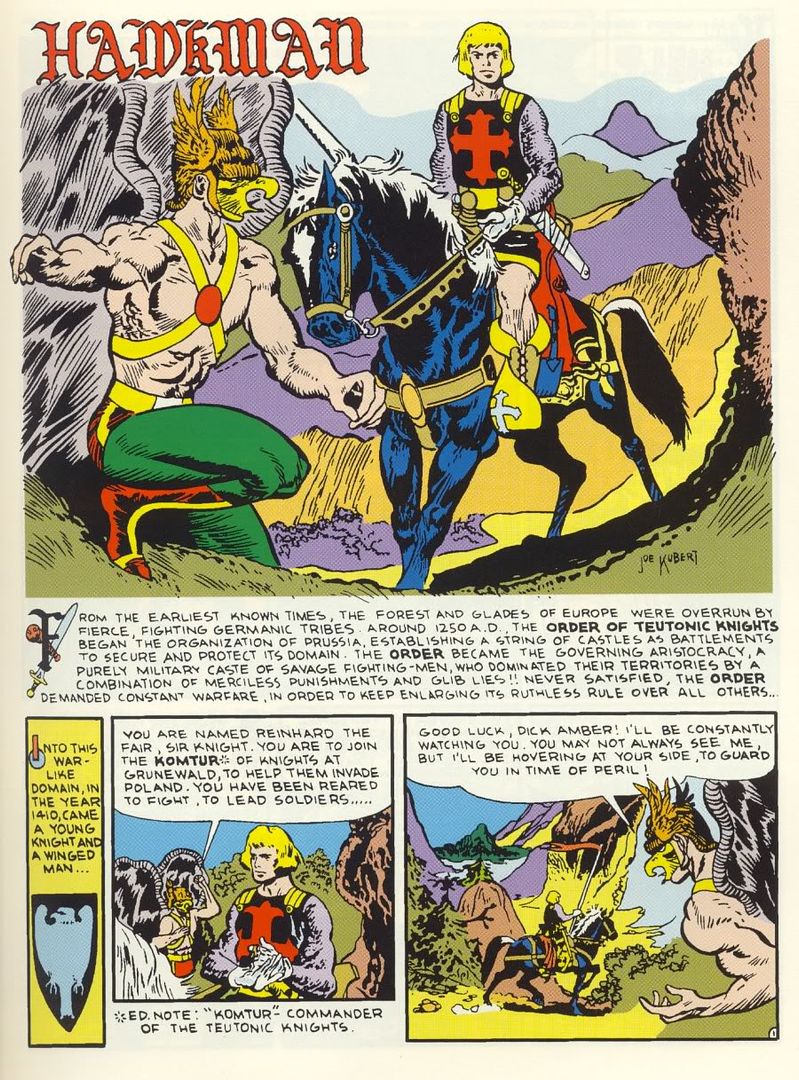
A WWII-era comic, via Crooked Timber, that argues why we fight: because the Germans are racially predisposed (since the 5th century!) to break treaties and kill the innocent. Our racial science is better than yours. (It's easy (and rewarding) to read the rest of the comic: just change the numbers at the end of the address:
AllStarComics24-06.jpg becomes AllStarComics24-07.jpg and so forth. You will note the comic's own collusion with German racial science: the hero's a perfect blond man, and the villains are dark-haired and deformed).