Sunday, June 17, 2012
Edinburgh
by J J Cohen
The rain it raineth. Steady patter of water at the window and a ceaseless procession of bright raincoats and dark umbrellas. The day promised sun but has offered only low clouds and bursts of rain. The abiding grey doesn't annoy me. I've been walking Edinburgh, and its dark stones are livelier wet. A cafe, a museum, a cafeteria called The Mosque gave me windows to watch the city's Sunday progress. I'm back at the hotel now, packing and musing, feeling a need to write.
I'm a little homesick. I miss Katherine and Alex on Father's Day. I missed calling my dad: the first year I've sent him an email for today. Home tomorrow, I know, if I'm able to make my tight connection at Charles de Gaulle. For now I'm thinking about movement, process, community, travel, rain.
'Sensualising Deformity,' the conference I came to Edinburgh to attend, was the kind of event that leaves a long wake. The sessions blended monster theory, disability studies, cultural criticism, and art. Its population of presenters was diverse, and young. It was one of those events that gives you the sense that something important is emerging, something shared and now better recognized. I don't think this emergence will be easy: because so many of the attendees were UK graduate students and post docs, there were numerous stories about the impact of budget cuts on being able to sustain a program of study, and tales as well about the unkindness of established scholars to those with precarious job situations. I frequently found myself wondering at the conference why so many academics are so ungenerous to the next generation, the future of their own field.
I'll be thinking about the conversations that unfolded here for a long time. I made many new friends -- and finally got to meet Margrit Shildrick, whose work I've long admired. Two friends of long aquaintance made the event special: Rosemarie Garland-Thomson, with whom I was in a Body Theory Reading Group in the late 1990s and who has inspired both my work and my thinking about the public responsibilities of the intellectual; and Michael O'Rourke, whom I've known for maybe eight years and who through his being cross with me at just the right moment, his never losing faith, and his own brilliant example ensured that my scholarship didn't take a lonely and historicist swerve c.2005. Having both Rosemarie and MOR at the same conference made me think of debts owed to friends. I was one of the keynotes at the conference (as was Rosemarie) because, in part, as a pioneer in disability studies she helped me to understand our intellectual obligation to speak outside our fields at every opportunity and to imagine as wide a community as possible coming into being through the work we undertake. MOR turned me on to Quentin Meillassoux, and then Graham Harman and Object Oriented Philosophy and Speculative Realism. My keynote was an ecocritical account of the grey ecology that zombies inhabit and figure -- and it wouldn't have happened had he not been the angel attending its birth.
Many years have passed since I have been to Edinburgh. The last time I passed through the city I was backpacking. I'd just come from Skye and Inverness; I was headed to York and Whitby next. That was the summer between completing my BA at the University of Rochester and starting my PhD at Harvard. In that solitude of wandering I'd like to say I grew up, but I don't think that was really the case.
I was afraid of encountering that earlier self as I walked through Edinburgh today. The streets were vaguely familiar, the Royal Mile exactly as I thought it would be again, the castle still stately. But I also went to some sites I hadn't seen before, such as the National Museum: wonderfully, the prehistory of Scotland is told there mostly through stone, a kind of geonarrative of the restless earth. Even the glaciers the exhibit features were rocky, scraping across the mountains like sandpaper and leaving gifts like erratics stranded on transformed landscapes.
And speaking of rocks, as on my first visit I hiked the extinct volcano known as Arthur's Seat. The steep little mountain looms over one of the University of Edinburgh dorms. Since the sun sets so late here, I hiked along the crags and up to the peak on my first night, watching the last rays from the top. A cold wind was blowing, the hills were green and waving with pink and yellow wild flowers. A density of primal lava, the Seat has not eroded like the surrounding area, making its dark rock seem eternal. It isn't. My visit to the museum reminded me that Scotland wandered away from Greenland to bump against England long ago, and that volcanos like this one are the remnant of that collision. The weight of glaciers made Scotland's middle sink; their melting scoured its landscape. Everything changes, nothing endures. I was thinking about the rocks with Pictish and early Christian symbols carved into them I saw at the museum. Some are vivid. Others have faded to merest indentations. None of their messages are easy to comprehend.
I hiked to the top of an extinct volcano and I wondered if I would see or feel anything of the self who hiked that same slope more than two decades ago. If there were traces of his passing to be discerned, I wasn't able to recognize them. That seems to me OK.
And now, off to dinner with MOR and some of the conference organizers. Tomorrow at 4 am, the trek begins towards home.


Thursday, June 14, 2012
REMINDER: Michael Camille Essay Prize Deadline: June 30th

by EILEEN JOY
Just a reminder that the deadline for the first Biennial Michael Camille Essay Prize, jointly sponsored by postmedieval, Palgrave Macmillan, and the BABEL Working Group, is looming: JUNE 30th. To recap:
The competition is open to early career researchers: those currently in M.A./Ph.D. programs or within 5 years of having received the Ph.D. (that will include those graduating in 2007 or later). Essays in all disciplines are encouraged. The prize is for the best short essay (4,000-6,000 words), the 2012 thee for which, inspired by Camille’s last book on the gargoyles of Notre Dame, is: Medievalism and the Monsters of Modernity (conceptualized and imagined in any way the author sees fit). The award for 2012 will include: publication in postmedieval, 250 dollars, and one year’s free print and online subscription to the journal.
The prize is named after Michael Camille (1958-2002), the brilliant art historian whose work on medieval art exemplified playfulness, a felicitous interdisciplinary reach, a restless imagination, and a passion to bring the medieval and modern into vibrant, dialogic encounter. In addition, we wish to honor Camille for his attention to the fringes of medieval society, to the liminal, excluded, ‘subjugated rabble,’ and disenfranchised, and to the socially subversive powers of medieval artists who worked on and in the margins. The prize is also named after Camille because his work was often invested in exploring ‘the prism of modernity through which the Middle Ages is constructed’ and because, as his colleague at the University of Chicago Linda Seidel said shortly after his death, he had ‘a mind like shooting stars.’
Submissions will be judged by a panel of scholars selected from postmedieval’s Editorial Board, and the winner will be announced at the 2nd Biennial Meeting of the BABEL Working Group, to be held September 20-22, 2012 at Northeastern University in Boston, Massachusetts. Please send submissions (as a Word document, formatted according to Chicago Manual, author-date format with endnotes + list of references at end) to the editors, Eileen Joy and Myra Seaman, at postmedievaljournal@gmail.com.
Wednesday, June 13, 2012
GOT YOUR NOSE: Bisclavret defaces his wife
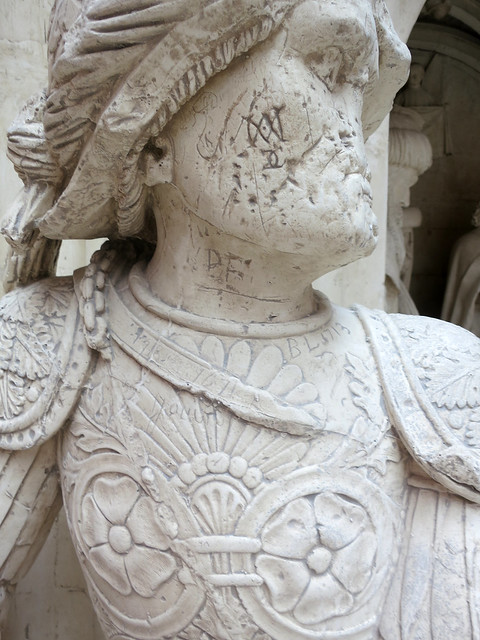 |
| Plaster cast from the Palais de Chaillot |
First, join us in wishing Jeffrey safe travels.
Then, lest it be said that my promises or threats aren't worth the nose they're printed on, here, for your use, is my monumental post on the noselessness of Bisclavret's wife.
Recall that towards the end of Marie's lai, Mr. B's wife shows up at court, only to be attacked by her lupine husband:
Oiez cum il s'est bien vengiez!The loss of the nose has long been a rich interpretative site in Bisclavret criticism. We can divide the readings into several groups:
Le nes li esracha del vis.
Que li peüst il faire pis? (Bisclavret 234-36)
"Just hear how successfully he took his revenge. He tore the nose right off her face. What worse punishment could he have inflicted on her?" (translation by Gallagher. My own translation would go like this: "Listen to how well he avenged himself! He tore her nose off her face. What worse could he have done to her?")
- psychoanalytic ones, which pun on vis [face] and vit [penis]: e.g., Bloch, Labbie, and Dolores Warwick Frese, "The Marriage of Woman and Werewolf: Poetics of Estrangement in Marie de France's 'Bisclavret'" in A. N. Doane's and Carol Braun Pasternack's anthology Vox Intexta: Orality And Textuality in the Middle Ages, rooted, I believe, in Jean-Charles Huchet, "Nom de femme et ecriture feminine au Moyen Age: Les Lais de Marie de France," Poetique 48 (1981): 407-30. Essentially, Ms. B had illegitimately taken on the phallic function and has it torn from her. This helps explain why only her female descendants are noseless;
- claims that nose-removal was a common torture in the Middle Ages, which I think is a wild exaggeration: I'm looking forward to seeing Larissa Tracy's further contextualization: I believe she's arguing that the court of Henry II, being antipathetic to torture, would have found the scene repugnant;
- claims that the nose-removal makes the wife more bestial: for reasons I'll explain (far) below, I disagree; I'm more in the neighborhood (less in the same block than on the same bus line) as Laurence M. Porter's proposal in Women's Vision In Western Literature: The Empathic Community that "Wolves have prominent muzzles and the missing nose makes Bisclavret's wife's face resemble a human skull more than a wolf's head, suggesting the skull underneath the skin, the illusoriness and transcience of sexual delight";
- interconnections with many, many stories of Roman virgins and, in particular, virgin saints, who cut off their noses to make themselves unattractive to the Barbarian invaders [see Claude Thomasset, 'La femme sans nez', Littérature et médecine II, ed. Jean-Louis Cabanès, Eidolôn, 55 (Bourdeaux: Université Michel de Montaigne, Bourdeaux III, 2000), 57-52 and Jane Tibbetts, 'The Heroics of Virginity: Brides of Christ and Sacrificial Mutilation," Women in the Middle Ages and the Renaissance: Literary and Historical Perspectives Ed. Mary Beth Rose. Syracuse: Syracuse UP, 1986]: implicitly, then, Bisclavret's assaulting his wife's attractiveness;
- and finally, most influentially, a great many claims that losing the nose [or losing the nose and ears] was a punishment for an adulterous wife. See Stith Thompson Q451.5.1, Nose cut off as punishment for adultery. This requires a lot of detail.
Saxo Grammaticus tells the story of Hjalte, who's with a ladyfriend while his king's being betrayed. When Hjalte hears the sound of battle, he decides to leave her to rescue his lord. His ladyfriend asks him "si ipso careat, cuius aetatis viro nubere debeat," if she should lose him, how old a man ought she to marry? He answers her by cutting off her nose.
Robert Stanton directed me to the laws of Cnut, which punish a female adulterer with the loss of her nose and ears. Frederick II of Sicily (1194-1250) commanded that an adulterous woman's nose be amputated, unless her husband didn't want this: otherwise, she would just be flogged ("adultera convicta de adulterio traditur viro, ut in recompensationem thori violati, truncetur ei nasus, & si maritus ei truncare non vult, fustigabitur"; h/t Shulamith Shahar The Fourth Estate for this reference).
Still earlier law codes might be referenced, with increasingly remote chances of relevance: Ezekiel 23:25 hints at the loss of nose and ears for adultery: medieval Biblical commentaries might profitably be consulted; the Byzantine Ecloga of 726 punishes adulterers of both sexes with nose-slitting; and Diodorus of Sicily's 1st c. BC universal history says that in Egypt, "In case of adultery, the man was to have a thousand lashes with rods, and the woman her nose cut off. For it was looked upon very fit, that the adulteress that tricked up herself to allure men to wantonness, should be punished in that part where her charms chiefly lay" (thanks to Sharon Kinoshita for proposing the web search that led me to these sources).
Looking ahead,
We might also look to the witness of medieval translations and adaptations of "Bisclavret." In Biclarel [warning: pdf], Mr. B just mutilates his wife's face (373-74), with no specific reference to her nose, and then she's walled up, presumably to be crushed or to starve to death (454-5). In the Icelandic version, he tears off her clothes and nose, and in the Old Norse version, "Bisclaret," he tears off his wife's clothes, but her female descendants are still born noseless. Incidentally, "Bisclaret" ends in a tantalizing way for werewolf scholars: "Nothing that happens now is more true than this adventure we have told you about, for many strange things happened in olden times that no one hears mentioned now. He who translated this book into Norse saw in his childhood a wealthy farmer who shifted his shape. At times he was a man, at other times in wolf's shape, and he told everything that wolves did in the meantime. But there is no more to be said about him. The Bretons made a lai, 'Bisclaret', of this story which you now have heard" (translation by Robert Cook and Mattias Tveitane).
And that would seem to be that: Ms. B loses her nose as a sign of her marital infidelity, or to humiliate her, or to disfigure her. Absent legal or (other) narrative evidence particularly from the court of Henry II, we don't have firm ground for these explanations, but we probably have enough to make our claims with sufficient confidence, and to say, as well, that any further interpretation would just be fanciful, evidence only of our critical ingenuity in this ongoing professional party game we call "producing a reading."
But I can't help myself: I have to propose one more possibility. Recall how my previous Bisclavret post takes the lai's opening as structurally analogous to a bestiary. From that, I'm led to illustrations in the bestiaries of Adam naming the animals:
 |
| Aberdeen Bestiary f 5r, detail |
She had been afraid of a husband able to shift from man to wolf; she wanted to be married only to a human, and nothing more; and for that, she's punished with nothing less that an inescapable humanity. In a lai, it's hard to imagine a worse punishment! She and her daughters, barred from the dangerous fun of men, have been made...well, boring.
More to come, perhaps, if you think this is worth developing.
Off to Edinburgh

.... and the "Sensualising Deformity" conference, where I will be presenting some version of this.
I'm very much looking forward to the event, not only because I get to see old friends (Michael O'Rourke! Rosemarie Garland-Thompson!) and make some new ones, but also because I haven't been to Edinburgh since the summer between finishing my BA and starting graduate school. I wandered for a few months around the UK, not carrying much more than some books and a backpack. Edinburgh was one of my stops. I climbed Arthur's Seat, took a haunted pub tour, wandered the streets. It was Fringe Festival, so the place was crowded -- and I'd been spending a great deal of time alone in these peregrinations, so the city's vitality was a bit overwhelming. But I saw Equus performed (naked and outdoors), heard some good music, was impressed by the beauty of the place ... it will be good to be back.
Monday, June 11, 2012
The Grey of a Zombie Ecology
by J J Cohen
My Big Project this summer -- and main way of ensuring that I never complete the book about the liveliness of stone I received fellowship funding to write, and will thereby end my career in misery and disgrace -- is an edited collection Prismatic Ecologies: Ecotheory Beyond Green (University of Minnesota Press). Mostly, Prismatic been a good experience: the majority of the contributors have been on time and at the peak of their creativity, amenable to the edits I've made to their essays and eager to have this collaboration succeed. Some of its most prolific contributors (Graham Harman, Tim Morton) have also been its swiftest -- no doubt there is a correlation there. I've had a few stragglers, and some essayists who required more prodding than I would have liked. The essay on "Red" had to be replaced this spring, but I love the piece that I now have. I recently lost both "Silver" and "Grey" -- and to ensure that something in that shade appears, I've been reworking my zombie project (which always had an ecological bent) to widen its scope into a grey [undead] ecology.
So far I'm pleased with the result. I'll be giving the essay a trial run in Edinburgh this week, where I'm a speaker at this conference. I paste its opening below; let me know what you think.
---------------

Grey is the fate of color at twilight. As the sun’s radiance dwindles, objects receive less light to scatter and absorb. They yield to the world a diminishing energy, so that the vibrancy of orange, indigo and red dull to dusky hues. A grey ecology, then, might seem a moribund realm, an expanse of slow loss, wanness and withdrawal, a graveyard space of mourning: no sensual bodies here, only perished flesh. Perhaps with such muted steps the apocalypse arrives, not with a bang but a dimming. Or maybe ashen grey is all that remains after the fires of the world’s end have extinguished themselves, when nothing remains to burn.
Yet this affective disposition in which greying signals depletion and lifelessness reveals only the stubborn embedment of our anthropocentricity. The colors which constitute the small portion of the spectrum humanly apprehensible recede, but they do not take the world’s vitality with them. The grey hour is liminal, a turning point at which owls, mosquitoes, vampires and the wind thrive, when stone cools for a while and continues its epochal process of becoming dust, when animals and elements continue indifferent to our proclivity to think that an evening’s color drain is a metaphor for human impermanence, or a cosmic acknowledgment of our little fits of melancholy. Grey includes death, but reminds that human mortality is a continuation of life by other means. We are too enamored of the red and blue of catastrophe – of a world destroyed in flame and flood. We like to imagine our own end, and assume at the demise of our race the world likewise terminates (fade to black) or that planet Gaia returns to the balance it possessed before apes became profligate humans (fade to deepest green).
Either way, the apocalyptic imagination has difficulty discerning the vivaciousness of grey. The gloaming is a place of life, but not necessarily in those sublime forms that we expect life to assume. A sensual grey ecology (and the grey aesthetics that accompany its exploration) is inhuman, but that does not render it misanthropic, disembodied or outside the human. Inhuman means "not human," of course, and therefore includes a world of forces, objects, and nonhuman beings. But in-human also indicates the alien within (a human body is an ecosystem filled with strange organisms; a human collective is an ecosystem filled strange objects), and requires as well a consideration of the violently inhumane. Grey, the nightfall hue of the in-between and the uncertain, a tint of many shades, is not easily circumscribed. It's an open aesthetic.
Yet a community comes into being through boundary. Forces, beings and things supposedly left outside dwell in an extimate or medial space, the unsettled oikos of dusk's fade. This liminal expanse marks the habitation of unfinished business, of traumas and exclusions. The story it conveys includes histories of injustice and violence. Grey is therefore the realm of the monster, that which appears at the perilous limit between what we know and what we do not wish to apprehend, what we are and what we must not be, what we fear and what we desire. Like the monster who conveys its force, a grey aesthetics will often take anthropomorphic form: our perceptions of the world are irremediably shaped by our humanity, and although we can attempt to discern what it is like to be a nonhuman thing, “one can never entirely escape the recession into one’s own centrism.”[1] Yet in grey – a process more than a color -- can be discerned (not clearly, but as if it twilight) the inhumanity through which dominating notions of the human come into being, notions that emerge through the sorting of who and what gets to dwell in the house and own a proper life, who and what will be excluded from both. Grey reveals the inhuman as a thriving of life in other modes, a vitality even in death that demonstrates how the nonhuman is already inside, cohabitating and, long after we perish, continuing. Grey is the human in the microbe and the stone as well as the virus and the rock in the human.
A grey ecology is an expanse of monsters, but that isn’t in the end such a dim place to dwell.
My Big Project this summer -- and main way of ensuring that I never complete the book about the liveliness of stone I received fellowship funding to write, and will thereby end my career in misery and disgrace -- is an edited collection Prismatic Ecologies: Ecotheory Beyond Green (University of Minnesota Press). Mostly, Prismatic been a good experience: the majority of the contributors have been on time and at the peak of their creativity, amenable to the edits I've made to their essays and eager to have this collaboration succeed. Some of its most prolific contributors (Graham Harman, Tim Morton) have also been its swiftest -- no doubt there is a correlation there. I've had a few stragglers, and some essayists who required more prodding than I would have liked. The essay on "Red" had to be replaced this spring, but I love the piece that I now have. I recently lost both "Silver" and "Grey" -- and to ensure that something in that shade appears, I've been reworking my zombie project (which always had an ecological bent) to widen its scope into a grey [undead] ecology.
So far I'm pleased with the result. I'll be giving the essay a trial run in Edinburgh this week, where I'm a speaker at this conference. I paste its opening below; let me know what you think.
---------------

Grey is the fate of color at twilight. As the sun’s radiance dwindles, objects receive less light to scatter and absorb. They yield to the world a diminishing energy, so that the vibrancy of orange, indigo and red dull to dusky hues. A grey ecology, then, might seem a moribund realm, an expanse of slow loss, wanness and withdrawal, a graveyard space of mourning: no sensual bodies here, only perished flesh. Perhaps with such muted steps the apocalypse arrives, not with a bang but a dimming. Or maybe ashen grey is all that remains after the fires of the world’s end have extinguished themselves, when nothing remains to burn.
Yet this affective disposition in which greying signals depletion and lifelessness reveals only the stubborn embedment of our anthropocentricity. The colors which constitute the small portion of the spectrum humanly apprehensible recede, but they do not take the world’s vitality with them. The grey hour is liminal, a turning point at which owls, mosquitoes, vampires and the wind thrive, when stone cools for a while and continues its epochal process of becoming dust, when animals and elements continue indifferent to our proclivity to think that an evening’s color drain is a metaphor for human impermanence, or a cosmic acknowledgment of our little fits of melancholy. Grey includes death, but reminds that human mortality is a continuation of life by other means. We are too enamored of the red and blue of catastrophe – of a world destroyed in flame and flood. We like to imagine our own end, and assume at the demise of our race the world likewise terminates (fade to black) or that planet Gaia returns to the balance it possessed before apes became profligate humans (fade to deepest green).
Either way, the apocalyptic imagination has difficulty discerning the vivaciousness of grey. The gloaming is a place of life, but not necessarily in those sublime forms that we expect life to assume. A sensual grey ecology (and the grey aesthetics that accompany its exploration) is inhuman, but that does not render it misanthropic, disembodied or outside the human. Inhuman means "not human," of course, and therefore includes a world of forces, objects, and nonhuman beings. But in-human also indicates the alien within (a human body is an ecosystem filled with strange organisms; a human collective is an ecosystem filled strange objects), and requires as well a consideration of the violently inhumane. Grey, the nightfall hue of the in-between and the uncertain, a tint of many shades, is not easily circumscribed. It's an open aesthetic.
Yet a community comes into being through boundary. Forces, beings and things supposedly left outside dwell in an extimate or medial space, the unsettled oikos of dusk's fade. This liminal expanse marks the habitation of unfinished business, of traumas and exclusions. The story it conveys includes histories of injustice and violence. Grey is therefore the realm of the monster, that which appears at the perilous limit between what we know and what we do not wish to apprehend, what we are and what we must not be, what we fear and what we desire. Like the monster who conveys its force, a grey aesthetics will often take anthropomorphic form: our perceptions of the world are irremediably shaped by our humanity, and although we can attempt to discern what it is like to be a nonhuman thing, “one can never entirely escape the recession into one’s own centrism.”[1] Yet in grey – a process more than a color -- can be discerned (not clearly, but as if it twilight) the inhumanity through which dominating notions of the human come into being, notions that emerge through the sorting of who and what gets to dwell in the house and own a proper life, who and what will be excluded from both. Grey reveals the inhuman as a thriving of life in other modes, a vitality even in death that demonstrates how the nonhuman is already inside, cohabitating and, long after we perish, continuing. Grey is the human in the microbe and the stone as well as the virus and the rock in the human.
A grey ecology is an expanse of monsters, but that isn’t in the end such a dim place to dwell.
[1]
Ian Bogost, Alien Phenomenology, or What
It’s Like to Be a Thing (Minneapolis: University of Minnesota Press, 2012)
80. On the unavoidability of anthropocentrism see also 64.
Friday, June 08, 2012
ITM Moderation Policy
by J J Cohen
It has been a while since we have spoken about the blog's comment moderation policy, so I thought it would be useful to remind readers of how it works.
In the Middle is a moderated blog that encourages comments from readers. We publish the vast majority of comments submitted to the blog. Anonymous advertisements and other kinds of spam are never published. We are always happy to feature notices of new books in the field, to promote conferences, and to help our readership garner contributions or attention for their projects; do not hesitate to approach any of the blog co-authors for assistance. The comment threads thrive on generosity and respectful disagreement. We do not publish ad hominem attacks, and we do our best to ensure that tone remains civil -- ideally, as it would be at the Q&A of a vigorous conference session. We do not abet trolling. Moderation is not the same as eliminating disagreement. The internet too often fosters drive-by snide and brief but dismissive remarks; check out the comment threads of any major newspaper (or even Inside Higher Ed, or The Chronicle of Higher Education) and you will witness ample, succinct disdain. ITM is a space for thoughtful commentary that advances conversation. Comments aimed at shutting conversation down, that make accusations rather than advance dialogue, or that stubbornly repeat points already made without elaboration are unlikely to be published. Very few such comments are in fact submitted, but we have found them to be stultifying if published. Each of the blog's four co-authors has the power to decide not to allow a comment (though we typically confer before making a decision). We also recognize that there will often be readers who will disagree with our judgments.
We did not come to the decision to moderate capriciously. Fortunately the internet is wide and offers many, many spaces for conversations of various kinds. We cherish the community that you as a reader have helped us to build here at ITM, and we are dedicated to its continued thriving.
It has been a while since we have spoken about the blog's comment moderation policy, so I thought it would be useful to remind readers of how it works.
In the Middle is a moderated blog that encourages comments from readers. We publish the vast majority of comments submitted to the blog. Anonymous advertisements and other kinds of spam are never published. We are always happy to feature notices of new books in the field, to promote conferences, and to help our readership garner contributions or attention for their projects; do not hesitate to approach any of the blog co-authors for assistance. The comment threads thrive on generosity and respectful disagreement. We do not publish ad hominem attacks, and we do our best to ensure that tone remains civil -- ideally, as it would be at the Q&A of a vigorous conference session. We do not abet trolling. Moderation is not the same as eliminating disagreement. The internet too often fosters drive-by snide and brief but dismissive remarks; check out the comment threads of any major newspaper (or even Inside Higher Ed, or The Chronicle of Higher Education) and you will witness ample, succinct disdain. ITM is a space for thoughtful commentary that advances conversation. Comments aimed at shutting conversation down, that make accusations rather than advance dialogue, or that stubbornly repeat points already made without elaboration are unlikely to be published. Very few such comments are in fact submitted, but we have found them to be stultifying if published. Each of the blog's four co-authors has the power to decide not to allow a comment (though we typically confer before making a decision). We also recognize that there will often be readers who will disagree with our judgments.
We did not come to the decision to moderate capriciously. Fortunately the internet is wide and offers many, many spaces for conversations of various kinds. We cherish the community that you as a reader have helped us to build here at ITM, and we are dedicated to its continued thriving.
Tuesday, June 05, 2012
Two Language Links of Great Use

Via Irina Dumitrescu, two valuable resources for ITM readers.
1. Digitized versions of the 245 Loeb classical volumes that have passed into the public domain are available for download here:
http://ryanfb.github.com/
2. Under the clever name of Liberation Philology, Ross Arthur's language drill software is now available for iPad and iPod. Four languages have been released so far: Latin, Ancient Greek, Old English and Occitan. I haven't had the chance to evaluate the programs yet but intend to. If you've tried them out, please post in the comments below and let us know how you found them. The iPads of the world need more Latin, Ancient Greek, Old English and Occitan upon them.
Friday, June 01, 2012
Bisclavret's (Secret) Diet
by Karl Steel
Our readers likely remember how Marie de France's "Bisclavret" begins, because it's one of our favorite stories:
Quant de lais faire m'entremetFrightening, no? Well, no, not really, since we never see our werewolf hero [hereafter Mr. B] eat anyone. Or really, anything (barring, perhaps, his estranged wife's nose). When Mr. B's wife wheedles him into giving up his secret, lupine life, he confesses that when he becomes bisclavret he goes into the great forest, into the deepest part of the woodland, and there lives on prey and plunder ("vif de preie e de ravine").
ne voil ubliër Bisclavret.
Bisclavret a nun en Bretan,
Garwalf l'apelant li Norman.
Jadis le poeit hum oïr
e sovent suleit avenir,
hume plusur garwalf devindrent
e es boscages maisun tindrent.
Garwalf, ceo est beste salvage;
tant cum il est en cele rage,
humes devure, grant mal fait,
es granz forez converse e vait.
Cest afere les or ester:
del bisclavret vus voil cunter. (Bisclavret, 1-14)
[In my effort to compose lays I do not wish to omit Bisclavret--for such is its name in Breton, while the Normans call it Garwaf. In days gone by one could hear tell, and indeed it often used to happen, that many men turned into werewolves and went to live in the woods. A werewolf is a ferocious beast which, when possessed by this madness, devours men, causes great damage, and dwells in vast forests. I leave such matters for the moment, for I wish to tell you about Bisclavret" (translation by Gallagher)].
This is violent language, but there's nothing here about his explicitly eating humans. At least not so far as he tells his wife, or us, for that matter. Jeffrey will remark on the vagueness of Mr B's account of his diet in a forthcoming piece in Studies in the Age of Chaucer; Burgwinkle's talked about it too ("As he ceases to be dangerous – no devouring of men that we know of – his wife appears ever more treacherous" (166); no doubt there's more: I don't have Bynum's discussion on hand, for example (although I don't think McCracken and Kinoshita discuss this matter in their recent critical companion to Marie).
Readers of my AVMEO essay would expect me to suspect Mr. B of anthropophagy: wolves like to eat people, and Marie's already told us werewolves eat people. Only special pleading could get Mr. B off the hook: maybe, some might say, Mr. B would be unlikely to find many humans to eat in the deepest part of the forest. That's not much of a defense. It's easier to accuse Mr. B of hiding the nastiest truth from his wife, who nonetheless proves that she understands him perfectly well by immediately plotting to get rid of him. More sympathetically, we might even suspect Mr. B not of being duplicitous, but of being too self-deluded to admit, even to himself, what he's really doing.
Maybe we can suspect worse. For while there's something marvelous about not being confined by the armor of an alienating (human) identity, there's also something horrific (to us) about letting the human frame slip. Again following the path laid by my AVMEO essay, I suggest that Mr. B's own vagueness hints at the consequences of giving up on human supremacy, namely, that once human supremacy doesn't matter, humans fall under the general category of "prey and plunder." There's no need for Mr. B to conceal anthropophagy, but neither does he need to disguise it with a euphemism, because, for him, human flesh is just like other fleshes. There's violence here; there's a wrong being done, to someone or something; but it's not a particular violence, or a violence that quite knows what it's injuring, unless it's the particular violence through which a nobleman sustains his position within the state of exception.
The dehumanized point of view isn't the only stance the lai takes, however. Its opening doesn't forget about the specificity of human flesh, not at all. I propose that we read the opening lines as modeled on a bestiary, not at all an inconsequential genre for the late twelfth-century England in which Marie wrote. See the Aberdeen Bestiary's entry on the wolf, for example. Like Marie's lai, we have an initial discussion of names, followed by a summary of behavior. To be sure, I may be over-reading the resemblance, but I suggest it to call attention to the generic difference between the lai's narrative and the lai's opening. Marie opens with what we might call a scientific and humanist voice, maybe like a bestiary, maybe not. Whatever the voice, it's knowledgeable, distant, one that looks out at the nonhuman world, always thinking of how it might help or hurt people. To this voice, a werewolf, like wolves in general, can only be a threat.
(Monday edit: I really do need to say, here, that Susan Crane's Animal Encounters will be doing interesting stuff with bestiaries and Bisclavret in ways that will be enormously important to my own developing Bisclavret argument)
The narrative voice, on the other hand, doesn't care so much about human supremacy. For this point, in the next few months, look for Cohen and, as well, Susan Crane's Animal Encounters; also see McCracken on translation and movement. The narrative voice concerns itself with gender and sexuality (see Burgwinkle and Tovi Bibring), and with feudal loyalties, but not with humanity, except to observe how it's slipped. Note that when the King meets (the) bisclavret, he declares, first, that "ele [i.e., this beast] a sen d'ume" [154; this beast has human intelligence], and then revises himself three lines later: "ceste beste a entente e sen" [157; this beast has understanding and intelligence]. Beasts, he realizes, have their own intelligence, not a wan imitation of human reason, but rather their own. When anthropocentrism collapses, what dangers follow?
We might therefore hear Mr. B's "preie e ravine" as at once being aware of the violence of appetite and unaware of the specificity of human flesh as compared to the flesh of deer, or pigs, or sheep. Mr. B may be hiding something from his wife; or he might just have forgotten, like most eaters, that what he eats has any significance apart from how it benefits him. After all, he's concerned mainly with his own safety, not hers, and not with--it seems--ours.
Or he might be observing that eating means subjecting someone or something to prey and plunder; that it means taking someone's "better part" (again, my AVMEO essay), regardless of what that thing is. This is a lai, in other words, that knows what it is to eat in a world without the comforts of a naturalized, absolute human privilege.
Next-Day Edit: that should read "without the comforts of a naturalized, absolute privilege, human or otherwise." For some recent discussions of posthuman ethics, relevant to my post, see Levi Bryant and Scu at Critical Animal. I think Scu gets it exactly right when he says "Ethics is not a pathway for innocence. Rather, it is about how to live after innocence, how to exist in a fully post-lapsarian world." I think that "Bisclavret" might answer Levi's statement that he's "not even sure what a non-anthropocentric ethical theory would look like." Well, here's one, and it's lycanthropocentric. It's not a flat ontology (edit of the edit: or rather, not a flat ethics), because--as Bogost reminds us--there's no escaping -centrism, of whatever sort. But to eat from the perspective of the wolf (as I suggest the Wolf-Child of Hesse does) or the werewolf (as Mr. B does), is certainly to be non-anthropocentric. Edit of the edit: although I may be speaking far above my pay grade, and certainly far outside my expertise, while we might be able to conceive of a flat ontology, I'm not sure we, or anything else, can conceive of a flat ethics.
And one more next-day edit: I know that going into the deep woods to "vif de preie e de ravine" essentially describes the life of a poacher, which matters, of course, in late twelfth-century England, given the rising importance of royal forest privileges. But I just don't see that observation leading to an interesting reading. I'm willing to be convinced otherwise.
That's all I have for now, though I have notes on hand for talking about the eaten nose. Those who looked at my book two proposal might suspect (correctly) that this material will probably form the introductory section to second chapter, leading up--of course--into my Wolf Child of Hesse discussion. Time, and effort, will tell. For now, though, I'm planning to learn what the latest issue of postmedieval has to say about about lepers.
(video from Emilie Mercier's animated Bisclavret)
Wednesday, May 30, 2012
NOW PUBLISHED: New Issue of postmedieval with Essay Cluster on Disability and the Social Body

A modest proposal for medieval disability scholars: let's indeed take
the distinction between ‘impairment’ and ‘disability’ off the table, and
while we’re at it, let's worry less about defining ‘disability,’ too.
Let's complement the abundant studies concerned with the manners in
which society at large might create ‘disabled’ outgroups
(medicalization, oppression, and so on) in favor of an inquiry into the
transformative effects that ‘disabled’ bodies might operate on other
categories of social identity. We must consider not only that disability
is constructed by bodily difference and by social perception, but also
that disability itself – whatever that is! – (re)constitutes and
(re)configures other, contiguous social categories. What will happen,
for instance, if we think of the medieval ‘disabled’ not as a
marginalized group, but as individuals (or groups of individuals sharing
certain physical/mental characteristics)
endowed with a unique capacity to redraw boundaries between margins and
center? Disabled bodies manifest a particular potential to perturb
existing social categories in the largely non-exclusionary,
pre-institutionalization, pre-nursing home Middle Ages, where the
much-vaunted (apparent) lack of a notion of ‘disabled’ identity renders a
broader swath of social boundaries permeable to the non-normative body.
In other words, medievalists are perhaps the scholars best
situated to escape the reductive binaries dominating contemporary
disability studies, to trouble these notions through new critical
conceptions of disability and community.
Julie Singer, "Disability and the Social Body" (postmedieval 3.2: 2012)
Myra Seaman and I are happy to announce the publication of the latest issue of postmedieval (Vol. 3, Issue 2), which includes a cluster of essays, edited by Julie Singer, on "Disability and the Social Body," that take up a diverse number of fields and disciplines, from musicology to French fabliaux to male friendship in 15th-century Cairo to hagiography to premodern medicine, as well as three regular articles (Chaucer! Mongols! Lesbians! Virgin Martyrs!), and you can see the full Table of Contents here:
Cluster Essays:
- Cluster Editor's Introduction: Disability and the Social Body (Julie Singer)
- How to Kiss a Leper (Julie Orlemanski)
- The Disabled Body in the Fabliaux (M. Andia Augustin)
- Drug Overdose, Disability, and Male Friendship in Fifteenth-Century Mamluk Cairo (Kristina Richardson)
- ‘That suck’d the honey of his music vows’: Disability studies in early modern musicological research (Samantha Bassler)
- Queer Relics: Martyrological Time and the Eroto-Aesthetics of Suffering in Bertha Harris's Lover (Kendra Smith)
- Networks of Exchange in The Franklin's Tale (Janet Thormann)
- Monstrous Mongols (Noreen Giffney)
Sunday, May 27, 2012
My Next Book: A Prospectus of a Prospectus

First: do please look again at the Wee Plea, and, if you want to continue the conversation, please join the ongoing post on activism and the academy.
====================
How to Make a Human's epilogue explores a handful of works willing to risk all by abandoning humanism: the tradition of the15 Signs of the Last Days; a lost oxen story from Paulinus of Nola; a holy horse carcass from Folcuin of St. Bertin’s portion of the Deeds of the Abbots of Saint Bertin; and a middle bit from Sir Gowther.
My next book will pick up where the first left off by concentrating on medieval works that imagine what it might mean to give up on human dominance. None of the works I'll examine in Book Two salves a nervous human conscience; all offer a way out of humanism, but at the price, not of humiliation, precisely, but of something far riskier than humbleness.
Surely there are other texts I could look at. But I'm a medievalist, so I'm writing about medieval texts. If you were to suggest that I might learn to write about something else, I'd pack my ears loosely with garlic and flee. Less glibly, I'd say that I'm interested in the outliers to a textual climate almost universally committed to human supremacy. I'm interested in texts that at least propose to leave off human supremacy, even though so much—salvation, most notably—is at stake.
Here's an outline, like the whole project, tentatively proposed. Following the introduction (duh), there will be three chapters: on pets; on feral children; and on worms and corpses. The conclusion will possibly develop the essay on fish knights I wrote with Peggy McCracken (incidentally, Peggy M. and Sharon Kinoshita have just come out with a book on Marie de France: well worth using). I hope to do Book Two in 65-80K words, that is, about 50-65K fewer words than How to Make a Human. All three chapters will have been published in some form by the time the book appears, as 2,000 words (dead pets), 7500 (feral children), and 5600 (worms). The book will allow each chapter to be the length it wants to be, likely 15-20K each, with another 20-25K words available for the intro and conclusion.
In more detail, the DEAD PETS chapter will revisit Cary Wolfe and Jonathan Elmer's old notion of the “Logic of the Pet” to see what affect and habit can do. No surprise, Haraway will be important here, but I imagine I'm going to turn up a host of other pet research once I start digging; as for affect, I barely have any idea where to begin: Fradenburg? Bersani? The chapter will start with Yvain's lion, if only because everyone's always asking me about it; then (maybe?) look at Bevis of Hampton's horse, Arondel; and conclude with a Middle English version of the canis legend (you know, the story of the dog, the baby, the snake, and an impetuous knight) in which the knight, mad with grief and guilt, drowns himself. I'll be happy to talk about other animal companions, if you have any on hand. Next day edit: rather than talk about Arondel, I think I'll do a pocket history of medieval pets and pet love, to set up the dogs story: I have material already on hand on Chaucer's Prioress; likewise Tristan's dog; and I can build on large body of already existing work on medieval hunting dogs.
The FERAL CHILD chapter will, in effect, follow humans out into the wild, by starting with another version of the canis legend in which the grieving knight does just that. If you've already read AVMEO, you know some of what I'll do here: my primary text will be the story of the Wolf Child of Hesse, from the Chronicle of the Benedictine Monastery of Saint Peter of Erfurt, although I plan to provide a pocket history of medieval and early modern feral children. Where chapter one centered on affect (how we're remapped by feeling, even to the point of suicide), chapter two will center on feeding and, in a larger sense, action, as in: what can we do when we can't let humanism guide us anymore? What might it look to eat without the confidence of doing the right thing, without the protection of a good conscience? My philosophical guides will be the ethical quandaries raised by Derrida's meditations on eating, and especially those of object-oriented philosophy and other new materialisms, for example, Ian Bogost's section on metaphorism in Alien Phenomenology and, I suspect, Karen Barad's (gigantic!) Meeting the Universe Halfway. I might even be able to squeeze in an appreciation of the brilliant (Not) Tilda Swinton twitter account. Likely I'll have to look at wilder manifestos on ethical eating.
The WORMS chapter turns from eating to being eaten. Having started with affect, and moved on to behavior, I'll be finishing with matter, with the flux of things that goes on, indifferent to our feelings or actions. I'll start by discussing a famous column from the Abbey of St. Marie in Souillac (see image above: for the whole flickr set from my visit, see here). My primary texts, however, will be medieval death art, particularly the Disputation Between the Body and Worms and its illustrations, from that well-studied Carthusian miscellany, British Library Add. 37049. Perversely, maybe, my reading of this pious material will be profane, not so much indifferent to its proper spiritual context but rather open to a more expansive sense of context than usual. I'll be conceptualizing the flux of matter as eating, and my guiding philosophical points might be the 'consumptive' element in Graham Harman's key examples, namely, the cotton and the fire and sucking tubes.
The FISH KNIGHTS strike me as a good place to leave off, because this weird episode from the Roman de Perceforest raises all the questions the book will have posed by this point: what happens when we come to love and admire the nonhuman; what happens when we're not sure we're eating the right thing; and what happens when we're no longer so sure about divisions between life and nonlife and organic and inorganic. I'll likely finish with points inspired by Eileen's AVMEO essay, viz., that in a material world, self-effacement is not an option, even if we try to do without the comfort of self-justification. We have to be somewhere; and we've already had a decision made for us to take up someone else's place, even if that place we occupy is always enmeshed in a world of other shifting agents, each with its own agenda (readers of The Ecological Thought might hear a friendly argument brewing).
My tasks are as follows: to read more deeply in ecocriticism, particularly in its more misanthropic veins. I'll want, as well, to read more versions of the canis legend (I've done 22 so far, and have about another 100 to go); to determine if more manuscripts of the Erfurt chronicle have turned up since the MGH published its edition 113 years ago; and, especially, I'll want somehow to avoid my own work's universalizing tendencies.
I'd especially like to try to pay more than lip service to gender. The canis legend tends to be terrifically misogynist; and the Disputation smugly inflicts putrefaction on a beautiful woman with as mean a spirit as we see in, say, The Testament of Cresseid. I need to do something with this, but right now I'm not seeing how to get this done in a project with such a posthuman trajectory. Even Stacy Alaimo's Bodily Natures --a great book for showing us how to do a feminist materialist criticism--mostly concerns humans, even if she conceptualizes the human in a way radically different from the traditionally bounded, denatured (neo)liberal humanist subject.
Wish me luck! And please give me suggestions or warnings. I'm not the fastest writer in our world, so there's still time for you to intervene.
If you're nice, in comments, I'll tell you want Book #3 will be about.
Wednesday, May 23, 2012
Lab and Field Reports for the Organism of Poetic Research

The BABEL Working Group is very much interested in fostering and cultivating what we are calling para-academic [coinage: Nicola Masciandaro] alt-lit-cult events, that also involve premodern studies + everything else studies + fine arts mashups, and we will have quite a bit of that on display at our biennial meeting in Boston this coming September [the final program for which will be posted this coming weekend] and also in two symposia-drawing boards to be held in 2013 [in California and New York: details coming later in the summer], AND SO IN THE MEANTIME, I encourage anyone who will be in New York City this weekend to attend an event co-organized by the Hollow Earth Society [who have collaborated with punctum books on various events already] and the Organism for Poetic Research, or OPR [founded and led by Daniel Remein, Ada Smailbegović, and Rachael Wilson, who will be with us in Boston as well]:
Lab and Field Reports for the Organism for Poetic Research on the Skin of Space + PELT No. 1 Release
Friday, May 25th
8:00 p.m.
Observatory
543 Union Street
Brooklyn, NY 11215
The Organism for Poetic Research consists of exactly what its name says it does. The publication PELT constitutes its epidermal organ, its interface with the world. Operating at the crux of empirical and humanist methodologies, fascinated with differentiation, the OPR has been studying the problem of the Skin of Space as an important political effort. This event marks the release of the first volume of PELT, titled ‘The Skin of Space,’ and heralds the occasion with the presentation of additional field and lab reports on the subject, in the form of poetry, lecture, and findings presented in printed graphic arts.
REPORTS FROM:
Lytle Shaw is the author of Cable Factory 20 (Atelos), Frank O’Hara: The Poetics of Coterie, articles on Smithson, and the forthcoming Specimen Box (Periscope) and Fieldworks: From Place to Site in Postwar Poetry (Univ. Alabama Press). He is associate Prof. of English at NYU.
Ed Keller is Associate Dean of Distributed Learning and Technology and Associate Professor, School of Design Strategies, at the New School. He is also a co-founder with Carla Leitao of AUM Studio, an award winning architecture and new media firm, and his work and writing has appeared in Praxis, ANY, AD, Arquine, Leonardo Electronic Almanac, Architecture, Parpaings, Precis, Wired, Metropolis, Assemblage, Ottagono, and Progressive Architecture.
Jeff T. Johnson’s poetry is forthcoming or has appeared in 1913 a journal of forms, dandelion magazine, Slope, and Whiskey & Fox, among other publications. Critical essays have appeared in The Rumpus, Coldfront, Sink Review, and elsewhere. He lives in Brooklyn, is Editor in Chief at LIT, and edits Dewclaw. He is currently working on LIVE FROM THE VOID, a typographic projection digitally rendered in architectural model space. For more information, visit jefftjohnson.wordpress.com.
Daniel C. Remein and Ada Smailbegović are colleagues as Ph.D. candidates in the English department at NYU, and are co-founders, with Rachael Wilson, of the Organism for Poetic Research.
BF Bifocals is a collective that does contemporary design, free.
Gracie Leavitt’s first book of poetry—Monkeys, Minor Planet, Average Star—is forthcoming from Nightboat Books. She is also the author of the chapbook Gap Gardening, out this year from These Signals Press. Poems have appeared or will soon in such journals as The Brooklyn Review, Conjunctions, Lana Turner, LIT, The Recluse, Sentence, and SET. Transatlantic collaborations appear in Whiskey & Fox’s series “Parks and Occupation.”
Monday, May 21, 2012
Activism and the Academy: A Forum
A collation of guest posts.
Introduction
Jeffrey J. Cohen
If tenure is to be meaningful, then scholars must also be activists. This activism can take many forms: speaking out about unjust policies at one's home institution as well as elsewhere; protecting those who likewise speak out and do not have the same employment security (adjuncts, the untenured, staff); demonstrating; writing; listening; communalizing; deploying social media to bring attention to what might otherwise remain hidden; making appointments with those in authority and attempting to persuade; cultivating the expressiveness of those younger in the field; creating spaces of engaged conversation not limned by fear of retribution; making openings where both desired change and unexpected possibility burgeon; bringing controversial topics into the classroom; forming alliances; being straightforward about what one believes. Activism is supposed to be a fraught topic, but for me activism is a kind of honesty, and honesty is the easiest thing in the world. Honesty's repercussions aren't always pretty, I know, but better to be honest than to hide one's ethics because of imagined repudiations. Activism isn't us against the world; activism is finding what is already good and intensifying it to the point at which its promise overwhelms darker things.
Well, that's my credo at least.
I was happy to see that the Society for Medieval Feminist Scholarship had sponsored a panel on the topic at the most recent Medieval Congress in Kalamazoo. Most of the themes I've researched in my career are inextricable from activism (race, gender, queerness, ecology, antisemitism), and the more I hear people agonize over the question of activism in the academy as if that issue had not been deeply meditated upon since at least the 1960s (ecological criticism is especially blind to its own inheritance this way), well the more I want to think deeply about the topic. I noted that Eileen Gardiner, one of the new co-directors of the Medieval Academy of America, would present. I attended the session, and I was glad I did. We had one of the most engaging conversations I've participated in at Kalamazoo: excellent presentations mostly but not wholly on the MAA and Arizona (more below), but with a significant piece on feminism and environmental studies in the classroom, and then audience members speaking eloquently of their own experience (Cord Whitaker and Lara Farina were especially memorable).
When the MAA decided to hold its annual meeting in Arizona despite the protests of many of its members, I canceled my membership. How could I belong to a professional organization that diverged so greatly from my values? You may remember that we at ITM crowdsourced the composition of a letter urging that the meeting not be held in the state; go here for the letter and its 170 signatures. On the one hand, the MAA decision was a complicated one, balancing potential activism, financial responsibilities, and the legal repercussions for the executive council (who had no indemnity insurance). On the other, racism is racism, intolerance is intolerance, and there you have it. I recently renewed my MAA membership, though. The MAA has two new co-directors, and I believe that they are working diligently to change the structure of the institution to make its operations more transparent and democratic. I also believe that burning a bridge is a lazy mode: it's harder to work for institutional change, and walking away frees you from that labor. That isn't a good choice. So I am giving my support back on the condition that things really do change at the Academy. From what I saw at Kalamazoo, there are reasons to be hopeful.
Because the topic of activism is at the heart of In the Middle's mission, I invited the session participants to post their remarks here. Not all of them were able to. I also invited some audience members who had been part of the vigorous discussion as well as other scholars who have thoughts on the subject but could not attend. I thank them for sending me their posts, and I invite you to add your own comments below.
-----------------
Sally Livingston
The Society for Medieval Feminist Scholarship sponsored a panel discussion on Activism and the Academy at this year’s Kalamazoo conference. The idea originally came out of the controversy surrounding the Medieval Academy of America’s decision to hold its 2011 meeting in Arizona. Although our membership was not in agreement, a strong majority felt that we, as an organization, should not sponsor sessions at the meeting. At the same time, we believed that the issues raised by Arizona needed a forum for further discussion.
The goal of the Activism and the Academy session was not to attack the MAA—far from it. We are heartened by the changes in the organization that are responding to the concerns of the membership. Rather, we wanted to engage in the question of activism productively, to learn from what was indeed a very difficult time, and find ways to move forward in the discussion. Our wish was to focus on the larger questions of the role of the intellectual in society, the appropriateness of an organization to be politically (re)active, and the idea that was so central to second-wave feminism, that the personal is political.
The conversation at Kalamazoo resulted in a lively discussion among panelists Eileen Gardiner, Dorothy Kim, Asa Mittman, and Sara Ritchey and the audience, which both clarified and broadened these issues and introduced new ones. It needs to continue beyond a single session at a single conference, and I hope this forum will suggest ways we might do so.
------------
Eileen Gardiner, Co-Director, MAA
---------------
Beyond Arizona, my question to the MAA is what will it do now to encourage faculty and student diversity within its membership? How will it make minority members feel welcomed, safe, and equal in its organization? These questions not only speak to the MAA’s current situation, but also to its history and legacy. I would like to speak about the MAA’s legacy specifically in the example of the first Pierpont Morgan Library director, Belle da Costa Greene. Belle Greene was the child of Richard Greener and Genevieve Ida Fleet Greener. Both her parents were mixed-race; her birth certificate identifies her as colored. Her father was the first African-American man to graduate from Harvard. When her father left for a diplomatic post in Vladivostok, she and her mother changed their name to Greene and began to pass as white. She created a Portuguese grandparent to explain her complexion and exotic facial features. Her history speaks to the presence of American minorities in medieval studies, but also to the difficulties of being let into these lofty circles. While working at the Princeton University library, she met and became J. P. Morgan’s personal librarian in 1905. She helped him amass one of the most important medieval manuscript and rare books collections in the country. She is quoted as having said that her goal was to make his library “pre-eminent, especially in incunabula, manuscripts, bindings, and the classics.” She laid the groundwork for the research library that it is today. She became director of the Pierpont Morgan Library in 1924 and she retired in 1948. Under her 24-year directorship, she made numerous forays to Europe to buy and consult with some of the most prominent manuscript librarians in the period: including Sydney Cockerell at the Fitzwilliam Museum in Cambridge and Eric Millar at the British Museum. In Francis Wormald’s review of the volume dedicated to her retirement—Studies in Art and Literature for Belle da Costa Greene, ed. Dorothy Miner (Princeton: Princeton University Press, 1954)—he writes:
---------------
Reflections on Activism and the (Medieval) Academy
------------
Introduction
Jeffrey J. Cohen
If tenure is to be meaningful, then scholars must also be activists. This activism can take many forms: speaking out about unjust policies at one's home institution as well as elsewhere; protecting those who likewise speak out and do not have the same employment security (adjuncts, the untenured, staff); demonstrating; writing; listening; communalizing; deploying social media to bring attention to what might otherwise remain hidden; making appointments with those in authority and attempting to persuade; cultivating the expressiveness of those younger in the field; creating spaces of engaged conversation not limned by fear of retribution; making openings where both desired change and unexpected possibility burgeon; bringing controversial topics into the classroom; forming alliances; being straightforward about what one believes. Activism is supposed to be a fraught topic, but for me activism is a kind of honesty, and honesty is the easiest thing in the world. Honesty's repercussions aren't always pretty, I know, but better to be honest than to hide one's ethics because of imagined repudiations. Activism isn't us against the world; activism is finding what is already good and intensifying it to the point at which its promise overwhelms darker things.
Well, that's my credo at least.
I was happy to see that the Society for Medieval Feminist Scholarship had sponsored a panel on the topic at the most recent Medieval Congress in Kalamazoo. Most of the themes I've researched in my career are inextricable from activism (race, gender, queerness, ecology, antisemitism), and the more I hear people agonize over the question of activism in the academy as if that issue had not been deeply meditated upon since at least the 1960s (ecological criticism is especially blind to its own inheritance this way), well the more I want to think deeply about the topic. I noted that Eileen Gardiner, one of the new co-directors of the Medieval Academy of America, would present. I attended the session, and I was glad I did. We had one of the most engaging conversations I've participated in at Kalamazoo: excellent presentations mostly but not wholly on the MAA and Arizona (more below), but with a significant piece on feminism and environmental studies in the classroom, and then audience members speaking eloquently of their own experience (Cord Whitaker and Lara Farina were especially memorable).
When the MAA decided to hold its annual meeting in Arizona despite the protests of many of its members, I canceled my membership. How could I belong to a professional organization that diverged so greatly from my values? You may remember that we at ITM crowdsourced the composition of a letter urging that the meeting not be held in the state; go here for the letter and its 170 signatures. On the one hand, the MAA decision was a complicated one, balancing potential activism, financial responsibilities, and the legal repercussions for the executive council (who had no indemnity insurance). On the other, racism is racism, intolerance is intolerance, and there you have it. I recently renewed my MAA membership, though. The MAA has two new co-directors, and I believe that they are working diligently to change the structure of the institution to make its operations more transparent and democratic. I also believe that burning a bridge is a lazy mode: it's harder to work for institutional change, and walking away frees you from that labor. That isn't a good choice. So I am giving my support back on the condition that things really do change at the Academy. From what I saw at Kalamazoo, there are reasons to be hopeful.
Because the topic of activism is at the heart of In the Middle's mission, I invited the session participants to post their remarks here. Not all of them were able to. I also invited some audience members who had been part of the vigorous discussion as well as other scholars who have thoughts on the subject but could not attend. I thank them for sending me their posts, and I invite you to add your own comments below.
-----------------
Sally Livingston
The Society for Medieval Feminist Scholarship sponsored a panel discussion on Activism and the Academy at this year’s Kalamazoo conference. The idea originally came out of the controversy surrounding the Medieval Academy of America’s decision to hold its 2011 meeting in Arizona. Although our membership was not in agreement, a strong majority felt that we, as an organization, should not sponsor sessions at the meeting. At the same time, we believed that the issues raised by Arizona needed a forum for further discussion.
The goal of the Activism and the Academy session was not to attack the MAA—far from it. We are heartened by the changes in the organization that are responding to the concerns of the membership. Rather, we wanted to engage in the question of activism productively, to learn from what was indeed a very difficult time, and find ways to move forward in the discussion. Our wish was to focus on the larger questions of the role of the intellectual in society, the appropriateness of an organization to be politically (re)active, and the idea that was so central to second-wave feminism, that the personal is political.
The conversation at Kalamazoo resulted in a lively discussion among panelists Eileen Gardiner, Dorothy Kim, Asa Mittman, and Sara Ritchey and the audience, which both clarified and broadened these issues and introduced new ones. It needs to continue beyond a single session at a single conference, and I hope this forum will suggest ways we might do so.
------------
Asa Simon Mittman
I was pleased to be asked to speak in this roundtable, since
I care greatly about the subject, but am often at a loss for methods. I hope that after the initial posts, here, we
can use the comments section to assemble practical suggestions on how to engage
our various communities and constituencies in progressive activism. I was asked to join the panel as a result of an
open letter I drafted on behalf of MEARCSTAPA (an organization focused on
the study of monstrosity in the Middle Ages).
The letter was addressed to the Medieval Academy, in response to the
controversy over the annual meeting, then scheduled to meet in Tempe, at a time
when Arizona was passing and debating a slate of laws targeting Hispanic
populations (native and immigrant, documented and undocumented). With the backing of the MEARCSTAPA board and,
later, many of its members, I pressed for the cancellation or relocation of the
meeting. While this effort was
unsuccessful, I remain proud of the effort.
In an effort to clarify the stakes, I have excerpted
sections of the Curriculum
Audit, Mexican American Studies Department (MASD), Tucson Unified School
District, conducted in
2011 – after the debate over the Medieval Academy meeting was concluded – and
distributed these at the Kalamazoo roundtable.
The basic
parameters against which the MASD was assessed belie both the perspectives of
the lawmakers, and their paranoia:
Arizona Revised Statue 15-112(A) prohibits a school district or charter
school from including in its program any courses or classes that includes any
of the following:
1. Promote the overthrow of
the United States Government.
2. Promote resentment towards
a race or class of people.
3. Are designed primarily for pupils of a particular ethnic group.
4. Advocate ethnic solidarity
instead of treating pupils as individual
(This passage appears five times: 4, 11, 18, 50 and 68, emphasis added)
The program passed
its review, but the audit found “[e]vidence indicates MASD curriculum units
contain questionable commentary and inappropriate student text” (34). The objections largely focused on the
discouragement of involvement, of activism among students, with the audit finding
“an overabundance of controversial commentary inclusive of political tones of personal activism” (34, emphasis added). Our
nation is hardly plagued by an overly activist and engaged youth population! They should be out in the streets, based on a
torrent of information about their future prospects. Below are just a few of many examples of the
audit’s findings:
“Questionable” Curriculum Unit: The Struggle for Ethnic Studies in Tucson:
Protection Under the 1st and 14th Amendments
“This unit centers on the investigation of HB 2281, specifically on its
implications for the first and fourteenth amendments constitutional rights of
our students and teachers… The commitment to combat the aggressive dehumanization of our community culminates this unit… students will take action to promote
and defend ethnic studies courses and curriculum” (35, emphasis added).
“Questionable” Book: Social Reproduction Theory: Contemporary Manifestation in Education and
in Arizona State Laws/Bills
“Our State Superintendent is often maligning the Mexican American
Studies Department with many criticisms one of which is that we are creating ‘Revolutionaries’ intent on
the overthrown of our government by going out and protesting… Our Mexican
American Studies students are indeed engaged
in this political process of problem solving, public speaking, petitioning,
and yes protesting in hope of creating
a more just, humane world for all” (35, emphasis
added).
“Questionable” Book:
Gonzales, Rodolfo “Corky” (2001) Message
to Aztlan: Selected Writings
“[E]ncouraged Chicano youth to
get involved by: encouraging them to lead marches, to organize
demonstrations, to plan conferences, and to get involved with politics” (40, emphasis added).
“Questionable” Book:
Martinez, E.S. (1990) 500 Años Del Pueblo Chicano / 500 Years of Chicano
History in Pictures
“Because it is a political book, with an activist agenda, it does more
than tell a story. It emphasizes the
ability of people to fight against their oppression. While this may be one
way of skewing the truth, it is also a way to mobilize and organize in a
community” (40, emphasis added).
The Medieval
Academy has made serious changes to its leadership in the wake of the
controversy, and these are most welcome.
Moving beyond this individual instance, it is my hope that we can fine
ways to encourage students (and colleagues, and ourselves) to get involved. I
have too often taken the easy route (“I’m a medieval art historian. I can’t work that material into my
courses.”), and am frustrated by others, who do not engage in activism out of
fear. To all my tenured colleagues out
there (and to myself, as well), I say, What
are you afraid of?
---------------
Eileen Gardiner, Co-Director, MAA
Rather
than re-present my Saturday remarks, there are a few points I’d like to make
again about learned societies. Then taking these into consideration, I’d like
to ask for your thoughts about future directions.
Learned
societies like the MAA are given tax exemption and the right to self-governance
in exchange for fulfilling a social role, as defined usually by the
organization’s charter.
The
MAA charter is very similar to those of other learned societies. It is based on
its Articles of Organization (23 December 1925) and states that the purpose of
the MAA is "to conduct, encourage, promote and support research,
publication and instruction in Mediaeval records, literature, languages, arts,
archaeology, history, philosophy, science, life, and all other aspects of
Mediaeval civilization, by publications, by research, and by such other means
as may be desirable, and to hold property for such purpose."
The
MAA’s actions do need to be guided by two considerations:
1.
According to
Federal Law, the exempt purposes set forth in section 501(c)(3) are charitable,
religious, educational, scientific, literary, testing for public safety,
fostering national or international amateur sports competition, and preventing
cruelty to children or animals. The term charitable is used in its generally
accepted legal sense and includes relief of the poor, the distressed, or the
underprivileged; advancement of religion; advancement of education or science;
erecting or maintaining public buildings, monuments, or works; lessening the
burdens of government; lessening neighborhood tensions; eliminating prejudice
and discrimination; defending human and civil rights secured by law; and
combating community deterioration and juvenile delinquency.
2.
On the other
hand: In general, no organization may qualify for section 501(c)(3) status if a
substantial part of its activities is attempting to influence legislation
(commonly known as lobbying). A 501(c)(3) organization may engage in some
lobbying, but too much lobbying activity risks loss of tax-exempt status.
Legislation includes action by Congress, any state legislature, any local
council, or similar governing body, with respect to acts, bills, resolutions,
or similar items (such as legislative confirmation of appointive office), or by
the public in referendum, ballot initiative, constitutional amendment, or
similar procedure. It does not include actions by executive, judicial, or
administrative bodies. An organization will be regarded as attempting to
influence legislation if it contacts, or urges the public to contact, members
or employees of a legislative body for the purpose of proposing, supporting, or
opposing legislation, or if the organization advocates the adoption or
rejection of legislation.
So while the current
leadership has a legal and fiduciary responsibility to protect the status and
survival of the institution entrusted to it, it can and should also speak out
on issues when it can bring its particular expertise to bear. To do this
effectively and consistently, other learned societies have adopted advocacy
policies — endorsed by their memberships — which guide the leadership in
responding to different situations and requests.
For instance:
The American Historical
Association (AHA) states that it is an advocate for historians in the nation’s
capital and beyond. The association’s current advocacy initiatives include:
·
Supporting
open access to historical records
·
Protecting
academic freedom and the free movement of scholars
·
Promoting the
profile of history and the humanities in public culture
·
Preserving
federal funding for libraries, archives, historical sites, and K-12
history-teaching initiatives
·
Assisting
Ph.D. candidates and their doctoral institutions in thinking widely about the
career possibilities open to them
The Modern Language Association
(MLA) advocates on the following issues:
·
The Future of
Scholarly Publishing
·
Graduate
Education and the Job Search
·
Publishing,
Teaching, and Scholarship
·
Staffing,
Salaries, and Other Professional Issues
The American Anthropological
Association (AAA), because its discipline specifically engages in questions of
diversity, has a broader range of advocacy (http://www.aaanet.org/about/policies/index.cfm),
including:
·
Statement
on Disabilities
·
Statement
on Ethics
·
Statement
on Laws and Policies Discriminating against Lesbian, Gay and Bisexual Persons
The policies of other
societies, if they have one, can usually be found easily on their websites.
Considering the MAA’s mission and expertise, what are the issues that it
can and should be engaged in? To support the study and teaching of the
humanities is surely one. Does the MAA (and do other learned societies) have a broader mission in contemporary society? And if so,
how do we define that?
Or do we already have a major
task, demanding all our skill and creativity, with our struggle to support the
humanities in contemporary society. And, if so, how can we better do that?
---------------
Dorothy Kim
“Diversity and the Medieval Academy of America”
On August 8, 2010, my colleague posted a letter I wrote to the Medieval Academy of America about their decision to go forward with the annual conference in Tempe, Arizona on her blog: Quod She. I am “the general” who penned that letter to the MAA. All of this protest, discussion, and anguish was over SB 1070. Today, things have not gotten better in Arizona; they have gotten much worse. There has been an insidious attack on ethnic studies and on the state’s education curriculum. And though many originally felt that this controversy did not really impinge on the research and pedagogical areas of medievalists, I believe it is impossible to utter that sentiment today. When a state has decided that it’s political mandate allows it to rewrite the history of Christopher Columbus, our research and curricular voice as medievalists (and the MAA as the country’s oldest medieval organization) must be heard.
But beyond the political discussions occurring over the various laws, banned books, banned curriculums, exiled programs happening in Arizona, the most wrenching effect of the Medieval Academy of America’s decision was that it made the annual Medieval Academy of America meetings into an uncomfortable and inaccessible space for medievalists today who have a non-standard American accent and/or skin that is brown, black, yellow, or something in-between. Though our field is international and has scholars from around the world, medieval studies is not an ethnically-diverse field. But that profile is changing with the prominence of multiple senior scholars in the field (Sharon Kinoshita, Bill Jordan, Geraldine Heng to name a few); newer scholars who have joined the tenure-track ranks; and up-and-coming graduate students in programs across the country.
But beyond the political discussions occurring over the various laws, banned books, banned curriculums, exiled programs happening in Arizona, the most wrenching effect of the Medieval Academy of America’s decision was that it made the annual Medieval Academy of America meetings into an uncomfortable and inaccessible space for medievalists today who have a non-standard American accent and/or skin that is brown, black, yellow, or something in-between. Though our field is international and has scholars from around the world, medieval studies is not an ethnically-diverse field. But that profile is changing with the prominence of multiple senior scholars in the field (Sharon Kinoshita, Bill Jordan, Geraldine Heng to name a few); newer scholars who have joined the tenure-track ranks; and up-and-coming graduate students in programs across the country.
Beyond Arizona, my question to the MAA is what will it do now to encourage faculty and student diversity within its membership? How will it make minority members feel welcomed, safe, and equal in its organization? These questions not only speak to the MAA’s current situation, but also to its history and legacy. I would like to speak about the MAA’s legacy specifically in the example of the first Pierpont Morgan Library director, Belle da Costa Greene. Belle Greene was the child of Richard Greener and Genevieve Ida Fleet Greener. Both her parents were mixed-race; her birth certificate identifies her as colored. Her father was the first African-American man to graduate from Harvard. When her father left for a diplomatic post in Vladivostok, she and her mother changed their name to Greene and began to pass as white. She created a Portuguese grandparent to explain her complexion and exotic facial features. Her history speaks to the presence of American minorities in medieval studies, but also to the difficulties of being let into these lofty circles. While working at the Princeton University library, she met and became J. P. Morgan’s personal librarian in 1905. She helped him amass one of the most important medieval manuscript and rare books collections in the country. She is quoted as having said that her goal was to make his library “pre-eminent, especially in incunabula, manuscripts, bindings, and the classics.” She laid the groundwork for the research library that it is today. She became director of the Pierpont Morgan Library in 1924 and she retired in 1948. Under her 24-year directorship, she made numerous forays to Europe to buy and consult with some of the most prominent manuscript librarians in the period: including Sydney Cockerell at the Fitzwilliam Museum in Cambridge and Eric Millar at the British Museum. In Francis Wormald’s review of the volume dedicated to her retirement—Studies in Art and Literature for Belle da Costa Greene, ed. Dorothy Miner (Princeton: Princeton University Press, 1954)—he writes:
When Miss Belle Greene was retired from the Directorship of the Pierpont Morgan library an old friend wrote to her: ‘Your long rule has been one of unexampled brilliance’; and indeed she may be compared with the two greatest librarians of the last 100 years: Leopold Delisle and the Cardinal Ehrle. For she created the Morgan Library and by her wisdom and enthusiasm made it the great institution it now is.
She was also one of the first female fellows of the Medieval Academy of America; a fellow in perpetuity to the Metropolitan Museum of Art; a consultant to the Walters Art Gallery Board of Trustees; and a trustee of the Art Foundation; a board member of the College Art Association; a member of the Library Advisory Council for the Library of Congress; a member of the Index Society; and on the editorial board of the Gazette de Beaux Arts and Art News. She had to pass as white for most of her life in order to become one of the most important medieval manuscript librarians in the last century.
The problem with Arizona was that it made medievalists of color feel as if they too needed to hide their ethnic identity to be part of this academic meeting. My question to the Medieval Academy of America today is what will they do to change this dynamic?
The problem with Arizona was that it made medievalists of color feel as if they too needed to hide their ethnic identity to be part of this academic meeting. My question to the Medieval Academy of America today is what will they do to change this dynamic?
---------------
Sara Ritchey
I should be honest and express first and plainly that I found the “Activism in the Academy” panel, sponsored by the Society for Medieval Feminist Studies, to be a rather frustrating experience. So I will: I did.
We all agreed, didn’t we? Everyone reading this blog and attending this panel agreed, with our most wrenched hearts and aching guts, that Arizona’s SB 1070 and the bill to ban ethnic studies are racist policies that must end. These sentiments are obvious, shared, clear.
What was not clear, and remains unclear, is how, as a medievalist collective, to respond to such social injustice everywhere among us.
The K’zoo discussion was stifled by the mistaken premise that boycotting Arizona was the only satisfactory response that the Medieval Academy of America could have adopted. And by fixating so intently on the MAA’s failure to boycott, we never managed to address practices or principles for medievalists seeking to engage the world as activists, activists seeking to bring our academic credentials and specializations into conversation (and action) with the present.
When the MAA voted not to opt for a boycott, many medievalists turned to the Academy and launched a boycott against it by withdrawing memberships. The collective medievalist activism that took place in the Summer of 2010 and the months to follow and that, according to the conversation that took place in Valley II, is still happening today, is directed against the Academy, not against Arizona’s heinous laws. It is an activism that petitioned the councilors to agree not to attend, that published these pleas on blogs and circulated petitions, and that, after members of the Academy voted to proceed with the meeting, withdrew memberships. These were not acts and voices that rallied against Arizona’s repugnant legislation. Instead, they rallied against a geriatric organization that boasts the perfectly saccharine mission of promoting education and scholarship on matters medieval. I find this approach to activism misplaced and misguided.
So I represented a lone position on the K’zoo panel: the one that said go to Arizona. Go carrying banners and flaming torches, go naked through the streets, go with an arsenal of cellphones programmed on speed dial to KNXV-TV, the Arizona Republic, and the State Press, go with prepaid bail bonds, but go.
And here’s why: by boycotting the state of Arizona we boycott all of its people. All of them. Including the millions of people of color who live there, raise families there, and cannot just ‘leave’ or ‘boycott’—the people who work in the hotels where these conferences take place, or attend the schools where ethnic studies programs have been targeted or, miserably, eliminated. Boycotting is one tactic, but is it the most useful, the most appropriate, the most powerful weapon in our arsenal? When we boycott the people most directly affected by such legislation, we fail to learn from them, to deepen our histories and our understanding, our ability to be responsible activists.
What do I mean by responsible activism? If there is anything that I’ve learned from teaching history at a public, regional university in Louisiana it is the importance of witnessing. For me, that means confronting the realities of certain laws, polemics, policies and cultural persuasions firsthand. It means asking of the people directly affected: what can I do? How can I show my solidarity? How can I help? It means denying myself the academic privilege of voice and authority for a moment simply to be present, to hear stories, and to bear witness to the ways that legislation affects individuals and families. Taking a stand from the remote comfort offered by air-conditioned campus office space and expressed through our multiform word processing gadgets and web-based connectivity might make us feel good, and affirm our ideals to each other. But it assumes too much. It assumes that our ideals are not in need of revision. It assumes that our ideals accurately reflect a very distant lived reality. It assumes that we already know, that we’ve already witnessed, that we’ve already heeded the call, the cry. I’m not willing to assume these things, and I don’t think that our collectivist organization should be willing to either. Instead, I believe we should allow ourselves to be remade by those voices, those cries; to rethink our role, our place, and our practice in light of those needs.
In terms of my own academic writing and teaching, this principle of present witness has resulted in long, extraordinarily un-academic conversations and involvements. I am a member of the board of directors of Faith House of Acadiana, a shelter and resource center for survivors of abuse, where students enrolled in my “Love and Marriage in the Middle Ages” course volunteer their time and labor as part of a service learning requirement. In that course I seek to demonstrate for students how the medieval emergence of romantic love and sacramental marriage continues, and powerfully so, to shape dastardly feminine ideals, cultural prescriptions of heterosexual desire, and sexual policing particularly of the female body. It is one of two service learning courses that I teach. The other, “Histories of Nature,” involves students in a project to adopt locavore vegetarianism while working in a low-income community garden. It offers medieval models of the natural, material world as sustainable alternatives to contemporary discourses on nature as an abstract Other existing in opposition to humanity and its culture. My rationale in so aggressively linking the present to the premodern is that we can’t understand the quiet undercurrents of past injustice and oppression, or even beauty, without recognizing political and social failures in the faces of the present. In addition to teaching, I have written opinion pieces and letters to newspaper editors from the perspective of historical religious studies in order to lament certain Vatican decrees and, moreover, to outline how the misogyny and fear-mongering institutionalized in the medieval Church continues to exert influence over contemporary American policy in schools, healthcare, and marital laws. I have been criticized privately and publicly for drawing too direct a line from the silencing of voices and erasing of persons in the medieval past to similar though more subtle silence and erasures today. But I stand by my methods: we cannot be responsible activists without witnessing and listening, and we cannot be responsible medievalists without making present meaning.
The Medieval Academy is now, laudably though late, refining its mission and updating its by-laws in light of these concerns. That is: the MAA is reinventing itself as a result of its own act of witnessing. I am tremendously grateful to Eileen Gardiner for her attendance at the K’zoo session as part of this act of aggiornamento. Eileen listened patiently to our grievances, she asked what she could do, what we needed, and by her willing presence showed her solidarity with those who felt elided, unrepresented and hurt by the Academy’s decisions. In doing so, she has renewed my hope that there is indeed a place for activism in the medieval academy, and that we carve out a place for our voices and actions by coming together in frustration, in concern, in celebration, but most important, in open conversation.
----------------
Reflections on Activism and the (Medieval) Academy
Cord J. Whitaker
During the panel on Activism and the Academy, I was struck
by the mention of “safe spaces.” Those who brought up the phrase were referring
to just how unsafe the space created by Arizona’s current political climate is
for persons of color. While Tempe, Arizona could have been a perfectly safe
space for some members of the Medieval Academy, it could not have been safe or
comfortable for others. It occurred to me that while many of us may think of an
academic organization as a safe space for its members, it is not a foregone
conclusion that this is or should be the case.
Is a safe space the ideal space for productive scholarship? For
that matter, is any space in a ubiquitously political world uniformly safe, or
does safety in one area require the sacrifice of safety in another? Is it
possible that creating a safe space for members within the organization
sometimes requires that the organization itself assume an unsafe position
within the wider world?
These questions, it seems to me, can be consolidated into
the question of whether activism is, or should be, within the purview of the
Medieval Academy of America. If the organization’s mission is indeed “to
conduct, encourage, promote and support research, publication and instruction”
in medieval studies, then the organization’s membership must ask how
their collective can best achieve these goals. In order to act in the best
interests of medieval studies and its scholars, then the organization should
act in accordance with the modes that produce the best intellectual work in
medieval studies. Indeed, the mission is to be carried out “by publications,
by research, and by such other means as may be desirable.” To what extent might
those “other means” be political action that may expose the organization to
economic, legal, or other undesirable repercussions? In my opinion, being open
to and prepared for such exposure is required in order to operate within the
modes that also produce the best medievalist scholarship. Earnestly
studying the middle ages is never really safe. It always has the potential to
disrupt the fictions of progress that make the “modern” possible, medieval
studies always threatens to uncover disturbing origins of current social and
political processes, and at that it is often maligned by scholars in other fields
no matter how progressive medievalists’ scholarly approaches actually are. In
short, the medievalist organization’s ethical imperative may be to seek not to work in safe spaces. Forming a
risk-taking organization may, after all, be the best way of birthing an entity
that ultimately represents its members’ interests by challenging head-on the
threats (to the organization as a whole as well as to individual members and
groups of members) that lurk in the world outside. When a group’s members are
willing and prepared to face fear and anxiety collectively in order to defend
one another from the threat of injustice—that
group will have created a space in which I want to be, even if it is only safe
in that its members are ready, willing, and able to be unsafe together.
---------------
Richard Newhauser
BOYCOTTS
One of the topics David Hollinger mentioned in his opening remarks on activism at the OAH/NCPH meeting was the importance of assessing the chances for any chosen form of activism to achieve a significant effect. Clearly, this issue must be addressed before anyone recommends that an institution be involved in political activism. For the discussion surrounding the MAA meeting in Arizona, this concern came down to the question of whether boycotts can ever apply enough pressure to make them successful. Those of us who urged the MAA to move last year’s meeting from Scottsdale in order to honor the call for a boycott of Arizona businesses until the offensive parts of SB 1070 were revoked heard constantly that boycotts are not an effective form of activism. As it turns out, however, boycotts of Arizona businesses have a history of being effective, and the boycott begun in 2010 is no exception. It might be worthwhile, then, to review some of the results of the boycott to be able to document that at least in this case (and perhaps for similar situations should they arise elsewhere) the MAA could have helped apply pressure to end a racist policy in Arizona.
Just prior to the MAA meeting in March of last year, and as a direct response to business losses due to the boycott, the Arizona legislature voted down five bills meant to make life more impossible for anyone appearing to be an Hispanic immigrant. The business community in Arizona estimated that SB 1070 had cost the state anywhere from $50 million to $150 million in lost revenue in the tourism sector alone since 2010. Business leaders urged representatives in the Arizona State Senate to vote against the bills so as not to encourage more organizations and tourists to join the boycott. More information can be found here:
There is, in fact, something of a history of effective boycotts of Arizona. In 1990, the citizens of the state rejected the recognition of Martin Luther King Day as an official holiday. A boycott of Arizona was called and even the National Football League decided to move the Super Bowl that had been planned for Tempe in 1993 to Pasadena. It is estimated that for the two years of the boycott the state lost around $350 – $500 million in tourism revenue and projected revenue from hosting the Super Bowl. This pressure helped motivate the business community to support the recognition of Martin Luther King Day in 1992. More information is here:
Finally, there is the recent story of Russell Pearce, the mastermind of SB 1070. In November of last year, he became the first sitting state senate president in American history to be recalled from office by the voters of his district. He was defeated by another Republican who rejected the harsh methods called for in SB 1070. No one can argue that the boycott led to the removal from office of Mr. Pearce, but the effectiveness of the boycott certainly brought notoriety to Mr. Pearce and loss of revenue to the business community he represented, and these factors encouraged his opponents to seek his recall.
We can hope the need for a boycott never arises again, though these days that seems a distant hope. But we can at least put to rest the claim that boycotts are not effective. Intolerance may play well to extreme elements in American society, but profit trumps bigotry here, and this is one reason why boycotts are effective.
------------
Larry Scanlon
Ubi
Potestas Ibi Refragatio
Some are born activists; some become
activists; and others have activism thrust upon them. Like it or not, I think the third predicament
is the one in which medievalists will increasingly find themselves for the
forseeable future. They will find
themselves there partly because they are medievalists, but mainly because they
are academics at a time when higher education in the United States finds itself
facing intense, untenable and unprecedented financial pressures. In addition to the usual challenges
non-profit enterprises confront during sluggish economic periods, higher
education currently is also being expected to absorb a precipitous decline in
public subsidies while making itself more accessible to students of limited
means. If this expectation seems like
magical thinking, that is because magical thinking is precisely what it is. And this expectation comes from what now
counts as the political center in our increasing polarized and rightward
shifting polity, large segments of the Democratic party (including, lamentably,
the Obama administration), opinion leaders, corporate philanthropists, and the
more responsible corporate leaders themselves.
In addition to this broadly shared but impossible desire for a magical
transformation, higher education also faces the unremitting hostility of the
country's other national political party, which, in its current quest for
ideological purity, has honed itself down to a mysterious, but highly effective
alliance between ultra-wealthy, free-market dogmatists and religious
extremists.
Readers
will forgive my apocalyptic tone—I am a medievalist, after all, in case any of
you had forgotten! But however one wants
to quibble with the details of the sketch I have just presented, or question
its severity, the fact is that higher education in the United States (and elsewhere,
mutatis mutandis) is under pressure
to make major structural changes.
Whatever strategy we decide offers the best way of resisting this
pressure, ignoring it does not seem like a very viable option. It is in this sense that I am arguing that
Medieval Studies has had activism thrust upon them. A few facts seem to me beyond dispute. There are very powerful political forces in
our society who firmly believe that all acamedic research which cannot be
immediately fed into profit-making is a complete waste of money, as is any
academic degree that does not confer a specific, immediately employable
qualification. One may object that this group does not constitute a majority,
and that is probably true. But it is
also true that they are setting the agenda.
They are very determined, and no amount of rational discourse is going
to dissuade them from their goals. Those
who do not find a way to resist are likely simply to be rolled over. As for the possible modes of resistance, most
of them are too obvious to need rehearsal here.
They begin with exercising all of one's relevant constitutional rights
as vigorously as possible. As Occupy
Wall Street has just illustrated, the right to free assembly is often more
important even than the right to vote.
(In this context, it is also worth noting that one of the immediate
forerunners to OWS was the "occupaton" of the Wisconsin State Capitol
in reaction to Scott Walker's draconian union-busting legislation. According to some reports I have seen, those
demonstrations were catalyzed by the UW-Madison TAA, the teaching assistants'
union.)
The current situation also brings with it a big
conceptual change. Academic activism has
traditionally had a certain penitential cast.
Activist academics generally conceived of themselves as acting from a
certain position of privilege. To be sure, that privilege has not yet
disappeared. But acting from a position
that is itself under assault is much different than acting from a position that
is secure. Academic activism of the more
traditional kind no doubt will and should continue. But now activists will need to act on their
own behalf as well. As is true in many
other ways, progressive thinking about academic activism has been shaped by
Marxist tradition. It is worth recalling
a chacrateristically severe comment by Louis Althusser, made in passing in his
most famous essay, "Ideology and Ideological State Apparatuses": "Like
every ‘intellectual,’ a philosophy teacher is a petty bourgeois. When he opens his mouth, it is
petty-bourgeois ideology that speaks: its resources and ruses are infinite." (The irony that it was teachers rather
than—God help us—the communist party who made this essay famous is one I do not
have time to pursue here.) In the 1980's
Barbara Ehrenreich and others tried to update or supplement the classic notion
of the petty bourgeoisie with the notion of the professional/managerial classes
(PMC), classing teachers and academics with lawyers, doctors, and corporate
managers, rather than just shopkeepers.
But either way, it is striking to note the fate of teachers in contemporary
political parlance. At the same time
that the pseudo-hagiographical figure of the long-suffering taxpayer has replaced the citizen as the
sole subject of civic concern, the figure of the small business owner and the entrepreneur
have become the sole agents of civic virtue.
Meanwhile, teachers are routinely vilified; their greed and their
incompetence taken as so self-evident that it needs no particular
demonstration. The symbolic drive to
separate teachers from the PMC has accompanied concerted and so far largely
successful attempts to reduce their compensation and restrict their
professional autonomy. If, as many have
argued, we are witnessing a fundamental restructuring of our economy, will one
of the results be a deprofessionalization of teaching, including college
teaching?
At the risk
of breaking my own apocalyptic mood, let me add that I do not think the answer
to that question is yes. In spite of
the fond fanstasies of the neo-Randians and their fellow-travellers, advanced
economies, however they are restructured, cannot do without well-functioning
educational systems, and such systems, like any valuable commodity, cannot be
priced at the whim of the buyer. Most of
the current, completely misnamed "market solutions" to social costs
of higher education are only slightly more rationalized versions of the same impossible
basic fantasy. Thus, for example, the
idea that universities could be pared down to STEM fields will work only if
scientists can learn to communicate both among themselves and with
non-scientists using mathematical symbols exclusively. (By the same token, I reject the view,
expounded recently by Carey Nelson in Academe,
that the brunt of the current assault will be taken by humanities disciplines
alone. In fact, the effect is likely to
be much more fractured and mediated.
Thus, physics is in more danger than either English or History, and only
slightly better off than foreign languages and classics—which really are in a
very perilous state.) At the same time I
think the academy is in for a rough time for quite a while. Quite how rough will depend on how hard we
are willing to fight back, and how robustly we are willing to draw on the power
and privilege we actually possess, however limited in scope they may be.
For make no
mistake about it: we do have power. As a
great man (and medievalist manqué)
once said, "Where there is power, there is resistance." Everyone has power, and if the power of the
academic is generally more symbolic than material, it does not therefore follow
either that academics have no material power at all, nor that their symbolic
power cannot be put to material effect. Case
in point: the 2010 Medieval Academy imbroglio.
As I understood it, one of the reasons offered by those in favor of
ignoring the boycott, and going ahead to hold the annual meeting in Arizona as
planned, was the claim that boycotts don't work and that no one was going to
care what a group of medievalists did in any case. I found, and still find, this view frustrating;
partly because it was demonstrably inaccurate, but mainly because its
pretension to world-weary pragmatism amounts to very little more than
gratuitous self-marginalization. As we
all quickly discovered, in these days of all internet all the time, no one
flies under the radar. Articles in the Chronicle and Inside Higher Education brought the conflict to the attention of
the rest of academia; but they also caught the attention of conservative trolls
who wouldn't know the Investiture crisis from second base. As result, the MAA managed to get bad PR from
both sides. To the rest of academia, we
fulfilled the stereotype of the clueless medievalist, so wrapped up in his own
arcane little world that he is unable to recognize the political urgencies of
the present. To conservative bystanders,
with their usual lack of interest in the facts, that the MAA was actually breaching
the boycott made no difference. These
conservatives were only too happy to dismiss the MAA as yet another left-wing
outfit up to the usual PC hi-jinks.
In case
anyone needed it, this spring has brought startling new evidence of the power
of the boycott: Komen, Limbaugh,
ALEC. In each case, some very determined
activists—all of them, I would warrant, possessing less personal prestige or
resources than the average tenured academic—managed, through the skillful use
of social media, to stop a powerful right-wing initiative dead in its tracks in
a matter of days. (Additional
retrospective sidelight on the MAA mess: the corporate advertisers and sponsors
who were the targets of these boycotts knew bad PR when they saw it. They did not bother to debate first amendment
rights, fiduciary responsibilities, or budgetary commitments. They just hightailed it.) I am not suggesting boycotts are the
political be-all and end-all, still less that scholarly societies all need to
develop standing boycott policies. I am
only suggesting we need to start doing a better job of standing up for
ourselves. Like any human social
activity, scholarship has always had a political dimension. For the immediate future we can expect this
dimension to be front and center, and that has very little to do with the
internal influence of politically inflected scholarly approaches. The Republican party and its conservative
allies is in the midst of staging its own demotic, right-wing version of the
Cultural Revolution. It is trying to
politicize everything. Those seeking the
insulation of some neutral scholarly cloister are bound to be disappointed.
Subscribe to:
Posts (Atom)