Showing posts with label identity. Show all posts

Sunday, May 19, 2019

Game of Thrones’ Peasants are a Problem of White Supremacy—and Its Victims, too

Peasants are the Real Victims of Game of Thrones’ final episodes, and in the real world, so are we.

By Cord J. Whitaker


In Game of Thrones, as the Mother of Dragons soars above and burns everything in sight, the huddled, pleading peasantry sets the scene for a showdown between Jon Snow’s ethics and Daenerys’ desire for vengeance. But the battle is really between a convenient plot device and historical reality. The peasants are that battle’s victims. 

Courtesy of HBO

Combustible as they are, they are also fuel for white supremacy.

Season 8, Episode 5 begins with Cersei enacting a plan we knew was coming. The peasants who live outside King’s Landing are racing to get inside the city walls. Even a casual viewer who has only started watching in this, the show’s final season, would know that Cersei is planning to use the people as a human shield. She, as Daenerys flatly puts it, considers her rival’s mercy a weakness. Dany has learned a few lessons about weakness, though, since she nearly lost the Slaver’s Bay city of Mereen because she freed the slaves but did not kill the masters. She was too merciful. She will not let that happen again. Cersei, of course, considers Dany’s signature act, the act of freeing slaves—let alone sparing their defeated masters—already too merciful. Too weak.

Soon the camera pans in from the racing crowd to focus on a mother and her young daughter—six or seven years old perhaps. As the mother drags her daughter along, attempting to keep her from being trampled in the fray, the girl clutches a wooden horse figurine. We know these characters will be minor but significant. The viewer already wants them to survive.

The feeling is only amplified when the same mother-daughter duo helps Arya Stark. Our trained assassin Night King-killing heroine is apparently no match for a stampeding crowd of Kings Landingers when she is nearly trampled to death. Until the mother reappears in the crowd and offers her hand and pulls her up. Arya is soon separated from the duo again. A significant time passes before Arya encounters them once more. Now, Dany and Drogon, her nearly eponymously named dragon, have almost completed their task. The city is in ruins, death is all around, the killing is no longer discriminate. Dany and her forces—even the usually quite moral Unsullied general Greywormare burning, stabbing, and beating unarmed men, women, and children. When Arya, careening through the ash-strewn streets, stumbles into an entryway, she finds a mass of huddled women and children. Ever the hero, she commands, “You can’t stay here. You have to keep moving.” “We can’t go out there,” one woman responds. “You have to,” says Arya. “Everyone out there is dead,” the woman retorts. “If you stay here, you’ll die!” Arya exclaims. She grabs the only two people willing to trust her—the peasant mother and daughter. The three flee down the street together, until the mother is injured by a passing horse ridden by what appears to be a Dothraki warrior—i.e., a member of Team Daenerys. Arya and the daughter help her up, but she is too injured. They can’t move quickly enough. She begs Arya, “Take her!” Arya pulls the girl along, but she resists and runs back to her mother who is now collapsed in the street. Dany and Drogon approach from the air. Fire engulfs everything. When Arya awakes at the end of the episode, she and the viewer are treated to a view of the mother and daughter’s bodies, charred black and in a death embrace. The girl still clutches her horse figurine, also charred black. 

If Arya is dismayed by the indiscriminate killing, Jon Snow is all the more disturbed. The episode features more than a few scenes of Jon staring at one atrocity, and then another, in horror. It is as if he has never participated in the violence of war. But he has. In one case, Jon catches a member of Team Daenerys preparing to rape a pleading woman. Jon stops him, and then kills him. 

The near rape scene, along with Arya’s mother-daughter duo, draws an ethical comparison between Jon, and with him Starks in general, and Daenerys, who burns and pillages from the air. We get the sense that Dany and Jon’s romantic relationship probably won’t survive. The viewer would do well to remember that Dany, a victim of assault herself, certainly would not approve of any of her retinue committing rape. But she is busy burning everything and everyone in sight and is not on the ground to witness war crimes or punish warriors for them. Jon is left to avenge the peasant where he can and to wrestle with his girlfriend-aunt’s willingness to treat them as collateral damage. By the end of the episode, Jon looks like the good guy.    

Cersei is defeated and, presumably, dead. (The Sopranos-style fade-to-black leaves one to wonder.) In Episode 6, the throne of the Seven Kingdoms will fall to its Targaryen heir, and whether that will be Jon or Dany is playing out on the backs of Kings Landing’s peasants. In Season 8, the peasants are but pawns in a queen’s, and king’s, game. 

The peasants are not only Dany’s victims. They are Jon’s, too. Even more importantly, they are also the victims of Song of Ice and Fire writer George R.R. Martin and HBO showrunners D.B. Weiss and David Benioff.

Martin, Weiss, and Benioff have claimed that they want to combine “the realism of historical fiction with some of the appeal of fantasy,” and that they seek to present something like the ‘real’ Middle Ages. But the huddled masses of peasantry we encounter in Episode 5 are a simplistic and unrealistic representation of medieval tenant farmers. The so-called ‘peasants’ revolts’ that rocked England and Europe in 1380 and 1381 are a prime example of peasant power. In response to what they considered unfair taxation, farmers in England rose up against their lords, the members of the burgeoning merchant class, and Church and secular officials. In England, they streamed into London, murdered well-to-do merchants, brutally beheaded the Archbishop of Canterbury, and negotiated with the king from the banks of the Thames. He floated on a barge in the middle of the river from what he hoped was a safe distance. The peasants had identified and threatened his mother and her retinue as they returned to London at the end of a journey. These peasants were not people who feared royal power. 

Nor were they afraid to use institutions to challenge their superiors. We have records of litigation in which farmers challenged lords who behaved too oppressively, and local manor courts made up of peasants had the right to fine the lord. As medieval historian Christopher Dyer points out, medieval peasants lived in “substantial houses” and preeminent British historian of the Middle Ages Terry Jones points out that “the amount of work required to pay rent and taxes was probably pretty similar to that needed now.” While the show has had some moments in which stereotypical power dynamics were inverted—such as Cersei’s walk of shame when, not yet on the throne, she was paraded naked through the city and pelted with rotten food and excrement as an act of forced contrition for her sins—for the most part, the common people have been presented as hapless and in awe of, or grateful for, the power of their lords, ladies, kings, and queens. This is not the real Middle Ages.

Unfortunately, Martin, Weiss, and Benioff are not the only people who believe that the peasant cowering before a nobility with unchecked power represents the real Middle Ages. I tip my hat to Helen Young of Deakin University in Australia; she has spent countless hours examining white supremacist websites for their medievalism. One telling comment on the well known site Stormfront reads:


If serfs were happy as serfs, it is because they were not the weaklings bowed before the power of lords and kings that Game of Thrones presents. On the contrary, the Stormfront writer longs for strict and simple hierarchy. Martin has claimed that “the class structures in places like [medieval Europe] had teeth. They had consequences. And people were brought up from their childhood to know their place and to know that [sic] duties of their class and the privileges of their class.” The Stormfront writer wants us to return to this Middle Ages. 

Martin’s interpretation and the Stormfront commenter’s ideal of the Middle Ages is not one in which power is shared. Perhaps this is why, despite many speculations that Dany and Jon could marry and many viewers’ hopes that they would, the idea is quickly dashed by Dany’s longtime advisor Lord Varys in Season 8, Episode 4 when Tyrion suggests it. Dany, Varys opines, would never share power. Why would she? After all, Game of Thrones’is not a medieval world in which a court made up of peasants can decide to fine their lord on behalf of other peasants.   

Game of Thrones comes to its end in an age when the Middle Ages have become a rallying point for white nationalism and supremacy. When white nationalists marched on Charlottesville in August 2017, they bore medieval-style shields; the insignia of the Holy Roman Empire, founded in the Middle Ages; and banners emblazoned with medieval runes. On March 15, 2019, an Australian man stormed into two mosques in Christchurch, New Zealand and killed 51 people. He injured another 49. His arsenal and battle gear were covered with references to the Middle Ages, from the black sun inspired by the designs on early medieval Merovingian discs—Heinrich Himmler made it into a symbol for Nazi Germany’s SS in the 1930s—to the name of Charles Martel, the Frankish leader who in 732 defeated a Muslim army that was advancing on the French city of Tours. Martel was grandfather to Charlemagne, the first emperor of the Holy Roman Empire. How we interpret the history of the Middle Ages is a life and death matter. 

And so is how we interpret its peasantry. Much white supremacist medievalism draws its power from two ideas: first, that medieval Europe was homogeneously white (and the peasant masses in Episode 5 were, from what I could tell, all white); and second, that a young white man can and should can claim spiritual nobility, a spiritual knightliness, and the entitlements that come with it. In fact, the Italian philosopher and self-appointed medievalist who inspired Benito Mussolini’s fascist racism has been connected with Steve Bannon and is cited outright by alt-right leader Richard Spencer. According to him, the “exoteric tradition represented by devotional Christianity” was of an “inferior character” to the “higher forms of spirituality” practiced by the likes of the Knights Templar. A peasant could attain knighthood if he only tapped into his superlative spiritual worth. It is known that economic disadvantage plays a role in the development of alt-right and other white supremacist attitudes. As long as peasants are portrayed as downtrodden masses, then young white men in America, Europe, and the West more broadly who feel economically disadvantaged due to geographical location, educational level, or multi-generational poverty are encouraged to fashion themselves the peasants who will rise to become knights. The narrative is seductive. To a certain extent, it is the narrative animating Jon Snow’s character, and even King Arthur’s. But it is faulty and, when pushed to its extremes, deadly.   

Game of Thrones has made for exceptional TV precisely because it has shied away from facile conclusions and instead has focused on the uncertainty—between justice and injustice, between lies and truth—that characterizes the real world. The depiction of a completely powerless peasantry readily herded into the killing fields is not in keeping with the more complicated spirit of a story of political intrigue. You can never really know whose side someone like Varys—or Tyrion—is on, so why should you know that the peasants will fall for Cersei’s tricks or suffer at the hands of any king or queen? Worse yet, the depiction fuels the fire for white supremacists who wish to see the world in black and white. They can easily imagine themselves peasant victims, and they can delightfully imagine themselves hero knights who rise up to defend their people. That fantasy is what was behind carrying faux medieval shields at Charlottesville, but it shouldn’t be what’s behind an interest in watching Game of Thrones

If the showrunners can right the ship for a final episode in which Dany doesn’t have to viciously kill Jon to retain the throne, or in which Jon doesn’t have to save humanity from the Mad King Redux by killing Dany, Game of Thrones has the chance to do a new thing by showing its viewers that power in our world doesn’t have to be a zero-sum game. If there can be room for more than one person—representing various genders, races, creeds, and class backgrounds—sharing power at a round table à la King Arthur’s, then racist ideologies become a whole lot less attractive. 

If, on the other hand, Game of Thrones concludes while doing TV business as usual, then racism and the Cersei-style manipulation of class that feeds it will continue uninterrupted. The peasants will remain victims even when they think they’ve become knights, whether in the show’s world or ours.


Cord J. Whitaker researches and teaches late medieval English literature and studies medieval religious conflict and the history of race at Wellesley College. He is one of the bloggers at In the Middle. His book entitled “Black Metaphors: How Modern Racism Emerged from Medieval Race-Thinking” will be published by the University of Pennsylvania Press in September 2019.

Saturday, June 30, 2007

Little Quote of the Day: Fetchez la vache

Been quiet around these parts. Here's a placeholder QOTD to supplement our various posts on heterogeneity and the English past (for example, here and here).

While browsing in a library, I ran across Bernard Ribémont's modern French translation of Jean Corbechon's Middle French version of Bartholomew the Englishman's De proprietatibus rerum. My curiosity did not disappoint me when I wondered what Jean would have to say about England.

We have the usual descriptions of England taken from Bede, but then Jean hits a snag: a wild praise of England as a land so rich that it needs nothing from other lands, a land whose people are generous, honest, fun loving, and then--you can just see him throwing his quill down in disgust--he declares that there's just too much to summarize and that the work praises England rather too much. It is 1372, after all. He then writes:
... il croit louer son pays et, en fait, il le blâme, car il dit que les Anglais descendent des Géants tout d'abord, puis de Brutus et des Troyens, enfin des Saxons. En disant ainsi, il en fait des bâtards en leur donnant plusieurs pères. Et puis il parle très imparfaitement de cette question, car il oublie la conquête faite par le duc Guillaume et les Normands, qui conquirent l'Angleterre si vaillamment qu'il en reste encore les traces dans les armoiries et les coutumes. Cela ne doit par être oublié, car il y a moins de honte à avoir été conquis par les Français ou les Normands que par les Saxons. (238)

He believes that he is praising his country, and in fact, he is scorning it, because he says that the English descended from giants first of all, then from Brutus and the Trojans, and then finally from the Saxons. In saying so, he makes them bastards by giving them several fathers. Moreover, he speaks very imperfectly on this issue, because he forgets the conquest of Duke William and the Normans, who conquered England so valiantly that there are still traces [of the conquest? of the Normans?] in the heraldry and customs of England. This should not be forgotten because there is less shame in having been conquered by the French or the Normans than by the Saxons.
(image taken from here)

Postscript: ALK just asked me, "Are there medieval accounts of boring people? Like some monk writing about another monk who was really boring." I had to say that I didn't know. Any suggestions?

Tuesday, June 05, 2007

La disparition de Richard Taylor

I love the idea of this book. A French novel that unfolds entirely in England, with quotidian English characters who eat mushy peas and pork pies ... but who speak only in French (in fact those two foods are some of the very few English words in the book). Lucy Dallas writes of Arnaud Cathrine's La disparition de Richard Taylor in the TLS
The novel is pitch perfect; the absurdity of these British people speaking in French soon fades away, though perhaps it contributes to the unsettling atmosphere. ("Lost in London" 27 April 2007)

Something about this act of reverse translation and its estranging effect is certainly related to our little thread on wonder ... as it is to thinking about the compelxities of what it means to be English in an England that has ceased to be very English.

I've been ruminating over how contemporary writers in England narrate -- or assume, or critique -- life in the changed nation as my department initiates a new British Writer in Residency program with a transnational Britain focus. Nadeem Aslam will be our first guest, giving me the impetus to read -- finally -- his Maps for Lost Lovers. I suppose the project I was formerly calling Infinite Realms is the medieval symptom of all this.

Monday, March 12, 2007

Tis Like the Howling of Irish Wolves Against the Moone

In a thirteenth-century Latin poem on the Wonders of Ireland, immediately before a description of a man who lived headless for 7 years and a few entries before yet another one of those surprising references to ships floating in the air, there's this:
De hominibus qui se vertunt in lupos

Sunt homines quidam Scottorum gentis habentes
Miram naturam majoram ab origine ductam,
Qua cito quando volunt ipsos se vertere possunt
Nequiter in formas lacerantum dente luporum,
Unde videntur oves occidere saepe gementes;
Sed cum clamor eos hominum seu cursus eorum
Fustibus aut armis terret, fugiendo recurrunt.
Cum tamen hoc faciunt sua corpora vera relinquunt,
Atque suis mandant ne quisquam moverit illa;
Si sic eveniat, nec ad illa redire valebunt.
Si quid eos laedat, penetrent si vulnera quaeque,
Vere in corporibus semper cernuntur eorum.
Sic caro cruda haerens in veri corporis ore,
Cernitur a sociis, quod nos miramur et omnes.
(Thomas Wright and James Orchard Halliwell, eds, Reliquiae Antiquiae: Scraps from Ancient Manuscripts Illustrating Chiefly Early English Literature and the English Language, Vol I, London, 1841, 105; also available online here in Mommsen's edition; best edition in Gwynn's The Writings of Bishop Patrick, Dublin, 1955)

"There are certain men of the Celtic race who have a marvelous power which comes to them from their forebears. For by an evil craft they can at will change themselves into the shape of wolves with sharp tearing teeth, and often thus transformed will they fall upon poor defenseless sheep, but when folk armed with clubs and weapons run to attack them shouting lustily then do they flee and scour away apace. Now when they are minded to transform themselves they leave their own bodies, straitly charging their friends neither to move or touch them at all, however lightly, for if this be done never will they be able to return to their human shape again. If whilst they are wolves anyone hurts or wounds them, then upon their own bodies the exact wound or mark can plainly be seen. And with much amaze have they been espied in human form with gobbets of raw bleeding flesh champed in their jaws" (lovely quaint translation from Montague Summers, The Werewolf in Lore and Legend, 1933, 207-208)

According to Bernard Merdrignac, "Les loups, saint Guénolé et son double," in Religion et mentalités au Moyen Âge, 2003, 457-65 (via Hervé Martin), the poem is a paraphrase of material by an eleventh-century Bishop of Dublin, Patrick (d. 1084). In other words, it's a pre-conquest poem likely revived for use in an Ireland conquered yet again. Apart from the Merdrignac and the Martin (presumably, since I've yet read it), the poem doesn't yet seem to have received what we owe it. A search of google books turns up virtually nothing; the International Medieval Database suggests Máire West, "Aspects of díberg in the tale Togail Bruidne Da Derga," in Zeitschrift für celtische Philologie 49-50 (1997): 950-964; and the closest the MLA gets us is Winifried Schleiner, "'Tis Like the Howling of Irish Wolves Against the Moone': A Note on As You Like It, V.ii.109," English Language Notes 12 (1974): 5-8. I'm certainly missing something, as this putatively exhaustive search turns up neither the Merdrignac nor the Martin nor the work on wolves by Philippe Ménard or Aleks Pluskowski. In other words, I'm probably missing something, but all I have right now is my own library and the false plenitude of the internets.

I don't have much to say about the poem yet. My point here is simply to introduce it in the hopes that someone will recall an essential article on the poem, invisible to google books and the main databases, or, better yet, in the hopes that it generates interpretation and wonder from my co-bloggers and our readers. For now, I'm struck first by the poem's muddling of responsibility for the lycanthropy. Does the power to turn into wolves come "ab origine ductam"? In other words, is the power racial and hence to some degree outside their power? Is it a natural wonder ("miram naturam")? Or is it by will ("quando volunt")? Whence comes the evil (since they're changing shape "nequiter")? Or are these the wrong questions to ask?

I also wonder about the "men who run at them armed with clubs and weapons" [q: what makes a club different from armum?]--their Irish (?) enemies--and about suis--their Irish (?) Werewolf (?) companions? Who colludes and who does not? And, to sharpen/hobble Wright's translation in the last lines, who are the witnesses to all this? ("One with raw flesh stuck to the mouth of his true body has been seen/examined thus by (our?) associates/colleagues/allies, which we and all others wondered at")? And what of the raw flesh of sheep (not of humans) stuck to their face? Why should violence be the ineluctable mark of their racial stain (?), whether the violence they suffer or the violence they cause?

One way in might be through JJC's discussion of Gerald and Werewolves in On Difficult Middles:
Medieval writers were fond of attaching allegorical meanings to fauna, spawning a tradition of bestiaries that were ultimately more about humans than animals. Gerald leaves us in no doubt what the wolf represents when he writes later in the Topography that 'wolves in Ireland generally have their young in December, either because of the extreme mildness of the climate, or rather as a symbol of the evils of treachery and plunder which here blossom before their season.' The Irish inside their wolfskins are not very different from the treacherous, plunder-driven Irish inside their human forms. Their lycanthropy only makes visible in their bodies what they already are... (86-87)

With that in mind, I wonder about the poem's insistence on "true bodies"? Why should the werewolf's true body be a human form rather than a form that admits of both bodies? Doesn't the mouth smeared with sheepblood display the doubled body that is their actual, true form, the wolf and the human together? Building on her work on resurrection doctrine, Caroline Walker Bynum speaks of werewolf stories as indicative of an understanding of "the embodied nature of self" and reflecting "less a desire to shed body than an effort to understand how it perdures, less an escape into alterity than a search for the rules that govern change" (Metamorphosis and Identity, 109), where the human form, the "corpora vera" underneath the wolf, persists despite mutability. But I wonder if the truth smeared over the face is another kind of bodily truth, one not of bodily depths underneath but one of surfaces, one of stains.

What do you all make of this?

Wednesday, February 07, 2007

Hats off to Philo

This week's Nation includes Stefan Collini's review of John Haffenden's nearly 1500-page two-volume biography of William Empson. First, I want to thank Collini for reminding me of a book whose call I answered when I was an undergraduate, startlingly relevant now because I have just finished teaching (and grading a set of papers on) Paradise Lost. This book is Milton's God (1961), in which Empson "took every opportunity to denounce the savagery and sheer horribleness of ostensibly familiar biblical teachings such as [and here Collini quotes] 'the doctrine that God is a sadist who could be bought off torturing all mankind by having his son tortured to death.'" Strong words, and all the stronger for me as a Freshman, when I had deracinated myself scant years before from Christian Fundamentalism.

Collini quotes--to his credit, disapprovingly--Haffenden's claim that Empson "'invented modern literary criticism in English.'" Let's put aside the questions of the boundaries of modernity (although I'm inclined to think that Haffenden means 'what literary critics do now,' in which case what I have to say would be just even without bracketing off modernity), and let's put aside the distracting specificity of "in English," and let's, as medievalists, give Haffenden the trapdoor. For those of you not in on medievalist slang, "trapdooring" is what happens when someone claims some technology, or mode of thought, or system of life (even including subjectivity itself) as an "invention" of Modernity. Along comes a medievalist (beginning I suppose with Haskins' Renaissance of the Twelfth Century) and points out, no, the "origin" of such things predates Modernity (whatever that is), sometimes by thousands of years, or, better yet, declares that origins (or beginnings or breaks) themselves are far from the most interesting topic of investigation. Hence trapdooring, as the claimant for Modernity's specialness gets dropped into the fifteenth, or twelfth, or ninth centuries, or gets dropped into an abyss where beginnings no longer matter.

Let it be so for Haffenden and his claim, because if I wanted to discover the origins of "modern literary criticism," by which I mean painfully close reading, sometimes tortured interpretation, in an effort to make the text speak its truth, I would locate it not in the twentieth century, not even in the twelfth, but in the first (BCE), with the allegoresis of Philo Judeaus. Here he is on a bit of Genesis's Creation story:
"And all the grass of the field," he proceeds, "before it sprang up." That is to say, before the particular things perceptible by the external senses sprang up, there existed the generic something perceptible by the external senses through the fore-knowledge of the Creator, which he again called "the universe." And very naturally he likened the things perceptible by the external senses to grass. For as grass is the food of irrational animals, so also that which is perceptible by the external senses is assigned to the irrational portion of the soul. For why, when he has previously mentioned "the green herb of the field," does he add also "and all the grass," as if grass were not green at all? But the truth is, that by the green herb of the field, he means that which is perceptible by the intellect only, the budding forth of the mind. But grass means that which is perceptible by the external senses, that being likewise the produce of the irrational part of the soul.
In its general forms and desires--painstakingly reading to justify a claim that the text is speaking itself when in fact you're making the text speak for you--I don't see a fundamental difference between this mode of criticism and what we "modern" literary critics do nowadays. The truth towards which we orient the text is (perhaps) different: class consciousness, for example, rather than God, but in each case, tellingly, there's often a more or less acknowledged desire to make the text speak morally. In this, and in other ways, neither exegesis nor literary criticism are ever only about the text. (He ponderously intones truths everyone already knows)

I like finding the origins of still vibrant Western modes of thought or activity in Judaism (see JJC's comment on the "Jewish sciences" here; and, by the way, what I'm saying isn't anything new, really. For a different, although allied, investigation, see here). But it's only in part because of his Jewishness that I claim Philo for the origin. I claim Philo also because of his hybridity: because he lived in Alexandria, a polyethnic metropolis; because he wrote in Greek, the cosmopolitan language (the "English" of his day, like English, a language with multiple centers); and because he drew on Jewish and Greek philosophy to build up the structures of his thought.

I claim Philo because I want that point of origin for "modern" criticism to be something uncontainable within monadic categories of Christian, Jewish, or "Pagan," Greek or Hebrew. I want the pure beginning always to be irreducibly multiple, irreducibly impure. For exemplifying this, hats off to you, Philo.

(image from here: I'd like to think it's evocative that it's a Pseudo-Philo.)

Tuesday, January 16, 2007

"It is time for a feminism of the monstrous"

Check out this post by Little Light, on the seam of skin and scales.

I especially like these sentences, on monsters and category violation:
What I say may be in a language incomprehensible, but there is a time for that, and it is right now, because this is a monster's creed. It is for the cobbled-together, the sewn-up, the grafted-on. It is for the golden, the under-the-earth, the foreign, the travels-by-night; the filthy ship-sinking cave-dwelling bone-cracking gorgeousness that says hell no, I am not tidy.


(Thanks to the splendiferous Ancrene Wiseass for sending the link my way).

Wednesday, February 22, 2006

Against Allegory (More Medieval Animals)

[update 12/21: welcome visitors from BuzzFeed. You'll find quite a bit on this blog about interspecies relations by searching "animal" next to the Blogger button]

In completing my thread of posts on medieval animals, I'd like to return to the venomous toads of last week.

I gave two twelfth-century British examples of these amphibians: swarming man-eaters in Gerald of Wales, and poisonous dungeon lurkers from the anonymous Peterborough Chronicle and Thomas of Monmouth's Life of St William of Norwich. Both these kinds of toads are easy to transform into historical allegories.

Gerald traced his ancestry from a Norman family who had been enthusiastic colonizers of Wales. To solidify a new dominion, these conquistadors had intermarried into the local royalty, producing hybrid (Norman-Welsh) children. Gerald's anthropophagic toads are a common trope in the literature of colonization. A land that is being subjugated by newcomers is imagined to be capable of devouring its occupants. The expression of this anxiety -- or fantasy -- goes at least as far back as the Hebrew bible, where the spies sent by Moses into Canaan return with stories of indigenous monsters and a country that can engulf its settlers ("The country we explored will swallow up all who go to dwell in it. All the people we saw were giants [Anakim]," Numbers 13:32). Contemporary versions of the trope mostly involve cannibalism, but see the recent film King Kong for a spectacular version of the foreign land where native fauna devours new arrivals.

The poisonous toads are, I think, more specific: not subtle allegory at all, but the kind of symbolism that beats you vigorously over the head to ensure that you get it. The metaphoric poison of the civil war between Matilda and Stephen finds its creepy embodiment in the lethal toads of the Peterborough Chronicle and Thomas of Monmouth. Their shared setting is also important: both tell narratives that unfold in the dungeons of castles, architectures linked in the English mind to conquest and upheaval. The strife that the two claimants for the crown engendered resurfaced Conquest-induced traumas and anxieties that had gone dormant. The toads, serious creatures as venomous as asps, embody the return of this perturbation over national community and its limits.

Yet does every animal have to be reduced to a human story?

Alphonso Lingis has written eloquently of the animal we carry within, and the ways in which this inner alterity scatters the human:

Our bodies are coral reefs teeming with polyps, sponges, gorgonians, and free-swimming macrophages continually stirred by monsoon climates of moist air, blood, and biles. Movements do not get launched by an agent against masses of inertia; we move in an environment of air currents, rustling trees, and animate bodies ... Our legs plod with elephantine torpor; decked out fashionably, we catwalk; our hands swing with penguin vivacity; our fingers drum with nuthatch insistence; our eyes glide with the wind rustling the flowering prairie. ("Animal Body, Inhuman Face" Zoontologies 165-82, quotation at 167)


Donna Haraway, former theorist of cyborgs, current theorist of interspecies comminglings, similarly writes that dogs – like any animal that has become our queer companion – "are not about oneself ... They are not projection, nor the realization of an intention, nor the telos of anything" (Companion Species Manifesto 11). The multiplicitous interrelationships in which animals and humans find themselves entangled amount to "ontological choreography, which is that vital sort of play that the participants invent out of the histories of the body and mind they inherit and that they rework into fleshly verbs that make them who they are." (100). Derrida's l'animot , Lingis's oceanic humanity, Haraway's companion species: an invitation to explore a spacious corporeality beyond the specious boundaries of the human, to invent through alliances with possible bodies a monstrous kind of becoming that carries history within but which is not reducible to historical allegory, cannot in the end be sorted for its use value.

Sir Gawain and the Green Knight features a protagonist's movement across similarly animated geographies. In that somber errantry we can see not just an instance of the pathetic fallacy, where anthropocentrism leads a human author to glean nothing but human meanings from a non-human landscape, but what the philosopher Gail Weiss has called "embodiment as intercorporeality," can see the ways in which our very identities are dispersed across the relations we form (Body Images: Embodiment as Intercorporeality ) Even better, this vegetal and animal dispersedness could be termed an interspecies alliance, the mode by which a knight of the Arthurian Court can share his sorrow at the world's chill with birds who huddle in winter misery. These animals give voice to their sadness in a language that, while not human, is also not so very difficult to understand:

The hazel and the hawthorn were all intertwined
With rough raveled moss, that raggedly hung,
With many birds unblithe upon bare twigs
That peeped most piteously for pain of the cold.
The good knight on Gringolet glides thereunder
Through many a marsh, a man all alone. (744-49)


We know already that this last line must be untrue. Despite what at first glance appears to be his somber solitariness, Gawain's subjectivity is entangled in hazel and hawthorn, his embodiment completed by shivering birds, his knightly identity inseparable from his good steed Gringolet.

Sir Gawain glides through a world alive with flora and fauna, a world where he can never be "a man all alone."


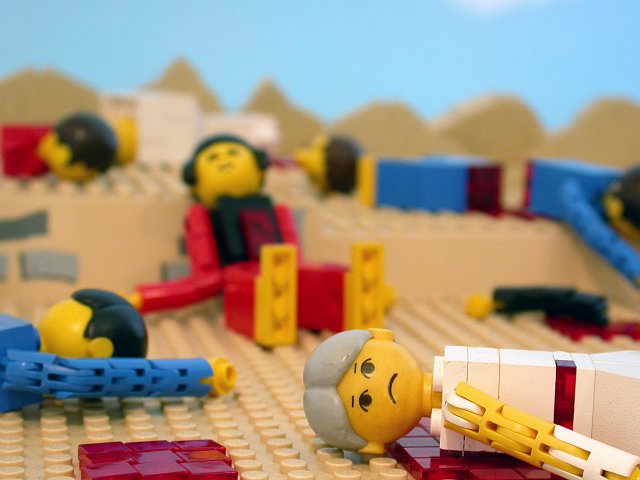
(Much of this post taken from my essay in progress, "Inventing with Animals in the Middle Ages." Comments welcomed. The image of slaughtered Lego Anakim that begins this post is taken from the stunning Brick Testament of the Rev. Brendan Powell Smith, specifically here)