Showing posts with label multilingualism. Show all posts

Sunday, July 28, 2013

"Trading Tongues" is HERE!

by JONATHAN HSY


I’m pleased to announce that today is the official release date of my book, Trading Tongues: Merchants, Multilingualism, and Medieval Literature (Ohio State University Press, 2013). It is the most recent addition to the series “Interventions: New Studies in Medieval Culture” (ed. Ethan Knapp), where KARL’s book also appeared.

This book has been a long time coming. It began a decade ago (!) as a dissertation project about merchant culture in medieval London but it gradually transformed into a broader exploration of the social dynamics of travel, polyglot literary identities, and languages in motion.

Here’s the description from the OSU Press website:

Trading Tongues offers fresh approaches to the multilingualism of major early English authors like Geoffrey Chaucer, John Gower, Margery Kempe, and William Caxton, and lesser-known figures like French lyricist Charles d’Orléans. Juxtaposing literary works with contemporaneous Latin and French civic records, mixed-language merchant miscellanies, and bilingual phrasebooks, Jonathan Hsy illustrates how languages commingled in late medieval and early modern cities. Chaucer, a customs official for the Port of London, infused English poetry with French and Latin merchant jargon, and London merchants incorporated Latin and vernacular verse forms into trilingual account books.
Hsy examines how writers working in English, Latin, and French (and combinations thereof) theorized the rich contours of polyglot identity. In a range of genres—from multilingual lyrics, poems about urban life, and autobiographical narratives—writers found venues to consider their own linguistic capacities and to develop new modes of conceiving language contact and exchange. Interweaving close readings of medieval texts with insights from sociolinguistics and postcolonial theory, Trading Tongues not only illuminates how multilingual identities were expressed in the past; it generates new ways of thinking about cultural contact and language crossings in our own time.

And here are a few lovely blurbs:

“Hsy’s development of the concept ‘translingual’—emphasizing the capacity for languages within the same space to interact, to influence, and to transform each other through networks of exchange— is visionary. Trading Tongues is poised to make a significant contribution both to linguistic studies of the fourteenth and fifteenth centuries in England and to the study of Middle English literature.” — Christopher Cannon, New York University
“Trading Tongues is accomplished, intelligent, and assiduous. Hsy provides some excellent and original close readings of multilingual texts; I particularly admire his chapter on London merchants, and his final discussion of a Charles d’Orléans ballade is superbly interesting. The research is strong, the style elegant and well-turned, and the quality of argument high.” —Ardis Butterfield, Yale University

You can read excerpts from the book (contents, introduction, first chapter, and index) on the OSU Press website (top left corner of page)—and you can search and preview other parts of the book on Amazon.

Many people—including my colleagues, my co-bloggers and ITM readers, and other people (online and in real life)—have played a role in shaping this project. I hope those of you with interests in translation studies, comparative literature, historical linguistics (among other things) will find this worth your while!

Thursday, July 04, 2013

Language Ecology: Living, Endangered, and Undead Tongues

by JONATHAN HSY


[NOTE: This is another blog posting about languages and mobility -- quite a flurry of ITM postings along these lines this week! See the recent posting by KARL STEEL about multilingual Istanbul and the myth of a monolingual/monocultural past; see also the posting by EILEEN JOY about the forthcoming issue of postmedieval on "Medieval Mobilities" (eds. Laurie Finke, Martin Shichtman, and Kathleen Coyne Kelly).]

Linguistic Habitats


Above, the current front page of the Endangered Languages project, an online collaborative endeavor to promote global linguistic diversity (see the EL blog and EL Facebook page). Endangered Languages is also one of the featured elements of the Smithsonian Folklife Festival now underway in Washington DC (see the "One World, Many Voices" homepage). Snapshot taken 3 July 2013.

National Geographic's Enduring Voices documentary project transforms linguists (and linguistic anthropologists) into real-life Indiana Jones-style hero-explorers. See for instance this account of an expedition to record speakers of a language called Xyzyl (pronounced hizzle). In these narratives, "explorers" set out to (re)discover so-called "hidden" or obscure languages (i.e., enter them into annals of Western, scientific, recording and description), and they work together with local communities to help preserve precious, rare languages like Xyzyl -- and others around the globe -- from extinction. The work being done here is very important -- not just for its impact on our knowledge of the planet's linguistic diversity but also on an intangible preservation of sociocultural assets: the number of speakers of Xyzyl and many other indigenous and minority tongues around the globe continue to dwindle as speakers "leave" these languages for "global juggernauts" like English, Mandarin, Arabic, Spanish, Russian. Moreover, our ethical relationship to "at risk" languages (or "endangered" plurilinguistic environments) is akin to our salvific relation to particular nonhuman creatures (or specific ecosystems). A clear message emerges from the "Language Hotspots" map (which you can see on the Living Tongues website and also HERE) -- as well as related blogs such as Enduring Voices and Endangered Alphabets. Namely, stewardship of our shared global environment must include stewardship of a global linguistic ecology. Collaborative efforts of the Endangered Languages project (image and caption above) and others have deep ethical implications. Once languages are lost, they -- like extinct species -- are gone from the earth forever. *

What I find so interesting here (in the outreach and public relations materials for these projects) is the affective mechanism of salvific representation at play. National Geographic publishes gorgeously aestheticized images of colorful, weird underwater creatures (see HERE and HERE) or super-cute endangered marine animals (see HERE) -- and sends the implicit message that we should somehow act to preserve them. In a similar fashion, the magazine offers a set of carefully crafted and curated images of human environments through the work of photographer Lynn Johnson; her "Vanishing Voices" gallery suggests that languages themselves must be rendered exotic, appealing, "worthy" of being saved. Johnson has the very curious task of working to "translating" lived, dynamic human language into static images for (progressive and openminded) mass consumption and edification. And she manages to achieve these effects quite well through these highly evocative scenes -- with images interwoven with informative text.

The "story" these images tell about indegneity and located-ness of languages is crucial as well. This photo gallery gets us "interested" in languages that we might not otherwise know or care about, but also images remind us that it's not enough just to describe, capture, or "record" any given language. Nor can we simply take a language--a living thing--and simply "transplant" it from one geocultural or social context into new place and expect it to thrive there. Preserving a language is as much about preserving a (distant) way of living and thinking as it is about a way of speaking. For a language to flourish, one must also sustain its entire sociocultural habitat.

Transporting Languages

How relate to temporally distant medieval texts? One is the "un-translatability" (non-transportability) of language, that we as modern readers can engage with distant texts while also having a clear respect for the "native habitat" of the original language in which surviving texts are written. I find that teaching Middle English texts requires students (and teachers) to inhabit a cultural space that is profoundly not our own. Chaucer is well-known for reflecting on the cliché that the "past is a foreign country," an idea that registers quite well to modern English readers encountering his slightly-alien Middle English:

Ye knowe ek that in forme of speche is chaunge
Withinne a thousand yeer, and wordes tho
That hadden pris, now wonder nyce and straunge
Us thinketh hem, nd yet thei spake hem so,
And spedde as wel in love as men now do.  (Troilus and Criseyde, II. 22-26) 


In my own teaching, try to instill oral performance of Middle English in the original language -- or rather, its editorial (re)construction as printed in the Riverside Chaucer (or whatever edition we might be using at the time). Voicing Middle English aloud is just one way of physically inhabiting a language that is not one's own.

So how does one fully reinhabit an already-dead language, or quasi-moribund-zombie language (such as Anglo-Saxon, Old Norse, Anglo-Norman, Middle English)? To what extent are we -- by which I mean literature scholars, linguists, historians, and others -- acting as stewards of tongues, or sustainers of "lost" historically distant ways of living?

Animating Languages

We are in the business of reanimating zombie languages on an everyday basis, when you think about it. Take Latin, for instance. The Vatican (in the discourse of a New York Times article written last in fall 2012) continues to "breathe new life" into the language order for it to survive in a modern secular world (see HERE), and to some extent Latin has its own "cultural life" in the modern world through other avenues: new coinages are generated in Latin via institutionalized religious contexts (e.g. see words for "computer," "jet(plane)," and others in the Lexicon Recentis Latinitatis), but new coinages are also created via secular means, as previously unattested species are identified and given official Latin names (see the fly named for cartoonist Gary Larson). In these little ways Latin does continue to have a "life" in our contemporary world, but thinking about how a language like Middle English or Anglo-Saxon might "live" today is perhaps a different prospect. We will never know what the language of Chaucer or the Beowulf-poet or Kempe actually sounded or "felt" like, and whatever we offer will always be a strange living-and-dead fantasy: a (lovingly researched) reconstruction.

Perhaps best way, then, of thinking of our activities as scholars, historians, teachers, students (people interested in the linguistic ecologies of the past) is to say we are not detached (social) "scientists" nor paternalistic/parental curators and custodians but rather inter-temporal ambassadors, people who mediate between present-day audiences and distant, seemingly alien cultural environment. Yet even this ambassadorial comparison is inexact: most envoys or emissaries have (or should have) a secure sense of the interests that they are "supposed to represent" or advance. In our own ambassadorial functions -- our living in and with past and present languages -- we are in a position that is much more flexible and cannot be disentangled from professional and personal desires. Through our work with texts (or music, drama, manuscripts, sculpture, architecture, what have you) we not only grant partial access to an alien past or distant cultural habitat; we also actively reacquaint ourselves with our own time and place, recognizing the strangeness of the manifold world that we inhabit now and think we know so well.


* Something I admire about the discourses of linguistic preservation on such websites is how they avoid starkly utilitarian or capitalist justifications. I wouldn't want to make the argument that if we "lose" indigenous languages, we might lose an important cultural "resource" such as indigenous knowledge of the medicinal value of Amazonian plants, or what you will (what a shame if such cultural knowledge could no longer be exploited by pharmaceutical corporations!).

Tuesday, July 02, 2013

NOW PUBLISHED: Medieval Mobilities [postmedieval 4.2]

[image on cover: Carhenge, Alliance, Nebraska, 2007; photo by Tom Boettcher]

by EILEEN JOY

Somewhat serendipitously, given both Jonathan's and Karl's recent posts, respectively, on Canadian heraldry and multilingual graffiti, and their emphases on what might be called the "mouvance" of medieval objects (including language, texts, etc.), the most recent issue of postmedieval on MEDIEVAL MOBILITIES, edited by Laurie Finke, Martin Shichtman, and Kathleen Kelly, has published this week. In their introduction to the issue, Laurie, Marty, and Kathleen write,
The idea for a special issue on the transcultural Middle Ages with a focus on mobility came from a mystery novel. The events of Maureen Duffy's Orpheus Trail are set in motion by the discovery in an Anglo-Saxon burial of several objects of Middle Eastern origin, including talismans representing Mithric and Orphic cults. While the police sort out a series of grisly murders involving a pedophile ring exploiting migrant boys (another contemporary example of transcultural movement across borders), archaeologists and museum curators of Middle Eastern Studies, Egyptology, Anglo-Saxon England and, oddly, Victoriana, try to figure out how these antiquities fetched up in Essex. It requires a collaboration among experts from several disciplines to solve the murders by deciphering clues from the ancient past. As the ‘trail’ in the title suggests, the novel highlights flows across boundaries, both national and disciplinary: a temporal and geographical line that stretches back ‘from Essex to the North African deserts and the sphinx's smile’ (Duffy, 2009, 123).

Duffy's premise that an Anglo-Saxon grave might contain objects from the Middle East is not fiction. Archaeologists, numismatists and historians who study the remains of medieval material culture are constantly confronted with the reality of how often and how far goods traveled in the Middle Ages. 

This issue of postmedieval, then, asks a deceptively simple question: How did ‘things’ circulate globally across borders during the Middle Ages and with what consequences for cultural interaction? The volume assumes the construct of a transcultural Middle Ages and puts that paradigm into dialogue with the emerging field of mobility studies. The trans in ‘transcultural’ certainly captures something about movement: How did coins minted in Samarkand end up in England? Christianity from the Eastern Mediterranean rim in China? A focus on the transcultural Middle Ages is often a focus on ideas, people and goods once they have arrived. What happened to them in their new home? To focus on mobilities, however, is to pause on the road, not to reconstruct the means by which things arrive, but to examine the route itself. What we want to celebrate as cultural fluidity – something that new approaches to medieval studies allow us to see more and more – is the result of mobility.
For the most part, mobility studies – the critical study of the movement of people, goods and ideas – is dedicated to the contemporary moment, a present of displaced persons and immigrants and city streets and airport lounges. Scholars associated with mobility studies tend to cluster in social anthropology, cultural geography and sociology. While a number of medievalists have begun cruising cultural geography and sociology and explicitly articulating a more global, transcultural and mobile Middle Ages, medievalists have been working in the domain of mobility studies without naming or theorizing it as such before ‘mobility studies’ was recognized as an interdiscipline. Mobility studies is in need of historicizing, and the Middle Ages is in need of mobility theories.
The volume has many precursors, of course [from the Hakluyt Society established in 1846 to Paul Zumthor's and Jerome McGann's work on textual mobilities to  Latour's actor-network theory to David Wallace's new Literary History project to Geraldine Heng and Lynn Ramey's Global Middle Ages project to Sharon Kinoshita and Brian Catlos's medieval Mediterranean studies to Suzanne Conklin Akbari's work on the Norman world "as a cultural network connecting Sicily, Italy, France and England by sea routes from the Mediterranean to Scandinavia," and beyond], but there is a special connection in this issue as well with the work of British sociologist John Urry [also the respondent to this issue], whose "mobile sociology" brings important light to the role of non-human objects and agents in the mobile systems that have shaped various global histories. Ultimately, as the editors explain, such a project of tracing the global circulation of medieval objects, and thus of describing a "medieval world system,"
can only ever be collaborative because no one individual or discipline can have the necessary expertise to describe the whole world. This volume is both prolegomenon and call to explore collaboration as a kind of flow, and scholarship itself as a knowledge transfer between domains. We want to suggest that strategic uses of those flows might counter static understandings of scholarly activity and expertise. We open ourselves up to some of the messiness of the Middle Ages by recognizing how often people, objects and ideas were on the road, in movement, in flux, never completely locatable at a single fixed moment, in a single place or speaking in a single language.
Herewith, then, the Table of Contents [and note that there is an awesome Book Review Essay as well by Kathleen Biddick on "transmedieval mattering"], and if anyone who does not have institutional access to the journal would like any or all of the essays in this volume, please just email me at: eileenajoy@gmail.com.


Editors' Introduction

  • "The world is my home when I'm mobile": Medieval Mobilities / Laurie Finke, Martin B. Shichtman, and Kathleen Coyne Kelly

Essays

  • A Restless Medieval? Archaeological and Saga-steads in the Viking Age North Atlantic /  Douglas J. Bolender (Field Museum of Natural History) and Oscar Aldred (Newcastle University)
  • Have Dante Will Travel: On the Limitations of Personal Mobility / Daniel Hartnett (Kenyon College)
  • Der guote Gêrhart: The Power of Mobility in the Medieval Mediterranean / William Crooke (East Tennessee State University)
  • Mobile Language Networks and Medieval Travel Writing / Jonathan Hsy (George Washington University)
  • Ruins in Motion / Heather Bamford (Texas State University-San Marcos)
  • Virtual Mobility: Landscape and Dreamscape in a Late Medieval Allegory / Anne Harris (DePauw University)
  • Flea and ANT: Mapping the Mobility of the Plague, 1330s-1350s / Kathleen Coyne Kelly (Northeastern University)

Response Essay

  • Medieval Worlds and Mad Max / John Urry (University of Lancaster)

Book Review Essay

  • Transmedieval Mattering and the Untimeliness of the Real Presence / Kathleen Biddick (Temple University) *reviewing: Karen Barad, Meeting the Universe Halfway: Quantum Physics and the Entanglement of Matter and Meaning (Duke UP, 2007); Jane Bennett, Vibrant Matter: A Political Ecology of Things (Duke UP, 2010); Lanfranc, On the Body and Blood of the Lord and Guitmund of Aversa, On the Truth of the Body and Blood of Christ in the Eucharist, trans. by M.G. Vaillancourt (Catholic U America P, 2009); and Eric Santner, The Royal Remains: The People's Two Bodies and the Endgame of Sovereignty (U Chicago P, 2011).

Briefly Noted: A Multilingual Doorframe in Istanbul

by KARL STEEL

On Facebook, my coblogger JONATHAN HSY (whose recent post on Canadian Heraldry you should read) links to fine post by linguistics prof Ingrid Piller on language diversity in medieval and modern Constantinople/Istanbul. 


She shares this picture of graffiti runes in Hagia Sophia, which she connects to a Chinese Flyer for an room for rent in modern Antwerp, which leads to consideration of how official monolingualism tends to erase evidence of multilingualism.   

Piller finally leads us back to modern Istanbul and modern Turkey's famous language reforms, where she observes:
The reform was “a catastrophic success,” as the Turkologist Geoffrey Lewis has called it. As a result, most contemporary Turkish speakers are cut off from their linguistic and cultural heritage predating the 1930s. A famous – and also ironic – example of the monolingualization of Turkish is the fact that a major 1927 speech by Atatürk, the founder of the Turkish Republic, has had to be ‘translated’ repeatedly into contemporary Turkish so as to remain comprehensible to contemporary Turks.
In Istanbul, as elsewhere, contemporary examples of ‘super-diversity’ – the Russian ‘Sale’ signs in the shop windows, the tourist communications in all the languages of countries with strong currencies, the handwritten Arabic ‘for rent’ signs, the Kurdish music stalls – are impossible to ignore. By contrast, the fact that super-diversity has been a characteristic of Istanbul-Constantinople-Byzantium since time immemorial is easy to overlook.
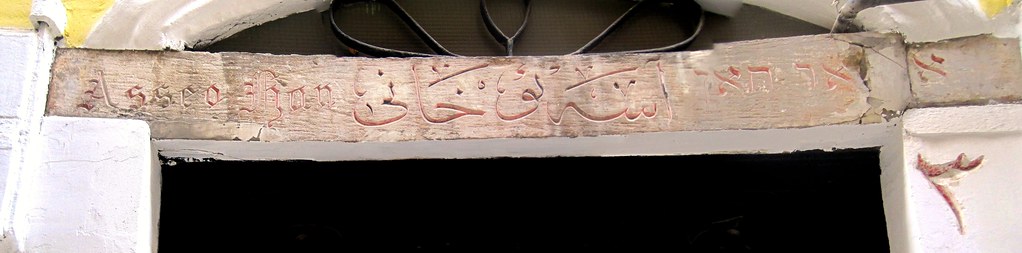
I'm presenting all this to join Jonathan in encouraging you to read her post, but also to share a photo with you, which I took on my Istanbul trip in January 2012. While there, my very multilingual colleague Louis Fishman (his twitter account; some articles; and here we are trying to solve a historical puzzle) gave my wife and me a tour of a few neighborhoods and took special effort to point out the following near İstiklal Avenue:


poorly stitched panorama. Sorry.
Click on the image to see it better (edit: I've now uploaded the original set of photos, which I think probably give a better sense of what the door lintel looks like: see here). That's script in Roman letters, transliterating an Ottoman Word (it says Asseo Han," the Han or caravanserai of the Asseo family), and possibly the same phrase repeated in Ottoman Arabic and Hebrew. Louis said that one of these, representing the Han of another family, had also been visible directly across the street, and taken down or otherwise obscured to present a monolinguistic Turkish past, which he then connected to the controversy over Bonomo (a Sephardic Jewish Turk) representing Turkey at the Eurovision contest. Louis's apartment in Kurtuluş (a view), where we were staying, was itself a formally Greek neighborhood, but purged of Greeks in the 1955 pogrom.

More data, then, for Piller's observations.

Sunday, October 28, 2012

Between Species: Animal-Human Bilingualism

by JONATHAN HSY

ITM readers: Jeffrey posted about the "Burnable Books" blog earlier, and I wanted to bring your attention to a fun experiment unfolding there: the idea is the use social media to practice talking about our work! (Check out the writeup on the blog and on twitter - use the hashtag #3tweetsmax)

In the spirit of sharing, here's a half-completed essay that I've been working on (as Frankenstorm approaches...)


Sounds of nonhuman things: De voces variae animacium
St Gallen Stiftsbiblothek Codex Sang. 225 p. 132
[Embiggen or flip through the entire manuscript HERE]


Animal Voices:

I'm currently completing an article on medieval animal-sound wordlists (often under the Latin title heading such as voces variae animantium, which translates literally as “the different voices of animate things”) for a forthcoming essay collection. These lists took many forms, but the one thing they have in common is (at the very least) a list of animals with the appropriate Latin verb denoting the sound each one produces.[1] For example, this page above transmits one such list (flip through the entire manuscript HERE – and thanks to Chris Piuma for bringing this link to my attention!); see also a transcription HERE [If you don’t read Latin, the first items on the left column read “Ovis bobat / Canis latrat / Lupus ululat…” which means something like “the sheep bleats / the dog barks / the wolf howls …” etc.] These lists are interesting for many reasons; among other things, they often break open our (modern and Western) ideas of exactly constitutes an “animate” honhuman agent in the first place; for instance, fire and running water among things that make sound.[2] Adding to this complexity, some other Latin wordlists are accompanied by parallel translations of the verbs into other languages. In thinking about these lists, I want to concentrate just on the human/animal interface here, and take these lists seriously as modes of enacting animal-to-human translations.[3] These lists, all their variety and complexity, provide exciting venues for considering a range of medieval language-crossings – movements across species boundaries, and movements across (human) cultures.

If you’ve ever compared animal sounds with someone who speaks another language, it can be surprising to find out that an animal “sounds different” in a different cultural environment – to an English speaker, a dog goes woof woof (or bow wow); to a Chinese speaker this same animal goes 汪汪 (wang wang).[4] Some of the broad similarities among animal sounds across languages could suggest a certain pan-cultural onomatopoeia, inviting us to ask whether there is some universal or deeply ingrained capacity for humans to mimic animal sounds in similar ways. I would take the information on this page with a grain of salt, but assuming most of its entries are more or less correct it does nicely illustrate how even non-related languages can share similar sonic strategies for animal-sound mimicry: cats across human cultures utter something remarkably like meow; snakes invariably use some sort of sibilance (S-sounds); the rooster makes some sort of multisyllabic sound full of voiceless velar stops (i.e. consonant K). (Cross-linguistic research in the field of linguistic anthropology can, at times, support possible points of connection between animal mimicry and sonic features cutting across human languages; for instance, the frequent occurrence of “r” and “g” sounds in frog names across two hundred languages in New Guinea might be a case of a frog-imitating cross-linguistic feature.[5])

These medieval wordlists readily reveal the sheer complexity of this messy zoo-anthro-linguistic soundscape we inhabit. The phrase “lupus ululat” (the wolf howls), for instance, is a formulation that appears in many Latin lists like these, and translating such a statement actually poses a bit of a challenge; in this phrase, the verb actually denotes two things at once – the creature’s action, and a mild imitation of the sound the creature produces. In “lupus ululat,” the assonance of “u” sounds in the verb paired with the noun “lupus” strongly reinforces the aooooo!!! sound. But “ululat” is also employed (elsewhere in other lists) to denote the utterance-and-sound of an owl, so one might say the verb is something like mimetic homonym: the Latin “ululat” splinters into two different the modern English verbs “hoots” (in the case of an owl) or “howls” (in the case of a wolf).

I’m dwelling on this multivalent sound-action “ululat” as an invitation to think more closely about the relationship between animal vocalization (as ventriloquized via human language) and bilingualism, and to more carefully consider the role that animal sounds themselves actually play as didactic strategy for second-language acquisition. Contemporary social science research is quite interesting in this regard: one study on French contexts reveals that onomatopoeia (including animal mimicry) can play a key role in language instruction.[6] To draw from a different cultural environment, Japanese researchers have suggested that verbs that have onomatopoeic patterns – including ones that imitate animals – may actually facilitate their mastery by schoolchildren.[7]

In a medieval context, this animal-human interface plays a role in language learning as well. In Aelfric's Grammar, for instance, the translation of Latin animal sounds into Old English becomes a pivot point that establishes a shared grammatical feature across languages while also opening an opportunity for creative translation. The text translates a sequence of third-person Latin verbs expressing the actions of nonhuman agents (e.g. Latin pluit becomes rinþ, “it rains”); in the case of animal utterances the inherent sounds of the relevant third-person Latin verbs only haphazardly “carry over” into their Anglo-Saxon verb equivalents. Some of the Latin/Anglo-Saxon pairs read as follows (and, once again, translation into modern English is admittedly tricky): ouis balat / scep blaet = the sheep bleats (says baaa); bos mugit / oxa hlewð = the cow says moo (the ox lows); equus hinnit / hors hnægð = the horse neighs (whinnies, goes hinhnignnnh).[8] What sort of imaginative work are these bilingual animal sounds are performing? Rather than thinking of these pairings as instances of the same animal vocalization replicated divergently in Latin or in the vernacular, I’d like to entertain the possibility that the reader (medieval or modern) is actually invited to process these disparate linguistic units concurrently, approximating in one’s memory to arrive at a zoo-vocalization that can never be transcribed (in any human language or writing system).[9]

Dwelling on these bilingual examples from Aelfric's Grammar allows us to approach the voces variae animantium wordlists in new ways. Rather than thinking of a “one way street” of translation from animal sound to human imitation, I would like to imagine medieval people entertaining the possibility of mutual interspecies exchange or convergence, or uttering two species-marked languages at once. I might suggest that each of these verbal vocalizations – rather than providing inadequate anthro-imitations of animal sounds – are best construed as ambilingual utterances that resonate across species difference.

All of this is just to say that we need not necessarily follow the lead of Priscian and other medieval Latin grammarians by segregating the “inarticulate” animal vox (voice, utterance) from rational human speech that can be set to writing. It's precisely the dynamic interface between species utterances – these near and partial modes of understanding, and the perceived gap between inarticulate sound and proximal modes of (human) articulation – that I find most worth pursuing. [10]

Languages Collide:

These animal-sound wordlists are just one avenue for exploring the contours of inter-species communication. A literary text like Chaucer’s Squire’s Tale offers the fantasy of a “queynte ryng” which (worn on the finger) allows a Tartar princess to understand the “leden” (speech or utterance) of a “faucoun peregryn [o]f fremde land” (peregrine falcon from a foreign land) (435, 428-429).[11] In this text, though, the bird’s “leden” is fully rendered as Middle English discourse, and we actually don’t get any hint of the sounds of bird vocalization through the text. Other literary texts do find ways to more pointedly explore I might call a concurrent trans-species language processing that entails an overt mimicry of bird sounds. In Chaucer’s Manciple’s Tale, the god Phoebus teaches his pet bird how to speak (or to imitate human speech – the text is a bit unclear about the distinction).[12] The bird witnesses Phoebus’s wife having an affair with another man, and when the bird reveals the news to Phoebus the bird’s utterance is recorded as “Cokkow, cokkow, cukkow!” (243). This moment is a “joke” on many levels. First of all, in Middle English, this would have registered as a near-pun with the utterance “Cuckold! Cuckold! Cuckold!” Second, the bird conspicuously speaks Middle English here, breaking any fiction that this exchange is happening in ancient Greek or whatever Phoebus would have actually spoken “back in the day” with his bird. Third, the bird could be interpreted as simply “being a bird” at this point in narrative – i.e., the bird is making ordinary avian squawks that accidentally sound as if it is speaking in Middle English. At this moment in the story, Chaucer provides an onomatopoeic transcription of bird vocalization that simultaneously conveys meaning in a human language.

Other literary texts find inventive means to encode intra-species avian communication as well. In John Clanvowe’s The Boke of Cupide, a cuckoo and nightingale engage in an extended debate, and the literary discourses employed by these two different birds are differentially encoded as if through two different human vernaculars – or at least two distinct sociolinguistic registers within a single language (Middle English). Throughout this text, the cuckoo asserts that his language is clear and plain, and his simple English diction conveys this effect; the nightingale – whose sonic performance considered much more sophisticated – utters a “nyse, queynt crie” (strange, unfamiliar cry) that employs obscure forms of French-inflected vocabulary (133). She (the nightingale) utters “Ocy! Ocy!” – a common way of transcribing birdsong in French, enacting a longstanding literary French-language pun on the imperative form of occrire: “Kill! Kill!”[13] The simple (English) cuckoo does not understand what this (French) nightingale-vocalization means, and he requires verbal translation (126-135). In this case, two different types of bird vocalization awkwardly clash across two languages within a single literary text.

Further collision of animal sounds across languages can be enacted through versified animal-sound lists as well. For instance, Walter of Bibbesworth’s Tretiz sets out to teach the reader how to speak French; within this work, a versified list of the sounds of animals in French (“la naturele noise des toutes manere des bestes”) is recorded alongside marginal gloss “cribs” written out in Middle English.[14] Reading across these glosses, one can discern cases when some aspect of onomatopoeia is preserved (“louwe oule” = “wolfe yollez,” 256); in other cases consonant clusters are slightly transmuted (“gruue groule” = “crane crekez,” 250), or the strategies of animal mimicry are transmuted (the French “vache mugist” – with an implicit “moo” sound in the verb – gives way to a repetition of vowels in the English “cow lowes,” 250).

In the bilingual (bird/English) episode in Chaucer’s Manciple’s Tale, the inter-linguistic (French/English) translation of birdsong enacted by Clanvowe’s nightingale, and the glosses in a bilingual versified wordlist, animal utterances serve as a disruptive and generative force that tests the very limits of language and mobilizes expanding strategies of (human) vocalization. Rather than conceiving human and nonhuman utterances as operating on separate tracks – or thinking of animal vocalizations by means of analogy to human linguistic utterances – we can entertain a collaborative processing of languages: the human and (with, alongside) the nonhuman.

But Wait...
           
In concentrating on sonic phenomena as the privileged mode of interaction between species, it may be the case I’m “on the wrong track” (trailing a “red herring,” or “off the scent” perhaps?). As anyone who has pets (or interacts frequently with animals) would know, much inter-species communication is non-verbal and also non-sonic – facial expressions, somatic mimicry, physical contact (aggressive or playful), biting, motion (e.g. pointing, blocking one's path), sniffing (and emitting pheromones), leaving excrement or other internal fluids where one should not, among other modes of interaction.

As a gesture to an inter-species world of interaction beyond the sonic, I’ll just end by suggesting one medieval venue for human mimicry of animals that is enacted through somatic, nonverbal expression. In his fascinating study of the practices and social meanings of silence in medieval monastic communities, Scott Bruce traces the nuanced role of (deliberately minimalist) systems of gestures; since monastic communities were obliged to take a vow of silence, a very rudimentary form of nonverbal communication was permitted – and only in limited contexts – as a substitute for speech.[15] In a discussion of one medieval Latin record of the Cluniac sign lexicon, Bruce notes that the acknowledged (permitted) “sign for a book written by a pagan author involved a gesture that mimicked a dog scratching its ear because, as the author of the sign lexicon explained, people without faith were comparable with dogs” (64).[16] In this suggestive system of codified gestures, those who are “not like us” – those who inhabit an existence across a boundary of religious difference – are equated with animals. While this exclusionary sentiment effectively dehumanizes other people, this compound sign requires a humbling form of embodied mimicry: a human must enact a silent becoming-animal gesture.

I am still sorting out where essay is going, but in the end I hope to get us out of the false dichotomy of meaningless, inarticulate animal sound vs. rational, transcribable human speech. Rather than reifying species difference or even stabilizing one cultural mode for encoding animal sounds, medieval wordlists and literary texts encourage us to think more creatively about inhabiting that blurry and fuzzy communicative zone where anthropocentric and zoocentric worlds meet, shape, and transform one another.


[1] For an overview of this medieval list tradition, see D. Thomas Benediktson, “Polemius Silvius’ ‘Voces Varie Animacium’ and Related Documents of Animal Sounds.” Mnemosyne LIII, I (2000): 70-79; see also D. Thomas Benediktson, “Cambridge University Library L1 1 14, F. 46r-v: A Late Medieval Natural Scientist at Work.” Neophilologus 86 (2002): 171-177. For an important early study, see Wilhelm Wackernagel, Voces variae animantium. Ein Beitrag zur Naturkunde und zur Geschichte der Sprache (Basel: Bahnmaier, 1869).
[2] Bottom of right hand column: “Ignis crepitat” [fire crackles], “Cursus aquarum murmurat” [running water murmurs].
[3] Although it’s more accurate and nuanced to refer to a distinction between “human and nonhuman animals,” I will simply refer (for the purposes of this venue) to the categories of the “animal” and the “human.” In my usage of these terms I’m more or less trying to follow the lead of Karl Steel, How To Make A Human (Ohio State UP, 2011), 19-20.
[4] It is interesting that this instance of onomatopoeia is polysemic; the “water” radical in the character 汪 is an indication of its use in literary contexts to refer to the sound of water (especially when its broad and deep).
[5] Terence E. Hays, “Sound Symbolism, Onomatopoeia, and New Guinea Frog Names.” Journal of Linguistic Anthropology 4, 2 (1994): 153-174.
[6] Brunet, Jean-Paul. “L’Onomatopee dans la classe de français (Otomatopoeia in the French Class).” Canadian Modern Language Review 45, 1 (October 1988): 139-145.
[7] Imai, Mutsumi, Sotaro Kita, Miho Nagumo, and Hiroyuki Okada. “Sound symbolism facilitates early verb learning.” Cognition 109 (2008): 54-65.
[8] Full passage: “Manega word synd, þe ne magon habban þa twegen forman hadas, ac habbað þonne þriddan: tinnit swegð, pluit rinþ, tonat ðunrað, fulminat hit liht […]. Ealswa be nytenum: canis latrat hunt byreð, lupus ululat wulf ðytt, equus hinnit hors hnaegð, bos mugit oxa hlewð, ouis balat scep bleat, sus grunnit sing runað” [There are many verbs that may not have the first two persons but have the third one: it sounds, it rains, it thunders, it lightens (i.e. lightning strikes) … It is the same way with animals: the dog barks, the dog wolf howls, the horse neighs, the ox lows, the sheep bleats, the pig grunts]. J. Zupitza, Aelfrics Grammatik (Berlin: Weidmannsche Buchhandlung, 1880), 128-129.
[9] This is a tangent, but for the voces variae animantium as a memory tool, see Carruthers, Book of Memory, 138, 158-160.
[10] At this point let me just note that I’m well aware that there is a rich scholastic discussion how vox is defined, particularly along the lines of human/animal difference; see for instance Karl’s discussion on ITM a few years ago; see for instance Karl’s book at 20 (note 69) and 49 (note 40); see also Eco, Umberto, R. Lambertini, C. Marmo, and A. Tabarroni. “On animal language in the medieval classification of signs.” In On the Medieval Theory of Signs, ed. Umberto Eco and Costantino Marmo (Philadelphia: Johns Benjamins, 1989), 1-41. At this point, though, I'm trying to avoid scholastic taxonomies of vox articulata and vox inarticulata etc. as I feel that “buying into” such vocabulary too soon can constrain how think about these medieval lists and prevent us from imagining what sort of sonic or sensory worlds such lists might seek to inhabit.
[11] The meaning of “leden” is disputed; in the Riverside Chaucer, 3rd Edn (gen. ed. Benson, Oxford UP, 2008) this word is glossed as “language.” The Middle English Dictionary additionally provides a slightly broader meaning of “speech, utterance” (def. 2a) or an additional definition of birdsong or animal noise (def. 3a and 3b). Robert Boenig and Andrew Taylor (The Canterbury Tales, Broadview, 2008) capitalize the word “Leden” with this explanation: “The term “Latin” here can be taken to mean ‘foreign language,’ since in the Middle Ages Latin was the universal second language” (232, note 2). In this literary context, of course, this polysemic term could mean all of these things simultaneously.
[12] The narrator states that Phebus “taught it [the crowe] speke as men teche a jay … And countrefete the speche of every man/He koude, whan he sholde telle a tale” (132-135).
[13] V.J. Scattergood, The Complete Works of John Clanvowe (Cambridge: Brewer, 1975), 84n124-135. See also Elizabeth Eva Leach, Sung Birds: Music, Nature, and Poetry in the Later Middle Ages (Ithaca: Cornell, 2007), 244; on “oci” as the stylized song of the nightingale in medieval French culture, see 91.
[14] William Rothwell, ed. Walter de Bibbesworth: Le Tretiz (Aberystwyth: The Anglo-Norman Hub, 2009). In the longer version I will also engage with an excellent article by William Sayers, “Animal vocalization and human polyglossia in Walter of Bibbesworth’s thirteenth-century domestic treatise in Anglo-Norman French and Middle English.” Sign Systems Studies 37, 3/4 (2009): 525-541.
[15] Scott G. Bruce, Silence and Sign Language in Medieval Monasticism: The Cluniac Tradition c. 1900-1200 (Cambridge: Cambridge University Press, 2007).
[16] Transcribed in Bruce, footnote 43 (Cluny, no. 73): “Pro signo libri secularis, quem aliquis paganus conposuit, premisso generali signo libri adde, ut aurem cum digito tanga, sicut canis cum peed pruriens solute, quia nec inmerito infidelis tali animanti conparatur” [quoting Signa Loquendi, ed. Jarecki, 134].