Showing posts with label manuscripts. Show all posts

Tuesday, November 07, 2017

Teaching the Canterbury Tales with online manuscripts/incunabula: a quick intro

by KARL STEEL

This semester is my first time teaching the Canterbury Tales to doctoral students. To rise to their level, I decided manuscripts would be a big part of my teaching: after all, as digitization is much advanced since I myself was getting a PhD [mumble] years ago, manuscripts can, and probably should, now be a key focus to medievalist graduate training anywhere, even in the hinterlands of Manhattan.

Apart from the expected Ellesmere and Hengwrt manuscripts, and the useful tools at the Norman Blake Editions of several key CT manuscripts and, as well, Manly and Rickert, here's what's undoubtedly a partial list of fully digitized Canterbury Tales manuscripts, or, at least, the ones I've found easiest to navigate:
British Library, Harley ms 1758.
British Library, Harley ms. 7334.
Cambridge Trinity R.3.3.
Cambridge Trinity R.3.15.
Caxton 1476 and 1483 printings.
Codex Bodmer 48.
Oxford, Bodleian, Christ Church ms. 152.
Oxford, Bodleian Douce 218 (Richard Pynson printing, 1491-92).
Oxford, Corpus Christi College ms 198.
Yale, Beinecke Library, Takamiya ms 24 (the 'Devonshire Chaucer').
Yale, Beinecke Library, Takamiya ms 32 (the 'Delamare Chaucer')
If you're reading this, I trust you're already familiar with manuscript variance with the Cook's Tale or the variously omitted stanzas from the Envoy to the Clerk's Tale (or the omission of the Envoy altogether). I trust you'll want less famous examples, maybe to help you through this term, or to get you started on the next.

What varies most, perhaps, is the manuscript apparatus, like section headings and divisions, which give us a sense of how this work might have been read and sorted. For example:

Bodleian, Christ Church MS 152 26v

This is the Knight's Tale. How do the pieces fit together? Where the Riverside has "Explicit secunda pars / Sequitur pars tertia," and where Hengwrt 25v has "Explicit prima pars / Incipit pars secunda," Christ Church 152, 26v, has "the ordinaunce of lystys that thesyus ordaynyd" [corrected]. Does the Knight's Tale comprise abstract parts of equal weight, or is it a sequence of events? If so, whose doings are worthy of "ordaining" the divisions of the plot?

Or here's the Reeve's Prologue in Corpus Christi College ms 198, 54v:

Corpus Christi College ms 198, 54v

Our medieval scribe has started the tale at the prologue itself ("Explicit fabula molendmain [the Miller] / here bygynneþ þe Reeues tale" -- note the mixture of Latin (Explicit) and English (bygynneþ)); an early modern reader intervenes, and writes "Prologue" in the margins. Are they comparing manuscripts? Or is it a sign of an independent interpretation?

When does the Wife of Bath's Tale start?

Harley 7334 89r, with a red "Narrat" in the margin.
In at least one case, in Harley 7334 89r, her tale - or one of them anyway - begins after the Pardoner interrupts her, where we have a red "Narrat" in the margin. Here, then, the Wife's prologue is split between a prologue, where she does scriptural interpretation, and a tale, where she finally begins to tell us something of her "experience."

Most interesting to me, however, is what the manuscripts call what the Friar does at the end of the Wife's Prologue, or first Tale, or whatever else it might be called. Here's my (crowded) slide:


Is it just "words between" the Friar and Summoner? It is an "interpretation" of the Wife's tale? An "interruption"? Or is it just a neutral ending of the Wife's prologue, and the words of the Friar, following neatly? It depends! And a lot depends on it.

As we all know, in their capacity for nuanced forms of emphasis, manuscripts are closer than print is to speech. We on the other side of Gutenberg have generally lost rubrication, marginalia too, or underlining, manicules, and slight enlargements, like so, from the Friar's Tale:

Codex Bodmer 48 91r
Should the carter be taken down to hell? "Nay q[uo]d þe deuel," he absolutely should not.

Finally, a bit on early modern readers of Chaucer. Griselda's story is a marriage story, after a fashion, which perhaps helped suit this blank space for an early modern family record:

Harley 1758 126v
The Fox children crowd in over the course of the sixteenth century, here and on the next page, before the Franklin's Tale -- not the Merchant's -- begins.

And this, a record of what one early modern reader cared most about:

Cambridge Trinity R.3.3 38r
Cambridge Trinity R.3.3 38r gives us an early modern reader who, like many of us, is curious about the rest of the Squire's Tale. They've clearly "sought in diuers places" for the "the reaste" but found nothing except the final two lines about Apollo, just like you have in your Riverside.

More interesting is what doesn't get changed: in red, "The Prologue to the Merchaunt." Turn the page, and we have the words of the Franklin to the Squire, but here assigned to the Merchant, and then the Merchant's Tale ("Whilom there was dwelling in Lombardy / A worthy knight"). No correction. No indication of difference, despite our reader likely having encountered the Franklin and his tale in these passages as they hunted in diverse places. Here at least is one reader who wasn't bothered by variance in Tale order. If you're having your students read Arthur Bahr, this is as good illustration as any of ways to think the Canterbury Tales as other than "fragments."

Wednesday, March 29, 2017

Skin color and musical notation: A few fascinating manuscript images

by Karl Steel

One of my (many!) procrastination habits is poking around in manuscripts online to see what might turn up. Recently, I’ve found the following–
To start you off lightly, here’s a multicolored embroidered repair to a hole in a Historia Scholastica manuscript, in a section about the various woods used to manufacture Jesus’s Cross:

Aarau, Aargauer Kantonsbibliothek, MsWettF 9 203r
And then this – the Occitan Abreviamen [or Abreujamen] de las Estorias, Egerton MS 1500, c. 1321-1324, an illustrated universal history, specifically, a diagrammic chronicle, remarkable, to me at any rate, for its representations of differences in skin color. Here’s one image:


Kings of England and Sicily, and Sultan of Egypt, 53r

and here’s another, 52v, from the same manuscript:


Guy of Lusignan and Sibilla of Jersualem;  Isabella, below, with 3 of her 4 husbands [Almaric, Henry & Conrad]
There is work on the manuscript by Catherine Leglu and especially by Federico Botana, but to my exceedingly limited knowledge, nothing on its skin tones. We could use further comparison. Botana’s superb codicology puts Egerton 1500 alongside Venice’s Biblioteca Nazionale Marciana, MS Zanetti Latino 399, but unfortunately, as the latter manuscript isn’t online, I don’t know how it shows its sultans, nor its Sibilla or Isabella. Nor do I know enough about diagrammic chronicles even to know whether it’s more or less unusual to decorate genealogies with faces: for example, click through for a Biblical genealogy from the Aargauer Kantonsbibliothek, MsWettF 9 239v, mostly a list of names, but also featuring a delightfully nonplussed bird, grumpy at being dragooned into the Flood storyCambridge, Trinity Library O.1.78 provides only the names of the English kings; see also this mixture of the two in the Biblical genealogies in Dijon Bibliothèque municipale Ms 634, a manuscript of Peter of Poitiers’ Compendium

As further evidence that I poked around a bit, I can also cite these from the British Library: Royal MS 14 B VI (genealogy of the Kings of England, faces and for most kings, full bodies); Royal MS 14 B V (similar but with the full complement of silly medieval marginalia – snails, animal doctors, deer-hunting rabbits, &c); Add MS 48976 (the Rous Roll, so delicately drawn, whose genealogy diagrams are just names, sometimes becrowned); Cotton MS Domitian A VIII (English kings, just names); Cotton MS Nero D I (Matthew Paris’s notes, just names); Harley MS 7353 (Edward IV and biblical typography plus an actual genealogical tree with potentate portraits as leaves, and, well, just click through). The Abington Chronicle [Cambridge Trinity R.17.7] sadly isn’t online yet.
If anyone’s fishing around for an essay topic, then, you might want this in the mix as well:
King Penda, a red-faced pagan. Houghton Library 40, Chronicle c 1470
No other king in the manuscript is so colored; and if you’d like to try to guess by reading about Penda in a proximate English history, be my guest.
Finally!
Marvel at this notation of hunting horns, represented as floating in air, as sound, in Hardouin de Fontaines-Guérin’s Livre du Tresor de VanerieThere are just the three manuscripts, one of which, I believe, is a postmedieval copy, and the other unillustrated. But one, BnF 855 is so, so wonderful:
Paris BnF fr. 855 53v
Notation like this graces so many of its illustrations. Of course your humble procrastinator is not the first to notice these: as of the 1990s, the modern expert is Eva Marie HeaterJulien Brunelliere has written on it more recently; and Henri Kling cracked the code in 1911.
Finally, it was edited twice in the nineteenth century, its illustrations reproduced both times, and once in a style that, at least for those of us who read independent comics in the 1990s, recalls nothing other than Dame Darcy’s legendary Meat Cake:
Villot ed, 1855.
Please compare, and with that, I am done, and back to much more mundane medieval matters:
Dame Darcy, Meat Cake #0, 1996.

Tuesday, May 05, 2015

You know, the one with the Rocks – Trinity Colllege R.3.3

by KARL STEEL

In last night's Chaucer class, while trying to illustrate a point about the Manciple's Tale. I found myself in Cambridge, Trinity College R.3.3, a Canterbury Tales manuscript of c. 1450-1475. This is what grabbed me, above: at 108r, you'll see the ending of the Prioress's Tale (here reading "for the reverence of his moder Marie. Amen"), followed not by Thopas, but by the FRANKLIN.
Dividing the Prioress from the Franklin, we have: "Hic incipit prologus de Frankeleyun cum fabula sua de Rokkes de Brytaine" (here begins the Franklin's prologue with his tale of the Rocks of Briton [or Bretagne]")
Forgive me if I'm repeating something someone already said: I'm not a manuscripts scholar, my paleography is weak, and various quick, morning searches in various databases for Trinity R.3.3 commentary haven't been successful, even though I know some of you have written about it: but I love this incipit. I would suspect our students, and most of us too, think of the Franklin's Tale as mostly about honor, truth, the problem of sovereignty, class conflict in narrative and rhetoric, and the indifference or nonexistence of the gods. But here's someone who, like Jeffrey (eg here and here), thinks it's a tale mostly about ROCKS.
(quick check suggests there are no other such incipit summaries in the mss (the others are just tags like "here begins the Cook's Tale," etc, but we do have this this rather self-satisfied, nonmedieval manicule at 38r)

(I don’t suppose anyone knows off hand if any of the other fifteenth-century copies of the Franklin’s Tales are marked this way?)

Wednesday, December 31, 2014

Fire, Air, Earth, Water: Elemental Order vs. Phenomenological Order

by KARL STEEL

First, read Eileen's post on the new issue of postmedieval, which looks like one for the ages. And then Jeffrey's 2014 retrospective, and then this, below, which I suspect may be the final ITM post for 2014.

Or maybe not?
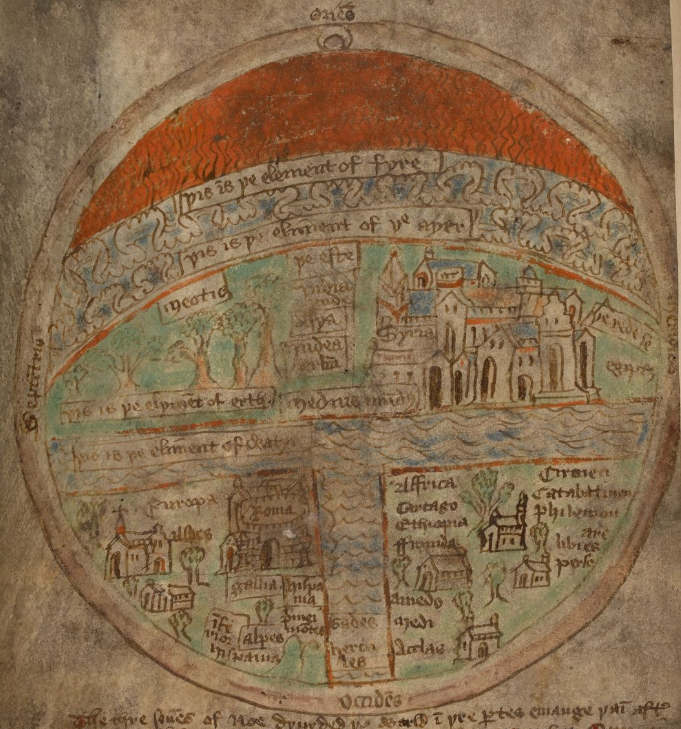
  CaptureHere's a T-O Map from the Mandeville epitome that begins that famous fifteenth-century Carthusian miscellany, British Library Add 37049, f. 2v. (also famous for including the unique copy of the Middle English "Disputation between the Body and the Worms," which I write about here).

Warning: I'm not a map scholar, and, as Chet van Duzer probably already said what I'm about to say here, I apologize. Be patient and imagine briefly that you're one of my students, befuddled, curious, and confused. Or imagine you're one of my colleagues, ideally one who knows more about paleography, maps, and medieval science than I do. I humbly submit myself to the correction of all. 

I'm fond of this map because it comprises two intersecting two-dimensional planes, which together generate an approximation of three dimensions. Note, first, the geography: the left bottom quadrant is Europa, the right bottom quadrant Affrica, and the top half Asya (if I'm reading that right). Various cities and regions have been labeled: Syria, Alpes, Roma, Gallia (France), Hispania, Ethiopia, Carthago, etc.

Meanwhile, at the very top we find a band of red, which is Fire; below that, a band of clouds running through a scribble of blue, which is Air; below that, written below a band of trees, Earth; and then, dividing the Asia, Europe, and Africa, the element of Water.

If fire, being lightest, is above the slightly heavier air, and if both of these are above the surface of the earth, then the labeling of elements intersects the world map at a perpendicular. There's a catch, though: as earth is heavier than water, the labeling of elements reverses the final two, as it places water, incorrectly, below the earth. The simple explanation is that this reversal just represents our experience of our world: so long as we're not wading or drowning (or being rained upon), earth, for us, is above the water, whatever the claims of natural science.

The reversal also neatly represents our world's slightly off-kilter arrangement of elements, as explained by one far-seeing mid-fourteenth-century theorist. Jean Buridan's commentaries on Aristotle's De caelo et mundi and Meteorologica consider the question of whether the whole earth is habitable. His answer? One quarter, yes, the rest not. He doesn't get to that conclusion without some struggle. In Joel Kaye's summary, Buridan first:
raises a question that Aristotle had never considered: why would any one quarter of the earth be more likely to remain above water and habitable than any other quarter?...Given the spherical nature of the earth, given that according to Aristotelian physics all earth falls naturally to the earth's center, given the great abundance of water with respect to land, and assuming with Aristotle...that the universe is eternal...why in the fullness of time should any portion of land whatsoever remain habitable above water? (94)
To save the world from drowning, Buridan concocts "an interconnected physical system in dynamic equilibrium" (95), in which heat and cold make the earth above waters slightly lighter than drowned earth, so that the earth's weight and its center of magnitude slightly differ. Only the earth below the waters is as cold as it naturally should be. The off-kilter interaction of earths of varying density, balanced in an eternal motion of unbalance, keeps exactly one ever-shifting quarter of the earth above water (96).

Is this eternal, Weeble Wobbly unbalance what's represented by the T-O map of BL Add 37049? Doubtful. More likely, it represents the lived, human experience of elements, with the earth below us, and the water, we hope, even lower. But were some Carthusian bro a committed Aristotelian (unlikely!), we can imagine him looking at this map, on the verge of unloosing yet another "well, actually," but then thinking back to his studies, and resting content, temporarily above the waters.

(for more on floods, see Jeffrey here, with "Drown").

Sunday, February 23, 2014

An Early Modern Child's Drawing, in Melusine

by KARL STEEL

While looking for a suitable illustration to help teach Geoffrey of Auxerre's version of the Melusine story (n35 here for more), I ran across this, in Jean d'Arras' prose Roman de Melusine, BnF fr. 1485:


That's GREAT. I'm pretty sure this drawing's escaped (for now) the attention of Erik Kwakkel, that indefatigable emissary for medieval manuscripts, though he has blogged on doodles, and even children's doodles

Please let me know if you've seen this before, and where. Google searches for child drawing Melusine or l'enfant dessin Melusine get me nothing useful. For now, we'll just observe that this drawing, dating from, I guess, the late 16th or early 17th century, is all too appropriate in a story so concerned with lineage. 

And, uh, dinosaurs and maces.

(parenthetically, because I'm far outside my expertise here, but I've been asked to explain why I think this is a child's drawing. My stupid response is just that it looks like one. More considered, and even less expertly, I'd say that the elongation of limbs coupled with the enlargement of areas to accommodate detail (in this case, in clothing) that can't be rendered finely with a child's typically gross motor skills coupled (tripled?) with the complete indifference to the image's interaction with the text just says child to me. But it could be Paul Klee too! If this touches on your field, hazard a guess in comments, please.)


Thursday, October 24, 2013

Elizabeth of Schönau - the paths of God; also: Rabbits

by KARL STEEL

Continuing to uncork my blogging. Over at Tumblr, I've been doing light blogging, sometimes, but far from always, with a medieval theme. Often I'll share a manuscript image I've discovered serendipitously while looking for something else: today, I'm sharing one here, too, because it's just too beautiful to be hidden under the Tumblr bushel.

While looking for Paris, Bibl. Sainte-Geneviève, ms. 0020, I found a manuscript of Jacques Bauchant’s French translation of the visions of Elizabeth of Schönau (Bibliothèque nationale de France, Département des Manuscrits, Français 1792, c 1370-75). It's graced with a gorgeous and strange image:


Click to enlarge. The text is "Des visions Madame sainte Elizabeth des voies et du mont de Dieu du mistere et de la signifiance de ce," while the BnF's catalog copy explains further:

Au f. 5: peinture malheureusement abîmée, figurant la vision de sainte Elisabeth; la sainte étendue sur un lit contemple la montagne sur laquelle trône le Seigneur, vers qui s’acheminent divers petits personnages, marchant sur des bandes de couleur différentes, symbolisant les "voies de Dieu"
 At folio 5, a sadly damaged painting, picturing the vision of St. Elizabeth: the saint lies on a bed contemplating the mountain on which the Savior is enthroned, towards which several little figures are making their way, walking on bands of different colors, symbolizing the “ways of God"
As an animals guy, I've of course primarily interested in the rabbits in their mountain warrens, even on the slope leading to God. It just isn't a proper mountain without some nonhuman life, but that inclusion, necessary as it is for realism, also muddles any lonely anthropocentric visioning. There's no world worth having without, say, rabbits and grass and little holes. There are no rabbits in the original, nor any, so far as I can tell at a quick glance, in the translation. Love it.

(incidentally, the hardest thing for me to do? not so much the blogging; rather, it's responding to comments, even brilliant ones like those gracing my post from last night)

Sunday, July 05, 2009

Postcard from London, via Reykjavik

by Mary Kate Hurley

[Iceland -- the best layover ever]

One of the myriad things I'm doing this summer is researching Aelfric's Saints Lives in London at the British Library. Yes: I am actually consulting manuscripts, which is a new and exciting research prospect for me. I've been extremely lucky in terms of funding the trip: the Medieval Academy of America generously awarded me the E.K. Rand Dissertation Grant, one of several dissertation grants which they award each year.

Of course, I'll have a lot to say about the actual process of consulting the manuscripts (and I hope to blog a bit about Leeds, which I'll be attending next week, as well). But for now I have a quick question that I'd like to put to all you Norse specialists out there.

On my way over to London, I had a 10-hour layover in Reykjavik. Just enough time to trek all over the city (I was there mostly for the landscape -- museums and manuscripts are always interesting, but I was more intrigued by the land than the stuff from those who've lived on it), and then to head back for a short stay at the unofficial waiting area for Keflavik Airport travelers.

What caught my attention, however, was on the bus rides to and from Keflavik, where I found myself intrigued by these bizarre rock formations:


Now, I've tried googling them, and although I've found a few references, finding something specific about the structures is a bit difficult. So: anything strike you, dear readers? Some half-remembered fragment of a story from graduate school days past (long past or recently past...)? These seem like a lovely addition to the many other stones we've discussed here at ITM.

cross posted to OENY

Monday, December 15, 2008

Just sold at Sotheby's: A Big Chunk of British History

by J J Cohen

The Courtenay Compendium has been sold at an extraordinary price and appears headed out of England.

A small movement seems to be rising to stop the progress of this 14th C manuscript across the Channel. Listed at the auction site as having been sold for 937,250 GBP (!), the miscellany contains a previously unknown version of the Encomium Emmae (a work possibly commissioned by Emma herself, daughter of the duke of Normandy, wife first of Ethelred and then Cnut); a full version of Gildas; the travels of Marco Polo; William of Tripoli on the Saracens; and a collection of prophecies (none of which accurately predicts that the manuscript they appear within would someday be more valuable that the endowment of most US universities).

If anyone has any more information, please post!
[via Donald Maddox and the IAS/NAB email list]

Saturday, December 13, 2008

New Resource for Medievalists: Catalogue of Digitized Medieval Manuscripts

by J J Cohen

Matthew Fisher passed this along to me, and I am very happy to share what looks to be an important new resource for medievalists engaged in manuscript studies. I've been browsing the site and admire how much material has been collected. Bravo for creating the resource, UCLA CMRS.

Search under authors for Matthew Paris, for example, and you'll pull up three links, one for quick and full access to an Anglo-Norman verse life of King Edward the Confessor likely authored by Paris, then two links that will pause you at a registration page for the Parker Library (the fault of the Parker Library for making browsers register, not of the UCLA site). The search box at the Catalogue of Digitized Medieval Manuscripts makes helpful keyword suggestions, and a researcher can browse its links in multiple forms. Enjoy!


----------
It is with great pleasure that we would like to draw your attention to the Catalogue of Digitized Medieval Manuscripts. Hosted by UCLA's Center for Medieval and Renaissance Studies, the Catalogue seeks to provide a technological solution to a simple and rather delightful "problem": the breathtaking increase in the number of medieval manuscripts available on the web in their entirety, but in a bewildering range of venues and formats.

Currently, almost one thousand manuscripts, digitized and available in their entirety on the web, have been entered into the Catalogue. Users can search the Catalogue on basic information about manuscripts, such as the location, language, or date of a codex, or browse through the complete Catalogue.

We welcome feedback on your experience using the website, and particularly welcome suggestions for sites not currently represented in the Catalogue.

The Catalogue can be accessed at: http://manuscripts.cmrs.ucla.edu
More information about the project: http://manuscripts.cmrs.ucla.edu/about.php, or by contacting Matthew Fisher at fisher[at]humnet[dot]ucla[dot]edu

Sunday, February 10, 2008

Chaucerian Chromophobia? Beige Hengwrts and Bawdy Ellesmeres

I thank Michael Moon's "Do You Smoke? Or, Is There Life? After Sex?" in After Sex? On Writing since Queer Theory (SAQ Summer 2007) for its reference to David Batchelor's Chromophobia, a work that argues that:
The love of bright hues is an affliction as well as an alleged moral failing that has been routinely ascribed throughout the modern period to “orientals,” sensuous women, children, and “primitives” of “all stripes”...(Moon, 540)
I haven't (yet?) read Chromophobia, but I like what I know about it (e.g., his observations on the privilege of drawing over coloring in), and in my gleanings from here and there, I've been happy to turn up gemlike prejudices from our foundational thinkers. Aristotle called color a "pharmakon" (31), Isaiah 1:18 aligns color with sin and whiteness with purity, and Goethe observed
that savage nations, uneducated people, and children have a great predilection for vivid colours; that animals are excited to rage by certain colours; that people of refinement avoid vivid colours in their dress and the objects that are about them, and seem inclined to banish them altogether from their presence (qtd 112).
I now have that feeling that I contract from some of my favorites works, suspicion coalesced into a master thesis. Call it paranoid desublimation. With Batchelor lodged in my brain, I compare the dangerous passion of the Big Orange Splot to the rational, calm, beige futurity of Swedish design (see the interiors in Scenes from a Marriage, or, if you're an Ikeatiste, just look around).

I also consider the preference for the Hengwrt manuscript over the Ellesmere. At this point, and perhaps at all future points, I've only a hunch, a hunch, moreover, that's not been validated by sprints through (only) three articles (the Linne Mooney Adam Pinkhurst piece in the Jan 2007 Speculum, Michael C. Seymour's “Hypothesis, Hyperbole, and the Hengwrt Manuscript of the Canterbury Tales,” English Studies 68 (1987): 214-19, and Ralph Hanna's "The Hengwrt Manuscript and the Canon of the Canterbury Tales"), a hunch that has been validated, if we can call it that, only by a highly suspicious reading of Peter G. Beidler's characterization of the differences between Hengwrt and Ellesmere ("...the Hengwrt manuscript, the oldest and most authentic" vs. "the lovely Ellesmere manuscript" (29)), by the predilection for the adjective "lavish" when describing Ellesmere, and by ill-remembered, misconstrued, or invented conversations and gestures from conferences, seminars, and, probably, clambakes.

Nevertheless: is it possible that the preference for Hengwrt over Ellesmere, even when expressed with hierophantic jargon of the codicologist, is fundamentally a preference for cool reason over vivid pleasures, pure judgment of the Aesopian body of one manuscript over the all too obvious lavish enticements of another? Are leading questions a valid substitute for research into critical discourse? By all means, no, but if I can't offer my suspicions on a blog, how can I get them out of my head?

Thanks for the image, from here.

Thursday, June 14, 2007

Speaking of St Columba ...


... and all the fun he had at Iona (as I just did), high resolution images of a ninth century manuscript of Adamnan of Iona's Vita sancti Columbae [Cod. Sang. 555] may be accessed here.

In fact, you can browse an amazing array of the holdings of the
Abbey Library of St. Gall in Switzerland, in German, French, English or Italian. It's a stunning site. What a generous act to make the manuscripts so easily available.