Monday, April 16, 2007

Speaking of "The Birds" ...


... as I did in my thoughts on Lee Edelman's No Future, now you can watch Slavoj Zizek propel himself across Bodega Bay and into the movie itself. Yesterday's NYT reports on Zizek's new film, The Pervert's Guide to Cinema.

Oh, and just to restate: Zizek's reading of the birds in that film as the maternal superego is one of his less exciting interpretations, flattening an extraordinarily complex (and baffling) narrative into a psychoanalytic allegory. Edelman's reading, which stresses the inhumanity of the inscrutable avians, is more provocative.

My favorite quote from the article:
“I am too emphatic,” [Zizek] said emphatically. “Too expressive. I don’t think this works on screen. Even if I state something totally obvious, I say it with this intensity, as if I am saying the last truth.”

My super powers are just the opposite: even if I say the most insightful thing with the utmost intensity, it seems totally obvious. Now I know that if I ever touch Zizek he and I will mutually combust, leaving a yawning void where once we stood.

Sunday, April 15, 2007

Goin' Down to South Park by Way of John Mandeville

Something's bothering me, but I'm not sure how to articulate it. So forgive me if this post isn't fully polished or even fully coherent. Because I am going to throw out some random and free associations that collided in my world this week and made me think, "what the f*#k?" Which was partly prompted by one of my first-year writing students also asking, "what the f*#k?" [with "what the f*#k?" being understood here as a literalization of a sudden awareness of a certain obscene irony].

What is bothering me is what I will term, rather clumsily, an always-visible but non-provocative anti-Semitism that is always just . . . there and not-there [a kind of "background noise" of anti-Semitism that ultimately becomes a mainly unnoticed backdrop]. Because I had to deal with this in two wildly dissimilar contexts this week, via my first-year writing students' reactions to the most recent episode of South Park ["The Fantastic Easter Special"] and in the contemporary critical reception of Mandeville's Travels [which my M.A. seminar students are currently reading], it was especially jarring and . . . strange.

So, in my first-year writing class, we've been spending the last few weeks watching episodes of South Park and discussing various of the so-called "controversies" the show has provoked over the years [in some ways, by devising this segment of the course I was really just giving myself permission to finally watch a show I had somehow managed to never see for almost ten years. I now fully understand why it is so popular: because, frankly, it's funny as hell while also managing to push every red button that has ever existed, and yes, I've never laughed so hard nor been so amazed at the risks taken]. My students in this class have, for the most part [and somewhat disappointingly] shown themselves to be mainly blase about and accepting of everything: nothing really works them into any kind of a blather and even though my university is situated in a fairly conservative and fundamentalist Christian part of the country [southern Illinois], almost every provocative aspect of South Park I have raised with them has been met by a general consensus that the show is funny and no one should really be bothered by any of it because: a) most of the jokes reveal certain truths no one can really dispute without shame or lying, and b) no one should be bothered by what is ultimately just a joke [note the strange alliance of these two points, though: the show is funny because it is true, but don't be bothered, because it's "just a joke"--i.e., "real" but "not real" simultaneously].

Cut to this past week, when we were continuing our usual discussions [this time: was it okay to make fun of Steve Irwin, the Crocodile Hunter, just after he was killed by a stingray? was it okay to make fun of people with disabilities, such as "Conjoined Fetus Lady"? etc.], and one of my students confessed that, thanks to last week's "Fantastic Easter Special," he had finally been offended. In a nutshell, the show is a parody of Dan Brown's Da Vinci Code, in which St. Peter is revealed to have been Peter the Rabbit and the Pope is actually a rabbit whose mitre-cap hides his long ears, and in a related thread Jesus appears and ends up imprisoned in a cell, where he tells Kyle [South Park's token Jew] that his "super-powers" can only work if he is dead and he needs Kyle to "kill" him so he can "resurrect" himself outside the cell. Kyle isn't too happy about this, recognizing that this would mean the Jews--in the eyes of some--will have killed Christ not once but twice, but he reluctantly agrees and stabs Jesus in the neck. My student felt that this time, the creators of South Park had finally gone "too far." I asked him if he thought that it was wrong of the show to make fun of Christianity or of religion in general, and he said, no, it was okay to make fun of religion, but by depicting Jesus being stabbed in the neck, the show had violated something that should never be violated: the image of Christ. Another student agreed and said that, while he also agreed making fun of Christianity in general was okay, Jesus was an "iconic" and "sacred" figure that should not be violated in that particular manner [apparently, Jesus and George Bush shitting on each other and the American flag--"Cartoon Wars, Part II"--is okay; also, an anatomically-correct chocolate Jesus, titled "My Sweet Jesus" on display in a gallery in New York last week is also okay in the eyes of my students]. In point of fact, the image [iconic, sacred, or otherwise] of Jesus is being "violated" all the time on the show, but the Easter special, for whatever reason, had finally struck a chord with my students. After class, one student approached me in private and told me, in effect, that she was not religious [not Christian and not anything else] but she was disturbed at the fact that in every single episode, as far as she could tell, there were always several anti-Jewish jokes and no one ever seemed to care about that, and why was that? I told her that was a smart observation and that I did not have a ready answer for it, but that she should definitely think about it some more and see where that leads.

Of course, I am well aware that South Park is an equal opportunity basher of various icons, cultural and political beliefs, individual lifestyles, celebrity figures, religions, social trends, and human foibles, although at the same time, it has to be recognized that while they are supposedly "making fun" of everything and everyone, certain [I believe] pernicious prejudices are subtly reinscribed and reinforced [and I think this is especially the case with the show's anti-Semitism and homophobia]. Regardless of the fact that one show was a kind of "tear-down" of Mel Gibson's Passion of the Christ ["The Passion of the Jew"], and therefore made anti-Semitism the chief object of its humorous cultural critique, for the most part, anti-Semitic jokes and references always percolate below the surface of most episodes' more primary plot threads, serving as, again, a kind of background "noise." [I have, by the way, done some research into Matthew Stone and Trey Parker's "politics," and all I will say there is that, though they are often evasive on the subject, their recent interview in Rolling Stone shows them to be dangerously close to the ideology of the Bush White House and to neoconservatism; Trey Parker has also been quoted as saying, "we hate liberals more than conservatives, and we hate them"]. It is well-known that Matthew Stone is Jewish, and that fact is often pointed to as a reason why the show can't possibly be anti-Semitic, even though I would argue that many of the anti-Jewish riffs on the show are reprentative of a certain Jewish self-hatred. Yes, yes, yes . . . I realize that, since many of the anti-Jewish statements in the show come from the mouth of Cartman, the most desipicable and unlovable of the four "child" heroes of the show [therefore supposedly leading us to exclaim: anti-Semitism must be wrong if Cartman is its chief spokesperson!], but that only represents about 1/3 of the anti-Jewish statements and images that appear throughout the episodes, but . . . .

it isn't really my intention here to interrogate whether or not South Park is anti-Semitic in "the good way" or "the bad way," but rather to think about the ways in which its anti-Semitism goes largely unremarked in the more public debates over the show's "controversial" episodes, such that, for my students, anyway, Kyle stabbing Jesus in the neck is disturbing and offensive, not because it [laughably-ironically or more sadly] reinscribes the historical lie of "the Jews killed Christ," but because it simply "kills"/violates the sacred image of Christ [and by implication, is obscene in the same way rape is obscene]. By way of the "random association" I mentioned at the beginning of my post, I was thinking about all of this at the same time I was reading Mandeville's Travels and some contemporary scholarship on that text with my M.A. students. I am in NO WAY any kind of expert on this text and I have no real grasp on the rich and long history of scholarship on the text, but just in my random reading [mainly: Mary Campbell's The Witness and the Other World, Lisa Verner's The Epistemology of the Monstrous in the Middle Ages, and sundry other items], I was struck by how much critical energy was being expended to laud Mandeville as, among other things, the rail-track-layer for the modern novel and the "name" that signifies a certain imaginative openness to all things Other, including Muslims and monsters. As Lisa Vener puts it, "Mandeville" [which I enclose within quotation marks since he may not have "existed" as he describes himself in his book; "Mandeville" is therefore an author-function] does not "suffer" from the "perceptual limitations" of more Christian-inflected texts such as the pseudo-Letter of Alexander to Aristotle [in the Vitellius A.xv manuscript], and he "sees," instead "a variety of interpretive possibilities in all his surroundings" [p. 124]. Further, unlike earlier travel and "marvels" texts with a more [supposedly--I demur, actually] monological Christian world-view, Mandeville's Travels "considers many and various apsects of Christianity and paganism and how they coexist and even intermingle" [p. 126]. Finally, in Mandeville's Travels "the east does not function as just another physical space waiting to be 'read' (by Christians) or misinterpreted (by Alexander the Great) but rather as a multi-thematic venue full of potential meanings--religious, mercantile, and political" [p. 127].

Never mind for a moment the [I think] misuse of the term "paganism" above [a term often badly misapplied in my view to anything non-Christian]; what I am more distressed by [even more so in Campbell's account, where the Travels are seen as offering a richly textured and more "round" and "whole" world within which boundaries between "east" and "west" and between "same" and "Other" are problematized and "opened" to dialogic inter-formations] is the notion that the Travels offer a more generously imagined account of difference and Otherness than other predecessor travel and "marvels" texts, especially in its depiction of the Muslims and "monsters," while at the same time, the text is downright canonical in its use of standard anti-Jewish cliches. Therefore, as regards Jews [who are not, in point of fact, "encountered" or "faced" in the text in the same way various Muslims and "monsters" are, and therefore remain "spectral"], the Travels are decidedly not "full of potential meaning," but rather, foreclose the possibility of openness to the Jews at the outset. Of course, various scholars have remarked on the virulent anti-Semitism of the text, but then quickly pass over that to point out all the ways in which "Mandeville," again, "opens" the east to fluid and multiple meanings. But the Jews are accorded no such fluidity of meaning, trapped as they are within stock phrases that can be traced back to AElfric and Bede and beyond. Thus, in the Travels, while a Khan or a cannibal can teach a traveling Christian valuable life and moral lessons, a Jew is only good for being scourged [both metaphorically and more literally]. The point is noted by many, but bothersome to few.

I despair.

Low Rent Eisenstein


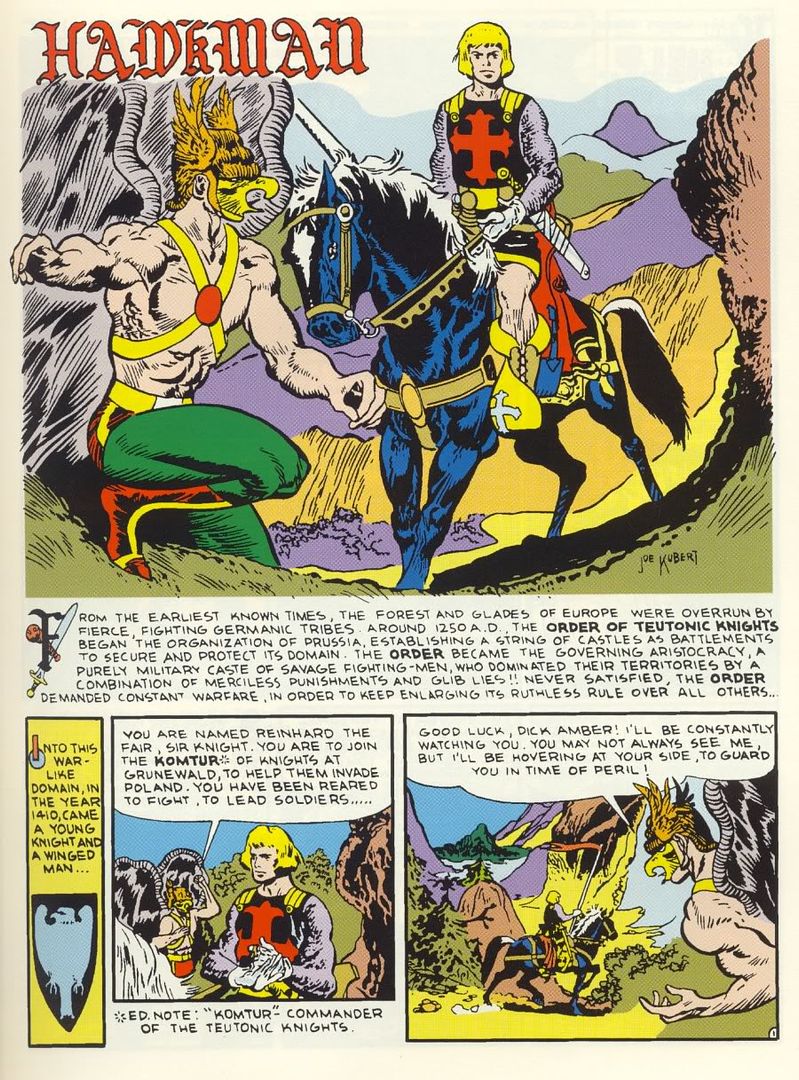
A WWII-era comic, via Crooked Timber, that argues why we fight: because the Germans are racially predisposed (since the 5th century!) to break treaties and kill the innocent. Our racial science is better than yours. (It's easy (and rewarding) to read the rest of the comic: just change the numbers at the end of the address:
AllStarComics24-06.jpg becomes AllStarComics24-07.jpg and so forth. You will note the comic's own collusion with German racial science: the hero's a perfect blond man, and the villains are dark-haired and deformed).

Saturday, April 14, 2007

The De Man Affair Part Deux?


A story appeared in yesterday's Irish Times newspaper claiming that the Polish sociologist Zygmunt Bauman (whose work on postmodernity, the holocaust and love I'm sure we all admire or have used) was not simply a member of the Communist party but also a political officer in the military branch of the Polish Secret Security Forces. Here's a snippet:

Sociologist Zygmunt Bauman' s hidden stalinist past
"Last month, the biggest German daily, the 'Frankfurter Allgemeine Zeitung', published an article in which Bogdan Musial, a Polish historian, revealed renowned Polish-British sociologist Zygmunt Bauman, one of the prophets of postmodernism and author of sociological bestsellers, once worked as an agent for the Stalinist military secret service", notes Andreas Hess, a senior lecturer in sociology. "It should not come as a surprise that Bauman's hidden past is so passionately debated in continental Europe. Despite their adversarial history, Germans and Poles are very critical when revelations come out about the fascist and communist pasts of their intellectuals.The public attitude in continental Europe differs considerably from countries such as Britain and Ireland which were never under the spell of either fascism or Stalinism. Here in Ireland, it is still possible to read the lamentations of an unreconstructed communist like the historian Eric Hobsbawm who celebrated the Stalinist line taken during the Spanish Civil War - and to let him get away with it." (13/04/2007)

I haven't seen the full article but the title "postmodernism made me do it" is indicative of the two potential sides that will be taken in response to this revelation: some will seek to defend Bauman's work and exonerate him of blame (which arguably is what Bauman's work seeks to do anyway: to exonerate himself) and others will say they were proved right all along that postmodernism is simply complicit with all the world's evils.

Three cheers for Eileen

and her co-editors. Check this out.

Friday, April 13, 2007

Eldritch hath a blog


My cat Eldritch has her own myspace (set up by my girlfriend Fiona). The curious can kill themselves by visiting: www.myspace.com/feline_magnificus

She has clearly read many medieval treatises so I'm hoping to persuade her to contribute to ITM at some point.

Quote of the day: Sir Amadace

While I was writing this, JJC, apparently, was continuing the conversation on queer theory and Edelman. If you haven't already read that post, well, get on it.

Sir Amadace is a romance unusually full of dead corpses. A necessary pleonasm (unlike Slayer's "rotten limbs lie dead"), here meant to distinguish merely dead corpses from slain corpses. What fighting there is occurs quickly, virtually off-stage (Amadace "wasse the best that evyr mon hade / In justing for to see. / Ther he wanne full mecul honoure" (533-35): and that's it). Amadace does not create corpses; he simply comes across them. The first he finds in a forest chapel stinking with the rot of a dead knight unburied because of his debts, whose widow, as she says, "sixtene weke I have setyn here, / Kepand this dede cors opon this bere, /With candils brennand bryghte. / And so schall I evyrmore do, / Till dethe cum and take me to" (193-97). Later, Amadace comes across a mass of corpses in a passage that I offer as today's quote:
Now als Sir Amadace welke bi the se sonde,
The broken schippus he ther fonde -
Hit were mervayl to say.
He fond wrekun amung the stones
Knyghtes in menevere for the nones,
Stedes quite and gray,
With all kynne maner of richas
That any mon myghte devise
Castun uppe with waturs lay;
Kistes and cofurs bothe ther stode,
Was fulle of gold precius and gode,
No mon bare noghte away. (517-28)

No man, that is, until Amadace himself, per the advice of a spectral knight, loots the corpses to outfit himself in a manner befitting his station. I found this scene--which I imagined as Amadace picking his way through the corpses--nightmarish, uncanny, not least of all because the scene is so eerily reminiscent (to summon a cliché) of other scenes in other romances, the turgid catalogs of sartorial excess in courts swollen with gold and men. One could almost forget that the knights in miniver amid their chests and coffers are dead: almost, but not quite.

No Future: Terminus

(for earlier posts on Lee Edelman's book No Future: Queer Theory and the Death Drive, look here, here, here, here and here).

No Future concludes with its strongest chapter, on Alfred Hitchcock's The Birds, the inhuman, and the queer. Aside from the author's decision to employ as many avian puns and clichés as possible in order to stress the bird in the human (after a few pages, the yuks about birds of a feather and cocks of the walk peck the feathered nest of the prose into corn), the chapter's strength is its focus upon the insufficiency of the category "human" to contain the vastness it is asked to tame. "Rather than expanding the reach of the human, as in Butler's claim for Antigone" Edelman writes, "we might ... insist on enlarging the inhuman instead" (152).

The chapter yields a quote that for me brings back the reasons the first chapter seemed so inadequate to its own grave pronouncements, namely:
"the fascism of the baby's face" ... subjects us to its sovereign authority as the figure of politics itself (of politics, that is, in its radical form as reproductive futurism), whatever the face a particular politics gives that baby to wear -- Aryan or multicultural, that of the thirty-thousand year Reich or of an ever-expanding horizon of democratic inclusivity. Which is not to say that the difference of those political programs makes no difference, but rather that both, as political programs, are programmed to reify difference and thus to secure, in the form of the future, the order of the same. (151)
Ralph Nader made a related argument in 2000 about Republocrats: it doesn't matter which side you choose, it's all the same political system, whichever party you elect perpetuates the present state. I don't think I'm risking very much to say that in a democracy (even a democracy within a republic) it is riskier to believe that every choice is the same choice and opt out (even if it is the mild form of opting out that voting for Nader represented) than it is to trust in the possibility of an unpredetermined, non-replicative future. Is it controversial to say that George Bush as president has brought about a profoundly different world from the one that Al Gore would have fostered? Is it controversial to say that fascist regimes like Nazi Germany and democratic ones like contemporary Great Britain might use love of the child in propagandistic ways, but that they are not self-replicating regimes of the same order, and possibly not to be mashed into a single shared Symbolic?

And that's what I found most tiresome about this book: not the fact that the future gets suspended, but that the whole of the past and the present, everywhere and everytime, are rendered the same thing. A Hitchcock film from 1963 gives us a glimpse of the same Symbolic Order as homophobic remarks made a far Left mayor of Lourdes, France, in 2000 (a mayor who made the international news not so much for those remarks, but because he was ousted from his party for having made them, a fact Edelman does not mention). The Symbolic is monolithic and homogeneous and immune to history. Its existence is approached, like that of the Real and the Imaginary, with a religious awe. All three work as they do apparently for the reason that Jacques Lacan, their prophet, stated that they work thus -- a kind of Deism without an actual God.

And without compassion. Probably the worst chapter of the book is "Compassion's Compulsion." Edelman is not the first to demonstrate how mandating compassion is a kind of tyranny, how compassion can be thinly disguised aggression. See, e.g., Freud or Lacan. Or Carolyn Betensky, whose work on bourgeois compassion possesses a subtlety that this chapter does not. Once compassion is defined simply as "identification, love of one's neighbor as oneself," there isn't anywhere to go but to show how coercive compassion actually is. Then, like Martin Landau's character in North by Northwest, we become ethical in resisting compassion, in stepping on the foot of the person clinging to Mount Rushmore, in refusing to grasp the outstretched hand of the one about to tumble to a painful death. The future, writes Edelman, "can only belong to those who purport to feel for the other (with all the appropriate implications that such a "feeling for" suggests)" (75). And yet compassion does not mean only to feel for: like sympathy, compassion is literally feeling with, suffering alongside [for you Latinists: com- plus passio, with plus suffering]. Compassion, that is, need not be the realization of the violent desire to render my neighbor myself. It can be the acknowledgment that the suffering of my neighbor, the feeling of my neighbor, takes me apart, makes me feel in ways that are intersubjective. Compassion isn't necessarily identification, if that is the simple imposition of self upon other; it can be a kind of disaggregation. It does not compel us, I think, to refuse the hand that extends itself, whether that hand clings to a mountain or is extended by some waif so cute and fragile that our impulse is to smack him back to his hearth rather than carry him atop our shoulders.

I understand well the book's joy in raising its middle finger to the Annies and Tiny Tims and Whitney Houstons ("I believe the children are our future!") of the world. There is something deliciously wicked about the gesture. And fairly harmless, I fear, since these are figures so maudlin they don't amount to much more than kitsch ... unless kitsch itself is the lethal stuff of our quotidian reality. Perhaps wide eyed waifs really are Hitlers in miniature. Perhaps they really do tyrannize the queer, and are part of the same murderous Symbolic that did in Matthew Shepard ("And that cradle must endlessly rock, we've been told, even if the rhythm it rocks to beats out, with every blow of the beating delivered to Matthew Shepard's skull, a counterpoint to the melody's sacred hymn to the meaning of life" 116-17). But I find myself unconvinced that their power is so vast. It seems to me that the world is wider than that, more contradictory and fragmented.

In the end I also can't stop thinking about my children. Yes, in a way I mean Katherine and Alexander, Kid #2 and Kid #1 on this blog, little bearers of half my genetic futurity and constant reminders that no matter how much I wish to identify with them or replicate myself through them, they will perpetually engage in some version of raising their tiny middle fingers at me, rebuking whatever fantasy I might have had that the future could be more of the same. But I also mean the Green Children, those verdant intrusions from a neighboring world who taught twelfth century England that the ground it inhabited was an Elsewhere, that the history it pretended to culminate was an Elsewhen, that the present it hoped to extend infinitely into the future was in no way sure to arrive. With their call to a true compassion (a suffering-with rather than a transformative identification) these children, more than any death-drive allied sinthomosexual that Edelman imagines, are inhuman, are queer.

Meanwhile in Romantic Studies: MC Nuts


ITM
brings you the latest craze in Wordsworth studies: rap induced frolics mid the daffodils, apparently led by those Furries that Karl used to post about. I can think of no better blending of urban aesthetics with the pastoral sublime. Indeed, I am strangely moved to a poetic emission:

I wandered lonely as a nut crazed mammal
O'er the sea and o'er the channel
I strive to be Worsdworthian cool
Furry and vital: believe it, fool!
Yo.
I said yo.
Check it!


Thursday, April 12, 2007

Happy birthday (n)50


We almost forgot to mention the transformation seen in our comments section: our beloved poster "N50" (AKA Violet Saunders) is now posting as "50."

Happy fiftieth birthday! May you have at least that many more!

Wednesday, April 11, 2007

Quote of the Day

A quote from Gabriel Marcel which I came across in Richard Kearney's Strangers, Gods and Monsters unreferenced and just had to track down:

Its from Homo Viator: Introduction to a Metaphysic of Hope:

"All then prepares us to recognize that despair is in a certain sense the consciousness of time as closed or, more exactly still, of time as a prison- whilst hope appears as piercing through time; everything happens as though time, instead of hedging consciousness around, allowed something to pass through it. It was from this point of view that I previously drew attention to the prophetic character of hope. Of course one cannot say that hope sees what is going to happen: but it affirms as if it saw. One might say that it draws its authority from a hidden vision of which it is allowed to take account without enjoying it.

We might say again that if time is in its essence a separation and as it were a perpetual splitting up of the self in relation to itself, hope on the contrary aims at reunion, at recollection, at reconciliation: in that way, and in that way alone, it might be called a memory of the future."

Michael Uebel would, I think, like this idea of hope as a reunion, a recollection, and a reconciliation which gives to the future a positive quality that sometimes the present and the past have difficulty in revealing. Marcel makes very clear here how an ethic of hope embraces the future.

The power of failure

A note from a former student concludes with the following:
PS- I should also thank you for a very valuable lesson you taught me in your class that spring. I had handed in some very sloppy work to you and received an F with a harsh note that I can still recite from memory. The wind was completely knocked out of my sails since I had never earned such an appraisal in high school. Had it not been for that wake-up call, I can't even imagine what my GPA would be now! I certainly never tried that trick again.
I of course have no memory of the comment that the student memorized. It amazes me, though, how many students have expressed gratitude later in their careers for my holding their work to a high standard. In at least two cases, a failing grade and an honest, challenging comment changed a life. In fact such students tend to be the ones I stay closest to.

It is very difficult to fail students: isn't it easier to give a D or C- or C+ or B-, let them slip by, and not have them show up at your office door, probably angry or upset, demanding more attention and some possibility of redemption? Easier, I guess, in that it is less work to give the higher and less laborious grade ... but then who is failing?

Chaucer is getting closer ...

If ITM is Canterbury, GC has just reached Bobbe-up-and-doun.

Look for the promised post the week after next.

Three words I overuse, especially in exclamatory sentences

twaddle
shamble
skulk

Tuesday, April 10, 2007

Another Heading for the Future (if it isn't Kaput that is)


A name which has been frequently invoked (by myself and Eileen) during ITM's conversations about No Future is that of the postmodern philosopher of religion John D. Caputo. For those who want to take some distance from Edelman while still eavesdropping on JJC's unfolding reading aloud there is a great conversation (a kind of on-line seminar actually) about two of Caputo's recent books, Philosophy and Theology and On Religion going on over at The Church and Postmodern Culture which offers "discussions of high-profile theorists in postmodern theory and contemporary theology, for a non-specialist audience that is interested in the impact of postmodern theory for the faith and practice of the church". It should give a flavor of why Eileen and i think Caputo is so important for anyone interested in futurity and formulating an ethics of joy and hope (Eileen can be Joy; I'll be hope).

Here's the link: http://churchandpomo.typepad.com/