A fascinating and fraught discussion is unfolding in the comments for the Shock of Recognition post. Substantial commentaries by Eileen Joy and Anonymous in Austin debate what is at stake in what we choose to study and what we choose to do.
Check it out.
[update 6/1: Really, check it out. The exchange continues, and it is bracing. I henceforth bequeath my blog to Eileen Joy and Anonymous in Austin.]
Wednesday, May 31, 2006


Tuesday, May 30, 2006
Eloquent silence

Quote of the day, again from Steven F. Kruger, The Spectral Jew. I'm enjoying my reading of this book so much that I have been slow in moving through its pages. In my own work, I've thought quite a bit about medieval noise. Today I'd like to share an excerpt from Kruger's book on the eloquence of silence.
Kruger is examining the records of medieval debates staged between Christians and Jews, disputations which generically unfold as Christian triumphs over innate Jewish blindness. What do you do when you are a rabbi forced to enter such a performance as the speaker for all Jews, your role as loser given to you in advance? What can you say against an authority that has already judged you as deficient and wrong? Is it any surprise that the textual record will record repeatedly that "The Rabbi publicly confessed that he knew nothing more with which to respond"?
Such repeated descriptions of Jewish nonresponse in the Christian record of the disputation add up to a declaration of Christian triumph, and in such moments of self-silencing, we might read the rabbis as participating in their own erasure, in the moves to contain and reduce the Jewish embodiment put at center stage in the disputation.
But Jewish self-censorship and silence might also be read as resistance -- a refusal, increasing as the debate proceeds, to participate in a process over which the rabbis have no control. That is, silence may be one strategy for staying Jewish -- for the rabbis' maintaining an integrity as Jews -- in a situation where doing so by presenting honestly the varying and sometimes discordant traditions of Jewish interpretation or by strongly proclaiming one's beliefs seems increasingly impossible. (p. 200)
Or as Cicero once said, cum tacent clamant: when they are silent, they scream.
The Postmodern Beowulf
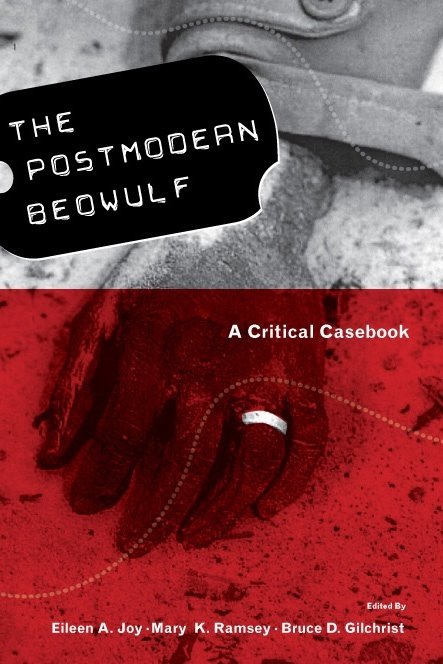
I've mentioned this new book in passing a few times on the pages of this blog. Here is a short excerpt from the preface that well captures the volume's ample ambition, followed by its table of contents. (Yes, the book has both a preface and a substantial introduction called "Liquid Beowulf" [which I've read and it is wonderful]. Eileen Joy must be a terribly prolix person).
Look for The Postmodern Beowulf this autumn via West Virginia University Press.
The attempt to restore historical complexity to our understanding of the past and its cultural forms, and to also show how Old English studies both practice and reformulate theory, suffices as a description of the project of The Postmodern Beowulf, which was initially born out of a desire to provide for students an anthology of “the best of” contemporary critical approaches to the poem and then later developed into a “casebook” that we hope more than amply demonstrates the ways in which Old English scholarship has debated, elucidated, practiced, historicized, and even developed theory in relation to the critical analysis of Beowulf. The book is divided into four sections—History/Historicism, Ethnography/Psychoanalysis, Gender/Identity, and Text/Textuality—that have been designed, not as much to represent specific movements within theory (such as deconstruction, new historicism, post-colonialism, Lacanian analysis, queer studies, and the like), as to offer broad contextual fields of inquiry within which certain questions regarding history, culture, identity, and language have perdured over time (and in response to which questions the more narrowly-defined theoretical “schools” have arisen). This is not to say that specific theoretical approaches are not purposefully highlighted in the volume, because many of them are, but it was also our concern to select essays that took up more than one narrowly-defined approach and that also combined approaches (both traditional and more contemporary) in strikingly innovative ways.
Table of Contents
Preface: Eileen A. Joy, "After Everything, The Postmodern Beowulf"
I. INTRODUCTION
Eileen A. Joy and Mary K. Ramsey, "Liquid Beowulf" [original essay]
II. HISTORY/HISTORICISM
CRITICAL CONTEXTS
Edward Said, "The World, the Text, and the Critic" [originally published in: Edward Said, The World, the Text, and the Critic (Cambridge, MA: Harvard University Press, 1983), 31-53]
Claire Sponsler, "In Transit: Theorizing Cultural Appropriation in Medieval Europe" [originally published in: Journal of Early Modern and Medieval Studies 32.1 (Winter 2002): 17-39]
BEOWULF
Nicholas Howe, "Beowulf and the Ancestral Homeland" [originally published in: Nicholas Howe, Migration and Mythmaking in Anglo-Saxon England (1989; Notre Dame, IN: University of Notre Dame Press, 2001), 143-80]
Allen J. Frantzen, "Writing the Unreadable Beowulf" [originally published in: Allen J. Frantzen, Desire for Origins: New Language, Old English, and Teaching the Tradition (New Brunswick, NJ: Rutgers University Press, 1990), 168-200]
John D. Niles, "Locating Beowulf in Literary History" [originally published in: Exemplaria 5 (March 1993): 79-109]
III. ETHNOGRAPHY/PSYCHOANALYSIS
CRITICAL CONTEXTS
Alfred K. Siewers, "Landscapes of Conversion: Guthlac’s Mound and Grendel’s Mere as Expressions of Anglo-Saxon Nation-Building" [originally published in: Viator 34 [2003]: 1-39]
John Moreland, "Ethnicity, Power and the English" [originally published in: William O. Frazer and Andrew Tyrell, eds., Social Identity in Early Medieval Britain (London: Leicester University Press, 2000), 23-51]
BEOWULF
James W. Earl, "Beowulf and the Origins of Civilization" [originally published in: James W. Earl, Thinking About Beowulf (Stanford, CA: Stanford University Press, 1994), 161-88]
John M. Hill, "The Ethnopsychology of In-Law Feud and the Remaking of Group Identity in Beowulf: The Cases of Hengest and Ingeld" [originally published in: Philological Quarterly 78 (1999): 97-123]
Janet Thormann, "Enjoyment of Violence and Desire for History in Beowulf" [original essay]
IV. GENDER/IDENTITY
CRITICAL CONTEXTS
Carol J. Clover, "Regardless of Sex: Men, Women, and Power in Early Northern Europe" [originally published in: Speculum 68.2 (April 1993): 363-87]
Jeffrey Jerome Cohen, "The Ruins of Identity" [originally published in: Jeffrey J. Cohen, Of Giants: Sex, Monsters, and the Middle Ages (Minneapolis, MN: University of Minnesota Press, 1994), 1-28]
BEOWULF
Clare A. Lees, "Men and Beowulf" [originally published in: Clare A. Lees, ed., Medieval Masculinities: Regarding Men in the Middle Ages (Minneapolis, MN: University of Minnesota Press, 1994), 129-48]
Mary Dockray-Miller, "Beowulf’s Tears of Fatherhood" [originally published in: Exemplaria 10 (1998): 1-28]
Shari Horner, "Voices from the Margins: Women and Textual Enclosure in Beowulf" [originally published in: Shari Horner, The Discourse of Enclosure (Albany, NY: State University of New York Press, 2001), 65-100]
V. TEXT/TEXTUALITY
CRITICAL CONTEXTS
Michel Foucault, "What is an Author?" [originally published in: Josué V. Harari, ed., Textual Strategies: Perspectives in Post-Structuralist Criticism (Ithaca, NY: Cornell University Press, 1979), 141-60]
Carol Braun Pasternack, "The Textuality of Old English Poetry" [originally published in: Carol Braun Pasternack, The Textuality of Old English Poetry (Cambridge: Cambridge University Press, 1995), 1-32]
BEOWULF
Gillian Overing, "Swords and Signs: Dynamic Semiosis in Beowulf" [originally published in: Gillian Overing, Langage, Sign, and Gender in Beowulf (Carbondale, IL: Southern Illinois University Press, 1990), 33-67]
Seth Lerer, "Hrothgar’s Hilt and the Reader in Beowulf" [originally published in: Seth Lerer, Literacy and Power in Anglo-Saxon England (Lincoln, NE: University of Nebraska Press, 1991), 158-94]
Susan M. Kim, "As I Once Did With Grendel: Boasting and Nostalgia in Beowulf" [originally published in: Modern Philology 103.1 (August 2005): 4-27]
POST-SCRIPT
Michelle R. Warren, "Post-Philology" [originally published in: Patricia Clare Ingham and Michelle R. Warren, eds., Post-Colonial Moves: Medieval through Modern (New York: Palgrave Macmillan, 2003), 19-45]
Afterword: James W. Earl, "Reading Beowulf with Original Eyes" [original essay]
Monday, May 29, 2006
Thursday, May 25, 2006
Ocular humanization


Last weekend Kid #1, Kid #2, and I put on our identical green Irish T-shirts and went to the movies (the Spouse would have been welcome to don an identical green Irish T-shirt, too, but it was her hard luck to be away on a business trip). Over the Hedge is what I'd describe as perfectly fine kiddy fare: not cloying like, say, The Tigger Movie (after which I seriously considered filing a lawsuit demanding that the 77 minutes painfully extracted from me be restored), and not driven by an attitudinal obnoxiousness masquerading as humor (a la the horrendous Chicken Little).
What struck me most about this film was the sheer cuteness of its animal characters. I'm not a warm and fuzzy person (see my evident misanthropy in the post below), but there is something so darn cuddly about those critters that, while my entranced progeny munched their popcorn, I was compelled to start theorizing.
The attractiveness of the animals, it struck me, owed much to their general anthropomorphism, and especially to their enormous, human eyes: these computer animated creations possess irises and pupils that belong to homo sapiens and not to other mammals. RJ the racoon's bright blue (!) orbs [see the picture, above] gave him not just a human but a juvenile look, activating the powerful "ooooooooohhh" gene. It was difficult to resist the urge to give him a cookie.
So here is the medieval part. Those oversized, sympathetic eyes reminded me of a strategy that a medieval illustrator utilized to humanize some monsters in an Anglo-Saxon Wonders of the East manuscript. I'm reproducing below a bit of a lecture I once gave on Anglo-Saxon monsters; for the full talk, folow the hyperlink at the title. For the scholarly version of these observations, check out the first chapter in Of Giants , or see the reprint in The Postmodern Beowulf.
-----------------
from Monsters, Cannibalism and the Fragile Body in Early England
Writers and artists in early medieval England were fascinated by the grotesque, the marvelous, the monstrous. Anglo-Saxon literature, historiography, manuscript illustration, and sculpture reveal a cultural obsession with the plasticity of the human form. The Wonders of the East, a catalogue of the monsters of the Orient bound with the famous Beowulf manuscript, is crammed with bodies transfigured and deformed. One magnificent illustration makes real the Donestre, a fabulous race described in the legends of the Greek conqueror Alexander the Great. The Donestre embody a monstrousness which is both corporeal and linguistic. Because they know all human languages, these strange creatures are able to greet travelers to their country with familiar speech, convincing foreigners that they know their kinsmen and homeland. After they lure their victims close with pleasant conversation, they kill them and devour their bodies except for the head, which they sit over and mourn with weeping. The illustration in the Old English Wonders of the East consists of three successive scenes, read clockwise starting at the top. Here the Donestre is a fleshy, naked man with a lion's head. His curly mane sweeps the curve of his shoulder, and with a sad frown and huge, watery eyes he commiserates with a traveler. The foreigner gestures widely, perhaps in the midst of relating some story about his distant home to his sympathetic listener. The patient monster extends an enormous hand to touch the speaker, a reassuring language of the body. Below and to the right is the next episode of the narrative: the Donestre, having heard enough, is busy devouring the traveler. The monster’s naked body is directly on top of the man, pinning him to the earth. The final scene, in the lower left corner, finds the Donestre looking melancholic. He holds his hands to furry ears, frowns miserably, and stares at the bodiless head of his victim, the only remnant of the feast.
When read chronologically through the three scenes, the Donestre's body undergoes a revealing transformation. At first more manly than bestial, the monster's animal head is fully anthropomorphized to give an sympathetic look — as if he were a medieval version of Simba or some other friendly character from The Lion King. Or, at least, one of the characters from The Lion King on steroids: his hands, calves, and chest bulge with muscles. Unlike any Disney drawing, though, this body possesses genitalia -- here painted bright red and prominently displayed. Compared to the hypermasculine body of the Donestre, the traveler's form is thin, has bad posture, and looks feeble. As the Donestre devours his victim, the monster’s body becomes more leonine: he is on all fours, as if he has just pounced; his nose and lips form a snout; his eyes suddenly lack whites. An oral, animal ecstasy characterizes the second scene as the Donestre -- bare buttocks arched above the prone foreigner's hips -- devours the man's erect arm. That this combination of violence and eroticism is difficult to contain in the illustration is indicated by the Donestre's very human left foot, which steps out of the picture and into the frame -- the only part of the image to violate its protective border. The last segment of the three-part story finds both bodies much reduced. The traveler has vanished, replaced by a peacefully oblivious head. The monster has become an indistinct collection of curved lines that center around a trembling hand, a dark eye, and a tight frown.
The literal incorporation of one body into the flesh of another, cannibalism might be glossed as the fear of losing that boundary which keeps identities individual, separate. The Donestre illustration from Wonders of the East uses cannibalism to explore the limits of personal identity, the fragility of the body as a container of a singular selfhood. The monster here is a cultural, linguistic, and sexual Other who seems to be intimate (he knows you, he can talk about your relatives, he can share in your homesickness), but who in fact brutally converts an identity familiar and secure into an alien thing, into a subject estranged from its own body. In the last scene of the narrative the traveler has been completely transformed. The severed head is an empty point of fascination that directs the viewer's gaze back to the new body in which the traveler is now contained, at the monster he has now become; the traveler ponders what he once was from the outside, as a foreigner. The Donestre transubstantiates the man, making him realize through a bodily conversion that he was always already a stranger to himself. The Donestre-Traveler stares at the mute, lifeless head with such affective sadness because at this moment of plurality he sees the precariousness of selfhood, how much of the world it excludes in its panic to remain self-same, singular, alone.
The monster exposes what Lacanian psychoanalysis calls the extimité, the "intimate otherness" or "interior exteriority" of identity. To be fully human is to disavow the strange space that the inhuman, the monstrous, occupies within. To succeed on a mass scale, this disavowal requires two things: a measure of cultural uniformity and relative social calm. Britain in the centuries before the Norman conquest was a hybrid collection of peoples who were constantly forced to examine who they were in relation to a shifting array of differences. "Anglo-Saxon England" is a blanket term that hides more than it reveals. In a real sense, there were no Anglo-Saxons, only scattered groups of varied ancestry in growing alliances who were slowly building larger political units. "England" existed as an ambiguous region of a larger island, and was very much in the process of being invented as a unifying geography, as a nation-idea capable of transcending the differences among those bodies it collects beneath its name. The various Germanic peoples who sailed to Britain beginning in the fifth century were ethnically diverse. As they settled the island they intermingled with the Britons and with each other. The Latin church meanwhile continued to colonize in successive waves. In 835, the Vikings began their violent incursions, raids, and settlements. The history of Anglo-Saxon England is a narrative of resistant hybridity, of small groups ingested into larger bodies without a full assimilation, without cultural homogeneity: thus the kingdoms of Hwicce, Sussex, Kent, Lindsey, Surrey, Essex, East Anglia, Northumbria, Mercia, Wessex were sutured over time into progressively larger realms, but despite the fact that they were eventually loosely unified under King Alfred, these areas retained enough force of difference to remain dialect regions that persist to the present day.
Anglo-Saxon England is not so very different from the monstrous Donestre who fascinated it: familiar and strange, hybrid rather than homogenous, a body that absorbs difference without completely reducing or assimilating it. Because of its diversity and because of its permeable, perpetually transgressed borders, Anglo-Saxon England was relentlessly pondering what it meant to be a warrior, a Christian, a hero, a saint, an outlaw, a king, a sexed and gendered being. If there is a generalization under which such a long and varied time period can be gathered without doing reductive violence to its expansiveness, it is simply that during the span of years now designated by "Anglo-Saxon England" the limits of identity were under ceaseless interrogation because they were confronted by almost constant challenge. It is not surprising, then, that the monster became a kind of cultural shorthand for the problems of identity construction, for the irreducible difference that lurks deep within the culture-bound self.
Wednesday, May 24, 2006
The shock of recognition
From an honor's thesis by Amy Baily, composed here at GW, a nifty piece of work in which various people were interviewed about authors, fictions, and illusions of presence:
Paging Molière: it's official, I'm a misanthrope.
I asked Jeffrey Cohen whether he’d trade reading Chaucer for being able to spend time with him.COHEN: No.(laughing) Amy, I'm sitting in this office not because I like people; I don't really like people; I like books and texts. If Chaucer hadn't written his books I wouldn't be interested in him. I wouldn't want anything to do with Chaucer the person.
AB:Who makes books?
COHEN: People, who get transformed by them and lose themselves in them. The person is not the book.
Sure, I get that little thrill of meeting an author when I go to a book signing ... especially if the author exceeds my fantasy of who that author is going to be. Most of the time they don't.
For me the book is different from the person, and the book doesn't necessarily make me want to meet the person or idolize that person, or give me a fantasy of "I could be that person's friend, or pick that person's brain." No, I'm just happy to be in the textual world, and that's enough.
Paging Molière: it's official, I'm a misanthrope.
Tuesday, May 23, 2006
"a place of expectation without promise of fulfillment"
Beautiful meditation on multiplication of negatives, Forster, translation and Old English verse at Old English in New York.
The BABEL working group

Born of jottings in a lounge in Asheville, launched via inscribed pumpkin on a misfiring medieval trebuchet, the BABEL Working Group is almost too astonishing to be believed. Almost. But because I know Eileen Joy is real -- or at least have some compelling evidence that she is real -- and because I know that BABEL is already sponsoring conference sessions and publishing projects (I have an afterword in a BABEL-affiliated collection, Reality, Television and the Middle Ages and a reprinted piece in another, The Postmodern Beowulf), I am going to stake my academic credibility (such as it is) on the fact that the amazing BABEL website is the future of medieval studies. Or, at least, of interesting medieval studies.
Here's a small taste:
How could we have a collective that could act as a lever for a new discourse within the academy aimed at reformulating and redefining what we think we mean by "humanism" and "the humanities," such that we could also advocate for the important role of humanities study in the post-historical, post-human, hell, post-everything university, and also in public life? We also desired to be able to undertake this venture, as well as engage in various collaborative activities, with scholars working in more modern humanities fields, and also with scientists working in cutting-edge fields such as biotechnologoy, robotics, artificial life, particle physics, etc. It was (and is) our feeling that many of the debates currently ongoing between the modernists, and between the scientists, regarding such subjects as "the future of literary studies" or "the future of the human," could benefit immeasurably from the "long" (or, "longer") historical perspectives of medieval studies, and moreover, medieval studies could benefit by being, not merely poachers of contemporary critical thought, but one of its many co-agitators. Finally, how could we create a space where, following Bill Readings, "the question of being-together is raised, raised with an urgency that proceeds from the absence of the institutional forms (such as the nation-state), which have historically served to mask that question" (The University in Ruins, p. 20). After much scribbling of all of this on Meantime Lounge cocktail napkins, BABEL was born.
Described as "a non-hierarchical scholarly collective, with no leaders or followers, no top and no bottom," the BABEL Working Group has taken as its current project musings upon corporality and posthumanity, topics near and dear to my own heart. Check out the website, and while you're at it glance at Eileen A. Joy's website, too.
I posted recently on the necessity of maintaining a sense of humor even when engaged in reflection upon Utterly Serious Topics (see Tiny Epiphany). The exuberant and cheeky BABEL Working Group delivers a manifesto for a serious and seriously engaged medieval future. Babel on!
Monday, May 22, 2006
Stone of Brutus
Seems I'm trying to set a record here for number of posts to In the Middle within a single day. Via the BBC via JKW at Pistols in the Pulpit:
London's heart of stone
By Sean Coughlan
BBC News Magazine
The mysterious "London stone" is going to be rescued from a building due to be demolished. Does it mean that London is going to be saved from an ancient legend?
You couldn't get much less of a romantic setting for an historic monument. It's in a kerbside cage, stuck on the wall of a sports shop in Cannon Street due for demolition.
The only clouds of mystery billowing around it are the car exhaust fumes from the traffic crawling through the City of London.
But this is the neglected setting of the London Stone - an ancient and mysterious object mentioned by Shakespeare, William Blake and Dickens, which has been seen as one of the capital's greatest relics since at least the Middle Ages and probably much earlier.
Now there are plans for the limestone block to be put into the Museum of London for safekeeping, while the building to which it's gloomily attached is pulled down and the site is redeveloped.
Protecting the stone might not be such a bad idea - since there is a legend that, like the ravens at the Tower of London, the fortune of the city is tied to the survival of the stone.
"So long as the stone of Brutus is safe, so long shall London flourish," says the proverb.
Moved to museum
This relates to the myth that the stone was part of an altar built by Brutus the Trojan, the legendary founder of London. This might be unlikely, but then again no one really knows its origin.
Hedley Swain, archaeologist at the Museum of London, says it is clearly an ancient block - but despite the many legends, there is no way of confirming its date or purpose.
A more pressing concern is how to rescue the stone from its current position, in a building that is set to be pulled down.
"The trouble is that at the moment it's not really looked after by anyone," he says. And although there is no fixed timetable, he is expecting the stone to be brought to the Museum of London for display while the new building is constructed.
"People go to look for it, thinking it's going to be a grand object, and then they walk up and down Cannon Street and can't find it."
"We get letters from people saying that it's appalling that it's being kept in this way."
But he says there is no way of confirming rival theories that it was a Roman distance marker or part of a prehistoric standing stone or any of the many more exotic myths.
The area between Cannon Street and the River Thames was a site of important Roman buildings - and he says that the stone could have been from these buildings.
But it could also have been much older and part of some other pre-Roman edifice.
Guarding the stone
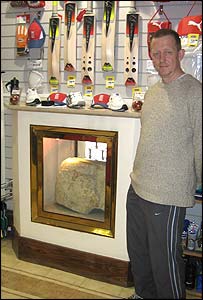
It's not entirely the case that no one is looking after the stone, because it does have a current custodian: Chris Cheek, the manager of the Sportec sports shop to which the stone is attached.
And even though he isn't a household name, Londoners might not realise that he has already saved their city from the destruction promised if the stone is lost.
"When we were setting up the shop, there were cowboy builders here, and one of them was just about to take a chisel to the stone. I told him 'Whoah. Stop right there.'"
And Mr Cheek has become attached to this strange situation, where one of the city's most ancient objects is parked in his shop, surrounded by football shirts, cricket bats and trainers.
In fact, while people try to see it from outside, the only decent view of the stone is from the cricket section in his shop.
Does he believe in the legend that London's future well-being depends on this stone?
"Yes. I do really. I'm not into hocus pocus, but there is something about this stone. For some reason it's been kept, there's something special about it."
Sacred stones
This could be because of its associations with druids, he suggests, or maybe just the sheer weight of history - from the Roman legionnaires through to the Blitz.
He also says it reveals something about people's characters.
"There are people who have travelled all the way from Australia to see this stone. And there are other people who are so hectic, so busy with their appointments, that they walk past it every day of week and never even see it."
"And there are people who come in for a pair of socks and then suddenly see it. 'Is that the London stone? I've heard of that'."
Mr Cheek also enjoys the idea that, until it's shifted to a museum, he is the latest in a long line of people to be in charge of something so mysterious and ancient.
The idea of sacred stones is a very ancient tradition - monarchs are still crowned on the Stone of Scone, the so-called "stone of destiny", in Westminster Abbey.
And the London stone has been the source of speculation right through the capital's history.
Magic powers
Queen Elizabeth I's adviser and occultist, John Dee, was obsessed by the stone, believing that it had magic powers.
Shakespeare depicted the 15th Century peasants' rebellion leader, Jack Cade, striking the London stone as a symbolic sign of taking control of the city.
And Mr Cheek can point out the grooves in the top of the stone, furrowed, he believes, by repeated sword blows.
Christopher Wren saw the foundations of the stone being excavated - and believed it to be part of a bigger Roman structure.
William Blake used the story that the stone had been part of a druid altar - reflecting another belief that it was from a pre-Roman religious stone circle on the site now occupied by St Paul's Cathedral.
The persistent story that the stone was the symbolic centre point from which every distance in Roman Britain was measured was already in circulation in the 16th Century.
Stone survivor
But maybe the London stone's most remarkable achievement is to have survived at all - through wars, plagues, fires and even 1960s planning, right in the middle of the financial district of the capital.
It's probably still in a setting not too far from where it stood when the Romans were building London.
In 18th Century prints it was kept in an elegant stone casing - and there are photographs of Victorian police men guarding the stone, when it was set into the wall of a church at waist height.
This church, St Swithin, was damaged during a bombing raid during World War II - and the stone was then attached to a new building on the site.
This current building is set to be pulled down - and the Corporation of London is ensuring that the replacement will be put the chunk of limestone on display in a way that is more prominent.
Archaeologist Hedley Swain says the stone also serves as a reminder that "under the superficial veneer of being a modern business capital, London has so many deep layers of accumulated history".
Mr Cheek says that the real appeal is its mystery. "If it doesn't have a beginning, then perhaps it doesn't have an end either."
Quote of the day: from Steven F. Kruger, The Spectral Jew
I can't seem to get these lines out of my head, so well do they convey Kruger's project in his new book. Here Kruger is speaking of the Dialogi of Peter Alfonsi, a conversation staged between a converted Jew and whats eems to be his former self. This Jew-that-was-Peter, named Moses, gets some of the best lines in the Dialogi, and does not in the end convert. Kruger writes:
Such "complex ambivalence," Kruger argues, accounts for the popularity of the Dialogi, which flourished at a time when "Islam in fact poses a significant threat to European Christian hegemony, and Judaism itself, no matter how diminished or historically 'humiliated,' persists as a presence within Europe" (124).
A longer review of this book will eventually follow ...
The Dialogi thus never takes the final step of remerging Peter and Moses. Peter's former self never disappears, is never transformed; Moses remains represent throughout -- "stolid," making his arguments of women -- a reminder of Peter's Jewishness that, at least in this text, is never effaced. Despite Moses's final concessions, and despite what we know about the real-life conversion of Peter, the text continues to enact a perverse Jewish countermovement to the (proper) movement of conversion. Moses's transformation through the spirit remains wished for rather than completed; as the text draws to its close, the preconversion Jew still stands alongside his postconversion self. A residue of Jewish identity is thus ineffably inscribed within Peter's celebration of his own embracing of Christianity ... It is a certain queer residue that maintains the converted Jew as still (in terms of gender, [quasi] race, and sexuality as well as religion) different from those whom he has joined through conversion. (p.123)
Such "complex ambivalence," Kruger argues, accounts for the popularity of the Dialogi, which flourished at a time when "Islam in fact poses a significant threat to European Christian hegemony, and Judaism itself, no matter how diminished or historically 'humiliated,' persists as a presence within Europe" (124).
A longer review of this book will eventually follow ...
Good medieval website

This website has been created by graduate students of medieval English literature at the University of Cambridge. Although much of the material and resources presented on these pages is directed towards the study of the literature of the Middle Ages, we intend that this site will evolve into both a useful collection of resources and also a point of contact for medievalists both at Cambridge and around the world who are engaged in the study of medieval English literature, history, culture, and thought.
An attractively designed site that provides a cornucopia of materials, including a sturdy Online Resources for Medievalists page.
Brilliant classics blog

Its title won't sound quite right if you've just been reading about the Warren Cup (below), but Kofi Campbell steered me towards this amazing blog: the Trojan war as narrated by a solider in Odysseus's army. Funny and smart.
Seth to Horus: "How lovely your backside is!"
And Horus to his mom: "Seth tried to know me."
Interesting article on a British Museum lecture series about same sex desire in the ancient (Egyptian, Greek and Roman) world. A related exhibit centers around the Warren Cup (1st C CE), a silver drinking vessel with two sexually explicit, homoerotic scenes. A nicely detailed image of the cup and some background can be found through the British Museum Compass. And there's even a site that sells replicas (and provides good background on the cup's Victorian discovery and the long road to its public exhibition).
Interesting article on a British Museum lecture series about same sex desire in the ancient (Egyptian, Greek and Roman) world. A related exhibit centers around the Warren Cup (1st C CE), a silver drinking vessel with two sexually explicit, homoerotic scenes. A nicely detailed image of the cup and some background can be found through the British Museum Compass. And there's even a site that sells replicas (and provides good background on the cup's Victorian discovery and the long road to its public exhibition).
Friday, May 19, 2006
Tiny epiphany
Watching Indiana Jones and the Raiders of the Lost Ark tonight with Kid #1 made me realize what bothers me most about The Da Vinci Code (other than the fact that Da Vinci is not a last name). Whereas the magnum opus of Dan Brown takes itself far too seriously, this fun little piece of American movie making refuses to deploy any of its mythology in a heavy-handed way. Nazis, the face-melting Angel of Death, rainforest temples loaded with rolling stones and poison darts: I'd forgotten all the chuckles the film provides, while in a way taking all these things seriously enough.
I love the fact that the United States ends up with the Ark of the Covenant, making the U.S the New Chosen People of the Biblical God ... only the ark gets misplaced in warehouse somewhere, and no one really cares.
I love the fact that the United States ends up with the Ark of the Covenant, making the U.S the New Chosen People of the Biblical God ... only the ark gets misplaced in warehouse somewhere, and no one really cares.
Same as it ever was
I've been thinking lately about a cross-dressing embroideress from late fourteenth-century London. Perhaps you've heard of John Rykener, AKA Eleanor [ Johannes Rykener, se Elianoram nominans ]. Dressed as a woman, Eleanor John was propositioned by a man named John Britby in 1395 and agreed to have sex with him for a certain sum of money. They were arrested while engaged in this "libidinous act" and brought before the mayor and aldermen of London. To the questioning authorities Eleanor John narrated a life filled with sex acts enjoyed abed and outdoors, sometimes for money or goods, sometimes not; sometimes with men (especially clerics), sometimes with women (including nuns). Much of the time in between these escapades was spent in women's clothing, living a quiet life of embroidery work. The remarkable contemporary document that gives a brief glimpse of Eleanor John's life was published by David Lorenzo Boyd and Ruth Mazo Karras a decade ago ["`Ut cum muliere": A Male Transvestite Prostitute in Fourteenth Century London," Premodern Sexualities , ed. Louise Fradenburg and Carl Freccero (London: Routledge, 1996) 99-116; the Latin document with an English translation can be viewed in the Medieval Sourcebook]. Carolyn Dinshaw provides a nuanced reading of the text in her book Getting Medieval: Sexualities and Communities, Pre- and Postmodern (Duke University Press, 1999), stressing "his/her queer and queering presence" throughout the narrative Eleanor John provides. [For a web accessible but condensed version of Dinshaw's argument, look here]. Rightly so, she contextualizes the legal document with reference to Lollards and the Canterbury Tales; rightly so, she stresses that there is also something untimely about the narrative, something that invites an affective, community-engendering reading.
I've been thinking about Eleanor John in relation to some keen words from the foremost modern philosopher of gender, Judith Butler. I'm a fan of all Butler's work, but have found her recent book Undoing Gender especially useful … and moving. In the introduction she speaks of the necessity, and difficulty, of bringing into being a livable life. That's no sloppy redundancy, but an acknowledgement that contemporary culture is very good at allotting spaces to those who dwell outside the sphere of the normal (as if a mere place were what tolerance is about); these spaces often turn out to be uninhabitable to those who are consigned within. We need a certain openness, she writes, a lack of predetermination when it comes to deciding what it means to be human: "We must learn to live and to embrace the destruction and rearticulation of the human in the name of a more capacious and, finally, less violent world, not knowing in advance what precise form our humanness does and will take" (35).
The search for a livable life: that's what it seems to me that Eleanor John was engaged in when apprehended in London in 1395 and compelled to a self accounting. We'll never know, of course, what desires animated Eleanor John; we'll never know if some severe punishment followed the confession to the mayor (no further record survives); we'll never even know what gender Eleanor John would choose, if given the choice-- or maybe for our transvestite-embroideress-prostitute-gigolo a livable life would have consisted in the option of not having to declare a choice, of not having to give a self-accounting that necessitated a self justification.
I write all this because two days ago at what was to be an ordinary lunch in an ordinary restaurant on a nondescript day, a friend confessed that he will, within a matter of months, be living as a woman. This friend – why not call him John? – has initiated hormone therapy and is beginning to live sometimes as (lets keep the medieval analogy going) Eleanor. For the most part the only vocabulary we have today for talking about transexuality involves jokes and tragedy. In John's case the decision and the change are in no way funny (even if John has the good humor to make light of what he can). John has young children. He, his wife, and his kids are close to me, my wife, our kids. We all love John and want him to be happy, but we are all only too much aware of the amount of present and looming pain. Selfishly, I am also mourning the loss of my friend – or, rather, the loss of my fantasy that I knew this friend as he is.
To confess his narrative to me was difficult for John. I could see it as he sat across from me, and as we walked back to my office at GW. He told me afterwards that he suspected I would accept him for who he had revealed himself to be. He knows that my family is queer friendly: many pals who are gays and lesbians, some close friends who live together as a polyamorous quad. But he was nervous all the same, especially because this means a major change not just for him but for his-- and our -- whole family. He and his wife will no longer live together, but will strive to remain best friends.
John, becoming Eleanor, is brave. He faces a wholly uncertain future: What will his kids think? The community? The conservative firm for which he works? Yet he faces that uncertainty with a courage that I can barely comprehend. I'm honored that he confided what he did in me, and I'm happy that he chose this difficult path to creating a livable life over the alternative he had seriously contemplated, suicide.
I will miss John, but "John" was partly a creation of my own ignorance. I will look forward, then, to getting to know Eleanor.
(posted with the permission of "John," who would rather have been compared to Joan of Arc)
I've been thinking about Eleanor John in relation to some keen words from the foremost modern philosopher of gender, Judith Butler. I'm a fan of all Butler's work, but have found her recent book Undoing Gender especially useful … and moving. In the introduction she speaks of the necessity, and difficulty, of bringing into being a livable life. That's no sloppy redundancy, but an acknowledgement that contemporary culture is very good at allotting spaces to those who dwell outside the sphere of the normal (as if a mere place were what tolerance is about); these spaces often turn out to be uninhabitable to those who are consigned within. We need a certain openness, she writes, a lack of predetermination when it comes to deciding what it means to be human: "We must learn to live and to embrace the destruction and rearticulation of the human in the name of a more capacious and, finally, less violent world, not knowing in advance what precise form our humanness does and will take" (35).
The search for a livable life: that's what it seems to me that Eleanor John was engaged in when apprehended in London in 1395 and compelled to a self accounting. We'll never know, of course, what desires animated Eleanor John; we'll never know if some severe punishment followed the confession to the mayor (no further record survives); we'll never even know what gender Eleanor John would choose, if given the choice-- or maybe for our transvestite-embroideress-prostitute-gigolo a livable life would have consisted in the option of not having to declare a choice, of not having to give a self-accounting that necessitated a self justification.
I write all this because two days ago at what was to be an ordinary lunch in an ordinary restaurant on a nondescript day, a friend confessed that he will, within a matter of months, be living as a woman. This friend – why not call him John? – has initiated hormone therapy and is beginning to live sometimes as (lets keep the medieval analogy going) Eleanor. For the most part the only vocabulary we have today for talking about transexuality involves jokes and tragedy. In John's case the decision and the change are in no way funny (even if John has the good humor to make light of what he can). John has young children. He, his wife, and his kids are close to me, my wife, our kids. We all love John and want him to be happy, but we are all only too much aware of the amount of present and looming pain. Selfishly, I am also mourning the loss of my friend – or, rather, the loss of my fantasy that I knew this friend as he is.
To confess his narrative to me was difficult for John. I could see it as he sat across from me, and as we walked back to my office at GW. He told me afterwards that he suspected I would accept him for who he had revealed himself to be. He knows that my family is queer friendly: many pals who are gays and lesbians, some close friends who live together as a polyamorous quad. But he was nervous all the same, especially because this means a major change not just for him but for his-- and our -- whole family. He and his wife will no longer live together, but will strive to remain best friends.
John, becoming Eleanor, is brave. He faces a wholly uncertain future: What will his kids think? The community? The conservative firm for which he works? Yet he faces that uncertainty with a courage that I can barely comprehend. I'm honored that he confided what he did in me, and I'm happy that he chose this difficult path to creating a livable life over the alternative he had seriously contemplated, suicide.
I will miss John, but "John" was partly a creation of my own ignorance. I will look forward, then, to getting to know Eleanor.
(posted with the permission of "John," who would rather have been compared to Joan of Arc)
Subscribe to:
Posts (Atom)