I just dismissed my last Barnard course, let them fill out evaluations, and had the penultimate sit here in my Barnard office. And I just discovered that one of my students had kept a record called "Quotable Karl (& Less Quotable Karl)," which she deposited in my mailbox. Here are the quotes:
On Switzerland: "You can see it in Goldfinger"*
On college-level spelling courses: "Oh, you mean without beer."
On the discursive construct of cannibalism** in Heart of Darkness: "Like you're on a ship that's being piloted by a burrito."
On pedagogy: "I'm just saying words."
On student discussion: "Gold stars for everyone!"
On his sentence: "No, that's stupid."
On contributing to society: "It's probably better -- for the world -- if I don't talk more."
On himself: "I'm full of deepness."
On domestic violence and Hurston: "I believe the word is 'blow,' not 'girly slap.'"***
--
Notes by the object of study:
* Frankenstein discussion.
** I love it when my students--my Freshmen!--start talking like this.
*** In correcting a student's misapprehension of Janie's violence in hitting Tea Cake in Their Eyes Were Watching God
==
I should also say that my students have parodied me to my face. They're especially fond of my use of the word "fantastic" as an all-purpose modifier for books I like. This happen to anyone else?
Monday, April 30, 2007


Burne-Jones, Chaucer, and the Slippage of Everything
 Okay, since spending some time recently watching a lot of episodes of South Park with my first-year writing students and reading Mandeville's Travels with my M.A. students [see previous post here], we can now call this an obsession of mine--by which I mean: noticing all the ways in which various anti-semitic discourses and even meta-anti-semitic discourses [whether in the form of apocryphal stories, reductively stereotypical tropes, satire, etc.] are made to kind of "disappear" in or move into the background of our "readings" of various texts: whether travelogues, television shows, or even paintings. My interest is not in delineating the contours of the anti-semitic discourses themselves [which are obvious], but in trying to take note of how we subvert a certain way of "taking note" of them [if that makes any sense].
I recently attended a show at the Saint Louis Museum of Art, "Waking Dreams: The Art of the Pre-Raphaelites from the Deleware Art Museum," in which I was able to view a painting of which I had formerly been completely unaware, Edward Burne-Jones's The Prioress's Tale (1898), based on Chaucer's tale of the same name. It was his last "produced" painting (he died that same year), and he had apparently been working on it for over thirty years. Burne-Jones had also worked with William Morris on his 1896 Kelmscott edition of the Canterbury Tales, and earlier in his career had also illustrated a wooden cabinet with scenes from this particular story. "The Prioress's Tale," of course, has generated much critical scholarship, especially as regards its virulent anti-semitism, with some critics feeling discomfited by what appears to be Chaucer's comfort with telling a supposedly uncritical story about a Christian child being savagely murdered by Jews and thrown into a communal privy, and others maintaining that since it is the Prioress's story, Chaucer is obviously doing something more subversive--i.e., this brutal and hate-filled tale, coming from the mouth of the nun who wears a necklace that declares "amor vincit omnia" and who is so "pitous" she would weep over a small mouse caught in a trap and whose table manners make her "ful semely" [but in a contrived manner--she "apes" politeness], cannot possibly be read "straight," and part of its shock value comes from who is telling it. I tend to agree with this latter view, and I actually believe Chaucer made some of the details in the tale as crude as possible in order to make this cliched martyr narrative both "cute" ["litel"] and sublimely horrible at once. With Chaucer, it's all about the layering. The layers, my friends, the layers.
By "referencing" this story of Chaucer's in a painting, there is already somewhat of an undermining of Chaucer's framing, because it is no longer the Prioress's story, per se, but is Burne-Jones's "lifting" and re-framing [literally] of two particular moments in that story: the murder of the boy--seen in the right-hand middle-third of the canvas, one woman can clearly be seen holding the boy down against his will, a dagger in her hand pressed against his back, with which we know she is going to slit his throat, while another women looks on, apparently an accomplice--and the moment at which the Virgin Mary places the grain on his tongue so that he can continue singing even though his throat has been cut. To a certain extent, Burne-Jones quite purposefully minimized the violence of both of these scenes. In the central image of the painting--where the Virgin Mary is bending over the boy who can be seen to be standing in a kind of grave in a garden of poppies and lilies, hands clasped in a prayerful pose--the boy is completely unmolested, his body whole and complete and beautifully boy-like. His actual murder is relegated to the background at the moment just before it actually happens. There is nothing in the painting to suggest that the boy is in the Jewish ghetto of the original tale. You have to look hard to notice the dagger.
I assume the original audience of this painting would have been more familiar than the museum-goers in Saint Louis with the original story and may have filled in the missing details, as well as looked for the murder weapon, and the imminent moment of the boy's murder. For the contemporary audience, the accompanying wall plaque and the iPod audio tour provide the necessary glosses on the painting, and to my surprise, while both mention that the painting is based on a story by Chaucer, the only narrative details provided are that the story is about a boy who is murdered while singing a hymn to the Virgin Mary, and that she is placing a grain in his mouth so that he can continue singing even though he has been murdered. All of the provided detail--brief as it is--focuses on the foreground of the painting, and no mention is made of what is happening in the background. I was looking for the murder scene, but I doubt other museum-goers were, and the detail will be lost to many without some kind of narrative guidance. Simply put, much of the content [and context] of Chaucer's original story is drained in this painting [by Burne-Jones], and the museum curators and exhibition authors have not seen fit to fill in much of what is missing, thereby flattening the painting's possible effects upon its viewers, as well as covering over the story's richly multi-layered history. For now, it's just another pretty picture in the room.
There are other interesting details in this painting which I am sure were intended by Burne-Jones as narrative "cues," but I did not have sufficient time to study them all, so if others have further thoughts about the painting, I would love to hear them. I wonder why Burne-Jones labored over this particular painting for so long? Does anyone know? I would love to know more about that, too. To a certain extent, the story obviously had some kind of hold on him, as it still does on us today.
Mary Beard on Hadrian's Wall
 In the latest entry of her blog, A Don's Life, Mary Beard examines the idée reçue that Hadrian's Wall was an attempt to insulate a Roman zone from a barbarian one. She points out that the structure is ineptly designed if it was originally intended to serve only defensively. She then describes the Roman notion of a frontier zone, a place not so much of fearful Us Versus Them as a geography of vivacious intermixture:
Despite the impression given by Hadrian’s Wall (and by a few other places largely in Germany) that they saw a linear divide between the empire and the barbarian world, the Roman image of the frontier was usually much more subtly nuanced. The empire shaded into “foreign” territory across many kilometres that were melting pot of cultural difference and often a hot-spot of trading and commercial activity. It was a question of frontier zones, rather than frontiers – governed partly by Rome, partly by a whole variety of non-Roman powers. Hadrian’s Wall, whatever its function, was an exception.She's referring to the Bush administration's idea of a security wall demarcating the US from Mexico. Who says late antiquity studies have nothing to say to contemporary immigration policy?President Bush and our other wall-crazy political leaders might learn from that.
Friday, April 27, 2007
Chaucer speaks
You will just have to take my word for it: the following is from the evil genius who originated the Chaucer blog. Enjoy! And thank you, "Geoffrey Chaucer," for this post.
----------------------------
 IF YOU REALLY want to hear about it, the first thing you’ll probably want to know is how it started and how I got the idea. Because this is the first time I’ve gone and written about it in my own words – broke character and all.
The thing is, it didn’t start out as anything special. I was messing around with that old friendster site and people were having a time making fake accounts for people like Dorothy Parker or Babe Ruth. So I made one for Chaucer. Then what the friendster people did, they started giving blogs to everybody on friendster, because of that crumby myspace having more features and all. So I thought what the hell and just started typing up stuff in Chaucer’s blog, I guess around May 2005 every once-in-a-while. Then I did that "internet abbreviations" job and people started commenting on it. Boy, I was glad just to get a couple of comments. And when you get readers, the thing is then you can make it a back and forth. So Chaucer did an advice column and somebody wrote in and asked about if the Gawain poet ever met Chaucer and I guess you could say I had a big old idea. I had Chaucer write about necking with the Gawain poet in France and I based it around that movie – Brokeback Mountain – that everybody was seeing back then. That’s when people started linking to it. I started seeing that danged post around the web. Somebody on livejournal even made a danged icon about it. I guess people thought it was sort of funny because it mixed things together in a way that didn’t really make sense but also sort of did. I was practically jumping up and down because there were these people out there who like hearing old Chaucer talk about crazy things in Middle English. I know it sounds corny but I felt kind of better about people because of that and so I thought it would be a helluva thing to have Chaucer’s blog get read by even more people.
Then I moved it to blogspot which was not necessarily a thing I knew about, but I knew it was better looking than that lousy friendster blog. That was March 26, 2006. The next part I don’t remember so hot. I guess it just sort of took off because of a lot of real decent people liked it. Like these two editors, Patrick and Theresa Nielsen-Hayden, they have this blog called Making Light that was one of the first big blogs to link to it. Boy, I bet about a thousand people must read that thing every day and they all saw the link to Chaucer. Also around the same time, it seemed to me all these medieval scholars were setting up websites. In the Middle started up around January 2006, I guess, right? And the medieval types that already had blogs, well they started talking to the new ones and everybody just kind of started talking to each other. For the first time at kalamazoo all the medieval bloggers met up. I guess you could call it a medieval blogging renaissance except medievalists get real teed off when you use that word. Anyway, all I did was I got on that bus and I rode it. A rising tide floats all blogs, yessir. All these people kept linking to old Chaucer, all kinds of people and too many to all say thank you to, though a couple stick out: In the Middle has for like a million years been saying things about the blog that sound real smart, like that thing that the blog “crosses historical lines so gleefully that the whole project can be called temporally impure,” which pretty much read my mind about what I wanted to do; and I’m real grateful to good old Doc Virago and Stephanie Trigg, and that crazy singer guy Momus who isn’t even a medievalist. And then they say a professor referred to the danged blog in a speech for a big meeting about Chaucer in July 2006. I wasn’t there on account of my flight not getting in yet and all so I didn’t hear him say it, but that really killed me to see that the blog was getting some “press.”
And that’s pretty much how it happened that I get all these terrifically intelligent people coming to the blog, even though I haven’t posted anything for like a hundred years and I feel lousy about it. The whole thing has just about knocked me out and I feel real thankful to everybody who’s liked the blog and linked to it and commented on it. It sure is a nice thing to write some jokes and have people like them.
And to tell you the truth I don’t mind making a buck here and there when I can either, so I started making some funny t-shirts for the blog and doing them through this site called zazzle, where you just make up the shirt and they sell it and you get little bit of the money. I can tell you I have made over a thousand u. s. dollars on those little tiny percentages and that is one heck of a thing, yes it is. The t-shirts that sell the best are the ones that aren’t too specific, like you might guess. Number one is “CHAUCER: Because Shakespeare was Too Easy,” number two is “I study medieval literature; because that’s where the money is” and third place is “Swynke, Drynke, Swyve, and Aftir Make Retraccioun.” I don’t understand why people are all crazy about that last one. Maybe somebody bought it for all of their family or something. Now that would be an unusual christmas. Anyway, it sure is something to think about me just walking down the street somewhere and seeing somebody wearing a t-shirt I put the words on. That would just crack me up.
Let’s see what else I can tell you. I get all kinds of crazy people writing in and I always just answer the emails as Chaucer in Middle English and all. The people who confuse me the most are the ones who make a big deal about things being accurate. Like this one person sent me an email saying “When exactly is this supposed to be happening. I’m guessing you’re setting it in 1385, but if so, why do you have?...” The reason I’m not specific is because I don’t want people to know whether it’s the past or the present, because that’s where the funny stuff happens. Like Chaucer playing video games or Lowys listening to rap or whatever. Boy, also sometimes somebody will write in and go around correcting my language, which I guess you could say I appreciate some of the time. But you see, I make stuff easier on purpose so that people can read it. Like I use “must” instead of “moot” and all that kind of stuff. That’s part of the mission, which is to be able to walk people into Chaucer who maybe only read his stuff like in one class and to also be funny to these brainy types who have like all of Jacob’s Well memorized. So when people correct me about the little kind of “mistakes,” boy I really get fired up. But I don’t want to sound like I’m perfect and all. I’m not exactly always putting my final e’s in the right places and remembering my subjunctives and all that. It’s a funny thing how you can read a language but not be able to write in it proper. And I appreciate the corrections but some people sure sound really angry about the subjunctive and I think, well I wouldn’t want to have a cocktail with them.
But there’s also a bunch of swell people who write in, too. Some of them help me. And some of those helpers, I don’t even know their names. This person who writes Katherine Swynford, I have no idea who it is. What we did, we just “met” through our characters. I saw her blog and when my family went on holiday – back when I was trying to do a post every week, what a time! – I had Chaucer email his “deere suster-in-lawe” and ask if she would like to guest blog. And she did it, old Katherine, she really did write some madman entries. Katherine Swynford, if you’re out there, give old Chaucer an e-mail. He’d sure love to have you back.
Also, Chaucer keeps trying to interview people who other people might have heard about. My idea was I’d have him ask people crazy questions. But not too many folks have been excited about it. Chaucer emailed old Harold Bloom and you know what Professor Bloom did? He actually responded, which is more than I can say for some people, and he was a real gentleman about it and said “Dear Chaucer: I am worn down this summer and can not be interviewed. With good wishes, Harold Bloom.” I swear to God. And there were some other people who were real nice but then got really really busy (I am looking at you Ray Smuckles). I do have one interview on file with this swell guy named Lord Whimsy who’s this kind of a modern-day dandy – he even wrote this terrific book about dressing up and all that’s a real hoot -- but I need to type that out and put it up. I’m pretty lazy, to tell you the truth. I could be about the laziest person in the world. Anyway, also people sometimes write in to interview Chaucer and once or twice they even wrote in to ask about putting something from the blog into a magazine. It never worked out with the magazines because they want my real name. And Chaucer always has to say something like “Ich am yclept Chaucer and ich haue the parish records to proue it!” and then Wired doesn’t get back to me because I don’t want my name in the byline. Because I’ve got this real thing about staying anonymous. I know it sounds crazy, but I think it’s real important.
You know, it’s like when you have someone in your family gets all dressed up as Santa Claus. And everybody, they know it’s not really Santa Claus. They probably know it’s Uncle Robin or whatever because they can see his wart on his nose. But if Santa Claus doesn’t go breaking his character, you’ve still got the make believe and everybody can have a good time. Or maybe it’s like how somebody puts this stuff on boozy old Poe’s grave every year on his birthday. Now that is just one helluva thing. But what would it be like if everybody knew that that somebody was Mrs. Carla Durbanville of Clichy-sous-Bois, France, who flew over every year? I don’t want to know that this person who puts flowers and booze on Poe’s grave is Mrs. Durbanville, or even that it’s a French lady. And even though the Chaucer blog isn’t exactly some big mystery like that, I don’t ever want people to know who I am or even what type of person (though I wish they could see my hat, I’ve got this red hunting hat that’s pretty terrific). I think it should be a “blog written by Chaucer” not a “blog written by a Canadian gender-studies expert recently tenured in a large Midwestern research university in the voice of Chaucer.” If you like the blog, write to Chaucer. But don’t go trying to figure out who it is. Unless you really hate the blog, I guess, and you want to ruin it for everybody and for me too. But in that case I hope you have better things to do like maybe make your own blog about your problems with anger.
That’s about all I’m going to tell you about. I guess I can probably say I got some plans for the future. My big plan is, I’m just going to keep writing the danged thing until it jumps the danged shark, and then I’ll write it until it jumps the shark again because I don’t give a damn and sharks can be fun to jump. Heck, it’d be swell if I could push that interview thing, get a bunch of people who you look at them you wouldn’t think they like Chaucer but on the blog they talk about it. Maybe I’ll try old Will Wheaton. He really cracks me up. I’d like to have some professors talk about why they read Chaucer and all. I see that sometimes profs or teachers use the blog in assignments, so I’d like to make some parts of the blog that are about pegag- pedag- pedoogo- about teaching stuff, like maybe some fun stuff about Chaucer and his times and all, or about showing how the Middle English on the blog isn’t really like what you see exactly in Chaucer’s writings. Anything goes, as long as it’s not boring. I sure hate being boring and I try to avoid it all the time, which is why I’m not too sure about this long old paper I’m writing for you now, I tell you. If you want to know the truth, the whole blog is a viral marketing campaign for this pretty smart guy. His name is Chaucer. So I guess you could say I have an obligation to come up with some good plans all right, and to try and keep it funny, ywis, ye koude saye swich a thing.
----------------------------
 IF YOU REALLY want to hear about it, the first thing you’ll probably want to know is how it started and how I got the idea. Because this is the first time I’ve gone and written about it in my own words – broke character and all.
The thing is, it didn’t start out as anything special. I was messing around with that old friendster site and people were having a time making fake accounts for people like Dorothy Parker or Babe Ruth. So I made one for Chaucer. Then what the friendster people did, they started giving blogs to everybody on friendster, because of that crumby myspace having more features and all. So I thought what the hell and just started typing up stuff in Chaucer’s blog, I guess around May 2005 every once-in-a-while. Then I did that "internet abbreviations" job and people started commenting on it. Boy, I was glad just to get a couple of comments. And when you get readers, the thing is then you can make it a back and forth. So Chaucer did an advice column and somebody wrote in and asked about if the Gawain poet ever met Chaucer and I guess you could say I had a big old idea. I had Chaucer write about necking with the Gawain poet in France and I based it around that movie – Brokeback Mountain – that everybody was seeing back then. That’s when people started linking to it. I started seeing that danged post around the web. Somebody on livejournal even made a danged icon about it. I guess people thought it was sort of funny because it mixed things together in a way that didn’t really make sense but also sort of did. I was practically jumping up and down because there were these people out there who like hearing old Chaucer talk about crazy things in Middle English. I know it sounds corny but I felt kind of better about people because of that and so I thought it would be a helluva thing to have Chaucer’s blog get read by even more people.
Then I moved it to blogspot which was not necessarily a thing I knew about, but I knew it was better looking than that lousy friendster blog. That was March 26, 2006. The next part I don’t remember so hot. I guess it just sort of took off because of a lot of real decent people liked it. Like these two editors, Patrick and Theresa Nielsen-Hayden, they have this blog called Making Light that was one of the first big blogs to link to it. Boy, I bet about a thousand people must read that thing every day and they all saw the link to Chaucer. Also around the same time, it seemed to me all these medieval scholars were setting up websites. In the Middle started up around January 2006, I guess, right? And the medieval types that already had blogs, well they started talking to the new ones and everybody just kind of started talking to each other. For the first time at kalamazoo all the medieval bloggers met up. I guess you could call it a medieval blogging renaissance except medievalists get real teed off when you use that word. Anyway, all I did was I got on that bus and I rode it. A rising tide floats all blogs, yessir. All these people kept linking to old Chaucer, all kinds of people and too many to all say thank you to, though a couple stick out: In the Middle has for like a million years been saying things about the blog that sound real smart, like that thing that the blog “crosses historical lines so gleefully that the whole project can be called temporally impure,” which pretty much read my mind about what I wanted to do; and I’m real grateful to good old Doc Virago and Stephanie Trigg, and that crazy singer guy Momus who isn’t even a medievalist. And then they say a professor referred to the danged blog in a speech for a big meeting about Chaucer in July 2006. I wasn’t there on account of my flight not getting in yet and all so I didn’t hear him say it, but that really killed me to see that the blog was getting some “press.”
And that’s pretty much how it happened that I get all these terrifically intelligent people coming to the blog, even though I haven’t posted anything for like a hundred years and I feel lousy about it. The whole thing has just about knocked me out and I feel real thankful to everybody who’s liked the blog and linked to it and commented on it. It sure is a nice thing to write some jokes and have people like them.
And to tell you the truth I don’t mind making a buck here and there when I can either, so I started making some funny t-shirts for the blog and doing them through this site called zazzle, where you just make up the shirt and they sell it and you get little bit of the money. I can tell you I have made over a thousand u. s. dollars on those little tiny percentages and that is one heck of a thing, yes it is. The t-shirts that sell the best are the ones that aren’t too specific, like you might guess. Number one is “CHAUCER: Because Shakespeare was Too Easy,” number two is “I study medieval literature; because that’s where the money is” and third place is “Swynke, Drynke, Swyve, and Aftir Make Retraccioun.” I don’t understand why people are all crazy about that last one. Maybe somebody bought it for all of their family or something. Now that would be an unusual christmas. Anyway, it sure is something to think about me just walking down the street somewhere and seeing somebody wearing a t-shirt I put the words on. That would just crack me up.
Let’s see what else I can tell you. I get all kinds of crazy people writing in and I always just answer the emails as Chaucer in Middle English and all. The people who confuse me the most are the ones who make a big deal about things being accurate. Like this one person sent me an email saying “When exactly is this supposed to be happening. I’m guessing you’re setting it in 1385, but if so, why do you have?...” The reason I’m not specific is because I don’t want people to know whether it’s the past or the present, because that’s where the funny stuff happens. Like Chaucer playing video games or Lowys listening to rap or whatever. Boy, also sometimes somebody will write in and go around correcting my language, which I guess you could say I appreciate some of the time. But you see, I make stuff easier on purpose so that people can read it. Like I use “must” instead of “moot” and all that kind of stuff. That’s part of the mission, which is to be able to walk people into Chaucer who maybe only read his stuff like in one class and to also be funny to these brainy types who have like all of Jacob’s Well memorized. So when people correct me about the little kind of “mistakes,” boy I really get fired up. But I don’t want to sound like I’m perfect and all. I’m not exactly always putting my final e’s in the right places and remembering my subjunctives and all that. It’s a funny thing how you can read a language but not be able to write in it proper. And I appreciate the corrections but some people sure sound really angry about the subjunctive and I think, well I wouldn’t want to have a cocktail with them.
But there’s also a bunch of swell people who write in, too. Some of them help me. And some of those helpers, I don’t even know their names. This person who writes Katherine Swynford, I have no idea who it is. What we did, we just “met” through our characters. I saw her blog and when my family went on holiday – back when I was trying to do a post every week, what a time! – I had Chaucer email his “deere suster-in-lawe” and ask if she would like to guest blog. And she did it, old Katherine, she really did write some madman entries. Katherine Swynford, if you’re out there, give old Chaucer an e-mail. He’d sure love to have you back.
Also, Chaucer keeps trying to interview people who other people might have heard about. My idea was I’d have him ask people crazy questions. But not too many folks have been excited about it. Chaucer emailed old Harold Bloom and you know what Professor Bloom did? He actually responded, which is more than I can say for some people, and he was a real gentleman about it and said “Dear Chaucer: I am worn down this summer and can not be interviewed. With good wishes, Harold Bloom.” I swear to God. And there were some other people who were real nice but then got really really busy (I am looking at you Ray Smuckles). I do have one interview on file with this swell guy named Lord Whimsy who’s this kind of a modern-day dandy – he even wrote this terrific book about dressing up and all that’s a real hoot -- but I need to type that out and put it up. I’m pretty lazy, to tell you the truth. I could be about the laziest person in the world. Anyway, also people sometimes write in to interview Chaucer and once or twice they even wrote in to ask about putting something from the blog into a magazine. It never worked out with the magazines because they want my real name. And Chaucer always has to say something like “Ich am yclept Chaucer and ich haue the parish records to proue it!” and then Wired doesn’t get back to me because I don’t want my name in the byline. Because I’ve got this real thing about staying anonymous. I know it sounds crazy, but I think it’s real important.
You know, it’s like when you have someone in your family gets all dressed up as Santa Claus. And everybody, they know it’s not really Santa Claus. They probably know it’s Uncle Robin or whatever because they can see his wart on his nose. But if Santa Claus doesn’t go breaking his character, you’ve still got the make believe and everybody can have a good time. Or maybe it’s like how somebody puts this stuff on boozy old Poe’s grave every year on his birthday. Now that is just one helluva thing. But what would it be like if everybody knew that that somebody was Mrs. Carla Durbanville of Clichy-sous-Bois, France, who flew over every year? I don’t want to know that this person who puts flowers and booze on Poe’s grave is Mrs. Durbanville, or even that it’s a French lady. And even though the Chaucer blog isn’t exactly some big mystery like that, I don’t ever want people to know who I am or even what type of person (though I wish they could see my hat, I’ve got this red hunting hat that’s pretty terrific). I think it should be a “blog written by Chaucer” not a “blog written by a Canadian gender-studies expert recently tenured in a large Midwestern research university in the voice of Chaucer.” If you like the blog, write to Chaucer. But don’t go trying to figure out who it is. Unless you really hate the blog, I guess, and you want to ruin it for everybody and for me too. But in that case I hope you have better things to do like maybe make your own blog about your problems with anger.
That’s about all I’m going to tell you about. I guess I can probably say I got some plans for the future. My big plan is, I’m just going to keep writing the danged thing until it jumps the danged shark, and then I’ll write it until it jumps the shark again because I don’t give a damn and sharks can be fun to jump. Heck, it’d be swell if I could push that interview thing, get a bunch of people who you look at them you wouldn’t think they like Chaucer but on the blog they talk about it. Maybe I’ll try old Will Wheaton. He really cracks me up. I’d like to have some professors talk about why they read Chaucer and all. I see that sometimes profs or teachers use the blog in assignments, so I’d like to make some parts of the blog that are about pegag- pedag- pedoogo- about teaching stuff, like maybe some fun stuff about Chaucer and his times and all, or about showing how the Middle English on the blog isn’t really like what you see exactly in Chaucer’s writings. Anything goes, as long as it’s not boring. I sure hate being boring and I try to avoid it all the time, which is why I’m not too sure about this long old paper I’m writing for you now, I tell you. If you want to know the truth, the whole blog is a viral marketing campaign for this pretty smart guy. His name is Chaucer. So I guess you could say I have an obligation to come up with some good plans all right, and to try and keep it funny, ywis, ye koude saye swich a thing.
Tiny Shriner Review: Rainy Day Edition
 The Tiny Shriner gazes down from his active water feature on JJC's window ledge, piercing the electrons of the internet with his diminutive Eye of Sauron.
He couldn't write worse prose if he tried to inscribe miserabler prose. Sadly, he composes this wretched prose without really trying.
But enough that is prosaic. Let's get back to the rainy day, as storm systems move across DC, dropping buckets of water and reverberating with rumbles of thunder that sound vaguely like "Alberto" "scandal" "subpoena" "resignation" and "Paul Dundes Wolfowitz."
What could be wetter than a mermaid? Actually, what happens when a mermaid sprouts legs and walks away from her aqueous existence? Check out Coffee and Critique for a slightly acidic but fair trade cup of analysis: Getting to the Bottom of the Little Mermaid. You will also be enlightened into the mysteries of the dinglehopper.
End of the year grading got you down? Well, the whole process will come speedily alive if one of your students threatens to sue! Delaying on finding entertaining ways to procrastinate instead of grading papers? (Sometimes our repetitious prose is so redundant we chuckle even as we type it.) Check out the Google referral links to this or any other blog. Machina Memorialis did, and discovered the Tiny Shriner's second favorite type of chat room (Tiny's most favorite focuses upon the sexual proclivities of gnomes.) If you prefer your erotic musings to be more medieval in their leanings, read the dapper Dr. Richard Nokes on Charlemagne's tawdry tangle with Shirley MacLaine. Or his link to a codpiece video.
Did you know that in the Middle Ages what we know was told to us by the church? And that nowadays what we know is told to us by aggregates of public opinion? Well, you will know these facts if you read Larry Sanger's essay at The Edge (Sanger is a co-founder of Wikipedia, an online resource that suffers the serious lacuna of having no entry for "Tiny Shriner"). Ironically, though, Sanger's piece is a traditional single author essay that tells you what you know and how you will know it while arguing that wikis and aggregates tell you what you know and how you know it.
Speaking of making things up, Dr. Virago is claiming she ran the Boston Marathon. Yeah, yeah Rosie Ruiz, we know you did. Just like JJC just got back from helping Stephen Hawking on his space flight. Medievalists exert themselves by lugging around Latin dictionaries. In cases of extreme emergency, they get up enough forward momentum to shamble. They do not run.
Finally, the Tiny Shriner wishes Stephanie Trigg a safe trip home. Her post from London captured well a familiar yearning that seems to haunt the last days of a trip abroad.
[For previous editions of the Tiny Shriner review, look here, here and here]
Thursday, April 26, 2007
Wednesday, April 25, 2007
Paging Dr Holsinger
From the front page of today's NY Post:

In honor (again and again and, indeed, again) of the impending arrival of a book I'm very much wanting to read, Bruce Holsinger's Neomedievalism, Neoconservatism, and the War on Terror. Description from here:
You may also peak at Amanda Marcotte on the opportunistic feminism of the right, where she observes,

In honor (again and again and, indeed, again) of the impending arrival of a book I'm very much wanting to read, Bruce Holsinger's Neomedievalism, Neoconservatism, and the War on Terror. Description from here:
President Bush was roundly criticized for likening America’s antiterrorism measures to a “crusade” in 2001. Far from just a gaffe, however, such medievalism has become a dominant paradigm for comprehending the identity and motivations of America’s perceived enemy in the war on terror. Yet as Bruce Holsinger argues here, this cloying post-9/11 rhetoric has served to obscure the more intricate ideological machinations of neomedievalism, the global idiom of the non-state actor: non-governmental organizations, transnational corporate militias, and terrorist organizations such as al Qaeda.
Neomedievalism, Neoconservatism, and the War on Terror addresses the role of neomedievalism in contemporary politics. While international-relations theorists promote neomedievalism as a model for understanding emergent modes of global sovereignty, neoconservatives exploit its conceptual slipperiness for their own tactical ends. Holsinger concludes with a careful parsing of the Bush administration’s torture memos, which enlist neomedievalism’s model of feudal sovereignty on behalf of the abrogation of human rights
You may also peak at Amanda Marcotte on the opportunistic feminism of the right, where she observes,
I would also add that for those who hoped cultural relativism would be the cure for imperialism, I can see why you’d think that. However, you’re quickly being proven wrong by the Christian right, who has learned to mimick the language of cultural relativism just as surely as imperialists like Bush have learned to mimick the language of humanism. I cannot tell you how many times I’ve written a post protesting the imperialist, genocidal bent of Christian wingnuts only to have them show up in my comments and accuse me of intolerance of their religion/culture.


Hybridity as the conjunction of the disparate, not the synthesis
From Judson J. Emerick's review of Charles B. McClendon, The Origins of Medieval Architecture: Building in Europe, A.D. 600-900, in The Medieval Review:
Much of our work here at ITM has stressed this phenomenon: cultural intermixture tends not to produce new stabilities so much as the conjoining of the disparate in its conflicts. This topic so interests me that I wrote a book about it (you can read the introduction here)... and am still thinking about hybridity for a current project.
McClendon ... describes ... a merging of "artistic traditions," classic and non-classic, that is, Antique and Germanic ... I find this a core issue that all readers of McClendon's survey will
wish to ponder. For instance, in Chapter 4, devoted to Anglo-Saxon
architecture in the seventh and eighth centuries (mostly in
Northumbria), McClendon tells of several ways in which Anglo-Saxon
builders followed Antique and Late Antique Roman tradition—by focusing
worship spaces on icons and stained-glass windows, and by building in
stone with arches, piers, and columns more Romano. At the same
time, McClendon insists, they also "subtly combined" that tradition
with ideas, motifs, and approaches from their own non-Antique,
Germanic practice. Thus the plans of the abbey churches at Wearmouth
and Jarrow follow that of the typical royal Anglo-Saxon long hall,
built of wood. A stained-glass window (he illustrates a reconstructed
example from Jarrow) or a columnar portal (the famous one from the
façade of St. Peter's at Wearmouth) incorporate forms or motifs from
Germanic Style II Animal ornament in Anglo-Saxon metalwork (see
McClendon's summary on pp. 82-83).
But do we really deal in these cases with the fusing, blending, or
mixing of traditions? Or do we encounter something more like
pastiche, the kind of bricolage that energizes virtually all
visual/architectural composition, and that takes effect from stark,
even violent juxtapositions? The plans of the late seventh-century
Northumbrian abbey churches may well play off that of the chieftain's
hall, borrowing the latter's prestige to make a political point, but
we need not present that as the result of any merging of Germanic and
Christian (Mediterranean, classic) taste or sensibility in
aesthetic terms. I would see rather one tradition (or practice
or visual habit) interrupting the other. The male saint depicted in
the stained-glass window from Jarrow functions like any Mediterranean
icon; those aspects of the portrait that echo motifs familiar from,
say, the jewels decorating the Sutton Hoo purse lid, overlie and
clash, rather than fuse with the Late Antique icon. The portal from
Wearmouth (pp. 73-79) conforms closely (if brutally) to norms
established centuries previously in ancient Roman Imperial Corinthian
scenic design: the builders merely substitute some Germanic
interlaced birds for the typical acanthus vine scrolls we expect to
see. Pastiche perhaps, but not, I submit, any blending of
practices, much less of any Antique architectural one with a
barbarian art of small-scale bodily adornment.
Much of our work here at ITM has stressed this phenomenon: cultural intermixture tends not to produce new stabilities so much as the conjoining of the disparate in its conflicts. This topic so interests me that I wrote a book about it (you can read the introduction here)... and am still thinking about hybridity for a current project.
Tuesday, April 24, 2007
The future has already happened. It just hasn't happened yet.
Check out this post at ads without products, on short-horizon futurity, imagination, Children of Men, narrative, and even literature departments. A quote:
PS In the department of "The last one to see Children of Men, please turn off the DVD player": I finall y watched the film this weekend. It reminded me so much of Y tu mamá también, with its background full of historically loaded images and narratives that crowd away the main story -- Eileen and Zizek were right on this. Weirdly, a power outage at my son's school gave the two of us the chance to watch Harry Potter and the Prisoner of Azkaban, another Alfonso Cuarón film. He certainly has a signature style: streamlined main plots dwarfed by boisterous mise-en-scène. It's as evident in a light kid's film (which actually has many a dark subcurrent) as it is in his excursions into speculative fiction and historical romance.
Also follow the embedded link to the YouTube trailer for Next, a preview that uses medieval-ish choral music to emphasize the scariness of its nuclear-blast-destined future.It is tough, though, to know exactly what to make of this development - the foreshortening of the future from way, way out there to quite soon to almost now down toward in selben Augenblick. On the one hand, of course, it marks a foreclosure of the concept that the world might be radically otherwise, as there will never be any time for it to radically change. On the other hand, the whole scenario calls to mind Benjamin's "Theses on the Philosophy of History" and its resistance to the Social Democratic concept of progress as a "progression through a homogenous, empty time" in favor of a "notion of a present which is not a transition, but in which time stands still and has come to a stop."
At any rate, perhaps this sort of issue is exactly the sort of thing that the present day literature department should take up as a task. We English professors love the conjunction of the aesthetic and the political. But something has happened that makes it nearly impossible (save through pseudo-blog) to make this argument publically.
PS In the department of "The last one to see Children of Men, please turn off the DVD player": I finall
 y watched the film this weekend. It reminded me so much of Y tu mamá también, with its background full of historically loaded images and narratives that crowd away the main story -- Eileen and Zizek were right on this. Weirdly, a power outage at my son's school gave the two of us the chance to watch Harry Potter and the Prisoner of Azkaban, another Alfonso Cuarón film. He certainly has a signature style: streamlined main plots dwarfed by boisterous mise-en-scène. It's as evident in a light kid's film (which actually has many a dark subcurrent) as it is in his excursions into speculative fiction and historical romance.
Saturday, April 21, 2007
Cho Seung-hui and Emma Smith’s “So What”?: Why the Humanities Don’t Matter, or, Into Our Own Dark Woods
 [cross-posted at Literature Compass]
There has been a lot of angst expressed on academic and especially on literary studies-focused weblogs this past week regarding the recent tragedy at Virginia Tech University. Apparently, the fact that the shooter, Cho Seung-Hui, was an English major, as well as a creative writer, has inspired a crisis among some that, at the end of the day, the humanities and liberal arts don’t actually humanize anyone. I thought it might be productive, especially in light of Emma Smith’s post on the recent Shakespeare Association of America conference [in which she muses that, at conferences, the important meta-questions of the discipline rarely get confronted], to highlight here some excerpts from conversations on this subject unfolding elsewhere on the blogospshere, add some of my own thoughts, and see if we might have a collective conversation here as well.
Over at the literary studies group weblog The Valve, Scott Eric Kaufmann [our friend of Acephalous, where his thoughts are cross-posted] wrote the following [see similar threads unfolding at In The Middle here and at Quod She here]:
Like everyone else this week, I’ve lost more than a little sleep thinking about what happened at Virginia Tech. I fret over the university context one minute, the comparative one the next—two hundred people died senselesly in Iraq yesterday—but more than anything else, it is the professional context that dogs my mind. Cho Seung-hui was an English major, after all, and thus an example of the abject failure of the liberal arts to humanize the troubled souls who study them. His plays are compelling evidence that Plato was onto something in Book X of The Republic: literature originates in the base, irrational place to which it appeals; and the production and consumption of it succours the worst in us. Put mildly, Cho’s work was not cathartic. He fell prey to the vicious cycle of unreason Socrates described.
As a senior English major at Virginia Tech, he could have taken courses that appeal to the most hardened culture warrior—Chaucer, Shakespeare, Augustan Literature, Romantic Literature, Renaissance Literature, &c.—or those the cultural studies side considers morally edifying—Ethnic Children’s Literature, Introduction to Women’s Literature, Introduction to African-American Literature, Literature and Ecology, Postcolonial Cultural Studies, Contemporary Horror, Women in Sport, &c. My intention is not to declare a pox on both houses, but to point to how thin this justification of our work is. One course in postcolonial literature does not a progressive make, nor will reading Shakespeare transform a troubled soul into a humanist. On one level, we know this—witness the photograph of the SS officer, feet on desk, reading Goethe—but on another, our professional identity intertwines with the notion that good books make good people, so long as someone teaches them how to read.
In the responses to Scott’s post, at both The Valve and Acephalous [which also deals at length with teaching Huckleberry Finn and with Amanda Claybaugh’s The Novel of Purpose: Literature and Social Reform in the Anglo-American World--on which point and related to the idea that literature could contribute to democracy, see also the Victorian scholar Caroline Levine's post on Claybaugh's book here], the following comments were offered:
[Joseph Kugelmass]: None of the things we value in ordinary, practical life, come with the guarantees we seem to expect from literature. Medical treatments are almost never 100% effective, particularly psychiatric treatments and medications. Nor are supportive environments and close-knit families always able to produce happy, well-adjusted individuals. Still, none of this leads us to consider such things to be without merit.
[Rich Pulasky]: In terms of the humanization of ordinary people by the humanites—I think that if this really occured, you’d expect grad students in the humanites to be significantly more humane than a sample of the population. I don’t think that this is observationally true. They are certainly more educated and articulate, of course, and can rationalize their choices better than the average person. . . . I think that there really is a sense in which novels are effective, and which education is effective at being “micropolitical”, that has nothing to do with making individuals more humane. Attitudes of reform within literature become class markers. Being racist, sexist, or homophobic, for instance, is socially disapproved for more than just humane reasons—it’s also lower class. I think that a lot of good has been done by this element of class emulation.
[Simon]: if we think blaming violent films and video games for massacres is silly (and I think we can all agree that it is) then it is equally silly to expect reading novels to prevent them. Literature can be as lurid in its description of violence as film can, but drawing a connection between cultural consumption and behaviour is impossible; simply, the determining factors are far too complex. If they were all that simple, perhaps horrific crimes could be more easily prevented, but culture - and life in general - would be pretty dull.
Of course, many blog commentators have pointed out in various ways that, as a possibly deeply insane [or psychotic] person, Cho Seung-Hui needed the help of mental health professionals more than he needed the help of literature or creative writing professors [and Michael Uebel has pointed out here how, even within mental health circles this incident poses troubling questions]. My own feelings [for the moment, anyway], as I posted in similar fashion at The Valve, are as follows:
I never thought reading literature humanized anyone or made them better citizens or better persons or more moral or whatever. My favorite two books on this point are James Anderson Winn’s The Pale of Words and Bill Readings’ The University in Ruins [Readings’ book, especially, is a must-read, I think, for anyone planning a future working in the humanities at the university level–it is a pessimistic but also hopeful book]. Furthermore, what Cho did at Va. Tech. has nothing to do with his being an English major [or even a creative writer] and it really surprises me how many people are anguishing over that fact. Art and literature attract devils as well as angels and both sane and insane men and women create art and literature. Of course, as a professor of medieval and other literatures and as a scholar of literature [and of literary and cultural thought], obviously I have to have some faith that what might be called the cultivation of good reading [and interpretive] practices [which practices, further, would not be couched in overt ideological contexts] and how the teaching of those practices might matter somehow in the inculcation of certain types of moral [and other] understanding in our students. But, over the years, I’ve also developed a hunch that we only really help students who are already hard-wired to embrace and open up to what we and literature have to offer. Remember that moment in the 1931 movie Frankenstein where the monster is stumbling around in a field somewhere and he sees a girl throwing flowers into a well and he’s like, “ooooo, ugh, oooo, cool” [said in his inimitable inarticulate way]? And then he’s also throwing flowers in the well and having fun? And then said girl ends up at the bottom of the well? In this sense, the “beautiful” can inspire wildly different responses–both good and evil–in different persons. In any case, the incident at Virginia Tech does not indict the humanities; I thought we stopped carrying that flag a long time ago. You can never teach morality. You can only model it. And maybe live it, in imperfect fits and starts, and only with the recognition that morality is more related to affect than it is to principles or rules or even final actions.
As to the relation of pedagogy to leading students to the better sorts of lives, I stopped agonizing about that a while ago. I don’t mean to say I don’t care about pedagogy [I care a lot], but that I don’t anymore torture myself worrying about whether or not I am leading my students to liberalism or humanism [or, humaness] or any other political or philosophical mode of being/thought, either through hectoring or a more subtle and laudably non-ideological method. Is there a way we can merely “be ourselves” [?], simply modelling to our students our desire[s] to read and think out loud and wonder and be moved? More and more, I worry less about students’ moral bearings [and lack thereof] and more about their emotional affect. I worry about their ability to be enchanted and to feel–”to feel” in the sense of allowing themselves to be swept away by art and literature into the lives of other persons. There is some kind of predisposition, I think, to being “open” to that possibility, without which ethics, of any sort, cannot be possible.
Is it possible to discuss this issue in a way that does not necessitate either arguing that: a) the study of literature contributes to a process of “humanizing” or “making better” certain human subjects, or b) the study of literature could never contribute to a process whereby certain human subjects could be led to living better lives?
Friday, April 20, 2007
Speaking of time...taking and wasting
According to Trebor Scholz: "MySpace has more than 100 million profiles but not all people who created accounts there are running active sites. Out of all time spent online by U.S. Internet users, 11.9% was spent logged on to MySpace.com. This makes it THE website where U.S. Americans spend the most of their time online in terms of a single website". This in a fascinating essay on the myspace/wiki generation and labor which is part of a cluster in Re-Public on the politics of myspace and wikipedia running from the optimistic (Mackenzie wark) to the nihilistic (Geert Lovink). Go here: http://www.re-public.gr/en/?cat=1
But before you do take a trip to south park with Jodi Dean (I Cite) as she describes a tour of Washington, DC's sites:
"The primary visual icons of DC thus seem to be metal detectors, security barriers, and armed guards. People stand around in long lines. It's like an airport. But, I think we got prepared for this quite a bit earlier--Disney prepared us for long lines, for herd-like compliance as the condition for order, security, and entertainment. Don't look behind the scenes, don't ask any questions. Just wait. Peacefully. And submit. Over an over. It's like anal sex--with each submission, it gets easier to take".
But before you do take a trip to south park with Jodi Dean (I Cite) as she describes a tour of Washington, DC's sites:
"The primary visual icons of DC thus seem to be metal detectors, security barriers, and armed guards. People stand around in long lines. It's like an airport. But, I think we got prepared for this quite a bit earlier--Disney prepared us for long lines, for herd-like compliance as the condition for order, security, and entertainment. Don't look behind the scenes, don't ask any questions. Just wait. Peacefully. And submit. Over an over. It's like anal sex--with each submission, it gets easier to take".
Just in time

The new issue of GLQ, guest edited by Beth Freeman, is on queer temporalities. The introduction provides a really generous and comprehensive snapshot of available work on time (and its pleasing to see medieval and early modern reference points here) and work which is only now emerging or forthcoming--(co)incidentally I've just finished Tom Boellstorff's A Coincidence of Desires" Anthropology, Queer Studies, Indonesia (Duke University Press, 2007) which argues for the "coincidence" of anthropology and queer studies, for a reparative deontologization of time and for queer hope as a method, an "optimism of the intellect" among other things in an extraordinarily rich argument. Medievalists and early modernists are well represented among the essays too: Carolyn Dinshaw and Carla Freccero participate in a roundtable discussion on queer temporalities with Judith Halberstam, Lee Edelman, Christopher Nealon, Roderick Ferguson and Nguyen Tan Hoang the highlights of which are Freccero describing herself as a "future dead person" and Edelman refusing a sweet "dollop" of "messianic hope". There is also an essay by Kathleen Biddick on Christian martyrdom which brings out many of the issues which have preoccupied us here recently including spectrality and seems especially urgent for any of us thinking about global politics and race right now. Go get absorbed in it if you have...
The raw material of desire
Pundits and cognoscenti can verbiate all they like about why the internet became as popular as it did so swiftly. I happen to know that the reason has simply to do with the strangeness -- yea, the queerness -- of human desires. Among these desires is that to know as much as possible about obscure, weird, and wonderful things.
Thus am I an avid reader of Boing Boing.
Yesterday, a post I fo und especially intriguing was on Fantasy Tech Support. It wasn't so much the spotlighted personal ad that piqued my curiosity, but the appended link to slash fiction about the PC and Mac guys from the popular TV spots. To which I say: wow. Our human propensity to drench even the most mundane of materials with ardor has never lost its ability to amaze me.
Being a medievalist, I also had to wonder: is their an analogue to this phenomenon in the Middle Ages? I'm sure there are many, but one that springs quickly to mind is Marie de France's lais. These twelve short narratives are so inventive in their investments of desire (in bodies, in objects, in animals) and so creative in their diagramings of how these desires move (almost always spreading desire far beyond the boundaries of the expected romantic couple), an appropriate subtitle for Marie's lais might be The Big Book of Polymorphous Perversity. I say that in admiration, of course.
Thus am I an avid reader of Boing Boing.
Yesterday, a post I fo
 und especially intriguing was on Fantasy Tech Support. It wasn't so much the spotlighted personal ad that piqued my curiosity, but the appended link to slash fiction about the PC and Mac guys from the popular TV spots. To which I say: wow. Our human propensity to drench even the most mundane of materials with ardor has never lost its ability to amaze me.
Being a medievalist, I also had to wonder: is their an analogue to this phenomenon in the Middle Ages? I'm sure there are many, but one that springs quickly to mind is Marie de France's lais. These twelve short narratives are so inventive in their investments of desire (in bodies, in objects, in animals) and so creative in their diagramings of how these desires move (almost always spreading desire far beyond the boundaries of the expected romantic couple), an appropriate subtitle for Marie's lais might be The Big Book of Polymorphous Perversity. I say that in admiration, of course.
Thursday, April 19, 2007
For whom would you die?

The words of Ancrene Wiseass on the death of Liviu Librescu at Virginia Tech made me ask myself: would I die for my own students? (Professor Librescu, a Holocaust survivor [why does that fact add so much more poignancy to a situation that requires no more?], died while blocking the door to his classroom so that his students had time to escape).
I'd like to think that the answer is yes, that I would demonstrate for my students the heroism (or is it simply the humanity?) that Librescu did for his. I certainly care deeply for the young men and women I am teaching. I want them to have a future that endures. But when faced with the choice of sacrifice or preservation, would my confidence falter? Am I more frail than I would like to suppose?
I don't know the answer to that, and I hope that I am never tested ... but I would like to believe that in the face of something so terrible the best part of me would triumph. Perhaps that is why I am in such awe of Liviu Librescu.
Wednesday, April 18, 2007
Scary students
The story behind the events at Virginia Tech continues to unfold, and now includes the fact the the gunman was an English major who penned disturbing works of fiction in his creative writing classes.
For those of us who have been teaching for quite some time, it's hard not to compare stories about who among the many seated in your classroom might have had it in them to commit an act of annihilation. When your career spans more than a decade, it's almost inevitable that you will have had the chance to get to know students who struggle with mental illness, anger, addiction. Sometimes, on a good day, you are able to help such a student: urging them into counseling, lending them the first sympathetic ear they've encountered, letting them know that they are far from the first young person to carry whatever albatross they find corded around their neck, giving them some compassion, some hope. At other times you come up against your human limits: the student is unreachable, inhabiting some dark place that they have no insight into how to flee, no desire to be helped into that flight.
Of all the troubles I've seen my own students struggle against, schizophrenia has been the darkest. How do you convince a student who has decided otherwise that you didn't strategically place certain posters in the hallway, that you didn't send emails to all the class but him, that you haven't been secretly sabotaging her progress towards her degree at every step? How do you know when the rage that failing a student can trigger is going to lead to some violent reaction, some act of hatred aimed not at you or your colleagues or your institution but at some intractable fantasy of those people and places?
For those of us who have been teaching for quite some time, it's hard not to compare stories about who among the many seated in your classroom might have had it in them to commit an act of annihilation. When your career spans more than a decade, it's almost inevitable that you will have had the chance to get to know students who struggle with mental illness, anger, addiction. Sometimes, on a good day, you are able to help such a student: urging them into counseling, lending them the first sympathetic ear they've encountered, letting them know that they are far from the first young person to carry whatever albatross they find corded around their neck, giving them some compassion, some hope. At other times you come up against your human limits: the student is unreachable, inhabiting some dark place that they have no insight into how to flee, no desire to be helped into that flight.
Of all the troubles I've seen my own students struggle against, schizophrenia has been the darkest. How do you convince a student who has decided otherwise that you didn't strategically place certain posters in the hallway, that you didn't send emails to all the class but him, that you haven't been secretly sabotaging her progress towards her degree at every step? How do you know when the rage that failing a student can trigger is going to lead to some violent reaction, some act of hatred aimed not at you or your colleagues or your institution but at some intractable fantasy of those people and places?
Tuesday, April 17, 2007
ITM extends its condolences
to the students, faculty and families affected by the murders yesterday at Virginia Tech.
Monday, April 16, 2007
Speaking of "The Birds" ...

... as I did in my thoughts on Lee Edelman's No Future, now you can watch Slavoj Zizek propel himself across Bodega Bay and into the movie itself. Yesterday's NYT reports on Zizek's new film, The Pervert's Guide to Cinema.
Oh, and just to restate: Zizek's reading of the birds in that film as the maternal superego is one of his less exciting interpretations, flattening an extraordinarily complex (and baffling) narrative into a psychoanalytic allegory. Edelman's reading, which stresses the inhumanity of the inscrutable avians, is more provocative.
My favorite quote from the article:
“I am too emphatic,” [Zizek] said emphatically. “Too expressive. I don’t think this works on screen. Even if I state something totally obvious, I say it with this intensity, as if I am saying the last truth.”
My super powers are just the opposite: even if I say the most insightful thing with the utmost intensity, it seems totally obvious. Now I know that if I ever touch Zizek he and I will mutually combust, leaving a yawning void where once we stood.
Sunday, April 15, 2007
Goin' Down to South Park by Way of John Mandeville
 Something's bothering me, but I'm not sure how to articulate it. So forgive me if this post isn't fully polished or even fully coherent. Because I am going to throw out some random and free associations that collided in my world this week and made me think, "what the f*#k?" Which was partly prompted by one of my first-year writing students also asking, "what the f*#k?" [with "what the f*#k?" being understood here as a literalization of a sudden awareness of a certain obscene irony].
What is bothering me is what I will term, rather clumsily, an always-visible but non-provocative anti-Semitism that is always just . . . there and not-there [a kind of "background noise" of anti-Semitism that ultimately becomes a mainly unnoticed backdrop]. Because I had to deal with this in two wildly dissimilar contexts this week, via my first-year writing students' reactions to the most recent episode of South Park ["The Fantastic Easter Special"] and in the contemporary critical reception of Mandeville's Travels [which my M.A. seminar students are currently reading], it was especially jarring and . . . strange.
So, in my first-year writing class, we've been spending the last few weeks watching episodes of South Park and discussing various of the so-called "controversies" the show has provoked over the years [in some ways, by devising this segment of the course I was really just giving myself permission to finally watch a show I had somehow managed to never see for almost ten years. I now fully understand why it is so popular: because, frankly, it's funny as hell while also managing to push every red button that has ever existed, and yes, I've never laughed so hard nor been so amazed at the risks taken]. My students in this class have, for the most part [and somewhat disappointingly] shown themselves to be mainly blase about and accepting of everything: nothing really works them into any kind of a blather and even though my university is situated in a fairly conservative and fundamentalist Christian part of the country [southern Illinois], almost every provocative aspect of South Park I have raised with them has been met by a general consensus that the show is funny and no one should really be bothered by any of it because: a) most of the jokes reveal certain truths no one can really dispute without shame or lying, and b) no one should be bothered by what is ultimately just a joke [note the strange alliance of these two points, though: the show is funny because it is true, but don't be bothered, because it's "just a joke"--i.e., "real" but "not real" simultaneously].
Cut to this past week, when we were continuing our usual discussions [this time: was it okay to make fun of Steve Irwin, the Crocodile Hunter, just after he was killed by a stingray? was it okay to make fun of people with disabilities, such as "Conjoined Fetus Lady"? etc.], and one of my students confessed that, thanks to last week's "Fantastic Easter Special," he had finally been offended. In a nutshell, the show is a parody of Dan Brown's Da Vinci Code, in which St. Peter is revealed to have been Peter the Rabbit and the Pope is actually a rabbit whose mitre-cap hides his long ears, and in a related thread Jesus appears and ends up imprisoned in a cell, where he tells Kyle [South Park's token Jew] that his "super-powers" can only work if he is dead and he needs Kyle to "kill" him so he can "resurrect" himself outside the cell. Kyle isn't too happy about this, recognizing that this would mean the Jews--in the eyes of some--will have killed Christ not once but twice, but he reluctantly agrees and stabs Jesus in the neck. My student felt that this time, the creators of South Park had finally gone "too far." I asked him if he thought that it was wrong of the show to make fun of Christianity or of religion in general, and he said, no, it was okay to make fun of religion, but by depicting Jesus being stabbed in the neck, the show had violated something that should never be violated: the image of Christ. Another student agreed and said that, while he also agreed making fun of Christianity in general was okay, Jesus was an "iconic" and "sacred" figure that should not be violated in that particular manner [apparently, Jesus and George Bush shitting on each other and the American flag--"Cartoon Wars, Part II"--is okay; also, an anatomically-correct chocolate Jesus, titled "My Sweet Jesus" on display in a gallery in New York last week is also okay in the eyes of my students]. In point of fact, the image [iconic, sacred, or otherwise] of Jesus is being "violated" all the time on the show, but the Easter special, for whatever reason, had finally struck a chord with my students. After class, one student approached me in private and told me, in effect, that she was not religious [not Christian and not anything else] but she was disturbed at the fact that in every single episode, as far as she could tell, there were always several anti-Jewish jokes and no one ever seemed to care about that, and why was that? I told her that was a smart observation and that I did not have a ready answer for it, but that she should definitely think about it some more and see where that leads.
Of course, I am well aware that South Park is an equal opportunity basher of various icons, cultural and political beliefs, individual lifestyles, celebrity figures, religions, social trends, and human foibles, although at the same time, it has to be recognized that while they are supposedly "making fun" of everything and everyone, certain [I believe] pernicious prejudices are subtly reinscribed and reinforced [and I think this is especially the case with the show's anti-Semitism and homophobia]. Regardless of the fact that one show was a kind of "tear-down" of Mel Gibson's Passion of the Christ ["The Passion of the Jew"], and therefore made anti-Semitism the chief object of its humorous cultural critique, for the most part, anti-Semitic jokes and references always percolate below the surface of most episodes' more primary plot threads, serving as, again, a kind of background "noise." [I have, by the way, done some research into Matthew Stone and Trey Parker's "politics," and all I will say there is that, though they are often evasive on the subject, their recent interview in Rolling Stone shows them to be dangerously close to the ideology of the Bush White House and to neoconservatism; Trey Parker has also been quoted as saying, "we hate liberals more than conservatives, and we hate them"]. It is well-known that Matthew Stone is Jewish, and that fact is often pointed to as a reason why the show can't possibly be anti-Semitic, even though I would argue that many of the anti-Jewish riffs on the show are reprentative of a certain Jewish self-hatred. Yes, yes, yes . . . I realize that, since many of the anti-Jewish statements in the show come from the mouth of Cartman, the most desipicable and unlovable of the four "child" heroes of the show [therefore supposedly leading us to exclaim: anti-Semitism must be wrong if Cartman is its chief spokesperson!], but that only represents about 1/3 of the anti-Jewish statements and images that appear throughout the episodes, but . . . .
it isn't really my intention here to interrogate whether or not South Park is anti-Semitic in "the good way" or "the bad way," but rather to think about the ways in which its anti-Semitism goes largely unremarked in the more public debates over the show's "controversial" episodes, such that, for my students, anyway, Kyle stabbing Jesus in the neck is disturbing and offensive, not because it [laughably-ironically or more sadly] reinscribes the historical lie of "the Jews killed Christ," but because it simply "kills"/violates the sacred image of Christ [and by implication, is obscene in the same way rape is obscene]. By way of the "random association" I mentioned at the beginning of my post, I was thinking about all of this at the same time I was reading Mandeville's Travels and some contemporary scholarship on that text with my M.A. students. I am in NO WAY any kind of expert on this text and I have no real grasp on the rich and long history of scholarship on the text, but just in my random reading [mainly: Mary Campbell's The Witness and the Other World, Lisa Verner's The Epistemology of the Monstrous in the Middle Ages, and sundry other items], I was struck by how much critical energy was being expended to laud Mandeville as, among other things, the rail-track-layer for the modern novel and the "name" that signifies a certain imaginative openness to all things Other, including Muslims and monsters. As Lisa Vener puts it, "Mandeville" [which I enclose within quotation marks since he may not have "existed" as he describes himself in his book; "Mandeville" is therefore an author-function] does not "suffer" from the "perceptual limitations" of more Christian-inflected texts such as the pseudo-Letter of Alexander to Aristotle [in the Vitellius A.xv manuscript], and he "sees," instead "a variety of interpretive possibilities in all his surroundings" [p. 124]. Further, unlike earlier travel and "marvels" texts with a more [supposedly--I demur, actually] monological Christian world-view, Mandeville's Travels "considers many and various apsects of Christianity and paganism and how they coexist and even intermingle" [p. 126]. Finally, in Mandeville's Travels "the east does not function as just another physical space waiting to be 'read' (by Christians) or misinterpreted (by Alexander the Great) but rather as a multi-thematic venue full of potential meanings--religious, mercantile, and political" [p. 127].
Never mind for a moment the [I think] misuse of the term "paganism" above [a term often badly misapplied in my view to anything non-Christian]; what I am more distressed by [even more so in Campbell's account, where the Travels are seen as offering a richly textured and more "round" and "whole" world within which boundaries between "east" and "west" and between "same" and "Other" are problematized and "opened" to dialogic inter-formations] is the notion that the Travels offer a more generously imagined account of difference and Otherness than other predecessor travel and "marvels" texts, especially in its depiction of the Muslims and "monsters," while at the same time, the text is downright canonical in its use of standard anti-Jewish cliches. Therefore, as regards Jews [who are not, in point of fact, "encountered" or "faced" in the text in the same way various Muslims and "monsters" are, and therefore remain "spectral"], the Travels are decidedly not "full of potential meaning," but rather, foreclose the possibility of openness to the Jews at the outset. Of course, various scholars have remarked on the virulent anti-Semitism of the text, but then quickly pass over that to point out all the ways in which "Mandeville," again, "opens" the east to fluid and multiple meanings. But the Jews are accorded no such fluidity of meaning, trapped as they are within stock phrases that can be traced back to AElfric and Bede and beyond. Thus, in the Travels, while a Khan or a cannibal can teach a traveling Christian valuable life and moral lessons, a Jew is only good for being scourged [both metaphorically and more literally]. The point is noted by many, but bothersome to few.
I despair.
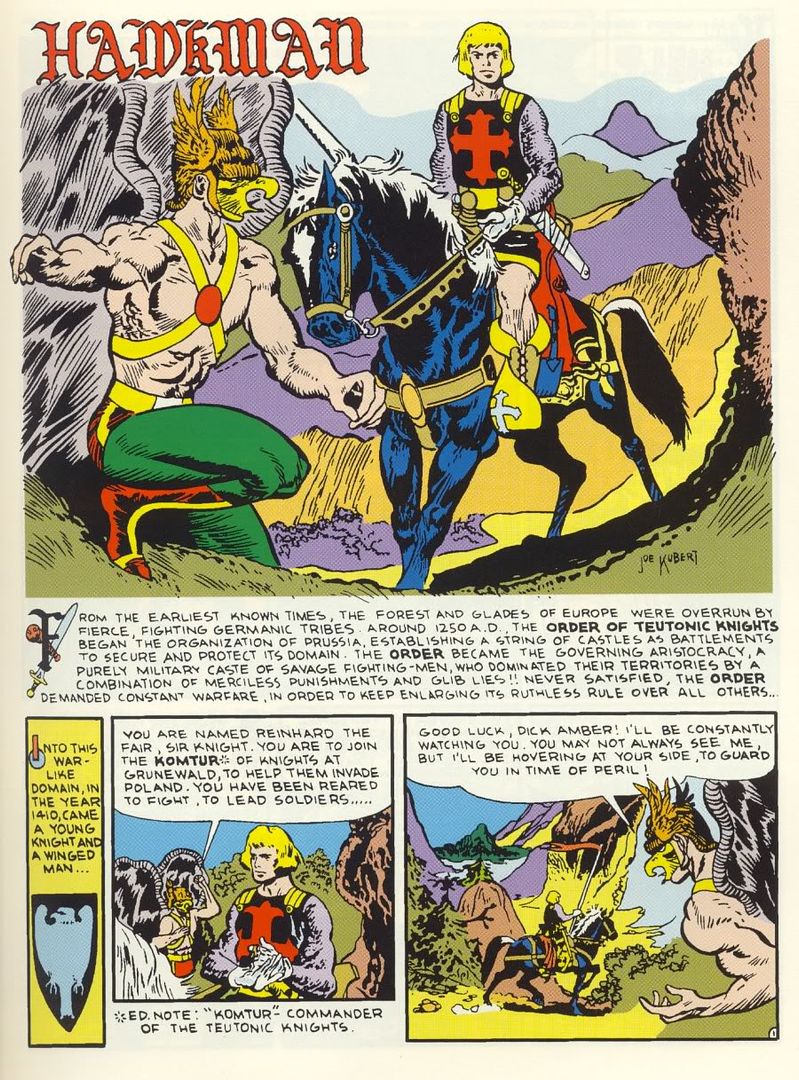
Low Rent Eisenstein

A WWII-era comic, via Crooked Timber, that argues why we fight: because the Germans are racially predisposed (since the 5th century!) to break treaties and kill the innocent. Our racial science is better than yours. (It's easy (and rewarding) to read the rest of the comic: just change the numbers at the end of the address:
Saturday, April 14, 2007
The De Man Affair Part Deux?

A story appeared in yesterday's Irish Times newspaper claiming that the Polish sociologist Zygmunt Bauman (whose work on postmodernity, the holocaust and love I'm sure we all admire or have used) was not simply a member of the Communist party but also a political officer in the military branch of the Polish Secret Security Forces. Here's a snippet:
Sociologist Zygmunt Bauman' s hidden stalinist past
"Last month, the biggest German daily, the 'Frankfurter Allgemeine Zeitung', published an article in which Bogdan Musial, a Polish historian, revealed renowned Polish-British sociologist Zygmunt Bauman, one of the prophets of postmodernism and author of sociological bestsellers, once worked as an agent for the Stalinist military secret service", notes Andreas Hess, a senior lecturer in sociology. "It should not come as a surprise that Bauman's hidden past is so passionately debated in continental Europe. Despite their adversarial history, Germans and Poles are very critical when revelations come out about the fascist and communist pasts of their intellectuals.The public attitude in continental Europe differs considerably from countries such as Britain and Ireland which were never under the spell of either fascism or Stalinism. Here in Ireland, it is still possible to read the lamentations of an unreconstructed communist like the historian Eric Hobsbawm who celebrated the Stalinist line taken during the Spanish Civil War - and to let him get away with it." (13/04/2007)
I haven't seen the full article but the title "postmodernism made me do it" is indicative of the two potential sides that will be taken in response to this revelation: some will seek to defend Bauman's work and exonerate him of blame (which arguably is what Bauman's work seeks to do anyway: to exonerate himself) and others will say they were proved right all along that postmodernism is simply complicit with all the world's evils.
Friday, April 13, 2007
Eldritch hath a blog

My cat Eldritch has her own myspace (set up by my girlfriend Fiona). The curious can kill themselves by visiting: www.myspace.com/feline_magnificus
She has clearly read many medieval treatises so I'm hoping to persuade her to contribute to ITM at some point.
Quote of the day: Sir Amadace
While I was writing this, JJC, apparently, was continuing the conversation on queer theory and Edelman. If you haven't already read that post, well, get on it.
Sir Amadace is a romance unusually full of dead corpses. A necessary pleonasm (unlike Slayer's "rotten limbs lie dead"), here meant to distinguish merely dead corpses from slain corpses. What fighting there is occurs quickly, virtually off-stage (Amadace "wasse the best that evyr mon hade / In justing for to see. / Ther he wanne full mecul honoure" (533-35): and that's it). Amadace does not create corpses; he simply comes across them. The first he finds in a forest chapel stinking with the rot of a dead knight unburied because of his debts, whose widow, as she says, "sixtene weke I have setyn here, / Kepand this dede cors opon this bere, /With candils brennand bryghte. / And so schall I evyrmore do, / Till dethe cum and take me to" (193-97). Later, Amadace comes across a mass of corpses in a passage that I offer as today's quote:
No man, that is, until Amadace himself, per the advice of a spectral knight, loots the corpses to outfit himself in a manner befitting his station. I found this scene--which I imagined as Amadace picking his way through the corpses--nightmarish, uncanny, not least of all because the scene is so eerily reminiscent (to summon a cliché) of other scenes in other romances, the turgid catalogs of sartorial excess in courts swollen with gold and men. One could almost forget that the knights in miniver amid their chests and coffers are dead: almost, but not quite.
Sir Amadace is a romance unusually full of dead corpses. A necessary pleonasm (unlike Slayer's "rotten limbs lie dead"), here meant to distinguish merely dead corpses from slain corpses. What fighting there is occurs quickly, virtually off-stage (Amadace "wasse the best that evyr mon hade / In justing for to see. / Ther he wanne full mecul honoure" (533-35): and that's it). Amadace does not create corpses; he simply comes across them. The first he finds in a forest chapel stinking with the rot of a dead knight unburied because of his debts, whose widow, as she says, "sixtene weke I have setyn here, / Kepand this dede cors opon this bere, /With candils brennand bryghte. / And so schall I evyrmore do, / Till dethe cum and take me to" (193-97). Later, Amadace comes across a mass of corpses in a passage that I offer as today's quote:
Now als Sir Amadace welke bi the se sonde,
The broken schippus he ther fonde -
Hit were mervayl to say.
He fond wrekun amung the stones
Knyghtes in menevere for the nones,
Stedes quite and gray,
With all kynne maner of richas
That any mon myghte devise
Castun uppe with waturs lay;
Kistes and cofurs bothe ther stode,
Was fulle of gold precius and gode,
No mon bare noghte away. (517-28)
No man, that is, until Amadace himself, per the advice of a spectral knight, loots the corpses to outfit himself in a manner befitting his station. I found this scene--which I imagined as Amadace picking his way through the corpses--nightmarish, uncanny, not least of all because the scene is so eerily reminiscent (to summon a cliché) of other scenes in other romances, the turgid catalogs of sartorial excess in courts swollen with gold and men. One could almost forget that the knights in miniver amid their chests and coffers are dead: almost, but not quite.
No Future: Terminus
(for earlier posts on Lee Edelman's book No Future: Queer Theory and the Death Drive, look here, here, here, here and here).
No Future concludes with its strongest chapter, on Alfred Hitchcock's The Birds, the inhuman, and the queer. Aside from the author's decision to employ as many avian puns and clichés as possible in order to stress the bird in the human (after a few pages, the yuks about birds of a feather and cocks of the walk peck the feathered nest of the prose into corn), the chapter's strength is its focus upon the insufficiency of the category "human" to contain the vastness it is asked to tame. "Rather than expanding the reach of the human, as in Butler's claim for Antigone" Edelman writes, "we might ... insist on enlarging the inhuman instead" (152).
The chapter yields a quote that for me brings back the reasons the first chapter seemed so inadequate to its own grave pronouncements, namely:
And that's what I found most tiresome about this book: not the fact that the future gets suspended, but that the whole of the past and the present, everywhere and everytime, are rendered the same thing. A Hitchcock film from 1963 gives us a glimpse of the same Symbolic Order as homophobic remarks made a far Left mayor of Lourdes, France, in 2000 (a mayor who made the international news not so much for those remarks, but because he was ousted from his party for having made them, a fact Edelman does not mention). The Symbolic is monolithic and homogeneous and immune to history. Its existence is approached, like that of the Real and the Imaginary, with a religious awe. All three work as they do apparently for the reason that Jacques Lacan, their prophet, stated that they work thus -- a kind of Deism without an actual God.
And without compassion. Probably the worst chapter of the book is "Compassion's Compulsion." Edelman is not the first to demonstrate how mandating compassion is a kind of tyranny, how compassion can be thinly disguised aggression. See, e.g., Freud or Lacan. Or Carolyn Betensky, whose work on bourgeois compassion possesses a subtlety that this chapter does not. Once compassion is defined simply as "identification, love of one's neighbor as oneself," there isn't anywhere to go but to show how coercive compassion actually is. Then, like Martin Landau's character in North by Northwest, we become ethical in resisting compassion, in stepping on the foot of the person clinging to Mount Rushmore, in refusing to grasp the outstretched hand of the one about to tumble to a painful death. The future, writes Edelman, "can only belong to those who purport to feel for the other (with all the appropriate implications that such a "feeling for" suggests)" (75). And yet compassion does not mean only to feel for: like sympathy, compassion is literally feeling with, suffering alongside [for you Latinists: com- plus passio, with plus suffering]. Compassion, that is, need not be the realization of the violent desire to render my neighbor myself. It can be the acknowledgment that the suffering of my neighbor, the feeling of my neighbor, takes me apart, makes me feel in ways that are intersubjective. Compassion isn't necessarily identification, if that is the simple imposition of self upon other; it can be a kind of disaggregation. It does not compel us, I think, to refuse the hand that extends itself, whether that hand clings to a mountain or is extended by some waif so cute and fragile that our impulse is to smack him back to his hearth rather than carry him atop our shoulders.
I understand well the book's joy in raising its middle finger to the Annies and Tiny Tims and Whitney Houstons ("I believe the children are our future!") of the world. There is something deliciously wicked about the gesture. And fairly harmless, I fear, since these are figures so maudlin they don't amount to much more than kitsch ... unless kitsch itself is the lethal stuff of our quotidian reality. Perhaps wide eyed waifs really are Hitlers in miniature. Perhaps they really do tyrannize the queer, and are part of the same murderous Symbolic that did in Matthew Shepard ("And that cradle must endlessly rock, we've been told, even if the rhythm it rocks to beats out, with every blow of the beating delivered to Matthew Shepard's skull, a counterpoint to the melody's sacred hymn to the meaning of life" 116-17). But I find myself unconvinced that their power is so vast. It seems to me that the world is wider than that, more contradictory and fragmented.
In the end I also can't stop thinking about my children. Yes, in a way I mean Katherine and Alexander, Kid #2 and Kid #1 on this blog, little bearers of half my genetic futurity and constant reminders that no matter how much I wish to identify with them or replicate myself through them, they will perpetually engage in some version of raising their tiny middle fingers at me, rebuking whatever fantasy I might have had that the future could be more of the same. But I also mean the Green Children, those verdant intrusions from a neighboring world who taught twelfth century England that the ground it inhabited was an Elsewhere, that the history it pretended to culminate was an Elsewhen, that the present it hoped to extend infinitely into the future was in no way sure to arrive. With their call to a true compassion (a suffering-with rather than a transformative identification) these children, more than any death-drive allied sinthomosexual that Edelman imagines, are inhuman, are queer.
No Future concludes with its strongest chapter, on Alfred Hitchcock's The Birds, the inhuman, and the queer. Aside from the author's decision to employ as many avian puns and clichés as possible in order to stress the bird in the human (after a few pages, the yuks about birds of a feather and cocks of the walk peck the feathered nest of the prose into corn), the chapter's strength is its focus upon the insufficiency of the category "human" to contain the vastness it is asked to tame. "Rather than expanding the reach of the human, as in Butler's claim for Antigone" Edelman writes, "we might ... insist on enlarging the inhuman instead" (152).
The chapter yields a quote that for me brings back the reasons the first chapter seemed so inadequate to its own grave pronouncements, namely:
"the fascism of the baby's face" ... subjects us to its sovereign authority as the figure of politics itself (of politics, that is, in its radical form as reproductive futurism), whatever the face a particular politics gives that baby to wear -- Aryan or multicultural, that of the thirty-thousand year Reich or of an ever-expanding horizon of democratic inclusivity. Which is not to say that the difference of those political programs makes no difference, but rather that both, as political programs, are programmed to reify difference and thus to secure, in the form of the future, the order of the same. (151)Ralph Nader made a related argument in 2000 about Republocrats: it doesn't matter which side you choose, it's all the same political system, whichever party you elect perpetuates the present state. I don't think I'm risking very much to say that in a democracy (even a democracy within a republic) it is riskier to believe that every choice is the same choice and opt out (even if it is the mild form of opting out that voting for Nader represented) than it is to trust in the possibility of an unpredetermined, non-replicative future. Is it controversial to say that George Bush as president has brought about a profoundly different world from the one that Al Gore would have fostered? Is it controversial to say that fascist regimes like Nazi Germany and democratic ones like contemporary Great Britain might use love of the child in propagandistic ways, but that they are not self-replicating regimes of the same order, and possibly not to be mashed into a single shared Symbolic?
And that's what I found most tiresome about this book: not the fact that the future gets suspended, but that the whole of the past and the present, everywhere and everytime, are rendered the same thing. A Hitchcock film from 1963 gives us a glimpse of the same Symbolic Order as homophobic remarks made a far Left mayor of Lourdes, France, in 2000 (a mayor who made the international news not so much for those remarks, but because he was ousted from his party for having made them, a fact Edelman does not mention). The Symbolic is monolithic and homogeneous and immune to history. Its existence is approached, like that of the Real and the Imaginary, with a religious awe. All three work as they do apparently for the reason that Jacques Lacan, their prophet, stated that they work thus -- a kind of Deism without an actual God.
And without compassion. Probably the worst chapter of the book is "Compassion's Compulsion." Edelman is not the first to demonstrate how mandating compassion is a kind of tyranny, how compassion can be thinly disguised aggression. See, e.g., Freud or Lacan. Or Carolyn Betensky, whose work on bourgeois compassion possesses a subtlety that this chapter does not. Once compassion is defined simply as "identification, love of one's neighbor as oneself," there isn't anywhere to go but to show how coercive compassion actually is. Then, like Martin Landau's character in North by Northwest, we become ethical in resisting compassion, in stepping on the foot of the person clinging to Mount Rushmore, in refusing to grasp the outstretched hand of the one about to tumble to a painful death. The future, writes Edelman, "can only belong to those who purport to feel for the other (with all the appropriate implications that such a "feeling for" suggests)" (75). And yet compassion does not mean only to feel for: like sympathy, compassion is literally feeling with, suffering alongside [for you Latinists: com- plus passio, with plus suffering]. Compassion, that is, need not be the realization of the violent desire to render my neighbor myself. It can be the acknowledgment that the suffering of my neighbor, the feeling of my neighbor, takes me apart, makes me feel in ways that are intersubjective. Compassion isn't necessarily identification, if that is the simple imposition of self upon other; it can be a kind of disaggregation. It does not compel us, I think, to refuse the hand that extends itself, whether that hand clings to a mountain or is extended by some waif so cute and fragile that our impulse is to smack him back to his hearth rather than carry him atop our shoulders.
I understand well the book's joy in raising its middle finger to the Annies and Tiny Tims and Whitney Houstons ("I believe the children are our future!") of the world. There is something deliciously wicked about the gesture. And fairly harmless, I fear, since these are figures so maudlin they don't amount to much more than kitsch ... unless kitsch itself is the lethal stuff of our quotidian reality. Perhaps wide eyed waifs really are Hitlers in miniature. Perhaps they really do tyrannize the queer, and are part of the same murderous Symbolic that did in Matthew Shepard ("And that cradle must endlessly rock, we've been told, even if the rhythm it rocks to beats out, with every blow of the beating delivered to Matthew Shepard's skull, a counterpoint to the melody's sacred hymn to the meaning of life" 116-17). But I find myself unconvinced that their power is so vast. It seems to me that the world is wider than that, more contradictory and fragmented.
In the end I also can't stop thinking about my children. Yes, in a way I mean Katherine and Alexander, Kid #2 and Kid #1 on this blog, little bearers of half my genetic futurity and constant reminders that no matter how much I wish to identify with them or replicate myself through them, they will perpetually engage in some version of raising their tiny middle fingers at me, rebuking whatever fantasy I might have had that the future could be more of the same. But I also mean the Green Children, those verdant intrusions from a neighboring world who taught twelfth century England that the ground it inhabited was an Elsewhere, that the history it pretended to culminate was an Elsewhen, that the present it hoped to extend infinitely into the future was in no way sure to arrive. With their call to a true compassion (a suffering-with rather than a transformative identification) these children, more than any death-drive allied sinthomosexual that Edelman imagines, are inhuman, are queer.
Meanwhile in Romantic Studies: MC Nuts

ITM brings you the latest craze in Wordsworth studies: rap induced frolics mid the daffodils, apparently led by those Furries that Karl used to post about. I can think of no better blending of urban aesthetics with the pastoral sublime. Indeed, I am strangely moved to a poetic emission:
I wandered lonely as a nut crazed mammal
O'er the sea and o'er the channel
I strive to be Worsdworthian cool
Furry and vital: believe it, fool!
Yo.
I said yo.
Check it!
Thursday, April 12, 2007
Happy birthday (n)50

We almost forgot to mention the transformation seen in our comments section: our beloved poster "N50" (AKA Violet Saunders) is now posting as "50."
Happy fiftieth birthday! May you have at least that many more!
Wednesday, April 11, 2007
Quote of the Day
A quote from Gabriel Marcel which I came across in Richard Kearney's Strangers, Gods and Monsters unreferenced and just had to track down:
Its from Homo Viator: Introduction to a Metaphysic of Hope:
"All then prepares us to recognize that despair is in a certain sense the consciousness of time as closed or, more exactly still, of time as a prison- whilst hope appears as piercing through time; everything happens as though time, instead of hedging consciousness around, allowed something to pass through it. It was from this point of view that I previously drew attention to the prophetic character of hope. Of course one cannot say that hope sees what is going to happen: but it affirms as if it saw. One might say that it draws its authority from a hidden vision of which it is allowed to take account without enjoying it.
We might say again that if time is in its essence a separation and as it were a perpetual splitting up of the self in relation to itself, hope on the contrary aims at reunion, at recollection, at reconciliation: in that way, and in that way alone, it might be called a memory of the future."
Michael Uebel would, I think, like this idea of hope as a reunion, a recollection, and a reconciliation which gives to the future a positive quality that sometimes the present and the past have difficulty in revealing. Marcel makes very clear here how an ethic of hope embraces the future.
Its from Homo Viator: Introduction to a Metaphysic of Hope:
"All then prepares us to recognize that despair is in a certain sense the consciousness of time as closed or, more exactly still, of time as a prison- whilst hope appears as piercing through time; everything happens as though time, instead of hedging consciousness around, allowed something to pass through it. It was from this point of view that I previously drew attention to the prophetic character of hope. Of course one cannot say that hope sees what is going to happen: but it affirms as if it saw. One might say that it draws its authority from a hidden vision of which it is allowed to take account without enjoying it.
We might say again that if time is in its essence a separation and as it were a perpetual splitting up of the self in relation to itself, hope on the contrary aims at reunion, at recollection, at reconciliation: in that way, and in that way alone, it might be called a memory of the future."
Michael Uebel would, I think, like this idea of hope as a reunion, a recollection, and a reconciliation which gives to the future a positive quality that sometimes the present and the past have difficulty in revealing. Marcel makes very clear here how an ethic of hope embraces the future.
The power of failure
A note from a former student concludes with the following:
It is very difficult to fail students: isn't it easier to give a D or C- or C+ or B-, let them slip by, and not have them show up at your office door, probably angry or upset, demanding more attention and some possibility of redemption? Easier, I guess, in that it is less work to give the higher and less laborious grade ... but then who is failing?

PS- I should also thank you for a very valuable lesson you taught me in your class that spring. I had handed in some very sloppy work to you and received an F with a harsh note that I can still recite from memory. The wind was completely knocked out of my sails since I had never earned such an appraisal in high school. Had it not been for that wake-up call, I can't even imagine what my GPA would be now! I certainly never tried that trick again.I of course have no memory of the comment that the student memorized. It amazes me, though, how many students have expressed gratitude later in their careers for my holding their work to a high standard. In at least two cases, a failing grade and an honest, challenging comment changed a life. In fact such students tend to be the ones I stay closest to.
It is very difficult to fail students: isn't it easier to give a D or C- or C+ or B-, let them slip by, and not have them show up at your office door, probably angry or upset, demanding more attention and some possibility of redemption? Easier, I guess, in that it is less work to give the higher and less laborious grade ... but then who is failing?
Chaucer is getting closer ...
If ITM is Canterbury, GC has just reached Bobbe-up-and-doun.
Look for the promised post the week after next.
Look for the promised post the week after next.
Tuesday, April 10, 2007
Another Heading for the Future (if it isn't Kaput that is)

A name which has been frequently invoked (by myself and Eileen) during ITM's conversations about No Future is that of the postmodern philosopher of religion John D. Caputo. For those who want to take some distance from Edelman while still eavesdropping on JJC's unfolding reading aloud there is a great conversation (a kind of on-line seminar actually) about two of Caputo's recent books, Philosophy and Theology and On Religion going on over at The Church and Postmodern Culture which offers "discussions of high-profile theorists in postmodern theory and contemporary theology, for a non-specialist audience that is interested in the impact of postmodern theory for the faith and practice of the church". It should give a flavor of why Eileen and i think Caputo is so important for anyone interested in futurity and formulating an ethics of joy and hope (Eileen can be Joy; I'll be hope).
Here's the link: http://churchandpomo.typepad.com/
Subscribe to:
Comments (Atom)