Showing posts with label history. Show all posts

Tuesday, March 17, 2009

For March 17: A Graveyard in Dover

[image: Though the Tiny Shriner is technically a homunculus rather than a leprechaun, he does enjoy March 17]

by J J Cohen

Ah, Saint Patrick's Day. Debunk your myths here. Celebrate or burn with shame: identity is all about ambivalence towards its history, after all.

Speaking of ambivalence, I have just returned from a visit to see family in New England, where Saint Patrick's Day attracts significantly more hoopla than March 17 earns in DC. Every restaurant we walked into, for example, immediately slapped a shamrock sticker on my daughter Katherine. Leprechauns, green streamers, pots o' gold at the end of rainbows having nothing to do with LGBT rights, shillelaghs, and moss colored balloons dangled wherever the eye glanced. Begora was about all I could say.

My sister lives in Dover, New Hampshire, in a new house nestled among some older ones. We stay with her when we visit, because (1) she has the space for us and (2) she is not as crazy as some other family members. Dover is a small town that grew along the Cocheco River, mainly as a textile mill flourished in the mid 1800s. Its diminutive "downtown" area preserves the red brick mill, now turned into a modest office building. The center of town is as thick with shopping as an English High Street, and most of these stores have been around for quite some time: a run down music shop, a bakery, a tobacco store, a card shop, a funky coffee house where people still wear tie-dye earnestly. Not far from town center have sprouted the required amenities of twenty-first century American living: Pizzeria Uno, Applebee's, Costco. The center, though, has managed to stay (through no particular effort) noncorporate, without becoming a gentrified or Disneyland version of a New England town such as you might glimpse in Hanover or certain overly precious sections of Vermont. If you are looking for a haberdashery or gourmet chocolate, Dover is not your destination. You will find, though, an unpretentious Irish bar on the water, excellent whoopee pies, and a comfortable Indian restaurant run by a family who converted a storefront.

Across the street from my sister's house is a weedy cemetery. Though not the oldest in Dover (there is a "Settler's Cemetery" down the road dating to 1640), the graveyard is impressive: rows of marble and granite-hewn markers, many shaped as angels or crosses or obelisks. My son Alex and I walked through the cemetery when morning sun and white snow rendered the expanse a space where it was hard to think much of death. We squinted to read names, and marveled at the number of markers announcing from which county of Ireland the dead beneath had arrived. We noticed that scores of graves recorded a two year span in the 1860s as dates of death. An epidemic must have carried from life many recent arrivals from County Armagh. Most of them were women. We thought that they must have come to Dover to work at the textile mill, and then perished when whatever fever swept and emptied the brick building. We knew we were being touched by history's receding traces, by stories that we would like to grasp better but that were too distant from us to hold. What did these women leave in Ireland? How frightening and exhilarating was the crossing of the Atlantic? Did the textile mill treat them as badly as the mills of Lowell and Lawrence? Did they die lonely, homesick, afraid?

The graveyard in Dover is not especially well tended. An ordinary feature of an ordinary New England landscape, many of the stones have toppled as ice has shifted the earth and wind has pushed relentlessly against their weight. Few of the markers show any sign of memorial visits. The writing is fading beneath lichens, the rock is cracked. The day will come when something else is built upon that space, or when the cemetery reverts to quiet field.

Sunday, February 08, 2009

The Future of 'The Weight of the Past' / Credo

[illustration: a projector supported by The Flowering of the Middle Ages and The Faerie Queene, a talk supported by more collaborators than any bound volume could contain]
by J J Cohen

First, a tremendous thank you to those who invited and coddled me in NYC (especially Hal Momma, Liza Blake, the Anglo Saxon Studies Colloquium and the NYU English Medieval Forum), and to all who attended my talk, asked me questions that ripped away its foundational assumptions, and otherwise provoked me to rethink everything I thought I knew. Subjective destitution and an existential angst hangover are a small price to pay.

Highlights: a reception before my presentation, so that I could urge attendees that I would sound a lot smarter if they would imbibe a glass or five of wine; an intimate dinner for 22 afterwards, with an excellent food and excellenter company; shenanigans and antics later that evening; hanging out in Brooklyn chez Karl; a good Indian dinner with a taste-free dessert; shenanigans and antics Friday evening at a faux British pub with red telephone booths and an upscale nautical-themed bar serving absinthe-infused "zombie" drinks in ceramic tiki head cups (where we got deep).

So I gave a presentation entitled "The Weight of the Past" at NYU on Thursday.

Of all the pieces for public performance I've composed, "Weight" is my favorite. The talk originated as my Holloway Lecture at McDaniel College, then underwent a series of radical mutations as it was adapted and refined for some other venues. NYU was its final performance: a form of the essay will soon see print, and I observe that unwritten academic rule that thoughts hardened into books don't get oral existence any more. Yet the closing night of "The Weight of the Past" has already proven to be far from its last metamorphosis. To adapt what I was attempting to argue in the presentation itself: as substantial and as fully materialized as the thing might seem, its trajectory has yet to be arrested and "The Weight of the Past" keeps becoming other things. The questions I was asked at NYU were so penetrating that they've challenged me to refine and even reconceptualize some of what I yearn to achieve -- especially as this nexus of obsessions begins to take its form as a future monograph.

This reformulation will be most evident in the closing movement of "Weight." In its current version, the coda arrives just after a conversation I restage with my daughter Katherine, one in which we think about memorializing the dead, especially in museum displays of prehistoric corpses. I posted one version on the blog quite some time ago as Who Mourns for Lindow Man?, then later reflected on the function that these vignettes perform in The Moment of Interpretation and Those Carried in Its Wake -- though spurred by a question by Carolyn Dinshaw, I want to emphasize that these are for me moments of collaboration rendered visible, rather than the use of a story, person, or object to achieve something that does not necessarily require extrinsic participation or agency. So, here is the ending to "The Weight of the Past":
To intertwine meditation upon past and future while retaining some confidence that we are doing justice to history, we must encounter the materiality of the past in a way that grants life to what might otherwise seem inert. We must keep the distant past, the present moment, and the future—near and distant—alive, capable of plenitude, heterogeneity, change. We must never cease to grieve for Lindow Man, no matter who in life he was. We must never think of Stonehenge or of Avebury as anything but a ring of stones that does not cease to dance. We must never forget that the past has a weight, but that weight is seen only in the past’s movement, in its desire ever to remain alive.
And here is the provisional credo (or the credo of provisionality) that starts to move beyond such termination.

Many things about the closing paragraph do not ring true to what I had hoped to achieve in the piece: its hortative mode, its ethical high-handedness, its injunction to mourning, its funereal finality.* I realize now that what I have been attempting in "The Weight of the Past" project is not an ethics but an ethos: instead of an ethics of compulsion to remembrance, an ethos built upon the practice of wonder. I am attempting an explicitly collaborative praxis -- and by "collaborative" I actually mean "inhumanly collaborative": I'm as interested in alliances with rocks, texts, forces of nature, and corpses as I am with the living and the dead. The project offers, I hope, an invitation to coinhabit a world made strange.

I don't think I can say it better than that right now.

*Questions from Karl Steel, Glenn Burger, Carolyn Dinshaw, and many, many others made me realize these facts so essential and so close to me that I could not discern them well.

Tuesday, March 18, 2008

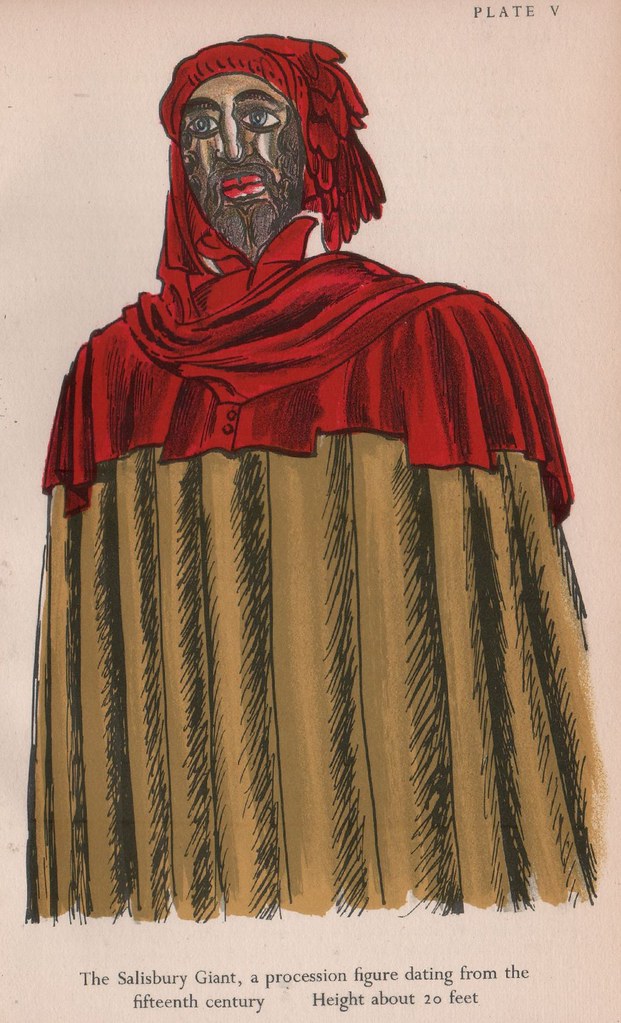
Mothers (and Giants) to Think Back Through

Maybe you know what to do with the Arthurian opening of the Wife of Bath's tale. I don't, not quite, but then again, I've only just started my path towards planting my flag on some portion of Chauceriana. I found one answer in Patricia Clare Ingham's "Utopia, Conquest, and the Wife of Bath's Tale," Texas Studies in Literature and Language 44.1 (2002) 34-46, but I'm sorry to say I found it more interesting than convincing. I'm sure the fault is my own. Ingham argues on behalf of the pastoral against its critics, who condemn it for its occlusions of material realities. In her hands, the pastoral and other utopian fantasies of the time before the proliferation of "halles, chambres, kichenes, boures / citees, burghes, castels, hye toures / Thropes, bernes, shipnes, dayeryes" (3.869-71) become a site of fantasy for the conquered and therefore a way to read past the conquering, dominant culture to otherwise lost voices. However, although a British Arthur is always a Welsh hero, although there's Celtic myth and memory in the loathly lady, the sovereignty hag, or whatever you want to call her, and although "Britons" (3.858) could be Welsh, I just can't hear the Welsh in the Wife's Tale. Maybe I don't have my ear pressed hard enough to the ground.

What I do sense are incubi, now exorcised by the friars, and the elf-queen, all of whom, inspired by Ingham, I read as a site of fantasy. As much as we love Gowther's father, his fourteenth-century fame barely rates in comparison to the cultural dominance of the incubi of the Albina legend. In a story that was translated from Insular French into Middle English, Latin, and Welsh--and what follows is a summary of one version--a Greek princess and her twenty-nine sisters plot to murder kings whom their father, a more powerful king, wants them to marry. Betrayed by the youngest sister, the remaining sisters are sent into exile on a rudderless boat, which drifts to an island christened Albion, after the oldest sister, Albina. After living for a time on a vegetarian diet, the sisters rejuvenate themselves with wild game and grow lustful. Their lust attracts incubi, by whom the sisters engender gigantic children. The children then breed with their mothers, and everyone continues interbreeding. Thus the island fills up with giants, who fight with each other so viciously that by the time Brutus arrives, 270 years later, only 24 giants remain, including a giant named Gogmagog who tells Brutus their history.

For a tale dominated by Guinevere, the voices of wives, widows, and maidens, and by an magical crone, I want Albina and her sisters to be its first gynocentric model of rule. It's a stretch, but I also want Albina and her sisters to be the "ladyes foure and twenty and yet mo" (3.992) that the rapist sees fleetingly "under a forest syde." I want Albina and her children to be an alternate genealogy for the Wife, one that's traced backed to a founding mother. After all, Albina lays claim to the island, bestows her name on it, and declares that these actions will memorialize the sisters forever in Albion. Her speech is a charter identifying the land with a noble and self-perpetuating lineage (think here of the women in the prologue, so many of whom--okay, two--are named Alys); nothing, barring of course the gender and gianthood of Albina and her children, is abnormal about eponymous identification with a land or claims that attempt to undercut other claims by declaring temporal priority. The sisters’ reproduction is also normative (or the normative in drag), because its outcome is a lineage, of sorts, one traceable directly to a founder and connected via that founder to a particular piece of land.

In essence, I want to trapdoor Ingham; but mainly I want to watch the Wife trapdoor everyone else. I want to read the first line of the tale, "In th'olde dayes of the Kyng Arthour" (3.858) not as "In the old days, the time of King Arthur" but as "In the days Arthur would have considered old," the time when in fact "this land fulfild of fairye" (3.859). After all, so far as I know (folklorists? Arthurian specialists?), in Arthur's time the land was mainly full of knights, who sometimes encountered a scattered a fairy or two like Gromer Somer Joure or a faux fairy like Bertilak; for throngs of fairies, we need to go back to Albina's day. Following Ingham, we might be able to recover Welsh resistance in this monstrous origin; but I think we can follow this back still further, to the Wife's own desires. What that would get us I don't know yet (please don't say the presymbolic Maternal!).

Hell, I don't know if I'm just recapitulating something that's been said 100 times already.

But, correcting for the nobility, I can't help but hear the Wife in this:
My fair sustres, ful weel ȝe knowiþ þat þe kyng oure fadir, vs hath reprouyd, schamed & dispised, for encheson to make vs obedient vn-to oure housbandes; but certes þat schal y neuere, whiles þat I lyve, seth þat I am come of a more hyere kynges blod þan my housband is.
And I'm not even sure I have to correct for the high kindred of Albina, since, after all, the Wife is so puffed up that "in all the parisshe wife ne was ther noon / that to the offrynge bifore hire sholde goon; / and if ther dide, certeyn so wrooth was she / that she was out of alle charitee" (1.449-52). And, if I can sense Albina in the tale's own prologue, maybe I can account for an episode that--maybe--doesn't get the respect it deserves. What the next step would be, I don't know yet.
==
(conversations continue below, and much excellence to read that merits more conversation: the Carnivalesque; Publishing and Our Discontents; the Frenchness of English Jews; Mary Kate on monsters and resistances to knowledge; and, of course, Eileen's mother of a post and its gigantic thread, "On the Virtues (and Loves) of Beautiful Singularities": all great stuff)

(image scanned from the delightful English Popular Art of Margaret Lambert and Enid Marx.

Sunday, October 14, 2007

"But History has already written that story": Heroes and Narrative


The scene: 17th century Japan. Hiro, a young man from the 21st century, has accidentally landed here after attempting to employ a superpower he has recently developed. Hiro can stop time. Apparently he can also time-travel. In last week's episode of Heroes (a show just entering its second season on NBC), Hiro's found a way to write notes in the 17th century that will survive into the 20th and be found by his friend Ando, kept safe inside the hilt of a sword used by the legendary Takezo Kensei. Takezo Kensei has been Hiro's idol since childhood, when his father told him stories of the great warrior. Arriving in the 17th century, Hiro finds that Kensei is not only a drunkard and a middling warrior at best -- but he's not even Japanese. He's English, a traveler. And yet he's supposed to be one of the greatest fighters of all time.

An initial excerpt from Hiro's monologues in the episode:

"Righting History and turning Takezo Kensei into a hero will not be easy. But at least I'm not alone. Ando, I've met the most beautiful woman Japan has ever seen, and I think I've fallen in love with her. The only problem? History has already written that story, and she is destined to be the great love of Takezo Kensei...It was clear Kensei wouldn't become a hero unless I forced him to learn the hard way. If he could defeat the ninty Angry Ronin, he'd have a chance at becoming a hero."


Hiro does Kensei the favor of dropping him off with the ninety Angry Ronin, and leaving him there to either "become" a hero or die. Of course, Kensei has a superpower too -- he can recover from any wound. He is, however, unwilling to use his superpower "wisely" -- i.e., for the good, or the good as Hiro sees it. Part of helping Kensei "fulfill" his destiny means that Hiro must give up a woman he believes he's in love with. The victory over the Ronin solidifies Kensei's place in the Princess' affections.

Later in the episode, Hiro is ready to leave: Kensei asks him how he's supposed to become the warrior he's "destined" to be if Hiro isn't with him. My point in summarizing this lengthy series of scenes from last week's episode is that it bears certain, if tenuous, relations with what I'm hoping to write about as I continue my dissertation prospectus. Thinking through the idea of history necessarily means asking questions about narrative: that much is obvious. Heroes, however, is coming at it from another angle.

Hiro seems to be playing a role that's difficult to imagine. Hiro's influence in the past -- pointing Takezo Kensei toward his "destiny", hoping to restore a timeline somehow made different by his presence there. Hiro remarks on the way in which "History" writes stories -- and has in fact already written the one he's in -- yet his work in the past (if you can call it that) creates the very stories he's claiming as a kind of inherited tradition.

I guess what's fascinating here is the way in which Hiro's position is that of the disembodied "History" he speaks of when he remarks that "History has already written that story." Of course, as viewers (co-conspirators?) we know that Hiro is only partially correct. History hasn't written the story -- or more precisely, hasn't written it yet. What's intriguing is that History -- in the form of Hiro -- has already heard the story - and knew it, in fact, in advance of arriving on the scene as an historical agent.

Heroes, I think, takes an interesting position vis a vis history and the role the subject can play in it (whether or not the writers are aware of it, though I'd like to think they know exactly what they're doing). History arrives from the future (literally in this case) and inscribes a narrative, a trajectory, where before were inert forces, empty lives and silent stones. JJC writes below that in encountering Barber rock at Avebury, My son and I touched a megalith’s cold side and felt our own desires. Hiro's dilemma in this episode of Heroes is that he knows history must be written as he has already heard it -- yet his desire is that it be written differently, perhaps even Otherwise.

I'm mixing a variety of thoughts in this post, which is the product of a long drive on the Blue Ridge Parkway earlier today. However, I think it's a productive mix: Caught between the stories he knows and the feelings he's developed for the Princess who is meant to love Kensei, Hiro's role as agent of History (or History incarnate) becomes mixed: his loyalties divided, he's caught between the past as he Knows it and the future he wants for himself. I wonder if there's a way of thinking through this odd relationship between Hiro, Heroes and the past that could be a productive exercise towards examining the writing of other historiographies. What happens when we bring our own subjectivity to the past? Can we ever escape the desire to see the world not as it is but as we've learned to narrate it, whether we encounter that world in a text we find in the archives or in 17th century Japan as a result of time-travel? My own answer is no, not entirely -- but then, I've never found myself, as Hiro does, writing a history that would be passed down not to others but to Me.

I suppose that History has always written our stories -- both in the sense that our stories are structured by an inherited tradition and by single humans' experiences of those times. The question is whether we can work to find the human agency that wrote that history, and the tensions that suggest there might have been a way of narrating it Otherwise.


cross posted at Old English in New York

Wednesday, October 10, 2007

At Avebury

Here is the draft opening to my new project on "The Weight of the Past." I'm attempting to frame the problem with an initially negative solution, but (you know me well, my readers) will eventually swing around to something more affirmative.

This project, I should add, is the biggest loser in the theft of my laptop: my research notebook, with the detailed scribblings, observations, outline, and bibliographic notes, vanished with that computer. I had not backed it up since August 17. But (speaking of swinging around to a more affirmative mode), the loss of the project's past has given me the chance to clear out some of the weight of that history, and to think certain components of my argument anew. That's strangely liberating, even if a buttload of work.

-----------------------------

We stand beneath the megalith. Brisk winds roam the grass. The sheep are complaining. “Can you feel anything?” I ask. His palm presses against the rock as eagerly as mine. “Yes,” he whispers, fingers searching clefts and lichen. “I think I do.” He places his head against the stone and closes his eyes, as if through an intimate touch he might discern hoary secrets. He seems as certain and as joyful as when, many years ago, he used to press his head to my chest to apprehend the life of an invisible heart. In a solemn voice, as if he has absorbed from deep in the rock its enduring history, he announces “It knows it killed someone.”

I realize immediately that my son must have pilfered my copy Aubrey Burl’s Prehistoric Avebury: Second Edition. He must have been reading the volume late into the night of our London flat. “Me, too,” I say. “I definitely feel something.”

I am lying. Like my son I want to feel power in the towering stone. Not the energy of astral planes or the pull of a vortex or proximity to pagan divinity. Not whatever it is New Age druids come to Avebury seeking. Yet as in their dreams, my desire is that the stone not be inert. My son is right: this megalith did, after all, take someone’s life. After standing for millennia, the 13-ton rock crushed a man and preserved him for six centuries beneath its bulk. The weight of the past, indeed. Alexander Keiller discovered the body in 1938 when he disinterred and re-erected the stone. Archeologists hypothesize that the skeletal remains were in life an itinerant barber-surgeon. His leather purse contained some scissors, a lancet, and some coins from the early fourteenth century. He was likely witnessing or even assisting in the contemporary effort to obliterate Avebury, “mightiest in size and grandeur of all megalithic rings” until a piecemeal destruction commenced in the Middle Ages. Pits were dug beneath the standing stones so that they toppled and were buried, acts of “pious vandalism” directed at what was probably understood to be an unchristian structure. Perhaps the effort was abandoned when the accidental entombment of the barber convinced its witnesses that these stones could still exert some force. Since its re-erection eight decades ago, the megalith has been known as Barber Rock, its new name bearing witness to the life it took.

As destructive as the fourteenth-century project of toppling Avebury may have been, this attempted annihilation of an architecture four thousand years old paradoxically assisted in preserving its components. Those rocks buried by medieval vandals where they fell were shielded from fragmentation and reuse in later periods. The seventeenth and eighteenth centuries were especially brutal to the Avebury stone circle. The utter destruction of numerous megaliths was accomplished through the use of fire, cold water, and sledgehammers. We will never know how many of the rocks became, once smashed to pieces, the foundations of local farmhouses and the stuff of quotidian roadways.

My son felt power abiding in a megalith that, having celebrated thousands of birthdays as part of a Neolithic architecture, fell upon and crushed a medieval man. The stone had patiently awaited resurrection for five hundred years so that it could again tower over a verdant field, could again render the humans standing alongside it small and ephemeral. With my son I wanted to believe that histories long separated from us can endure in objects like Barber Rock – and Avebury, and Stonehenge, and the prehistoric past, and the Middle Ages. I wanted to believe that human meaning can survive across inhuman temporal gaps. Yet I knew that the body of the crushed barber-surgeon, of the man who had dared to undermine the stone and had paid for the act with his life, had been rediscovered recently in London. A new theory holds that the barber was dead before the stone toppled over him. So much for the agency of the rock, its dangerous and enduring force. Those are powers we humans yearn to observe because we suspect that they do not exist, that time brings history to an oblivion as mute as stone.

Intimations of mortality. Whatever its initial architects called it, in whatever language they spoke but could not bequeath to us, Barber Rock has perhaps always been inert. The dolmens and stone circles that tourists wander Brittany, Ireland and Britain to glimpse -- architectures we think endure from time out of memory -- are typically modern reconstructions using nearby materials, designed to look Neolithic. Avebury is no different, a product of a massive restoration in the 1930s as much as a time capsule mailed five millennia ago. My son and I touched a megalith’s cold side and felt our own desires.

So much for the weight of the past. History, it seems, is literally immemorial, “out of memory,” impossible to hold for long.

Friday, March 16, 2007

16 March 1190: the events in York on Shabbat ha-Gadol


Today is the anniversary of the terrible events at York in 1190. I paste below a short summary from the BBC website. The best scholarly discussion is R. B.Dobson, The Jews of Medieval York and the Massacre of March 1190, University of York Borthwick Papers 45 (1974, rev. 1996).

One of the most infamous of the pre-expulsion pogroms took place in York on the site known as Clifford’s Tower. In March 1190, six months after the coronation of King Richard I, the city caught or was set on fire. Under cover of the fire a mob targeted the Jews. The family and friends of the leading Jew called Baruch* were attacked and killed and his wealth looted. He himself had already been killed in an attack at the time of the King’s coronation.

This and the attempted murder of Joseph, another leading member, led the Jews to seek shelter. They naturally looked to Clifford's Tower, the site for two castles built by William the Conqueror after his conquest of England in 1066. Its wooden defences or keep were first burned down during a local rebellion in 1069 before being destroyed for a second time during a siege of Jewish citizens in 1190.

The 1190 massacre stained the city's reputation for many centuries:

  • The warden allowed the Jews to enter and then left them alone (because the Jews were under the direct protection of the king)
  • They feared that the warden would be bribed to betray them so when he returned they refused to admit him
  • The warden complained to the sheriff John Marshall that the Jews cheated him
  • The Sheriff roused the militia and the rest of the townspeople
  • This large gathering beseiged the trapped Jews for some days while preparations were made to storm the castle and force them out to the mercy of the baying mob
  • A fire was started in their refuge, whether by the Jews or their persecutors is uncertain
  • When it became clear that their situation was hopeless many of the Jews took their own lives
  • Husbands killed their wives following the advice of Rabbi Yom Tov* from Joigny in France

On Saturday March 16, 1190 there was a special Sabbath celebration linked to the festival of Passover. As it dawned:

  • The Jews who had survived the terrible night of fire and suicide begged for mercy and offered to convert to Christianity if they were spared
  • They were tricked into leaving but were butchered instead of being allowed baptism
  • The ringleader Richard Malebisse and his accomplices went to the cathedral where they burned documents stored for safekeeping. These specified details of money they owed to the Jews. This, it would seem was the driving force behind the tragedy.
  • Malebisse escaped to Scotland
If you would like to read a bit more about how the events continue to be remembered and struggled over, check out this report of plans to build a shopping mall beside the site and the outrage these plans spurred.
(thank you, N50, for spurring this quick post)

Tuesday, January 02, 2007

Sors Virgiliana for the New Year

Inspired equally by Michael Foster Brian S. Lee on the Chaucer Listserv, who engaged in a bit of sortes Chauceriana, and JJC's post below on free will.

Cursor Mundi ll. 2007-2008 (in one of the EETS versions):
Noe þe lele, wit-outen plight,
Bigan neu biginyng for to dight
(Faithful Noah, without sin,* began to make a new beginning)

Here we have a promise of near complete destruction, or of a new beginning, or of the inability to make anything new (since the postdiluvian world recapitulates the antediluvian world): take your pick.

I'm reminded of Des Grantz Geanz--more anon?--and, once more, of Lyotard's "Defining the Postmodern":
The idea of modernity is closely bound up with this principle that it is possible and necessary to break with tradition and to begin a new way of living and thinking. Today we can presume that this 'breaking' is, rather, a manner of forgetting or repressing the past. That's to say of repeating it. Not overcoming it.

The Flood is the suicide of the world, in the Zizekian sense; it's also a record of the impossibility of that act, to wit (with an assist from Luther Blissett):
From someone Slavoj picked up the knack
of killing himself through The Act
He traverses, emerges,
has the same set of urges,
And sweats like a monkey on smack.


My wish for you: may 2007 be better than it possibly can.

(* I wanted this to be "without complaint," but the Middle English Dictionary just isn't on my side here...)