Showing posts with label old english. Show all posts

Saturday, February 07, 2015

2 Brief Notices: The Old English Poetry Project + Wael Shawky's Cabaret Crusades

by KARL STEEL

First read Jonathan Hsy below on the George Washington U Digital Humanities Institute's "Disrupting DH" event, paying particular attention to the CALL TO ACTION at the bottom.

Two things for you to do, whether you're not in NYC or you are.

First, the Old English poetry project, made by Bob Hasenfratz and Miller Oberman. I saw Bob present on this last night at the New York Medieval Club, where he described the project and walked us through some various ways of presenting translations of several Old English maxims. How should compounds be presented? How should punctuation be handled? Line breaks?

More importantly, he asked US to comment and to use this website in our teaching. Note the COMMENT function here, for example, which you'll find throughout the site: quibble with translations, make suggestions, build in your own glosses, have your students work out projects, and so on! The field's open. And continue coming back, as Hasenfratz and Oberman aim to translate no less than the entire poetic corpus of Old English. Those of our readers who are heavy into Old English and translation -- David Hadbawnik and Dan Remein for example -- may want to play around with Bob and Miller's manifestos, in particular (not least of all because Dan, along with Lawrence Venuti, was the guiding, and oft-cited, spirit of Bob's presentation).

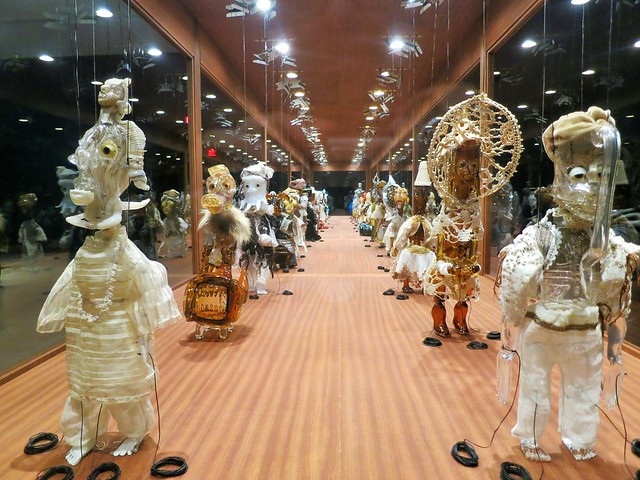
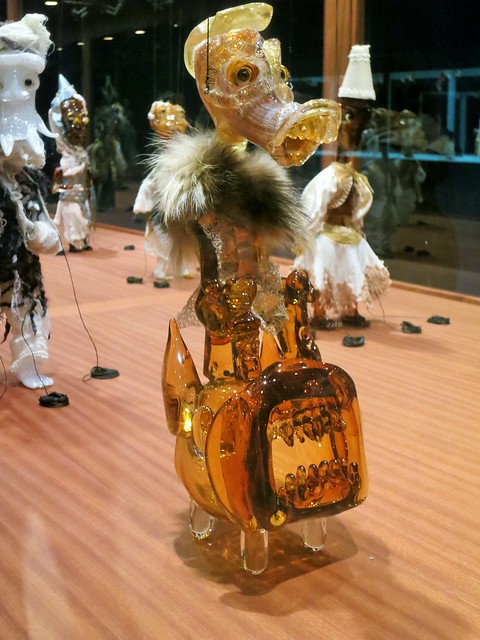
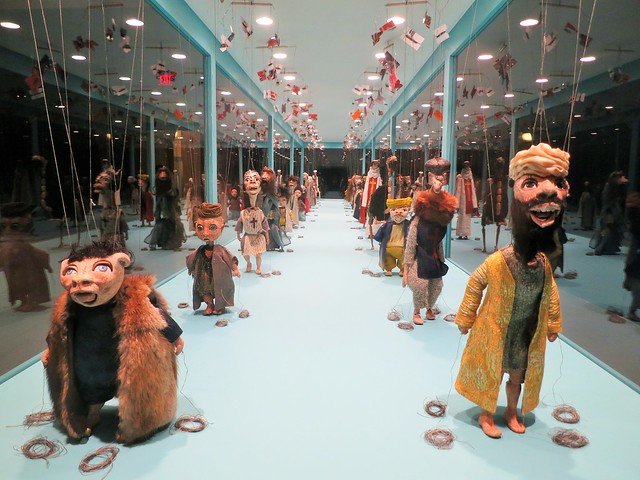
Second, PS1 just opened its show on Wael Shawky's Cabaret Crusades. First, I recommend reading Matt Gabriele's tweets on the crusades here. It'll just take a couple minutes. For a slightly longer take, Dave Perry in The GuardianThen get out to Queens, if you can, between now and the end of August, to see Shawky's marionettes and films, which base a retelling of the first and second crusades on Amin Maalouf's The Crusades Through Arab Eyes. Here's Shawky explaining the project (with French subtitles)


And here, a few of my photos from yesterday. If you're in NYC, I recommend doing what I'm going to do: grab your artist friends and make a day of watching the films. I suspect this will be my favorite PS1 show since their Schlingensief retrospective (confiteor: I tend to love PS1)

PS1: Wael Shawky: Cabaret Crusades

PS1: Wael Shawky: Cabaret Crusades

PS1: Wael Shawky: Cabaret Crusades

Monday, November 10, 2014

BABEL: Cosmic

by Mary Kate Hurley

[before you read my post, make sure you read Dorothy Kim's guest post on sexual harassment in the academy.  Send all your budding medievalists and early modernists to check out the Ph.D. at GWU. Most importantly, however, you should recreate the first nearly-eight-minutes of the Scale Session at BABEL Santa Barbara by reading Karl's post on the subatomic.  Feeling suitably small and/or large?  You may proceed.]


At BABEL Santa Barbara, I took part in the Scale plenary session—a collection of twelve different meditations on terms having to do with Scale. I found the entire session beautiful, exhausting, and deeply, deeply impressive – in terms of sheer breadth of approach, subject matter, and voice. I was excited to be a part of it, and so glad I was.

When I first started my paper, I swiftly realized that four minutes would mean “more footnotes than paper.” I’m an Anglo-Saxonist, so I’m usually just fine with that formatting requirement. This time, however, it was a slightly different enterprise. I wanted to find Old English ideas about the cosmic. I was almost certain that these ideas did not exist in a way recognizable to “modern” thinkers about the universe. So I did what any good Old English scholar with a paper to write would do: a search for cosmic in the OED, moving to a search in my Bosworth Toller dictionary app, followed by a search on the MED. Several references to cosmic appearing in the early Middle English Ormulum – a section that eventually got cut out of my paper for reasons of time – sparked a memory. Those who have studied it know: there are some very strange things that happen in the Anglo-Saxon Chronicle. For example, in one year, there is a great mortality of birds. No real reason given for it in the text. A lot of birds just died in 671. Which led me to wonder: I knew there were stars as portents in the Chronicle. But what if there were stars – like those dead birds – who weren’t there to mean something for humans, or at least weren’t given an explanation in the text? Which led me to the entry for 540, and my paper. Many things happened in the year 540 CE. But in this chronicle entry none of that becomes part of the text. For a brief space of a few lines, all we see is stars. 
 ________________

COSMIC

According to the Oxford English Dictionary, the cosmic is “Characteristic of the vast scale of the universe and its changes; applied to the distances between the heavenly bodies, the periods of time occupied in their cycles, the velocity with which they move, and the like.” In 1649, a now obsolete usage represents its first entry into the English lexicon, meaning “of this world, or worldly.” If you go far enough back in the literature, apparently, everything is about humans.

My question: “how can we think the cosmic?” It does not get bigger than this: the vast scale of the universe, everything from redshift to dark matter, knowing we are only that Pale Blue Dot—that’s us, that’s home (1)—that’s cosmic.

But could humans think about the cosmic before they could travel, or send proxies, to the stars? To the medieval writers and thinkers I study, the answer appears simple. To think about the cosmic was to think about God and his role in human events—that little man in the clouds in the Harley Psalter, sending angels into the time and tide of human events (which, of course, means war. Plus ça change.) Here and elsewhere it seems, medieval thinkers could not lift their eyes to the stars and see anything but the majesty of God.

And yet: One need not know we’re made of star-stuff to know that stars matter in medieval literature. Take, for example, Isidore of Seville’s meditation on stars in the Etymologies. Stars, he writes “are unmoving and, being fixed, are carried with the heavens in perpetual motion.” Despite not understanding how the heavens moved (or ... didn’t), Isidore understood the vast distance into which our present idea of the cosmic falls: “many stars,” he says, “are larger than the ones that we see as prominent, but since they are set further away, they seem small to us.” Impossibly far away and difficult to understand: this sounds more like the Cosmic we expect in the twenty-first century, but these stars do not partake of the illumination from within, as it were, that characterizes our Milky Way. Stars, Isidore reveals, are like the moon: “they are said not to possess their own light, but to be illuminated by the sun”.

“Everything is allegory”—this should seem familiar (2). We could reduce Isidore’s assertion about the stars to an allegory for God’s illumination, or more pointedly, the modern/secular truism that things are not illuminated in themselves, but illuminated by humans. The Anglo-Saxon Chronicle, for example, offers a number of instances where stars metaphorically do not possess their own light. The chronicle entry for 1135 demonstrates this nicely: a king travels on the sea, and when he sleeps during the day, the sky grows dark, the sun become pale like the moon, “the stars were about him at midday. Men were very much astonished and terrified, and said that a great event should come hereafter. So it did.” The stars exist to tell us that the king is about to die. Other entries are less explicit, but stars behave strangely in conjunction with births, deaths, appointments to bishoprics, and all manner of human events. But rarely—very rarely—stars behave differently. 


In the chronicle entries for 538 and 540 we see instances of astronomical signs that do not occur in conjunction with human events: Both years record eclipses, with the added bonus in 540 that the “stars showed themselves nearly a half hour after nine in the morning.” The text does not explain these events, nor does it follow them with human doings. These stars seem to exist, if only for a brief moment, beyond human meaning.

Thinking the cosmic, now or in the Middle Ages, requires a radical readjustment of scale, one difficult to perform and nearly impossible to fully comprehend. Yet, when one returns to old literature, we begin to see the tiny beginnings of thinking cosmically, thinking that will one day tend toward galaxies and interstellar expanses. Officially, the medieval period admitted no knowledge of an uncentered world—created by God, it was that scale that mattered, his Will that dominated it.  And yet, in the midst of a field of stars dominated by a single radiant intersection of the divine into a natural world, we can begin to see something else taking shape: we see stars out of time, showing themselves for nearly a half hour after nine in the morning. It is not much to go on, and centuries will pass before humans really understand—but in that most medieval of moments, stars cease to shine simply by virtue of a shining God, or the radiance of the Sun, or anything else. In that moment, we can begin to see stars that exist only for themselves –stars that are cosmic. 


1. Careful readers will note that I’m riffing on Carl Sagan’s beautiful and moving “pale blue dot” speech.

2. This statement – “everything is allegory” – was one of the two things that Steve Mentz asked us to remember in his plenary. This citation was an attempt at humor.
 

Monday, January 31, 2011

More Happenings in Toronto: A Conference of Interest

by Mary Kate Hurley

Anyone who knows me knows how attached I am to the Anglo-Saxon Studies Colloquium. And given the recent visit of Jeffrey to Toronto, it seems a good moment to call attention to the Seventh Annual ASSC Graduate Student Conference: Crises of Categorization, to be held at the University of Toronto on February 12.

Now, I'm always a little sentimental about this conference: after all, way back in 2005, it was the very first conference I organized. And what a long way it has come: in addition to now boasting a very nice Conference Website, this year marks the first time the grad conference has been held at an international location!

Organized by University of Toronto graduate students Peter Buchanan and Colleen Butler, "Crises of Categorization" will take place on February 12th at the Centre for Medieval Studies. This year's conference has three panels: "Transhistorical Anglo-Saxon England," "Storms Within and Without," and "Sex and Magic in Anglo-Saxon England." In addition to a number of really wonderful presenters (many of whom I know, some that I only know of), the conference has lined up respondents to each paper, which in past conferences has facilitated some really intriguing dialogue between presenters, responders, and participants in the event.

It looks to be a great event, and in the past has been a wonderful opportunity for graduate students and professors alike to discuss current work and new trends in Anglo-Saxon studies -- hope to see you there!

Wednesday, February 11, 2009

A Digital Codex


by Mary Kate Hurley

[illustration from the Lindisfarne Gospels -- thank you, BBC!]

Within a few hours of it being posted on the Valve last night, as a result of Scott Eric Kaufman's reading of a blog called "Readin" -- a number of my friends were emailing me about this. I haven't had the time to fully explore the website, but it would seem that UCLA has put together a page that allows for the easy browsing of all MSs that are digitally available online. Granted you may have already noted its existence through a post at ITM all the way back in December, but given that I noted it only in passing at the time, I thought it worth a second look.

From this article on the website:

Highlights of the virtual holdings include:
• The largest surviving collection of the works of Christine de Pizan, one of the first women in Europe to earn a living as a writer. The manuscript was commissioned by Queen Isabeau of France in 1414 and is now held by the British Library.
• An Irish copy of the Gospel of John, bound in ivory and presented to Charlemagne sometime around 800, now in the library of the monastery of St. Gall in Switzerland.
• The Junius manuscript, one of only four major manuscripts preserving poetry in Old English. Dated to around 1000, the book is now among the holdings of Oxford's Bodleian Library.
As an Anglo-Saxonist, I got no further than the Junius Codex. Along with Exeter, Vercelli, and the Nowell Codex, it houses Old English poetry, including Genesis, Exodus and Daniel. It was also my first Anglo-Saxon codex, which I saw at In the Beginning at the Smithsonian back in 2006. I'd be curious: do other medievalists out there remember their first manuscript? I mean, I'd seen other MSs here at Columbia's RBML, and at various museums and such. But to see the Junius, in person, even if I didn't get to "read" it more closely than through the glass protecting it -- that was pretty amazing.

I also couldn't help but think about the materiality of the codex. Of course I've gone on about this before. After a full semester, however, of one class on paleography and another on medieval book culture (the latter with Chris Baswell, who is part of the team that worked on assembling the UCLA site), I can't help but think about the objects themselves. Perhaps it's the lingering questions raised by Jeffrey's Weight of the Past talk last week, but I do tend towards feeling rather strange about digitized manuscripts. As teaching resources, they make the kind of intense paleographical work I did with Professor Dutschke possible in a way that before it would not have been outside of a few select places ten years ago.

However it also raises the question that all digital technology raises: that is, access. In this case, it's a question of access to the past. I'm working on a cataloging project with Prof. Dutschke for a few hours a week (along with several colleagues) -- and what I've realized is that there is so much to a manuscript that perhaps no digital reproduction, however fine, can represent. For example, I've often felt too squeamish to be a medievalist -- the thought of reading books that are written on animal skin often makes me hesitate to touch a manuscript. This Monday, for example, I sat in the Rare Books reading room and looked through a Chronicle written on parchment. The material of the text was utterly beyond my comprehension -- in addition to being in what was one of the worst late medieval hands I'd ever seen, the text was in German, a language I am slow to read when it's legible. However, the materiality of the book, the object itself, was exceedingly clear. Vellum, like un-moisturized skin, wrinkles. Yes, wrinkles. Texts age, and do so visibly. It's oddly similar to human skin in that regard.

This all tied in quite nicely to my Intro to the Major class, which I also taught this past Monday. I was introducing some of the ways medieval poetry thought about language, and the authority of the speaking or writing voice. After I gave an "introduction to Old English culture" that made me cringe slightly with its brevity -- we worked with one of my favorite of the Old English Riddles, Number 47:
Moððe word fræt. Me þæt þuhte
wrætlicu wyrd, þa ic þæt wundor gefrægn,
þæt se wyrm forswealg wera gied sumes,
þeof in þystro, þrymfæstne cwide
ond þæs strangan staþol. Stælgiest ne wæs
wihte þy gleawra, þe he þam wordum swealg.


A moth ate words; a marvelous event
I thought it when I heard about that wonder,
a worm had swallowed some man’s lay, a thief
In darkness had consumed the mighty saying
With its foundation firm. The thief was not
One whit the wiser when he ate those words.

Trans. Richard Hamer
When a poet in the Middle Ages looked at a book s/he didn't see something pristine, like my copy of Klaeber's Beowulf, which is still too new to be dog-eared and worn. Rather, books had long histories already, even when new -- it was not, as it were, their first life. And books were not safe from the ravages of time or even of the worms that also rend human flesh after death. Perhaps its worth remembering that even digital materials have worms which feed on data. Transience, it would seem, was and is part and parcel of textual experience. Rightly so, given that humans create them.

In part, and as always, it seems I've come back around to where I began when I started my musings: materiality and the medieval. We're always dealing, in some fashion, with what's left -- never an established whole, never a static object-of-knowledge. The medieval, it would seem, is always contextual, and therefore always contingent on the kinds of contexts we can find for it. It seems obvious, I suppose -- but every time I open my web browser and look at my first Anglo-Saxon codex, I don't know that I'll always acutely feel the absence of the codex Junius (given that it's not at my beck and call -- or even on this side of the Atlantic). But I do sense another kind of absence -- albeit one that is paradoxically full of lives and ideas and cultures that are always just beyond our ability to recall fully. I'm sure someone else has already said this -- but maybe we're always missing the Middle Ages?

Thanks to Scott Kaufman of The Valve for bringing this back to my attention, and to all the friends who forwarded it to me.

Cross posted at OENY.

More on something Beowulfian -- the conference for which it is intended -- on the morrow.

Friday, January 23, 2009

Beginnings


[figure 1: A view of Lake Erie, from Hamburg's public beach. I took this photo on a chilly day this past November.]

by Mary Kate Hurley

(Speaking of beginnings, don't miss JJC's post below, on a beginning we've all been watching the past few days.)

Despite the chill in the air and the snow on the ground here in New York, spring semester always puts me in mind to think about beginnings. Spring reminds me that when it comes to my medieval interests, it all started in the spring – in this case, spring 2002. My first Old English class started seven years ago this past Wednesday – and every year, I’ve grown more certain that if the course caught my interest, it was largely because of how difficult it was. I’d never learned a language before, truth be told – French had been part of my growing up, present both in and out of school thanks to my mother’s background as former French professor. And anyone who’s been through the American school system knows that it’s a rare thing to really learn English grammar. I joke about it, but I think I really did learn modern English grammar in my Old English class – I wonder if others have had that experience? I certainly didn’t know the difference between a nominative and a genitive (in terms of what the words meant, at any rate), and I don’t think I’d ever heard of the dative before. It was like a revelation, really: modern English just made so much more sense after taking Old English, from the past tense of verbs to the use of apostrophes to indicate possession. Grammar rules had reasons – who knew?

So awhile back, Jeffrey invited us to talk about what we're teaching this semester -- and now, finally, I can make my contribution to that discussion. This semester is pretty exciting for me, as I’m beginning my career in teaching literature, after five semesters teaching freshman composition. If you're familiar with my academic preoccupations, the way I plan to begin the semester won’t surprise you.

Columbia’s English department has recently instituted a new course for graduate students to teach. It functions as a kind of introduction the English major. Essentially, we cover various genres of literature (the triad of poetry, drama, prose), and critical methodologies for understanding and interpreting them. It’s a wide ranging class, in which a professor lectures for an hour once a week, and then graduate students teach a section of seminar that meets for two hours, also once a week, and covers more material than the lectures do. It’s a big course, and looks scary from the outside, but it’s not meant to be an in-depth study of any one period or method – it’s just introductions, making acquaintances, and learning to engage with texts in ways that are meaningful to current critical discourses.

All that aside, I wanted to start with something that would put everyone on the same level. I can’t teach literature without finding some way to put something medieval, or even better Old English, into it. I couldn’t even teach writing without using medieval references to illustrate writing points (like the idea of “auctoritee,” borrowed happily from Chaucer). My opening class? I think I’m going to start with something I know intimately, but am utterly unable to understand (yes, one honors thesis, one masters thesis, and countless translations later, I still don’t understand this poem – I doubt I ever really will). The idea here is to start from a place where there is no background information, to look closely at what can be understood without a sense of the context of a piece. So I’ll start with the manuscript: what can we tell just from looking at this text, as it appears on the page? Then, I hand out a modern edition of the poem (in old English, of course). I’m assuming no one will be able to read it. But if you know that it’s an edition of the MS we’ve been looking at, then what can you say about the text now? With a little luck, I’ll be treated to a rousing chorus of “It’s poetry!” The fun part will be discussing why we can say that now, if we couldn’t tell before. It allows discussion of editorial practice, and will hopefully allow us to talk a bit about assumptions concerning how poetry “looks.” Also: a great moment to point out alliteration, caesurae and the like.

From there, we move to a translation (I’m still deciding which to use, so any suggestions would be appreciated!), and what becomes an exercise in close reading of what the poem says, and how we arrive at conclusions about the techniques it is using to do so. Of course, I’ll close the class with a mini-lecture on the cultural and historical context of the poem, and hopefully that will spur a few more minutes of discussion and questions about how we can understand the poem in its literary and historical contexts. Ideally, it’ll be a fun exercise to think about how we approach poems, what we bring to the table in analysis, and how to think about a poem without immediate reference to the author’s biography or even any historical context. Most of all, I’m hoping it will get everyone talking early on in the class, as they will presumably all be coming in at the same level of knowledge concerning the poem in question.

In a class about introductions, you see, I’m planning to introduce them to the poem I’ve spent far too much time reading, thinking, writing and talking about, on ITM, OENY and elsewhere. My first real literature class? I’m teaching The Wanderer.

cross posted at OENY.

Sunday, August 17, 2008

Getting Anglo-Saxon, or, Anatomy of a First Chapter

[picture from the Vortigern Studies website. It's supposedly Orosius!]

by Mary Kate Hurley

Around the same time we finished out our group discussion of Getting Medieval, I reached a milestone of my own. I’ve recently completed work on my first dissertation chapter – and, though the chapter will no doubt be returned from my adviser with plenty of comments for my revision, I thought that I’d do a short series of posts on the process of getting this first chapter written, and what I’ve found now that I’m there. I’d wanted to do so as I was researching and writing – however, it would appear that learning to write a dissertation chapter makes it really hard to step back and write about writing that dissertation chapter. I’m hoping that, now I’ve “learned” how to write a chapter, I can share more of the second chapter as I go. The interactive part: I’d love comments and feedback, of course, but I’d also love to hear how other scholars approach the questions I’m raising here – grad students and more advanced scholars alike. Most specifically: How do you write a 45(ish)- page chapter on a text that you could easily write a book about? How did you narrow down your focus on your source(s)?


Correct me if I’m wrong: everyone who does a field in Old English literature, including prose, for their exams comes away with one translation out of the Alfredian corpus that qualifies as their favorite. And there are plenty to choose from, too: the Boethius, the Psalms, the Pastoral Care, the Dialogues, the Soliloquies -- and the subject of my first chapter, the Orosius. Although I certainly have a soft spot for the Pastoral Care and the Boethius (after all, who doesn’t love getting consoled by philosophy? And in Anglo-Saxon no less!), I suppose the Orosius is my “favorite.” I’m not quite sure what it was that attracted me to the Orosius, but I do know that unlike the majority of work done on Old English translation, it wasn’t the preface.

Why does that matter? To back up for those who haven’t slogged through the great works of Anglo-Saxon prose: The Old English Orosius is a translation (some, following the work’s editor Janet Bately, would call it a “paraphrase,” contending that it’s too close to the original to even qualify as translation!) of the Latin Historiarum Adversum Paganos. Written by the fifth century Spanish priest Paulus Orosius, the Latin text was meant to be a companion-piece to Saint Augustine’s City of God Against the Pagans. In the Historiarum Orosius intends to show how history may be read in light of Christianity – and moreover, that such a reading will show that the past was, in a sense, destitute: understanding and insight into historical happenings could not exist without the acknowledgement of Christ. He avers that these “pagans” do not know how to read history, that “they do not inquire into the future, and either forget or do not know the past,” and so they attribute the calamity of the sack of Rome to the “increasingly less worship of idols.”(1) In short: they assume their punishment for converting to Christianity is the sack of Rome by the Goths in 410. Orosius sets out to show them how in the grand scheme of things, life is much better post-Christ than before his coming. In so doing, he interprets pretty much everything through a lens of how much worse it used to be, and how we can see God’s work explicitly bringing Rome to Christianity, after which, things were comparatively less bad.

Orosius, then, clearly saw himself in the same tradition as Augustine in terms of his
understanding of the relation of human history to Divine Providence – he’d undertaken the project at the behest of Augustine, though the results were not really what Augustine wanted. Orosius’ conception of historia differs significantly from his mentor’s, which makes it clear why Augustine was so disdainful of his work. (2) Orosius’ difference from Augustine in his historical reasoning is a function of the way in which history itself is structured. Confronted with “a universal sweep, a universal explanation of men’s basic motives, a certainty of the existence, in every age, of a single, fundamental tension,” Orosius over-generalizes, and produces what Peter Brown describes as “a neatly-patterned Christian ‘Universal History’”. (3) In Augustine, the work of God in the world is always implicit, but can rarely be seen – “we can only be confident in general that all history is in God’s hands, but we cannot watch his hand at work.” (4) Orosius, on the other hand, seems to be certain that the work of the Almighty is easily intelligible to those who know the signs by which it can be identified. Moreover, history is easily sorted, categorized and judged: Orosius’ “catalogue of worldly woe” shows explicitly how the world waxes more evil earlier before Christ one looks. Thus it is only the person who cannot see with the clearer light of the Christian faith who would aver that the present, with its knowledge of both Christ and His redemption, is worse than the ignorant – and therefore all the more wicked – past.

The translation into Anglo-Saxon of the Latin Historiarum is highly abridged – it cuts the original seven books down to six, and leaves out large sections of the text (Bately, in her introduction to the text, gives a more complete summary of the textual differences, both the abridgements and additions) . However, the OE Orosius is most often noted for its additions. First, there are additions of mythological and historical information Orosius did not include in the Latin -- these would have been familiar to 5th century Rome but not to Anglo-Saxon England. More tellingly however, critics have been overly enamored of the so-called “geographical preface.” The Latin Historiarum features a discussion of the landmasses of the world, and the various populations therein. Seeking, apparently, to do them one better, the Old English Orosius includes a much remarked on insertion, usually referred to as the “Ohthere and Wulfstan” part of the text. In it, two “norðmenn” tell King Alfred about their travels in Scandinavia and other parts of the far north, and about the people who live there (including various “magical” things they can do!). A quick survey of the critical literature reveals a huge emphasis on the preface, and these two travelers – and so, my first goal was to avoid talking about the “original” parts of the text, or at least to avoid the preface!

This didn’t really narrow things down all that much. It did, however, give me a chance to use a hard-won realization from my translation studies courses and workshops: translations, if they are true translations, must not be treated as “derivative.” That lesson, repeated to me over and over again by Michael Scammell (my workshop professor, who finally convinced me that if I am ever to translate Anglo-Saxon poetry, I must learn to love Modern English as much as Old English. That project is deferred indefinitely.) allowed me to formulate a different way of understanding the text: if I’m not concerned with what’s “original” in the translation, how do I locate Anglo-Saxon England in a text so close to the Latin from which it is translated?

Next time: What Orosius Said, or, The Trial by Appendix

1. “qui cum futura non quaerant, praeterita autem aut obliuiscantur aut nesciant praesenti a tamen tempora ueluti malis extra solitum infestatissima ob hoc solum quod creditur Christus et colitur Deus, idola autem minus coluntur, infamant.” Trans. Deferrari, 4.

2.Cf. Rohrbacker, David. The Historians of Late Antiquity, 148. Rohrbacker cites a number of scholars who identify the tone of Augustine’s second book of the City of God as arguing against Orosius’ less philosophically sophisticated version of a world history.

3. Brown, Augustine of Hippo 321

4. Bittner 355


Works Cited
Bittner, Rudiger. "Augustine's Philosophy of History" in Gareth B. Matthews (ed), The Augustinian Tradition. Berkeley:University of California Press, 1999. pp. 345-360.

Brown, Peter. Augustine of Hippo. Berkeley: University of California Press, 1967.

Deferrari, Roy (trans). Orosius: Seven Books Against the Pagans. Washington: Catholic University of America Press, 1964.

Rohrbacker, David. The Historians of Late Antiquity. Routledge, 2002.

Cross posted at OENY.

Thursday, July 24, 2008

Believing the Wanderer


by Mary Kate Hurley

One of my best friends, Emily, wrote to me a few months ago asking me to write an essay for a CD she wants to put together. It consists in "This I Believe" style essays from a number of people she's close to, and her rationale for putting it together is that eventually she'll lose all our voices -- to death, or to time, or to distance -- and she wants to preserve them now, what we believe, who we are (at least, this is my interpretation of what she told me). And so I found myself, at long last, returning to a theme of mine. My first attempt, written for my final University Writing class this year, is available at OENY. My current attempt can be found under the "read more" cut below.

I've written on the Wanderer many times before. An honors thesis, a Masters thesis, various translations. This is the first time I've tried to articulate the poem's meaning to me in a spoken format. Moreover, it is the first time I've tried to articulate my first meeting with this poem, and more importantly, what it means to me personally -- and so I wanted to share it, not just with Emily (whom I met in the same Old English in which I met the Wanderer), but with other medievalist interlocutors. I realized, while writing it, that I really can pinpoint the moment medieval studies changed my life. It was imperceptible at the time, but this figure became central to my world for years. I wonder if others have found texts that have touched them in an academic way -- generating a passion for the medieval, or another field -- but also touched them in a profoundly life-altering, personal way. And I wonder if some of you might share those here, in the comments (I'm very interactive this week!).

So, this I believe, the Old English Edition.

Even voices from the distant past can change your life. Here is a voice I first met in a poem—first in its original Old English, then in translation:
Oft ic sceolde ana uhtna gehwylce
mine ceare cwiþan. Nis nu cwicra nan
þe ic him modsefan minne durre
sweotule asecgan.

Often, alone
I have spoken my cares in the hours before dawn.
No one now lives to whom I could tell
my heart’s secrets.

When I first encountered this character—this voice—from an eighth-century Old English poem, he was alone. He, the so-called “wanderer,” was bereft. He had fought loyally for his lord, but his lord had died, and now he was left in exile. In those times, a warrior depended on his lord for housing, legitimacy, and protection. His world had changed forever, and he could not change with it.

At nineteen I could understand that feeling. It was February, 2002: the year my life had—like his-- changed irreparably. The attacks on the World Trade Center and the Pentagon five months before had exposed the prejudices of my peers, as the world became an uncertain, violent place. My personal losses were no less life-altering: I had recently buried a friend who hadn’t yet turned 15, and was mourning a cousin who never saw his eleventh birthday. The Wanderer’s losses felt very familiar.

As a college sophomore, I enrolled in a class in Old English language and literature. It was there that I first met the Wanderer, and that meeting would change my life. Like friends who met their future life partners in college, I met the person—the voice— who would alter my life in a poem on that course syllabus. His words changed me, even though he spoke a language that hadn’t been spoken in a thousand years.

The Wanderer—exiled and alone—was traveling over the wintery waters, trying to find a place in which he could belong. He sleeps and dreams of his people, and, awakening to sea-birds, mistakes them for his companions. They swim away, leaving him to ponder his loneliness, and the empty ruins which remain from other civilizations that have been destroyed by time – the old work of giants, now empty.

The poem offers no homecoming for this exile. The tagged-on, four-line Christian ending brings the poem to a neat, Heavenly close, but it is not clear whose voice it is that speaks of Christian comfort. So when my literature professor asked us to imagine what it would be like to live in this Wanderer’s exile, in this place without certainty of a future, or hope for a better world, I immediately identified with the existential angst of his plight. How all life vanishes under night’s shade, as if it never were!

Time vanishes, with all the works of human beings. But the lesson I learned from the Wanderer wasn’t about loss. Rather, I learned that the words of others could cross time to touch the present day from a past so distant that its language had to be learned. If “communication” is what makes us human, then it is, in fact, the words of others which matter most. Voices from the past can still speak to a present world, and with them bear an important lesson. To live in this world, we must learn to love one another. To love one another, we must learn to hear. To hear, I believe we must start with a respect for the words of others.

I believe that medieval voices speak powerfully to a modern soul from a time long past. I believe we must let that past touch us, and through it, learn to hear the Other voices of our own time.

cross posted to OENY.

Tuesday, July 01, 2008

The State of the Field in Anglo-Saxon Studies

by J J Cohen

Read all about it in a special forum at The Heroic Age. You will see some familiar names.

EDIT by Eileen [7/1 @ 6:30 pm] Oh, SNAP! Jeffrey beat me to mentioning the special forum, but allow me to also direct your attention, in that same issue, to the first entry in what will be a regular Heroic Age feature, "babelisms," and the first essay to be featured in that column [edited by me], Daniel Murtaugh's "Absent Beowulf." Over and out.

EDIT by JJC [7/2 @ 6:30 am in a more soothing color than Eileen's glaring red of last night] Also don't miss Eileen's excellent essay "Queer Times, Queer Bodies and the Erotics of a Nomadic Anglo-Saxon Studies" here. Note too that the Kzoo 2009 CFP is out, and Eileen is all over it. Who is this Eileen person and why is she everywhere? Does she possess clones? Ought we to do something about her sudden omnipresence? She's the Paul Newman of medieval studies -- just as you can't walk through a supermarket without his leering head confronting you from the labels of bottles of salad dressing, microwave popcorn boxes, jars of pasta sauce, and cans of soup, so Eileen Joy is ubiquitous on every brand of medieval-related scholarship. Is this saturation somehow related to the apocalypse?

Saturday, April 26, 2008

Dreaming Language: Lytton Smith's Monster Theory


(I've been wanting to write about LJS's chapbook for about a month now -- a moment's rest in the rush of the end-of-semester madness made this finally possible. As some of you know, LJS is frequent commenter at In the Middle -- and I can't recommend his work highly enough. He's also a colleague of mine in the Columbia English department's Medieval contingent, and a fellow Anglo-Saxonist. That might be why it was a bit strange writing about him in the third person! I have to confess, I don't know how to write a poetry review...thoughts and comments welcome! The image is from national geographic, and illustrates another Loch Ness Monster theory. Seemed a good match.)

Reading Lytton Smith’s chapbook Monster Theory is a bit like stepping into a memory you’d forgotten. At first the reason seems obvious: in a book where so many poems take cues and even characters from the world long past, of course you’ll find something in it that is eerily familiar, whether a “Book of Encouragement and Consolation,” a “Charm Against the Loss of Crops,” or even a “Monster Theory.” However, on second approach, this strange familiarity becomes just that -- strange, but in the sense of the French étranger: foreign. If there is a memory here, it isn’t something entirely of the reader’s making. It’s at that moment, in the recognition of that which isn’t precisely recognizable, that the poet’s spell begins.The sense is that this book requires – demands – our complete attention, and moreover, demands to be re-read, even in absence. This little book of poems haunts the reader who lets its language speak to her.


Throughout the book, the poet asks for an gesture of imagination from his reader, and from the first a point of entry is established: “Bury your eyes in late barley,” opens the first poem, called “Scarecrow Work.” With this opening it becomes clear that there is a relationship forming, a world the poet constructs of language which, while it seems to be reveling more than revealing, will show the reader something that exists beyond the glittering surface of its words. Repetitions, particularly of verbs, seem important here, as in the last stanza of “Scarecrow Work”:
“…Your lesson: what will not scatter is safe, /
Is dove, is olive return.”

The existential status of that “which is” safe, isn’t merely safe, and the repetition of “is” – is dove, is olive return – suggests that, while each thing that does not scatter is safe, each thing that does not scatter will still scatter, if only in a proliferation of references.


The centrality of the poem “Monster Theory” to the chapbook which bears its name is well placed. A poem not unlike the patchwork [monster] it speaks, the work performed by each section of the piece stands in for a larger analysis of what the [monster] patterns, promises, reveals and conceals. Though the first section reminds us that “It is always at an outset a displacement—”, the bracketed [monster] moves quickly through that displacement and into a stunning soliloquy that closes the work. The poet writes of a village, a cartographer, a lost daughter, a gathering search for a monster which refuses restraint or removal (the almost playful lines of the fifth section enumerate the ways the [monster] thwarts any attempt to prevent his escape: “Cauldron of boiling water: stench, but not of burning flesh. /Buried alive: Why expect so much of wood and soil?”), and the rendering of the [monster] as myth (“two anxious and too young sentries posted at the cave entrance…” mark a particularly lovely line in the third section), until finally in the seventh section we see the [monster] speak. Though in dialogue with what we presume is the daughter he snatched away, the [monster’s] words are the only voice we are allowed to hear. We are confronted with a [monster] who seems to know his place, and this is where the poem’s provenance becomes strikingly clear. Inspired by the essay “Monster Culture (Seven Theses)” by Jeffrey Jerome Cohen (the introduction to a volume of collected essays called Monster Theory), Smith has retained some key phrases from Cohen’s article, and this lends the [monster] an eerie prescience, a theoretical take on lives human and monstrous which approaches a kind of philosophy of monstrous purpose: “The monster exists as harbinger to crisis, / devil’s advocate to the identity.” It becomes clear, however, that when this [monster] is allowed to speak, another aspect of human identity is at stake, and with language, this focus lends light to other work being done by these poems:
‘You of all should know fear of the monster
is a kind of desire, a way of loving without
the difficulty of touch.’ ‘............
.......................................
………………………’ ‘If your hands grant
a life I could not have imagined, the amber
of electric through the body, I have seen
also your weeping after.'
This sense of the body -- human or not – which simultaneously gives voice to and is voiced by language, is what Smith seems most interested by in so much of his poetry. The intersection of language and body, his poetry tells us, can be painful and profound.

“Annuls the Space/Time Experience” is one of the moments where the intense pain that language can cause is brought out most beautifully in the text. “Is this the dream of language,” the poet asks, and then confronts the reader with the possibilities: “a trap with rusted hasp (suggests escape / but offers teeth)” The musical beauty of language is not forgotten either, and in another moment of the same poem, we are offered these lines:

…and Ben has left
a written note as if to say the lair

is love of lair, the lyre a stringed bereft
of am, the lure just that, another dream
of language much as fluid as adrift…

The progression from lair to lyre to lure is particularly musical, and its setting in a poetic meditation on language is particularly appropriate. And yet, in spite of (and perhaps because of) the beauty of such lyric lines, the poem concludes on this haunting note:

“…we’ve fallen for our absents
and this is then the dream of language,
of those who’ve left, and left us with their absence.”


Those who’ve left, and left us with their absence – returning to this line, repeatedly, the haunting beauty of that which isn’t present (and so must be represented in language) is what it seems Smith is most adept at rendering. And of course, it is where bodily presence is least possible that it becomes all the more pronounced.

In a particularly bold poetic move, the poet writes in the voice of Eva of Wilton, the intended recipient of Goscelin of St. Bertin’s Liber Confortatorius. In “The Book of Encouragement and Consolation,” this young anchoress, who is only known through a letter she may have never received, and the voice of a man, Goscelin, whose love for her may have been implicated in her removal from St Bertin to Wilton, is given her own chance to respond. The embodiedness of her language – “(tongue / composed, the restrained throat forgotten / as threshold)” – as represented in the text is striking, and we remember that silence is an absence which implies a presence, and so lasts “only until its next breaking.”

Despite the deep ambivalence that becomes clear in terms of what “dream of language” we might ultimately embrace, the poet implies that this isn’t the end. If, as in “A Manual for Weather,” we are reminded that “All that is left of weather / Is how it is written…” and if we might (as with a bracketed [monster]) exchange the word “weather” for other words, Smith’s poetry envisions this status as one of hope, not desperation. If language cannot be fixed, or static, therein lies its beauty, its hope – its ability to live beyond us. Lytton Smith creates a world in which words are more than simply memory, and he invites us to leave our preconceptions about language and its myriad uses at the door. At the end of “A Manual for Weather,” positioned as it is at the end of Monster Theory, we are granted the grace of an unexpected arrival:

Welcome, friend. Leave your instruments
at the entrance. We live between weather
and earthlight: there is no use for them

here, no music without weather. Pitch
nor oscillation, string nor wind nor voice.


The poem ends where we do – at the limit of what language can represent. The final line goes out almost like a prayer – and a remarkable chapbook ends with what peace a world of language might finally give:

Silence, and words folding into it, enough.


________

Lytton Smith's Monster Theory was the winner of the PSA chapbook award in 2008. His book of poems, The All Purpose Magical Tent will be published by Nightboat Books in 2009. Lytton blogs at: The All Purpose Magical Tent.

Cross posted at OENYC.

Wednesday, April 09, 2008

An All Purpose Magical Tent, or, A New Old English Poet's Blog


[picture: Old English...or was it French...in New York. The Cloisters in Late Summer]

I miss blogging. Since the beginning of this school year, I've been learning on a number of levels -- learning how to be a "doctoral candidate"; learning how to write a dissertation; learning how to be a better teacher; learning how to be an organizer in the department; learning how to balance an Old English single-author blog with a medieval group blog (a task I'm always grateful for); learning how to find ways of exercising mind, heart and body that fit in ways that complement, rather than detract from, one another.

And it's April. Finally. The winter here in NYC appears to be abating, and by this time tomorrow I'll have written something that will vaguely resemble the first chapter of my dissertation. I've finally identified my Growing Pains again, and realized that that's the hard part about experiencing them: you never know when they're going to come back, and each time you experience them, it's something completely new and overwhelming.

But today I had an Epic Realization, and remembered that they too are like growing pains. Each time you experience them, it's just like the first time you realized. And my Epic Realization was this: what makes this work worthwhile are the people I've met doing it. My colleagues here at ITM -- co-bloggers and comment-ers alike! -- are a big part of that: the conversation that unfolds here is teaching me how to be a better, more humane academic, and teaching me how I want to see the field unfold as I begin to enter into it in a real way.

However, I'm also blessed with a number of talented colleagues here at Columbia, and it's my great pleasure to introduce one of them who has just (and finally!) started a blog of his own. Of course, an introduction isn't really necessary: you all know him already. LJS, of Monster Theory fame, has not only published his new chapbook but has also built an All Purpose Magical Tent. I'm psyched that LJS is joining the blogosphere, and am looking forward to seeing the ways he will bring together his poetry and his prose, and through the magic of the internet, bring them to us.

Welcome to the blogosphere, LJS!

cross posted at OEinNYC