Tuesday, February 28, 2006

Soupe au Cochon (or, A Wrinkle in Time)


Time is a substance; it accretes unevenly to objects, clings, seeps and penetrates, abrades. Like the molecules that in their aggregation give an object its heft, its solidity, time (as duration, as movement into futurity) is essential to an object's materiality. Just as friction or chemical reaction may erode an object's features, may alter its substance and form, temporality can be lost as an object mutates, headed either towards an oblivion of insubstantiality or a renaissance of new use that obscures its elder lives. Time could in fact be described as the infinite history of an object's materialization. Thickness of temporality, combined with the potentialities imbued by its physical composition and form, also ensure that an object asserts what amounts to a will as it moves through and is moved by the world.

Every object is therefore a temporal archive, a repository for multiple pasts and a trigger for potentially explosive futures. Even food, the most ephemeral of objects, can serve as such an archive, its dormant histories awakening to reassert themselves in surprising ways. Take, for example, pork. The pig carries its close association with humans in its genes: it doesn't fear the creatures who have domesticated it, and will happily cohabitate with them. Yet the pig also does not forget the omnivore of the woods from which it was shaped. A friend and foe at once, the pig carries with it all kinds of conflicting histories, much of it shaped by its own intimate otherness to the human – an intimacy furthered as the animal is transformed from a living creature to consumed nourishment.

In an age that lacks refrigeration the pig is a convenient storage device: feed it, fatten it, and when the need for sustenance is felt slay and eat it. Complexity enters this simple formula when the pig crosses a cultural border, devouring things that are forbidden to some humans, such as corpses or infants (Karl Steel has written astutely on this). And what of societies that do not consume pigs, peoples who in some ways define themselves by their abstinence from pork? What happens when Muslims and Jews mingle with those who eagerly partake of pig flesh? The animal, history repeatedly demonstrates, will become a powerful embodiment of belonging and exclusion – yet often in a way that confuses categories rather than keeps them cleanly separated.

In the Middle Ages, for example, pork could stand in for Christianity itself. Gerald of Wales once described a demon who announced that his favorite people to possess were Jews and demons, since he didn't care for the pork inside other Italians, making that common Christian food a strange equivalent to the Eucharist (Jewel of the Church 1.18). To penetrate a naval blockade of Acre, some Muslims shaved their beards, donned western clothes, and placed pigs aboard their ships, distilling the visible essence of being a Christian into sartorial choice, grooming, and consumption of pigs (Robert Bartlett, "Hair in the Middle Ages" 59). In a Middle English romance about Richard the Lionhearted, the English king mistakes the roasted Saracen he has been secretly fed for an especially tasty pig. Geraldine Heng has written at length about how this spectacular episode differentiates the Christians from the Muslims (Empire of Magic 63-113), but at the same time the cannibalism weirdly amalgamates the two identities. Similarly, as the Judensau the pig could become a metonym for the Jew, so that Jews and pigs eventually become closely associated rather than cleanly separated.

Back to the temporal archive: pork is a food central to Christian identity, a demarcative use that is positively medieval. Is it no surprise, then, that rightwingers in France -- people who are fond of imagining a medieval purity of the French and of Europe that in fact never existed -- have taken to serving pork-based soups to the poor in order to exclude impoverished Muslims and Jews from their charity? Craig Smith reports in the New York Times that "la soupe au cochon" has been christened "identity soup" by those who serve it (many of whom belong to the extremist Bloc Identitaire, whose websitefeatures feral pigs; if you want to see how simultaneously obnoxious and frightening these people are, check out this).

The Jews, the Christians, and the Muslims of today's Paris are not the same as the Jews, Christians, Muslims of the Middle Ages, but that pig soup and the lines of community and exclusion it is supposed to materialize really are part of the food's enduring medieval temporality. Spooning out dishes of pig soup won't work, of course, to bring about the wished-for boundaries and purified spaces; it may even provoke violence (in anger over exclusion, in anger over the fact that the soup isn't magically doing its demarcative job). This "traditional" meal of pig flesh is served with exuberance, and as if in perfect innocence ("la France n’est pas encore une république islamiste" the racists declare sweetly, ladle in hand). Yet la soupe au cochon marks a frightening return of medieval rhetorics of antisemitism and Islamophobia, demonstrating the ways in which an object as seemingly inert as bowl filled with pork can carry into the present its own little wrinkle in time.

Monday, February 27, 2006

Postcolonial Chaucer


Since so many people find this blog as they search the web trying to discover more about postcolonial theory, I offer the following: an excerpt from "Postcolonial Theory," published as part of Chaucer: An Oxford Guide ed. Steven Ellis (Oxford: Oxford University Press, 2004) 448-62. The fuller version contains sections on "Postcolonial London," "Chaucer as Island Writer," "Chaucer's Orientalism," and "Remembrance and Loss" (the last is about the Prioress's Tale and murdered children, Christian and Jewish alike).

Postcolonial Criticism
Postcolonial criticism explores those contact zones where multiple cultures clash, compete, coexist. Its analyses are, in the words of one highly regarded practitioner, predicated upon the critical examination of "the unequal and uneven forces of cultural representation involved in the contest for political and social authority" (Homi Bhabha, Location of Culture). Postcolonial critique emphasizes the heterogeneity of cultures, their commingling of differences in history, language, creed, custom, desire. Without a great deal of violence such differences cannot be assimilated into a uniform whole. Postcolonial critique aims to restore to the world its multiplicity, its pluralism, often by exploring minority histories that have been obscured. Although medievalists have only recently begun to cite postcolonial criticism explicitly in their work, its concerns have long been evident in their research.

Postcolonial Practice
The postcolonial criticism most widely influential in the academy derives mainly from the study of English imperialism; Europe's enduring fantasies of the east (christened Orientalism by Edward Said); and the decolonization of former French possessions. South Asia has received the most attention in the United States and England. Yet the intellectual genealogy of postcolonial critique spans the inhabited continents and addresses a vast array of cultures and histories, from the Caribbean and Latin America to Africa, Canada, Australia, and the United States. Postcolonial critique is connected to ethnic, race and area studies, as well as to feminism, disability studies and cultural materialism, not least because all these schools demonstrate an abiding concern with the excluded and disempowered. Postcolonial criticism evinces a deep sense of social justice. The world is assumed to be utterly messy and protean, a state of impure being described variously as creolization, doubleness, mesitizaje, metissage or hybridity. Attempts to sort and organize this turbulence more often than not reveal a desire to contain, degrade, and colonize whatever is perceived as foreign and threatening. Distrustful of official accounts of history, postcolonial criticism turns to the past in order to discover the contingencies that have formed the present.

Canonical Chaucer
Postcolonial critics cast a suspicious eye upon the claim that some few texts should be revered simply because they are part of a self-evident register of Great Works, and are interested in who gets left out from such lists. Some foundational scholarship in postcolonial theory ties education intimately to the aims of empire, especially when native or minority knowledges are denigrated so that the English language and Christian religion can be promulgated as universals. What worldview is being imbued as part of the educational process? Does imbuing an awe for Anglophone culture imply an inherent superiority? When a fourteenth-century poet like Chaucer is widely studied while contemporary authors writing in Scotland, Ireland, and Wales (or writing within England in, say, Hebrew) are not, are imperialistic objectives being silently reaffirmed?

That pedagogical traditions do change – and change radically – is obvious from a glance at Chaucer's education. He did not grow up reading classic English literature, for the simple reason that there wasn't any. For the educated class to which he belonged literacy meant Latinity, since Latin was the international language for keeping records, composing official documents, recording history, and reading authoritative literary classics. To go to school was to be disciplined into a discourse shared by a powerful masculine elite, bestowing prestige and cultural capital upon those in its possession. At court Chaucer would have spoken the Anglo-Norman dialect of French, an enduring inheritance from William's conquest of the realm. A colonizer's language, French had by Chaucer's day become a marker of social class rather than of ethnic difference. Chaucer probably wrote his first poetry in this elite tongue, but that did not render his relation to French and France any less ambivalent. He knew all too well the ebbs and flows of violence between England and its continental neighbor, not least because in 1359 he was captured while part of an invasion force. Chaucer never mentions the French presence in English history. The 'Man of Law's Tale' is set in the Anglo-Saxon past of the land; even though its narrator knows all the legal judgments from 'the tyme of kyng William' (GP 324) nowhere in this work or in any other does Chaucer mention the Norman Conquest. Yet although Chaucer likely conversed with his own parents in English, the language that he spoke with his wife (raised in the English court but of Hainault origin) and probably children was French.

In rejecting French as a literary vehicle Chaucer rejected the history that had previously made French both elite and prestigious. In deciding to write as if English were already a tongue that could bestow the same immortality on an insular author that Latin had given to Virgil, Chaucer undercut the classical tradition that had formed the core of his education, had formed him. The breathtaking panache of the words with which he closes his courtly poem Troilus and Criseyde can be appreciated only with this radical departure in mind:

Go, litel bok, go litel myn tragedye ...
And kis the steppes where as thow seest pace
Virgile, Ovide, Omer, Lucan, and Stace. (5. 1786-92)

Chaucer had reaped economic benefits from his knowledge of Latin, but through works like the Canterbury Tales he also sabotaged that classical tradition, stealing some of its status to bestow upon a vernacular that had for the past three centuries not seemed capable of being literary. Chaucer transformed a subaltern language into a readable one.

Given that Chaucer mastered a tradition only to reject its foundational claim to exclusivity, it is ironic that he should be regarded as the most canonical of authors. Chaucer's fifteenth-century followers, poets like Hoccleve and Lydgate, happily discovered in him a founding father whose sophisticated English they could harness to their own nationalistic aspirations. The problem with the doctrine of Chaucer's supreme Englishness, so popular during the Age of Empire, is that it has little basis in Chaucer's literary record. Although the frame of the Canterbury Tales unfolds in England, it does not seem 'a place for which we are encouraged to feel a particular affection, as a beloved land or heritage-site' (Derek Pearsall, 'Chaucer and Englishness'). Even the Canterbury Pilgrims are, on the whole, a motley and unidealized group.

Postcolonial criticism holds that writers and texts ought to be seen as part of history, not as transcending it. What this means in practical terms for the contemporary study of Chaucer is that it is often necessary for a disenchantment to be performed, rather like the clap in the 'Franklin's Tale' that dispels the visions of swirling 'revel' from the room to allow other, more quotidian kinds of magic to proceed (1203-4). Chaucer was a medieval poet, a limited and fallible human being. His works call into being an intoxicatingly imperfect series of worlds. It is difficult to reduce these wide expanses to a jingoistic paean or harness them to some xenophobic nationalism, though that never stopped later writers from trying.

The Medieval and the Postcolonial
Postcolonial critique is fundamentally about refusing to judge the non-Western and the non-modern by contemporary Eurocentric standards. 'The problem of getting beyond Eurocentric histories,' Dipesh Chakrabarty has observed, 'remains a shared problem across geographic boundaries' (Provincializing Europe). Isn't it somewhat perverse to find an entry for postcolonial criticism neatly tucked into an undertaking as official, Eurocentric and Anglophilic as an Oxford guide to Chaucer, founding father of the English literary tradition? Yet I wonder if such labels as 'Eurocentric' should be hurled so cavalierly at the Middle Ages, especially given that neither Europe nor England existed as the unified entities we now imagine are designated by the words. Neither Europe nor England are timeless; nor are they the inevitable culmination of evolutionary processes, as if they were modernity itself. They are, in other words, one or two centers among many others, composed in turn of multiple centers of their own.

The historian Robert Bartlett has written at great length of how Europe had to 'Europeanize' itself in order to be able to imagine a kind of transnational community ( The Making of Europe). This long and not unresisted process of internal harmonization meant that peoples finding themselves suddenly annexed to expanding realms had to give up their 'barbarous' ways, had to learn (in Uppinder Mehan's words) that they inhabited 'the margin of someone else's center' (''Nation' and the Gaze of the Other in Eighth-Century Northumbria'). Mediterranean culture displaced and absorbed other modes of being; the West slowly Latinized. England was meanwhile involved in a process of self-colonization, anglicizing its inhabitants in an effort to produce a nation united in culture, custom, and ardor. The once-circumscribed kingdom of England ambitiously began to imagine itself as coterminous with the British Isles, thereby appropriating more and more of the land to itself.

Postcolonial critique tends to concentrate on the 'middle spaces' which open up when a dominant culture's demand to recenter the world around itself is resisted. When London is granted no primacy over Dublin, Norwich or Cornwall, when Rome (or sometimes, in Chaucer's day, Avignon) is accorded no innate superiority over local shrines and 'provincial' rituals (or over Constantinople, Cairo, Beijing), the world begins to spin along multiple axes, the music of the spheres is traded for a noise that cannot be anticipated in advance. This conceptualization eliminates the binarism between subordinated peripheries and dominating metropoles, offering a multiplicity of centers instead. It also checks the tendency to think of that which is located at some important center as being more advanced, while that at the supposed fringe is primitive, uncouth. An ambition of postcolonial theory is to grant to all cultures a coevalness, a temporal equality that disallows careless labels like 'backward' and 'undeveloped.'

The tiny violin started playing in that last post ...

... and I don't want it to sound as if I'm complaining about the work I've taken on it. I love doing what I am doing -- even when it is (like the Reality, Television and the Middle Ages project) difficult to find what I want to say.

And besides, after I finish the afterword for that book and compose a keynote for this conference, I get to go here.

Friday, February 24, 2006

Reality, Television and the Middle Ages


Ah, the leisure laden life of a professor on sabbatical ... matinees, long bike rides, ceaseless hours of bad television.

If only.

Having finished the "Erotic Animals" piece, proofed the galleys and indexed my forthcoming book, and having just sent off "Inventing with Animals in the Middle Ages," I can now turn to the afterword I promised to the book referenced in my title above. It's edited by Eileen Joy, Myra Seaman, Mary Ramsey, and Kimberly Bell, and will be published in Palgrave's New Middle Ages series.

At least it does involve television: one of my favorite essays in this unusual volume is entitled “Outwit, Outplay, Outlast: Moral Lessons from Handlyng Synne and Survivor.” In the medieval version of the show, by the way, Chaucer forms an early alliance with Gower but is quickly betrayed, making him the first castaway voted off the island.

Check out the abstract for Reality, Television and the Middle Ages and let me know if you have any thoughts. I'll be happy to cite you in my piece.

Haunted houses, witches eerily dwindling

Of course, witches in tough economic times, like teachers, still need a roof over their heads. About 29 percent of Americans believed in haunted houses in 1990. Perhaps bolstered by a strong real estate market, Americans figured more ghosts would invest, and, by 2001, 42 percent of Americans believed in haunted houses. As witches moved out of American minds, they may have moved out of their houses too. The percentage of haunted house believers dropped to 38 in 2005.

-- David Epstein, "American Ignorance" (Inside Higher Ed)

Thursday, February 23, 2006

Boyarin on hybridity

Some recommended reading:

The most recent issue of the Journal of Medieval and Early Modern Studies is devoted to "Theory and the Study of Premodernity." Sarah Kay has a good piece on flaying and textuality, Paul Strohm provides a typically rich read of the death of Richard Duke of York in 1461, and so on.

I found Daniel Boyarin's JMEMS essay "Apartheid Comparative Religion in the Second Century: Some Theory and a Case Study" especially illuminating -- and useful. Boyarin maps how the line separating Jews and Christians came to be drawn, how the differences (and separations) between Christian and Jew had to be produced, and how in the process the intractable impurities that actually marked both these identities were denied.

Perhaps hybridity is just a personal obsession, but I'm in the process of blurbing an excellent forthcoming book by Kofi O. S. Campbell on the subject (De-Centering the Middle Passage: from Pre- to Postcolonialism on the Black Atlantic, coming out at Palgrave Macmillan). Added to good postcolonial medieval studies on the topic by scholars like Patricia Ingham and Michelle Warren, Campbell's book and Boyarin's essay suggest to me that postcolonial hybridity is a topic medievalists will be pondering fruitfully for some time.

Wednesday, February 22, 2006

Against Allegory (More Medieval Animals)

[update 12/21: welcome visitors from BuzzFeed. You'll find quite a bit on this blog about interspecies relations by searching "animal" next to the Blogger button]

In completing my thread of posts on medieval animals, I'd like to return to the venomous toads of last week.

I gave two twelfth-century British examples of these amphibians: swarming man-eaters in Gerald of Wales, and poisonous dungeon lurkers from the anonymous Peterborough Chronicle and Thomas of Monmouth's Life of St William of Norwich. Both these kinds of toads are easy to transform into historical allegories.

Gerald traced his ancestry from a Norman family who had been enthusiastic colonizers of Wales. To solidify a new dominion, these conquistadors had intermarried into the local royalty, producing hybrid (Norman-Welsh) children. Gerald's anthropophagic toads are a common trope in the literature of colonization. A land that is being subjugated by newcomers is imagined to be capable of devouring its occupants. The expression of this anxiety -- or fantasy -- goes at least as far back as the Hebrew bible, where the spies sent by Moses into Canaan return with stories of indigenous monsters and a country that can engulf its settlers ("The country we explored will swallow up all who go to dwell in it. All the people we saw were giants [Anakim]," Numbers 13:32). Contemporary versions of the trope mostly involve cannibalism, but see the recent film King Kong for a spectacular version of the foreign land where native fauna devours new arrivals.

The poisonous toads are, I think, more specific: not subtle allegory at all, but the kind of symbolism that beats you vigorously over the head to ensure that you get it. The metaphoric poison of the civil war between Matilda and Stephen finds its creepy embodiment in the lethal toads of the Peterborough Chronicle and Thomas of Monmouth. Their shared setting is also important: both tell narratives that unfold in the dungeons of castles, architectures linked in the English mind to conquest and upheaval. The strife that the two claimants for the crown engendered resurfaced Conquest-induced traumas and anxieties that had gone dormant. The toads, serious creatures as venomous as asps, embody the return of this perturbation over national community and its limits.

Yet does every animal have to be reduced to a human story?

Alphonso Lingis has written eloquently of the animal we carry within, and the ways in which this inner alterity scatters the human:

Our bodies are coral reefs teeming with polyps, sponges, gorgonians, and free-swimming macrophages continually stirred by monsoon climates of moist air, blood, and biles. Movements do not get launched by an agent against masses of inertia; we move in an environment of air currents, rustling trees, and animate bodies ... Our legs plod with elephantine torpor; decked out fashionably, we catwalk; our hands swing with penguin vivacity; our fingers drum with nuthatch insistence; our eyes glide with the wind rustling the flowering prairie. ("Animal Body, Inhuman Face" Zoontologies 165-82, quotation at 167)


Donna Haraway, former theorist of cyborgs, current theorist of interspecies comminglings, similarly writes that dogs – like any animal that has become our queer companion – "are not about oneself ... They are not projection, nor the realization of an intention, nor the telos of anything" (Companion Species Manifesto 11). The multiplicitous interrelationships in which animals and humans find themselves entangled amount to "ontological choreography, which is that vital sort of play that the participants invent out of the histories of the body and mind they inherit and that they rework into fleshly verbs that make them who they are." (100). Derrida's l'animot , Lingis's oceanic humanity, Haraway's companion species: an invitation to explore a spacious corporeality beyond the specious boundaries of the human, to invent through alliances with possible bodies a monstrous kind of becoming that carries history within but which is not reducible to historical allegory, cannot in the end be sorted for its use value.

Sir Gawain and the Green Knight features a protagonist's movement across similarly animated geographies. In that somber errantry we can see not just an instance of the pathetic fallacy, where anthropocentrism leads a human author to glean nothing but human meanings from a non-human landscape, but what the philosopher Gail Weiss has called "embodiment as intercorporeality," can see the ways in which our very identities are dispersed across the relations we form (Body Images: Embodiment as Intercorporeality ) Even better, this vegetal and animal dispersedness could be termed an interspecies alliance, the mode by which a knight of the Arthurian Court can share his sorrow at the world's chill with birds who huddle in winter misery. These animals give voice to their sadness in a language that, while not human, is also not so very difficult to understand:

The hazel and the hawthorn were all intertwined
With rough raveled moss, that raggedly hung,
With many birds unblithe upon bare twigs
That peeped most piteously for pain of the cold.
The good knight on Gringolet glides thereunder
Through many a marsh, a man all alone. (744-49)


We know already that this last line must be untrue. Despite what at first glance appears to be his somber solitariness, Gawain's subjectivity is entangled in hazel and hawthorn, his embodiment completed by shivering birds, his knightly identity inseparable from his good steed Gringolet.

Sir Gawain glides through a world alive with flora and fauna, a world where he can never be "a man all alone."


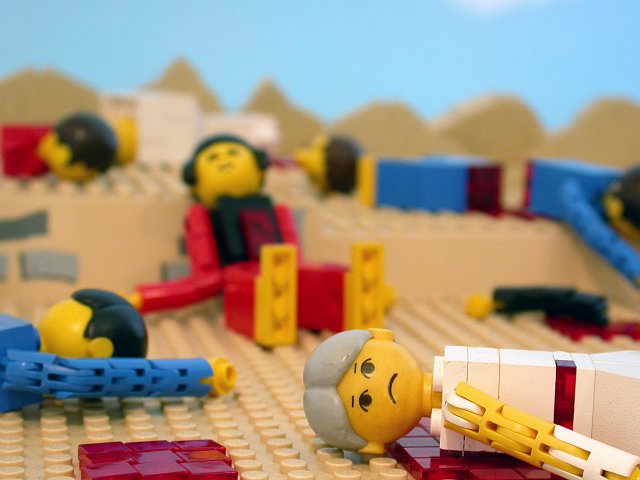
(Much of this post taken from my essay in progress, "Inventing with Animals in the Middle Ages." Comments welcomed. The image of slaughtered Lego Anakim that begins this post is taken from the stunning Brick Testament of the Rev. Brendan Powell Smith, specifically here)

Tuesday, February 21, 2006

Why are academics so funny?

That's "funny" in a Mark Twain sense, not "funny" as in "I am a lonely internet user in Tokyo seeking information on amorous hyenas" (see the post below).

Two recent blog entries that made me wish I could write so well:

(1) Dean dad's "compare and contrast" essay on the films Curious George and Brokeback Mountain. I was astonished to discover that both feature an obsession with men in hats.

(2) Richard Scott Nokes, of Unlocked Wordhoard, penning an angry letter to David Horowitz, demanding to know why he had not made the list of The 101 Most Dangerous Academics. Professor Nokes makes a persuasive case for his -- and an unnamed math professor colleague's -- inclusion.

Strange web searches that deposit readers at this blog

One of the more intriguing functions of a blog site meter is its ability to reveal what keyword search brought a particular reader to your pages (and do not worry, cravers of anonymity: the site meter cannot divulge your email address, simply your domain name).

Most of those who chance upon this site are drawn by searches that should end up here: "What is postcolonial theory" (Turkey); "Roger Caillois praying mantis" (Utrecht); even "one-eyed monsters" (Ontario). It's comforting to find that "postcolonial medievalists" is a fairly popular search, executed by readers in California, India, and London (the last one specifically from Lambeth ... could the Archbishop of Canterbury have taken a sudden interest in the postcolonial Middle Ages?) I have no idea why someone in Huntingdon, England, was seeking information on "carnivorous toads," but I'm pleased that this person actually found something relevant here.

Other searchers were no doubt disappointed in what they unearthed. I'd like to know more about the life of the internet user in Tokyo seeking information on "hyena zoophilia." Personally I have never been all that attracted to hyenas, and would like to know what all the fuss is about. Quite a few people seem to be interested in passionate relations between humans and bulls, if Google is to be believed. Only I could make that subject seem dull (check out "erotic animals" in the archive under 1/27/06).

Most puzzling of all to me, though, is the person in Pueblo Nuevo, Spain, who was researching "Middle Ages name of human meat" and "human flesh in European restaurants."

Hannibal Lecter, mon lecteur?

Saturday, February 18, 2006

So You Want to Raise a Medievalist II


You'll never transform your children into tiny medievalists until you (1) snatch them away from their Nintendo DS and (2) force them to learn Latin.

I don't have any advice on (1), but for (2) a book that is delightful -- and that now seems to be becoming a series -- is Minimus, from Cambridge University Press. As you may have guessed from the title, the book centers around the life of a small mouse (oh how those classicists love their puns). He dwells with a family who has been stationed in Roman Britain, near Hadrian's Wall, c.100 AD. This family is in fact based upon people whose lives are known from fragments of letters discovered at Vindolanda. The Latin is imparted through simple comic strips and activities. Recently, Minimus even gained his own website.

Minimus is a charming, low pressure way to have a child learn some basics of Latin. In my son's case, I should also add, it triggered an unhealthy interest in the worst of the Roman emperors. Ask him about anything that Nero or Caligula did, and he's happy to share his research (most of it based upon another British book, Ruthless Romans).

Friday, February 17, 2006

On the topic of lethal fauna

As a kid, I was addicted to “In Search Of,” with Leonard Nimoy. (I know, I know…) One episode that really stuck with me was about killer bees. We were supposed to be inundated with killer bees by the year 2000. What happened to the killer bees?

-- Dean Dad at Confessions of a Community College Dean

Thursday, February 16, 2006

toads: man-eating; poisonous


Readers want to know: what's up with that index entry on toads? (See "Index Joy") We know the Middle Ages were zany, you say, but could they really be so zany as to believe in not one but two types of lethal toad?

Well, yes.

The story of the man-eating toads (I suppose they would also eat women, and maybe even children, but in the story they devour only a man) was narrated by Gerald of Wales. This was the same twelfth-century writer who also loved to tell tales of self-castrating beavers and interspecies procreation. In a travelogue he composed of his preaching tour of Wales -- a tour that netted about 3000 volunteers for the crusades -- Gerald tells of a man plagued by toads. Great quantities of the creatures gather near him and joyfully nibble his flesh. Bedridden and in danger of being transformed completely into amphibian kibble, the poor fellow is eventually carried to the top of a tree by sympathetic friends. Carnivorous toads are, unfortunately for him, also arboreal. They climb the tree, troop to his branch and eagerly snack upon him, leaving only a skeleton clinging to the limb (Journey Through Wales 2.2)

More widespread in medieval literature are toads of the venomous rather than carnivorous variety. Working recently with texts produced around England's twelfth-century civil war, I became interested in two appearances of these creatures. The first is in the Peterborough Chronicle, a version of the Anglo-Saxon chronicle that was continued late into the century. The chronicle takes us inside the dungeons of malefactors who, because the king is weak, have been incarcerating innocents to extort their money. Death by toad venom ranks right up there with being suspended by your thumbs or having your brains forced out through your ears:


No martyrs were ever tortured as [these victims] were. They were hung by their thumbs or by the head, and corselets were hung on their feet. Knotted ropes were put round their heads and twisted till they penetrated to the brains. They put them in prisons where there were adders and snakes and toads, and killed them like that. [entry for 1137]


A second and eerily similar example of venomous toads can be found in Thomas of Monmouth's Life of St William of Norwich. Here we are once again taken inside one of these civil war dungeons:


There was, then, a woman of Brandney named Wimarc, who in the time of Stephen, when the days were evil, was given as a hostage at Gainsborough for her husband who had been taken by pirates. In his stead she was committed to prison with three other women and one man, and there she remained for long. These people, after long enduring miserably cold, hunger, stench, and attacks of toads, began to plan in concert the death of their gaoler (6.13)

In an inspired moment, the prisoners squeeze venom from some of these threatening but oddly handy amphibians and mix with it the gaoler's drink. Suspecting treachery, he forces them to imbibe their concoction. All but Wimarc immediately perish of toad poisoning. Her flesh swells grotesquely. Her skin nearly tears. Once she is finally released from prison, for seven years Wimarc is possessed of the body not of a human being but of "some portentous new monster." You will be happy to learn, though, that a pilgrimage to Saint William's shrine in Norwich brings her instant relief. She vomits the toad's venom over the pavement in front of the shrine ("there was enough of it to fill a vessel of the largest size") and is restored to her slender figure.

So medieval toads were indeed lethal ... but at least there was a possible cure.

The Medieval and the Political

For reasons that will become clear when I finally finish my index and post about another ongoing project, I've been thinking quite a bit about how the Middle Ages might intersect with contemporary political preoccupations in an untimely way. That a non-medievalist finds a book about medieval minority groups useful for thinking about the present is intriguing. Here's the link:

A Canadian Lefty in Occupied Land

(courtesy of the ever-rich History Carnival)

Tuesday, February 14, 2006

So You Want to Raise a Medievalist


Sure, there are classic books like the Lord of the Rings (Seth Lerer did a brilliant MLA paper a few years ago on Gandalf as philologist that made me realize my own career was set in place by my sixth grade reading). But then again Tolkien's opus is now on DVD, and who reads when they can watch a DVD?

A book that my son highly recommends -- and that I must admit that I'm getting all kinds of guilty pleasure from reading myself -- is Nancy Farmer's Sea of Trolls. Set on the northeast coast of England during Viking days, the story reworks Beowulf, among many other medieval stories. And where else can your kid read a novel in which some of the dialogue is in Old Icelandic -- and LIKE IT?

Monday, February 13, 2006

Another Book to Anticipate ...


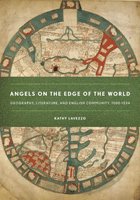
ANGELS ON THE EDGE OF THE WORLD:
Geography, Literature, and English Community, 1000–1534
by Kathy Lavezzo, University of Iowa

From the Cornell University Press website:

In a view that sweeps from the tenth century to the mid-sixteenth century, Kathy Lavezzo shows how the English people’s concern with their island’s relative isolation on the global map contributed to the emergence of a distinctive English national consciousness in which marginality came to be seen as a virtue. Lavezzo examines the many world maps and textual geographies produced by the English during these years. In a beautifully illustrated book, she argues that the English looked to the globe only to emphasize and, in time, to exalt their own exceptional geographic status.

The author charts this process by examining a series of wondrous maps and canonical texts. Demonstrating how medieval geographic notions conditioned English attitudes toward Rome, clarifying the complicated religious history leading up to Henry the Eighth’s divorce and the Reformation, Angels on the Edge of the World straddles the subjects—and methods—of literature, history, and cultural geography. It will be of special interest to those readers who use cartography as a way to map cultural identities.


In print this June.