Showing posts with label human. Show all posts

Monday, April 07, 2008

Gowther's Interrupted Utopia Idyll

I met with an independent study student today about Sir Gowther. Without much luck, we tried to track Gowther's developing relations with dogs after the Pope demands he "eyt no meyt bot that thu revus of howndus mothe" (296). At an Emperor's palace, he "droghe" a bone from a spaniel, "and gredely on hit he gnofe" (355-6), and, when the Emperor's daughter places a loaf of bread in one dog's mouth and flesh in another's, Gowther "raft bothe owt with eyggur mode" (449). Subsequent encounters with dogs (512-16, 610-11, and 649) are vaguer about how Gowther eats.

To resist masochistic readings of Gowther and to lessen the humiliation of his penance: these were my desires, and they came to nothing. There's just something irredeemably wretched and, well, bestial about the Pope's alimentary injunction and Gowther's obedient food-snatching. And there's no development at all: Gowther and the dogs just don't get along. But this, however, is the case only at the Emperor's place. My student and I noticed that Gowther's first encounter with dogs violates the Pope's strictures: when he is outdoors, resting on a hill, Gowther receives his food as a gift.
He went owt of that ceté
Into anodur far cuntré,
Tho testamentys thus thei sey;
He seyt hym down undur a hyll,
A greyhownde broght hym meyt untyll
Or evon yche a dey.

Thre neythtys ther he ley:
Tho grwhownd ylke a dey
A whyte lofe he hym broghht;
On tho fort day come hym non,
Up he start and forthe con gon,
And lovyd God in his thoght. (Sir Gowther 307-18)

Far from a humiliation, this encounter is a moment of tenderness, an astonishing tenderness, really, for a narrative that otherwise swings wildly between sadism and piety, and more often that not, combines the two. In today's conversation, I identified this encounter as a utopic moment. For a time, Gowther is trying to do nothing; he is out of doors, out of all civilized organization of space; and for three days, he suffers--or, better, enjoys--a dog's charity. Only when he finally gets up and goes does he secure this charity to a proper, divine source. But before he substitutes a divine for a demonic telos, before he stands up, before he begins to make his way to a court where he meets dogs who, there, function only in a grotesque mimesis of animality, before all this, in that time on the hill, Gowther has found, with this dog, another way of being.

It's a pity Gowther didn't end at line 318, or even a few lines earlier.

(picture from here. I might have referenced the lovely Pippi too)

Friday, December 28, 2007

The Phenomenology of Landscapes

I have been nearly successful in upholding my vow not to stimulate a single neuron between December 24 and January 1.

In years past a chunk of this time has been lost to the great vortex of MLA. For once, though, I don't have to attend this Convention of the Bespectacled, a fact both good and bad: good, because -- well, because I don't have to be there; bad, because that means we are not hiring this year, and we are down one early modernist. I have vowed to spend the hiatus as a normal person would: resting, eating, resting from eating, eating to assuage the hunger of resting from eating, resting from eating to assuage ... well, you get it. The best part of this week has been the liberation of my family from the tyranny of its schedule. No ballet classes, Hebrew school, fencing lessons, piano lessons, EcoDefenders meetings, readings, business meetings: almost nothing at all for any of us. This gift of time has given us the chance to halt our constant motion and reacquaint ourselves with each other. Interesting fact: until recently I had forgotten that I have TWO children. How wonderful it is to possess both a son and a daughter.

Today, though, most of the family has vanished to spend some time without The Killjoy (I think they mean our dog Scooby, but they seem to have forgotten that I am in the house as well. Odd.) I've been reading through an excellent book and thought I'd share it with ITM's readership, since it bears so directly on some conversations centering around the "Weight of the Past" project, on MKH's dissertation proposal, on Eileen's enduring interest in capaciously rethinking the human, and on Karl's animal-focused thoughts about boundaries and borders. Liza, a frequent contributor, will see that I have her in mind as well.

Readers may remember that not long ago in the comments to one of MKH's posts I suggested the philosopher Maurice Merleau-Ponty as offering a usefully embodied way of thinking about horizons. Right now I'm working through an e-book heavily indebted to M-P, on the experience of stone and observer, and thought I'd share some of its foundational precepts as useful for other projects. So here is Christopher Tilley, The Materiality of Stone: Explorations in Landscape Phenomenology, laying out some guiding principles for his scholarship on neolithic stone structures:

A phenomenological perspective provides an ontological ground for the study of
things, places and landscapes, a means of approach and a way of thinking through
the body in its participatory relation with the world. I summarize some fundamental principles.

1. A phenomenological approach to landscape and place, as discussed here, using
the framework of Merleau-Ponty's thought and interpretations of this thought
by others, is not a philosophical approach emphasizing the personal and the
subjective. It is an approach emphasizing the intertwining of subject and object,
things and persons, mind and body, places and Being in the world. The rejection
of any possibility of an objective approach does not mean that we pass into a
realm of personal subjectivity, because meaning is grounded in the sensuous
embodied relation between persons and the world, an invariant ontological
ground for all feeling and all knowing taking place through persons with similar
bodies.
2. Any study begins with lived experience, being there, in the world. It must
necessarily be embodied, centred in a body opening out itself to the world, a
carnal relationship. The exploitation of basic bodily dyads provides one entry
point into the study of place and landscape. A concentric graded sense of place
and landscape provides another basic way in which meaning may be explored.
Both originate in the body and extend outwards.
3. Perceptual meanings of place and landscape are constituted as gestalts, themes
against horizons, to which the human body and the external world both contribute,
a lived structure of experience formed through engagement and interaction
in which the body-subject and the world flow into each other and form part of
each other. The body is concretely engaged in the world from a particular point
of view that is always unfolding and changing in space-time. The mobile
interaction of the body in the world creates a framework for experience which
is produced in this lived interaction. What is experienced is an articulated
sensuous theme, against a horizon, in which perception is a meaningful bodily
organization of the perceptual field. There is a dialectical exchange between the
embodied structures of the engaged perceiver and the structures of that which
is perceived.
4. This involves a dehiscence, an opening of my body to things, a reversible
relationship between touching and being touched, myself and other, the effect
of myself on things and those things on me.
5. In an experiential relationship with things there is always a chiasm, an intertwining between 'outside' and 'inside', which mediate each other but never
totally fuse. So my body is in contact with the world but still separate from it.
My body experiences from the inside but opens itself to the outside. Since, as
an embodied observer, I perceive the world through a set of frameworks which
are habitual and grounded in the body, to a certain extent anonymous, these
frameworks cease to be mine alone and are not therefore 'personal'. They are,
however, both objective and subjective insofar as they simultaneously stem
from my own body. First-person experiences can be used to gain access to the
experiences of other persons because of the incarnate and sensuous opening
out of the 'primal' embodied subject to the world.
6. Our primordial experience is inherently animistic, disclosing a field of phenomena that are all potentially animate and expressive because our perception
involves the reversibility born out of our participation in the world.
7. Direct prereflective perception is inherently synaesthetic, disclosing the things
and elements that surround us not as inert objects but as expressive subjects
of experience, born out of our multidimensional sensorial participation in the
world.
8. There is a fundamental temporal dimension to the body, place and landscape
carried through movement and sedimented into what places and landscapes
are and how we experience them.
9. Persons do not passively receive information and knowledge about the world
but always act in accordance with practical projects, values, needs, desires and
interests. What information and knowledge is indeed received can only be
understood in the context of these needs, desires, etc. It is in the context of a
needful body reaching out to the world that meaning and significance are
found. The manner in which we experience place and landscape is, however,
forever unfinished, uncertain and therefore ambiguous. The ambiguity inherent
to both that which we investigate (place, landscape) and how we perceive
is not a problem for analysis. Instead it provides an inexhaustible field of
affordances for us.
10. The aim of a phenomenological analysis is to produce a fresh understanding
of place and landscape through an evocative thick linguistic redescription
stemming from our carnal experience. This involves attempting to exploit to
the full the tropic nature of our language in such a way as to seek the invisible
in the visible, the intangible in the tangible. The mode of expression must
resonate with that which it seeks to express.
Reference: Tilley, Christopher. The Materiality of Stone: Explorations in Landscape Phenomenology (Oxford: Berg Publishers, 2004) pp 29-30.

Cf. this summary, p. 31: "What I have been suggesting is that rather than regarding things, placesor landscapes primarily as systems of signs, or as texts or discourses which encode meaning and reflect social identities in various ways, we can regard them as agents which actively produce that identity. In other words we need to think about places and landscapes animistically, in an analogous manner to the way in which we like to think about persons, as entities who can and do make a difference. The move is from considering things as representing the world to us to things as producing that world for us. It is a move from the cognitive sign value of things to the embodiment of things, from the code of the world to the flesh of the world, from symbol to action. Producing human meaning in the world is all about establishing connections between ourselves and the disparate material phenomena with which and through which we live, the plants and animals, landscapes and artefacts that surround us, and this is the work of tropic language, of metaphor and metonymy."

Saturday, September 15, 2007

Inhuman history and POV

In Scenes from Deep Time: Early Pictorial Representations of the Prehistoric World, Martin J. S. Rudwick traces how Victorian illustrations of the prehuman world (especially those crammed with strange life forms like dinosaurs) were deeply influenced by depictions of biblical history, and especially by scenes of the seven days of creation. Rudwick writes:
It is easy to take these scenes from ‘deep time’ for granted. But they invoke a conceptual and material construction of a very peculiar kind. Their realistic style invites us to imagine that we are seeing the deep past with our own eyes, unproblematically, as if from a time machine. Yet we also know that in fact they are based on extremely fragmentary evidence, fleshed out with a complex network of theoretical inferences. Furthermore, a moment’s reflection shows that they are very far from any simple realism, not least because they crowd into one scene a variety of organisms that would unlikely to pose together so obligingly in real life

Rudwick is as interested in point of view as mis en scene: these snapshots of prehistory are always organized as if an invisible human being were the observer. The vanished but assumed human knower is omnipresent, even in dinosaur illustrations to this day, leaving invisible what is in fact a problem:
Scenes from deep time … had not been and could not be witnessed by any human beings at all. By definition they claimed to represent a human viewpoint in a world that was totally nonhuman because it was prehuman. Here, significantly, the only precedent that might have been helpful was one with which many ‘men of science’ were reluctant to be associated. Traditional biblical illustrations had always included scenes from the very beginning of time, before any human beings were present to record events depicted … However, that pre-Adamic human viewpoint was not a divine viewpoint, unless it was that of the anthropomorphic Yahweh ‘walking in the garden in the cool of the day,’ or, proleptically, that of the logos that ‘was made flesh and dwelt among us.'

The organizing principle of the picture, that which gives it meaning and coherence, saturates the visual field with human meaning. Inhuman history is made knowable by making it anthropocentric -- even in the supposed absence of the human.

I was thinking about Rudwick's book this morning while reading a review in the Washington Post of the new Ansel Adams exhibit at the Corcoran. Blake Gopnik writes about the POV in Adams' iconic nature photography and what vanishes from them. Gopnik is specifically interested in the various cars Adams used to transport himself to vistas that seem to lack human content:

Of course, none of those cars are visible in Adams's photos. (Or not in most of them, at any rate. More on that below.) But they are a hidden presence that helps give his photos force and builds their meaning. Adams and his images are a product of the glory days of Machine Age America, and they speak about it.

Adams's photos aren't just about landscape. They're about the particular confrontation between technology and landscape that made those photos possible. The images of the Sierra Nevada are as much about getting easy access to those mountains -- even with dozens of pounds of large-format camera equipment -- as about the mountains themselves. America's love affair with its landscape has never been only about the natural wonders it contains. It's been about pride in America's ownership of those wonders and the ability to go out from settled centers to take them in. Technology made it ever easier to make the trek; photographic technology made it possible to seize the instant of encounter and commemorate that ownership.


Gopnik even provides a commercial photograph that Adams created and which was discovered in a drawer at the Post:
Just by chance, The Washington Post also owns a bunch of Adams advertising shots, discovered in a drawer more than 10 years ago. There's not much of a clue to where they came from, but they feature trademark Adams subjects: the giant trees of northern California, the cliffs and peaks of Yosemite. Yet, in each shot, cars and roads bring people into the scene, so they can have fun and look sexy and, generally speaking, sell the tourist landscape all around them. One of them is a classically Adamsian shot of a famously huge tree -- with a shiny eight-door custom Cadillac parked at its base, disgorging happy city folk. In his commercial work, Adams depicted America's mechanized reality. His art displays its alter ego.

Though the website doesn't offer this image, it is quite intriguing: an absolutely immense Redwood with an absolutely immense Cadillac, Ansel Adams with the human that has always been his frame made suddenly and stunningly visible.

Thursday, July 26, 2007

An Historian's Notes for a Miloszan Humanism

In light of Jeffrey's recent trip, avec petit fils, to the Holocaust Museum in D.C., and with regard to our recent discussions on the links between human-ness and animal death, and on the curatorship, or is art?, of the dead bodies of the past, I thought I would share here an excerpt from and link to the complete essay, "An Historian's Notes for a Miloszan Humanism" [forthcoming in BABEL's special issue of the Journal of Narrative Theory] written by my colleague and great friend, Michael Moore, who is a scholar of early Frankish history. As I was undertaking the final copy-editing of this issue, I could not help but stop and be astonished, at more than one moment, in my re-reading of Michael's essay, which is both breathtaking in its elegance and poetry, and brave for its courage in advancing a defense of forms of medieval and early modern humanism that many would like to see put to rest forever. Which is not to say that Michael's argument in his essay represents some kind of unreconstructed and nostalgic bid for a traditional and "old" humanism that would never be able to account for or own up to its "evils" ["evils," moreover, which Michael purposefully confronts in his essay]; rather, his objective in wishing to revive certain "old" humanisms by way of the poetry of Czeslaw Milosz, stems from a concern with the ethical relationship between the singular self who is always held in singular present [modern] moments and the memory of others always already lost to the past. As he himself writes, "The defeat of the opalescent notion humanitas threatens to leave us without a legal subject of rights, and perhaps without a subject of history or literature as well. The problem is acute for historians, who want to validate their continued moral and intellectual preoccupation with the dead, their constant efforts to handle their belongings and books, and their efforts to preserve and understand their ephemeral voices."

Although BABEL had what might be called its "official" founding moment at the Congress on Medieval Studies at Kalamazoo in 2004, and its earlier more "unofficial" beginning at a bar in Asheville, North Carolina in the fall of 2003, it was being propelled even before that in my conversations with Michael, who inhabited the office next to mine in the basement of Peck Hall at Southern Illinois from fall 2003 to spring 2005, and who was always urging upon me the importance of a medieval studies that would be more contemplative and ethical with regard to what might be called the "dignity" and "freedom" and "happiness" of individual persons, and that would also focus more intently on friendship and amity as a disciplinary concern. Indeed, in the essay he contributed to our Palgrave volume, Cultural Studies of the Modern Middle Ages, "Wolves, Outlaws, and Enemy Combatants" [which looks at the Bush White House legal memos on the torture of "enemy combatants" in light of medieval laws of outlawry] he wrote,

The poet Goethe once declared that national hatred has a peculiar quality: "You will always find it strongest and most violent where there is the lowest degree of culture." Displays of hatred have been common in recent years, thriving in a moral atmosphere of decline. Nationalism has formed the crucial backdrop to the legal atavism and return to more primitive forms of law described here. The attempt to preserve a humane culture and to assert our rights or our love of the right, should not be left in the hands of a distant state, since these are qualities of the virtuous life. One should highlight the possibility of friendship and the connections between friendship, liberty, and joy. It is by no means easy to orient oneself during a period such as this one. While pondering the theme of this essay, I went on retreat to the monastery of Maria Laach (Monasterium Sanctae Mariae ad Lacum). Walking the paths lined with ancient beech trees or sitting in the quiet of the old liturgical library, I found that the topic troubled my thoughts. It seemed like a violation of the peace of the monastery to study torture and terrorism inside the walls, and yet those walls gave my reflections a hopeful and dignified frame. We have been given the world as a setting in which to practice virtue and to attain self-knowledge; we are also bidden to study the world and the human tradition. Only this can open the prospect of contemplative happiness, "to which the whole of political life seems directed." In periods of disturbance and change, personal constancy and discussions with like-minded friends become more important. If we can remain true to our friends, then "new paths will appear, enabling us to practice spirituality."
It would be impossible to overestimate the influence which Michael's thinking has had on my own these past few years. There has definitely been no love lost between Michael and "high" postmodern theory, and he can be unswervingly sentimental [he has been known to cry when reciting Milosz's poetry by heart to his students]. For these reasons, I initially worried that we would never be able to agree on our approach to medieval scholarship [except for the sentimental part, to which I say for myself as well, "guilty as charged"], but happily, I was so wrong. I would have to credit Michael for demonstrating to me, that in this "work" we do, whether of a more traditional historicist or postmodern theoretical bent, we should not be reticent about making claims for the value of the study of the dead as a mode of affective contact across time, and also as an aesthetic art that aims at a type of beauty in the present that could be said to be recuperative of persons both living and dead, however silly that may appear to some. I wonder, too, in my most recent reading in the most recent books in medieval studies but also more modern studies--including work published by Steven Kruger, Carolyn Dinshaw, JJC, Jodi Enders, L.O. Fradenburg, D. Vance Smith, Leo Bersani, Jorge Estaban Munoz, Elizabeth Grosz, John Caputo, Judith Butler, Michael O'Rourke, Michael Uebel, among others--if that idea of that kind of scholarship hasn't already begun to take root in a more widespread fashion. In any case . . . .

I leave you here with an excerpt from Michael's essay, and if you are smart enough to know you want to read the whole thing, go here.

* * * * * *

Humanism and the Flowers of Evil [second section of Michael E. Moore, "An Historian's Notes for a Miloszan Humanism"]

In 2000, the critic George Steiner was invited to look back over the twentieth century, in an interview with the French weekly L’Express. He pointed to the barbarism of a century marked by death camps, torture, deportation and famine, extending from 1914 to the terror-regime of Pol Pot and the Rwandan genocide. The twentieth century proved to be the defeat of civilized culture, according to Steiner: “Education: philosophical, literary and musical culture, did not impede the horror. Buchenwald was situated a few kilometers from the garden of Goethe” (qtd. in Simonnet). Jorge Semprun, who was himself interned in Buchenwald, later remarked in his memoir Literature or Life on the geographic and moral irony of this conjuncture. Semprun observed the terrible coincidence that brought Léon Blum, socialist, Dreyfusard, and author of the Nouvelle conversations de Goethe avec Eckermann, as a prisoner to the Ettersberg forest: “the quirk of fate that led Blum as a prisoner of the Gestapo to the very place where the conversations between Goethe and Eckermann occurred” (96; see also Blum).

The original Conversations with Eckermann are a monument of the maximal period of humanistic education and of a classicizing, humanistic love affair with the ancient world. The Antike was an ideal artistic realm that could be permanently reawakened and emulated. As Goethe remarked, commenting on the nature of Greek tragedy, its subject matter was “humanity in its whole extent” and so we should always study great writers, but “above all things, the old Greeks, and always the Greeks” (149–50). For Goethe, as for Schiller, the world of classical Greece was a beautiful world. As viewed from Weimar, all things in ancient Greece sparkled and were more worthy (see Bruford 86). For Semprun, in contrast, the experience of radical evil cast doubt, not only on such enthusiastic ideals, but on the continued possibility of literature, and his memoirs record his endeavor to fight his way back out of these ruins.

George Steiner strongly implies that the proximity of Buchenwald to the Oak of Goethe was far more than a coincidence: this happenstance illustrated the fact that the ideal of humanity developed during the Enlightenment, and expressed in the political ideals of the Eighteenth century, had completely failed to humanize the world. The inhabitants of Weimar who became Nazis and built the camps were in some way the heirs of Goethe and Schiller. Moreover, according to Steiner, the so-called humanizing effect of the liberal arts also seemed doubtful in the extreme. The humanities have become an isolating preserve in which the real world is kept at bay. While reading King Lear or the Fleurs du Mal, Steiner remarks, “I do not hear the cry in the street” [“je n’entends pas le cri dans la rue”] (qtd. in Simonnet). His best student, Steiner declared, was the one who completely rejected his teaching and went off to become a doctor, serving the poor in China. The anecdote reflects the skepticism of an old professor whose life had been wagered almost entirely on literature, and who arrived at the end of a terrible century marked by a sense of futility about the isolated contemplation of the scholar in his or her study. But Steiner’s criticism of literature, in the course of his own profoundly literary life, also brings to mind a saying of the anti-modernist and aphorist Nicolás Gómez Dávila, that “there is no humanism that does not carry with it a critique of humanism” (197). No mature and fully developed humanism can fail to incorporate the edge of critique, or fail to examine its own false paths. We can reflect that Steiner’s criticism is humanistic in its deepest orientation, as well as in its sense of rebellion and disquiet.

The question raised here is whether it is possible to discover a path for humanistic scholarship adequate to contemporary existence, yet still capable of offering the ressourcement provided long ago by medieval and classical humanism. As Robert Torrance has noted, we live in an era that has been defined as “not only post-structuralist and post-modernist, but post-humanist and indeed even post-human” (168). The possible collapse of literature, experienced with a sense of horror by Semprun, has become for many scholars an occasion for playful adventures in the ruins of old systems.

Humanism has been criticized along the lines of Steiner’s views at least since the end of the Second World War, in a Europe which had seen, in Steiner’s words, “the triumph of the inhuman at the heart of the century” (xi–xii). Traditional ideals could be maintained only with tremendous effort, or abandoned as no longer pertinent to the human condition. As early as 1951, for example, the anthropologist Lévi-Strauss argued that Europeans of the Enlightenment, who often spoke of humanity, did little more than project their own values and aspirations as a universal ideal of civilization: “the concept of an all inclusive humanity, which makes no distinction between races or cultures, appeared very late in the history of mankind and did not spread very widely across the globe” (Finkielkraut 2000, 5-6; see also Finkielkraut 1995, 55). The ideal of humanity therefore, despite its universal claims, was destined to remain a narrow European concept with limited impact on world consciousness. This has been one of the most devastating arguments raised against humanist traditions. So now, in the cultural conditions of “postmodern pluralism” as Gianni Vattimo argues, the very concept of humanity and study of the humanities seems suspect, unphilosophical, or undemocratic (3–5). In the 1960s, the ideal of humanism (along with the concept of the Rights of Man) was dismissed as a feature of petti-fogging bourgeois ideology (Judt 565). Thus we arrive at Foucault’s derisive comment that “Man is an invention of recent date” (387). If the constraints and disguises inherited from classical thought could finally be discarded, the early Foucault believed, then the unwelcome notion of humanity would at last be “erased, like a face drawn in sand at the edge of the sea” (387; see also Nehemas 170–73).

The most negative and vitriolic statement of this anti-ideal is that of Lacoue-Labarthe: “Nazism is a humanism in so far as it rests upon a determination of humanitas which is, in its view, more powerful” (95). Torrance is right to remark that nothing could be more anti-humanistic than this phrase. Lacoue-Labarthe’s strange saying was not intended to decry Nazi ideology so much as to sweep away the last crumbs of humanism from the respectable tables of the intellectual world, thereby to create more room for Heidegger and Heideggerian anti-humanism. Lacoue-Labarthe thus evidently shared Foucault’s revulsion at “the moralizing swamp of humanistic sermons” to be heard in post-war Europe, and Foucault’s anti-humanistic reaction to those sermons (Finkielkraut 2000, 28). It is equally interesting to note, in this connection, the contemporary turn from humanism in the neo-orthodox theology of Karl Barth, in favor of what Barth termed the “humanism of God,” meaning “God’s friendliness to man as the source and norm of all human rights and human dignity” (125). In contrast, however, Foucault’s perspective neither provided for a heightened awareness of justice, nor awakened energy for a greater engagement with the world, nor offered a defense of human dignity. There was an element of dandyism in Foucault’s reaction against what appeared to be a thoroughly exhausted humanism. Postwar efforts to pick up the threads of humanism often seem feeble in retrospect.

In his desire to find a path back from the horrors of the twentieth century, the Prussian historian Friedrich Meinecke famously suggested that “Goethe Communities” should be created in postwar Germany, so as to encourage the reestablishment of the spiritual life of Germans by “turning again to the altars of our fathers” in respect to religion. Meinecke hoped to bring about for his fellow Germans “an intensified development of our inner existence,” by looking back to the period long before Hitler’s Germany, when the generation of Goethe “strove for and to a large degree realized the ideal of a personal and wholly individual culture. This culture was thought of as having at the same time a universal human meaning and content” (113, 115). Meinecke’s humanist project is so well known in part because it appears so woefully inadequate to the situation of post-war Germany, and because it suggests a feeble and unrealistic reply to the monstrousness of the war and the radical evil unleashed by the Nazis. Moreover, German high culture and Bildung were not above reproach, since these values were held up as a fetish even by the Nazis, whose officer corps continued to wipe tears from their eyes at productions of Beethoven in the wartime concerts of the conducter Wilhelm Furtwängler.

So the question remains: is it still possible to explore “the opalescent notion humanitas” in the phrase of Ernst Kantorowicz, by means of deep study in the human tradition (1957, 451)? As the Carolingian scholar Alcuin explained, when we turn our attention to mankind, we discover a complete amalgam of dignity and abjection. If we wish to understand why humanity was created, the repulsive side of man should be put to one side, and “we should consider the nobility of the interior man” (col. 1101). Alcuin, the illustrious scholar of Charlemagne’s court therefore imagined a transcendental, universal human identity, based on the concept of the invisible soul and its likeness to God. The medieval and Christian roots of the figure of humanity are evident throughout the periods of scholarly and theological transit from late antique to later Renaissance and Enlightenment images of humanity. However, in the modern era, even long before WWII, such ideas began to lose their lustre. Under the impact of anthropology, from the beginning of the twentieth century, the wide examination of human types and human cultures had begun to dethrone those venerable medieval assumptions. Lucien Lévy-Bruhl, for example, after comparative research on the mentality of archaic societies (which he ordinarily termed “primitive”), concluded that there was no “identity of human nature” (75–79). According to Lévy-Bruhl, “since we have rejected the philosophies of history which provide a unifying principle in the form of theological or at least teleological ideas, the conception of humanity as a whole escapes us” (qtd. in Cazeneuve 24). Thus we really must ask whether it is still possible, or meaningful, to propose a humanism in the absence of a clearly defined essence of humanity.

Wednesday, July 11, 2007

Who mourns for Lindow man?

I'd gone to the British Museum early to get a look at the prehistoric section before the general public thronged the place. I filled my notebook with all kinds of observations about objects as temporal archives and the placement of the dead. I was hunched over Lindow Man when the family arrived. "Cool!" declared Kid #1 of the preserved corpse -- fragmented by a peat harvesting machine, but otherwise uncannily lifelike for a 2000 year old, a gift to the distant future of an anaerobic environment that has lingered from the distant past.

Kid #2, however, gazed into the darkened case that houses his remains and her eyes grew large. "Is he going to be OK?" she whispered.

"No," replied her brother confidently. "He's dead."

"I don't want him to be dead!" she said. "I want him to be OK."

"We all die. He's dead. He isn't going to get any better."

The news wounded her. "I want Lindow Man to be OK! I don't want him to be dead!" These last repetitions were accompanied by profuse tears. Lindow Man's corpse was too much for a three year old to accept. In life this person had been savagely beaten. He'd been given mistletoe to drink. His throat had been slit. The British Museum website reads like a True Crime! report:
The man met a horrific death. He was struck on the top of his head twice with a heavy object, perhaps a narrow bladed axe. He also received a vicious blow in the back – perhaps from someone’s knee – which broke one of his ribs. He had a thin cord tied around his neck which was used to strangle him and break his neck. By now he was probably dead, but then his throat was cut. Finally, he was placed face down in a pond in the bog.
Now Lindow Man is encased in glass, the resident of a museum display where hundreds look at his head, torso and arm every day, remarking upon how uncannily alive he looks but not feeling all that much for him. (I was told that he is the third most popular item in the BM, after the Rosetta Stone and Elgin Marbles).

Looking into the case, holding Kid #2's hand and running my hand through her hair, I suddenly wondered if anyone had ever grieved Lindow Man's passing. I wondered if my daughter, with her mind that cannot yet comprehend mortality but is beginning to see that all human lives end, I wondered if she was the first to mourn for Lindow Man.

(for an earlier post on Lindow Man, go here. Eileen's post on Time Forks got me thinking about this)

EDIT July 12
Here are some of the questions I've been contemplating as part of my research on this trip, questions that brought me to Lindow Man in the first place: Can the ancient past send legible messages to an uncertain future? Or is the future the people of history imagine simply a projection of their own present into eternity? Can an architecture or artifact really endure beyond such an inhuman temporal horizon, or are they destined to crumble, disaggregate, become mute? (Most dolmens and megalithic architectures -- the things we think will really endure -- tend to be reconstructions). Can the past communicate to us in a language of its own? In a transhistorical language? Or can the past be heard only in the auditor's language, an impoverished kind of listening? (Is Stonehenge Theirs, Ours, or Everyone's?) How do we treat ancient messages? As quarries for some quotidian uses? As sites in which to enact similar but related rites -- as in "numinous" areas that keep alive their sacrality in the movement from pagan to Christian? As museum exhibits? What is sacred about the past, or is reverence an impediment? At what point does a body interred in a grave (or thrown in a peat bog) become suitable for excavation and display? Under what conditions can a body be an object, and when is it a person? When is it sacred? When does it cease being human? Is a body buried with artifacts a message to the future, a letter to an uncertain receiver, a time capsule -- or instead a missive to lost gods and never to be opened by human hands? What happens to objects and people when they have become temporally enfolded? Can the older stories survive? How ought they to be commemorated, if at all?

Friday, July 06, 2007

Cynocephali, Animal Savagery, and Terror

Don't miss the vibrant tools discussion below. Go there first if you haven't already, and then, if you like, enjoy this long post for/over the weekend.

Sometime before 865, Ratramnus of Corbie wrote his Epistola de Cynocephalis, a teratologic work remarkable for focusing on only a single type of creature and for eschewing moralization. In essence, its concern is whether Cynocephali merit evangelization, not whether they, for example, represent backbiting. Following the Augustinian criteria of City of God XVI.8, the letter asserts that the Cynocephali are descended from Adam and hence human, but it doesn't stop here. The rest of letter compiles a Cynocephalic ethnography, muses in an Isidoran fashion on portents, and, finally, demonstrates incontrovertibly that these creatures possess reason.

Understandably, Ratramnus first handles the Cynocephalic voice and form:
forma capitis et latratus canum non hominibus, sed bestiis similes ostendit. Hominum denique est rotundo vertice caelum conspicere, canum vero longo capite rostroque deducto terram intueri, et homines loquuntur, canes vero latrant. (155: 24-27)

the form of their heads and their canine barking shows that they are similar not to humans but to animals. In fact, the heads of humans are on top and round in order for them to see the heavens, while those of dogs are long and drawn out in a snout so that they can look at the ground. And humans speak, while dogs bark.
But he raises these points only to counter them with a list of behaviors that argue for Cynocephalic humanity. That the Cynocephali live together in towns and engage in agriculture, that they evidence modesty by wearing clothing, and that they live together under a law, “Haec enim omnia rationalem quodammodo testificari videntur eis inesse animam” (155: 34-35; all these things seem to demonstrate that some kind of rational soul is in them). Ratramnus also observes that, “Homo vero a bestiis ratione tantummodo discernitur. Quae quod videtur inesse his de quibus loquimur, homines potius quam bestiae deputandi videntur” (156: 13-14; humans can be distinguished from beasts only by reason. From these things, a rational soul would seem to be in those of which we speak; they would seem to be regarded as humans rather than beasts). Ratramnus asserts that anyone who doubts the link between these behaviors and reason must himself lack reason (156: 9).

Ratramnus can't seem, however, to convince himself. Uncertainty pervades his letter, perhaps most evidently in its frequent use of videri (to seem): “videntur eis inesse animam,” “videtur inesse his,” “homines...videntur.” At this stage of his letter all Ratramnus allows, and that tentatively, is the possibility of Cynocephalic humanity, but neither the behavior he has cited nor the teratologic traditions of Christopher and monstrous births to which he next refers provide him with any definitive conclusions. It is only with his final point that Ratramnus at last transforms the uncertain videri to the active, confident videre (to consider or to see):
Accedit ad haec, quod scripta vestra testantur, domesticorum omne genus animalium, quae nostris in regionibus habentur, apud illos haberi. Hoc vero fieri posse, si bestialem et non rationalem animam haberent, nequaquam video; siquidem homini animantia terrae fuisse divinitus subjecta Geneseos lectione cognoscimus. Ut vero bestiae alterius a se generis animantia, et maxime domestici generis, curent et eis diligentiam adhibeant suisque cogant imperiis subjacere et usibus parere, sicut nec auditum ita nec creditum cognoscitur. (157: 10-15, my emphasis)

It is added to these things to which your letter bears witness that all the kinds of domesticated animals that are managed in our regions are managed among them. I consider that this could not be if they had a bestial and not a rational soul, since the living things of the earth were subjected to men by heaven, as we know from having read Genesis. But it has never been heard or believed that animals of one kind can by themselves take care of other animals, especially those of a domestic kind, keep them, compel them to submit to their rule, and follow regular routines.
Ratramnus takes three steps to establish these creatures as human and thus worthy of a missionary effort or, at least, to make them signal the necessary breadth of missionary activity: he silently eliminates their anthropophagy (a usual trait in the teratologic tradition on Cynocephali); he gives them agriculture, shame, clothing, and other human cultural characteristics; above all, he makes them keepers of domestic animals. Ratramnus defines the subjugation of these animals with a clause, “suis cogant imperiis subjacere,” crammed with three synonyms for command. It is this total assurance that confers humanity upon its actors: humans must monopolize dominion over animals if they are to claim human identity through it. With such a reckoning, Ratramnus has no need to account for the partially animal bodies of Cynocephali or their barking: his determination of the Cynocephalic relationship to animals dissipates any counterargument.

Something nevertheless continues to trouble Ratramnus. He adds that, “At vero Cenocephali, cum domesticorum animalium dicuntur habere multitudinem, eis minime convenit bestialis feritas, quorum animalia domestica lenitate mansuefiunt” (157: 15-18; but since the Cynocephali are said to possess a multitude of domestic animals, then animal savagery does not fit them because they tame their domestic animals gently). In characterizing the violence in which the Cynocephali supposedly do not engage with two words meaning “beast,” Ratramnus evokes a moral tradition that associated ferocity with animals: for example, Ambrose’s Hexaemeron VI.3.10 cautions, “If you revel in ferocity, the dominant trait of savage beasts for which reason they are slain, see that you, too, may not become a victim of your own atrocious cruelty.” The moral context cannot, however, exhaust the significance of Cynocephalic gentleness. It must be recognized that bestiae are, in a way, only animalia that refuse the humiliation of domestication, and that domestication cannot be enacted without some kind of subjugation. Nor, given the evidence of Ratramnus’s letter, can the subjugation of the Cynocephali be readily understood as gentle: the Cynocephali wear hides (presumably animal), and the excessiveness of the clause “suis cogant imperiis subjacere” strongly suggests that the Cynocephali master their animals at least through a monopolization of violence. It may be said that they dominate their animals gently, but no animal could ever resist their gentle regime. Ratramnus has not, then, purged his Cynocephali of violence: he has preserved its aspects of mastery for his newly born humans while imperfectly displacing the violence away from its enactors and onto its victims.

Today, I found myself reading Žižek in my study's hideous chair, where I ran across a passage that inspired me to repurpose more of my material on Cynocephali in what, I have to warn you, is going to be more of the same compounded by low-rent Žižekianism. In another discussion on "obscene enjoyment," this time in The Parallax View, Žižek characterizes the torture at Abu Ghraib as "a clash between anonymous brutal torture [i.e., that of S. Hussein's government] and torture as a mediatic spectacle in which the victims' bodies serve as the anonymous background for the stupidly smiling 'innocent American' faces of the torturers themselves" (372) through which the Iraqi victims become initiated into American culture in all its obscene excess; they simultaneously experienced American personal freedom and the outsourcing of torment that sustains it. Towards the end of the discussion, Žižek contrasts the Cold War to the War on Terror (and let's put aside whether his historical contrast works: I'm not so sure it does), where he observes, "The power which presents itself as being under threat all the time, living in mortal danger, and thus merely defending itself, is the most dangerous kind of power, the very model of Nietzchean ressentiment and moralistic hypocrisy" (373).

We have seen the response to the terrorist threat from enemies portrayed as religious fanatics, misogynists, and torturers; the appropriate response, at least so far as the Right is concerned, is to become religiously fanatic, misogynist, and to torture (a common point, available in many places, for example here; there's also Amanda Marcotte's observation that "When conservatives say, 'Freedom isn’t free,' they seem to mean that it exacts a price, but perhaps a more accurate translation would be, 'Freedom is slavery'). As you might expect me to do (and by anticipating your anticipation, I of course promise my secret possession of more thought on the matter than you see here: in other words, "as you might expect me to do" is a profoundly dishonest thing to say, and if I go any further, I won't get out)...okay, as you might expect me to do, I observe that the Cynocephali, despite Ratramnus's testimony, themselves must engage in animal savagery to keep their animals domesticated. They must, because animals are, now per Ratramnus's testimony, by their nature savage. One can hardly blame the Cynocephali, then, for what they must do (although Ratramnus implicitly blames them by declaring that they in fact don't do what we know they must do).

The low-rent Žižekianism follows. In this sense, then, the Cynocephalic body is the image of the constitutive excess of humanity, the 'bestial' acts--subjugation, carnivorousness--in which it must engage to distinguish itself from animals. Simply because of their bodies, the Cynocephali cannot help but act bestially; but they should not be thought other because of this. They are rather the desublimated form of the conflict internal to human identity. At least so long as it's a humanity defined by difference to animals (and I'm becoming increasingly uncertain that that's the only way to do it), there is no way to be human without being bestial.

I think I've hit the end of my tether, at least so long as I'm starting from where I do. I'm ready to try something different or, at least, to push Ratramnus and the Cynocephali to do something different (at least so long as we don't lose animality by reading them as disguised Saracens, which is the usual--and I should say productive--way to study Cynocephali): but I've no idea where to take it.

Texts

The letter, which survives in a single eleventh-century manuscript, is available in PL 121: 1153-56; Ernst Dümmler, ed., Epistolae variorum 12, Monumenta Germaniae Historica: Epistolae 6. (Berlin: 1925), 155-57 (quotations derive from, and are keyed to, this edition); and, in translation, in Paul Edward Dutton, ed., Carolingian Civilization: A Reader, 2nd ed., Readings in Medieval Civilizations and Cultures 1 (Peterborough, Ontario: Broadview Press, 2004). My translations mostly follow Dutton.

Note that a few other writers, all Greek, also remark on Cynocephalic animal husbandry; see Claude Lecouteux, "Les Cynocéphales: Étude d'une tradition tératologique de l'Antiquité au XIIe s." Cahiers de civilisation médiévale 24 (1981): 117-29, at 118, for Cynocephalic husbandry in Ctesias of Cnidus (5th-4th century BCE) and Aelian (1st-2nd century CE); at greater length, see Lecouteux, Monstres dans la littérature allemande, 21, who translates (from Greek into French) a medieval witness to Ctesias in a letter of Photios, a late ninth-century Patriarch of Constantinople.

Cartoon from Momma, by Mell Lazarus, Oct 31 2006, discovered through Comics Curmudgeon, which I love.

Friday, June 22, 2007

Mute Beasts

I cited some of my work on Cynocephali in this thread and felt compelled to share some more on dog-headed monsters. Does this have anything to do with our recent interests: wonder, privacy, cosmopolitanism, and the heterogeneity of the past? Perhaps not; you may wish to consider what follows only as a parenthesis.

--

In a tradition epitomized by Isidore of Seville, to the degree that Cynocephali bark, they lack language, therefore resemble animals, and are likely only animals. Isidore wrote that Cynocephalic barking “magis bestias quam homines confitetur” (reveals them to be more beasts than men), and the eighth-century Liber monstrorum, which emphasizes its monsters' inhumanity, describes Cynocephalic speech as “contaminated” or “perverted” by barking ("Cynocephali quoque in India nasci perhibentur, quorum sunt canina capita, et omne uerbum quod loquuntur intermixtis corrumpunt latratibus"): their voices, as much as their bodies, are contaminated to the degree that they are canine. The thirteenth-century Old French moralized translation of the section on monsters in Thomas of Cantimpré's De naturis rerum similarly observes that Cynocephali “com chien glatisent…/ mes sens de gens est lors savoirs” (489-90; bark like dogs, but have human sense): with the conjunction “mes,” it's clear that barking occludes or opposes the human qualities Cynocephali possess.

The depiction of Cynocephali (labelled "gigantes") on the Hereford Mappamundi seems to belong to this tradition. It is unclear, however, whether the map depicts only barking, which would, following the Isidorian model, demonstrate speechlessness and hence inhumanity; or speech, human by definition; or something for which neither the teratologic tradition nor traditions of natural history normally account: barking that is intelligible as speech to the Cynocephali but not to humans. After all, these Cynocephali face each other and look as though they are communicating. If the barking of the Liber monstrorum and the Hereford map is not opposed to sense, but is rather language evidencing sense, the “mes” of the moralized bestiary should perhaps be an “et”: barking would not be a contamination, but only another mode of communicating. If Cynocephalic barking can be a kind of language, then by the same token humans might reconsider other animals’ noises as potentially linguistic, though incomprehensible to humans. In that case, a key justification of the human subjugation of animals—the animal absence of language, frequently advanced as evidence of animal irrationality—might no longer obtain: if barking could be speech, the world of animals might either be a world of language or, just as confusingly, a world in which creatures or species must be individually assessed for the possession of language. In such a world, the previously homogeneous, predictable irrationality of animals gives way to uncertainty.

Granted, some medieval theories of language allowed for some manner of animal language: Roger Bacon observes that “gallina aliter garrit cum pullis suis quando invitat eos ad escam et quando docet eos cavere a milvo” (hens prattle to each other with their chicks when they summon them to eat and when they teach them to beware the kite), and Abelard allowed that dogs might intend different meanings with different barks. In each case, however, medieval theorists of language would still reserve something exclusively for the human, such as the power of abstraction.

But the gestures of the Hereford image are not the gestures of mere animals; they are not engaged in the merely instrumental communication through which hens share food or warn against predators; rather, their postures suggest intellectual work or at least conviviality among nonhuman mortal creatures. In response to this suggestion, the only recourse to establish or reestablish Cynocephalic animality would be simply, regardless of evidence, to declare them nonhuman. But such a declaration, effective as it might be, also declares the ineffectiveness of relying on animal noise to classify Cynocephali—or indeed any nonhuman creature—as animal. The only certainty is the cold comfort of a chauvinist tautology: if Cynocephalic barking is inhuman, it is because humans declare it to be so.

Sources Used and Essential Works on Cynocephali apart from Friedman

Eco, Umberto, R. Lambertini, C. Marmo, and A. Taborroni, “On Animal Language in the Medieval Classification of Signs,” in Umberto Eco and Costantino Marmo, eds., On the Medieval Theory of Signs, Foundations of Semiotics 21 (Amsterdam: J. Benjamins, 1989).

Hilka, Alfons, ed., Eine altfranzösische moralisierende Bearbeitung des Liber de monstruosibus hominibus orientis aus Thomas von Cantimpré, De naturis rerum, Abhandlungen der Gesellschaft der Wissenschaften zu Göttingen 7 (Berlin: Weidmann, 1933).

Lecouteux, Claude. “Les Cynocéphales: Étude d’une tradition tératologique de l’Antiquité au XIIe s.” Cahiers de civilisation médiévale 24 (1981): 117-29.

Newall, Venetia.”The Dog-Headed Saint Christopher,” in Folklore on Two Continents: Essays in Honor of Linda Dégh, ed. Linda Dégh, et al. (Bloomington: Trickster Press, 1980).

Orchard, Andy. Pride and Prodigies: Studies in the Monsters of the Beowulf-Manuscript, Rev. ed. (Toronto: University of Toronto Press, 2003).

Westrem, Scott D., The Hereford Map: A Transcription and Translation of the Legends with Commentary, Terrarum Orbis (Turnhout: Brepols, 2001).

White, David Gordon. Myths of the Dog-Man (Chicago: University of Chicago Press, 1991).


Monday, June 11, 2007

Richard Rorty on the Human

Today's Washington Post has an obituary essay by Adam Bernstein on the philosopher Richard Rorty, who died last Friday.

An heir to William James and John Dewey, Dr. Rorty advocated a philosophy known as pragmatism, which shunned what he considered a fruitless search to answer unknowable questions: What is the meaning of life? Do other people exist? He had rejected the field of analytic philosophy on the ground that it attempts to address those questions, which he largely considered a waste of time, and had created something akin to a hunt for timeless truths, another idea he strongly criticized ...

Michael Williams, philosophy department chairman at Johns Hopkins University, said Dr. Rorty, one of his mentors, "taught the lesson there are no fixed and permanent foundations for anything, that anything could be changed. Where some see this as cause for despair, he saw this as cause for hope because it meant we could always do better. . . . He reveled in contingency," what happens as a result of human progress.

Williams added: "Instead of trying to define the essence of human nature, Rorty thought we should creatively think up new possibilities for ourselves -- what to be, how to live. He said we are not hostage to how things are. He spoke of pragmatism as a future-oriented philosophy."

I love also this paragraph:
He also recalled the importance of his childhood interest in wild orchids, which he found near his parents' property in western New Jersey. He developed a strong aesthetic yearning for such "socially useless flowers," he later wrote in his autobiographical essay "Trotsky and the Wild Orchids." He spoke of hoping to find a way to balance this appreciation of pure beauty with his parents' emphasis on intellectual purity -- and he described philosophy as a way to work through his competing beliefs.

Monday, March 12, 2007

Tis Like the Howling of Irish Wolves Against the Moone

In a thirteenth-century Latin poem on the Wonders of Ireland, immediately before a description of a man who lived headless for 7 years and a few entries before yet another one of those surprising references to ships floating in the air, there's this:
De hominibus qui se vertunt in lupos

Sunt homines quidam Scottorum gentis habentes
Miram naturam majoram ab origine ductam,
Qua cito quando volunt ipsos se vertere possunt
Nequiter in formas lacerantum dente luporum,
Unde videntur oves occidere saepe gementes;
Sed cum clamor eos hominum seu cursus eorum
Fustibus aut armis terret, fugiendo recurrunt.
Cum tamen hoc faciunt sua corpora vera relinquunt,
Atque suis mandant ne quisquam moverit illa;
Si sic eveniat, nec ad illa redire valebunt.
Si quid eos laedat, penetrent si vulnera quaeque,
Vere in corporibus semper cernuntur eorum.
Sic caro cruda haerens in veri corporis ore,
Cernitur a sociis, quod nos miramur et omnes.
(Thomas Wright and James Orchard Halliwell, eds, Reliquiae Antiquiae: Scraps from Ancient Manuscripts Illustrating Chiefly Early English Literature and the English Language, Vol I, London, 1841, 105; also available online here in Mommsen's edition; best edition in Gwynn's The Writings of Bishop Patrick, Dublin, 1955)

"There are certain men of the Celtic race who have a marvelous power which comes to them from their forebears. For by an evil craft they can at will change themselves into the shape of wolves with sharp tearing teeth, and often thus transformed will they fall upon poor defenseless sheep, but when folk armed with clubs and weapons run to attack them shouting lustily then do they flee and scour away apace. Now when they are minded to transform themselves they leave their own bodies, straitly charging their friends neither to move or touch them at all, however lightly, for if this be done never will they be able to return to their human shape again. If whilst they are wolves anyone hurts or wounds them, then upon their own bodies the exact wound or mark can plainly be seen. And with much amaze have they been espied in human form with gobbets of raw bleeding flesh champed in their jaws" (lovely quaint translation from Montague Summers, The Werewolf in Lore and Legend, 1933, 207-208)

According to Bernard Merdrignac, "Les loups, saint Guénolé et son double," in Religion et mentalités au Moyen Âge, 2003, 457-65 (via Hervé Martin), the poem is a paraphrase of material by an eleventh-century Bishop of Dublin, Patrick (d. 1084). In other words, it's a pre-conquest poem likely revived for use in an Ireland conquered yet again. Apart from the Merdrignac and the Martin (presumably, since I've yet read it), the poem doesn't yet seem to have received what we owe it. A search of google books turns up virtually nothing; the International Medieval Database suggests Máire West, "Aspects of díberg in the tale Togail Bruidne Da Derga," in Zeitschrift für celtische Philologie 49-50 (1997): 950-964; and the closest the MLA gets us is Winifried Schleiner, "'Tis Like the Howling of Irish Wolves Against the Moone': A Note on As You Like It, V.ii.109," English Language Notes 12 (1974): 5-8. I'm certainly missing something, as this putatively exhaustive search turns up neither the Merdrignac nor the Martin nor the work on wolves by Philippe Ménard or Aleks Pluskowski. In other words, I'm probably missing something, but all I have right now is my own library and the false plenitude of the internets.

I don't have much to say about the poem yet. My point here is simply to introduce it in the hopes that someone will recall an essential article on the poem, invisible to google books and the main databases, or, better yet, in the hopes that it generates interpretation and wonder from my co-bloggers and our readers. For now, I'm struck first by the poem's muddling of responsibility for the lycanthropy. Does the power to turn into wolves come "ab origine ductam"? In other words, is the power racial and hence to some degree outside their power? Is it a natural wonder ("miram naturam")? Or is it by will ("quando volunt")? Whence comes the evil (since they're changing shape "nequiter")? Or are these the wrong questions to ask?

I also wonder about the "men who run at them armed with clubs and weapons" [q: what makes a club different from armum?]--their Irish (?) enemies--and about suis--their Irish (?) Werewolf (?) companions? Who colludes and who does not? And, to sharpen/hobble Wright's translation in the last lines, who are the witnesses to all this? ("One with raw flesh stuck to the mouth of his true body has been seen/examined thus by (our?) associates/colleagues/allies, which we and all others wondered at")? And what of the raw flesh of sheep (not of humans) stuck to their face? Why should violence be the ineluctable mark of their racial stain (?), whether the violence they suffer or the violence they cause?

One way in might be through JJC's discussion of Gerald and Werewolves in On Difficult Middles:
Medieval writers were fond of attaching allegorical meanings to fauna, spawning a tradition of bestiaries that were ultimately more about humans than animals. Gerald leaves us in no doubt what the wolf represents when he writes later in the Topography that 'wolves in Ireland generally have their young in December, either because of the extreme mildness of the climate, or rather as a symbol of the evils of treachery and plunder which here blossom before their season.' The Irish inside their wolfskins are not very different from the treacherous, plunder-driven Irish inside their human forms. Their lycanthropy only makes visible in their bodies what they already are... (86-87)

With that in mind, I wonder about the poem's insistence on "true bodies"? Why should the werewolf's true body be a human form rather than a form that admits of both bodies? Doesn't the mouth smeared with sheepblood display the doubled body that is their actual, true form, the wolf and the human together? Building on her work on resurrection doctrine, Caroline Walker Bynum speaks of werewolf stories as indicative of an understanding of "the embodied nature of self" and reflecting "less a desire to shed body than an effort to understand how it perdures, less an escape into alterity than a search for the rules that govern change" (Metamorphosis and Identity, 109), where the human form, the "corpora vera" underneath the wolf, persists despite mutability. But I wonder if the truth smeared over the face is another kind of bodily truth, one not of bodily depths underneath but one of surfaces, one of stains.

What do you all make of this?

Wednesday, February 21, 2007

5 letters on human nature


Just in time to intersect with the threads on humanism that have developed here and here arrive these letters from the New York Times editorial page.

The five missives respond to a recent opinion piece by David Brooks ("Human Nature Redux"). Brooks stated, without any particular argument, that belief in human goodness is as dead as Rousseau himself. He then observed with some shock that conservatives have not embraced evolutionary theory, a puzzling failure given that conservatism's truths coincide with evolution's emphasis upon the dark nature of man (<-- yes, I intentionally did not write "humanity" because gender seems an implicit part of Brooks' argument):
Here’s another perversity of human nature. Many conservatives resist the theory of evolution even though it confirms many of conservatism’s deepest truths.
I am guessing that those "deepest truths" include facts like humans have been since the days of the caves selfish bastards who'd sooner bash a club over a neighbor's head and steal his mammoth steaks than, say, found a charity dedicated to the discovery of an AIDS vaccine.

Oh, wait.

The column also contains a sentence that I swear has been plagiarized from, well, every undergraduate paper I have ever graded. Of Rousseau's noble savage Brooks writes: "This belief had gigantic ramifications over the years." Ramifications are bad enough, but when they are gigantic and endure not just for days but over the years ... watch out!

But back to evolutionary theory, selfish bastards, and (apparently) American conservatives. Here is the little aria that forms the middle of the piece:
Human beings operate according to preset epigenetic rules, which dispose people to act in certain ways. We strive for dominance and undermine radical egalitarian dreams. We’re tribal and divide the world into in-groups and out-groups.

This darker if more realistic view of human nature has led to a rediscovery of different moral codes and different political assumptions. Most people today share what Thomas Sowell calls the Constrained Vision, what Pinker calls the Tragic Vision and what E. O. Wilson calls Existential Conservatism. This is based on the idea that there is a universal human nature; that it has nasty, competitive elements; that we don’t understand much about it; and that the conventions and institutions that have evolved to keep us from slitting each other’s throats are valuable and are altered at great peril.

Today, parents don’t seek to liberate their children; they supervise, coach and instruct every element of their lives. Today, there really is no antinomian counterculture — even the artists and rock stars are bourgeois strivers. Today, communes and utopian schemes are out of favor. People are mostly skeptical of social engineering efforts and jaundiced about revolutionaries who promise to herald a new dawn. Iraq has revealed what human beings do without a strong order-imposing state.


Just the other day I was teaching Chaucer's Man of Law's Tale, and I suddenly realized as I looked around the room that -- had humans not evolved the institutions of classrooms and universities -- my students would be slitting my throat and dancing in my blood. Fortunately conservatism has ensured their docility.

Anyway, I do want to call attention to the possibilities that writers like Brooks and some of the scientists he cites (like Wilson) preclude. In the five letters to the NYT, for example, Matthew Brookoff agrees with Brooks but argues that these conclusions about human nature argue for liberalism, with its checks and balances. David Barash, an evolutionary biologist, opines:

David Brooks is half right in asserting that evolutionary biology shows human beings to be selfish, nasty and competitive by nature. In the process, he conveniently doesn’t mention the other half, which is far less conducive to conservative political ideology: the adaptive outcome in question through the machinations of our selfish genes is often achieved by organisms behaving altruistically toward one another, contributing to genetic success by enhancing the success of other bodies like relatives, reciprocating friends and even, on occasion, unrelated individuals within the social group.

William Flesch, a professor of English at Brandeis, insists upon the place of altruism:

Recent studies have argued very persuasively that humans are different, and that E. O. Wilson and Steven Pinker are needlessly pessimistic. We compete for status, true, but paradoxically the way we display status is by showing that we can afford to be generous to one another.

Michael Eigen, editor of The Psychoanalytic Review, inveighs against the stark binaries in Brooks' piece:

It is not a matter of one or the other or making a choice as to which is more basic. To put who we are in terms of one tendency versus another is to maintain an all-too-prevalent dissociative attitude that has played havoc with our sense of self for a good part of our history. I believe that evolution requires us to get beneath such categories and begin to partner the profound interweaving of multiple tendencies that give human nature the plasticity and persistence it demonstrates.

"Plasticity and persistence." Food for thought as medievalists here and elsewhere contemplate the universal, the ethical, the historically predetermined ... the human.

Wednesday, February 22, 2006

Against Allegory (More Medieval Animals)

[update 12/21: welcome visitors from BuzzFeed. You'll find quite a bit on this blog about interspecies relations by searching "animal" next to the Blogger button]

In completing my thread of posts on medieval animals, I'd like to return to the venomous toads of last week.

I gave two twelfth-century British examples of these amphibians: swarming man-eaters in Gerald of Wales, and poisonous dungeon lurkers from the anonymous Peterborough Chronicle and Thomas of Monmouth's Life of St William of Norwich. Both these kinds of toads are easy to transform into historical allegories.

Gerald traced his ancestry from a Norman family who had been enthusiastic colonizers of Wales. To solidify a new dominion, these conquistadors had intermarried into the local royalty, producing hybrid (Norman-Welsh) children. Gerald's anthropophagic toads are a common trope in the literature of colonization. A land that is being subjugated by newcomers is imagined to be capable of devouring its occupants. The expression of this anxiety -- or fantasy -- goes at least as far back as the Hebrew bible, where the spies sent by Moses into Canaan return with stories of indigenous monsters and a country that can engulf its settlers ("The country we explored will swallow up all who go to dwell in it. All the people we saw were giants [Anakim]," Numbers 13:32). Contemporary versions of the trope mostly involve cannibalism, but see the recent film King Kong for a spectacular version of the foreign land where native fauna devours new arrivals.

The poisonous toads are, I think, more specific: not subtle allegory at all, but the kind of symbolism that beats you vigorously over the head to ensure that you get it. The metaphoric poison of the civil war between Matilda and Stephen finds its creepy embodiment in the lethal toads of the Peterborough Chronicle and Thomas of Monmouth. Their shared setting is also important: both tell narratives that unfold in the dungeons of castles, architectures linked in the English mind to conquest and upheaval. The strife that the two claimants for the crown engendered resurfaced Conquest-induced traumas and anxieties that had gone dormant. The toads, serious creatures as venomous as asps, embody the return of this perturbation over national community and its limits.

Yet does every animal have to be reduced to a human story?

Alphonso Lingis has written eloquently of the animal we carry within, and the ways in which this inner alterity scatters the human:

Our bodies are coral reefs teeming with polyps, sponges, gorgonians, and free-swimming macrophages continually stirred by monsoon climates of moist air, blood, and biles. Movements do not get launched by an agent against masses of inertia; we move in an environment of air currents, rustling trees, and animate bodies ... Our legs plod with elephantine torpor; decked out fashionably, we catwalk; our hands swing with penguin vivacity; our fingers drum with nuthatch insistence; our eyes glide with the wind rustling the flowering prairie. ("Animal Body, Inhuman Face" Zoontologies 165-82, quotation at 167)


Donna Haraway, former theorist of cyborgs, current theorist of interspecies comminglings, similarly writes that dogs – like any animal that has become our queer companion – "are not about oneself ... They are not projection, nor the realization of an intention, nor the telos of anything" (Companion Species Manifesto 11). The multiplicitous interrelationships in which animals and humans find themselves entangled amount to "ontological choreography, which is that vital sort of play that the participants invent out of the histories of the body and mind they inherit and that they rework into fleshly verbs that make them who they are." (100). Derrida's l'animot , Lingis's oceanic humanity, Haraway's companion species: an invitation to explore a spacious corporeality beyond the specious boundaries of the human, to invent through alliances with possible bodies a monstrous kind of becoming that carries history within but which is not reducible to historical allegory, cannot in the end be sorted for its use value.

Sir Gawain and the Green Knight features a protagonist's movement across similarly animated geographies. In that somber errantry we can see not just an instance of the pathetic fallacy, where anthropocentrism leads a human author to glean nothing but human meanings from a non-human landscape, but what the philosopher Gail Weiss has called "embodiment as intercorporeality," can see the ways in which our very identities are dispersed across the relations we form (Body Images: Embodiment as Intercorporeality ) Even better, this vegetal and animal dispersedness could be termed an interspecies alliance, the mode by which a knight of the Arthurian Court can share his sorrow at the world's chill with birds who huddle in winter misery. These animals give voice to their sadness in a language that, while not human, is also not so very difficult to understand:

The hazel and the hawthorn were all intertwined
With rough raveled moss, that raggedly hung,
With many birds unblithe upon bare twigs
That peeped most piteously for pain of the cold.
The good knight on Gringolet glides thereunder
Through many a marsh, a man all alone. (744-49)


We know already that this last line must be untrue. Despite what at first glance appears to be his somber solitariness, Gawain's subjectivity is entangled in hazel and hawthorn, his embodiment completed by shivering birds, his knightly identity inseparable from his good steed Gringolet.

Sir Gawain glides through a world alive with flora and fauna, a world where he can never be "a man all alone."


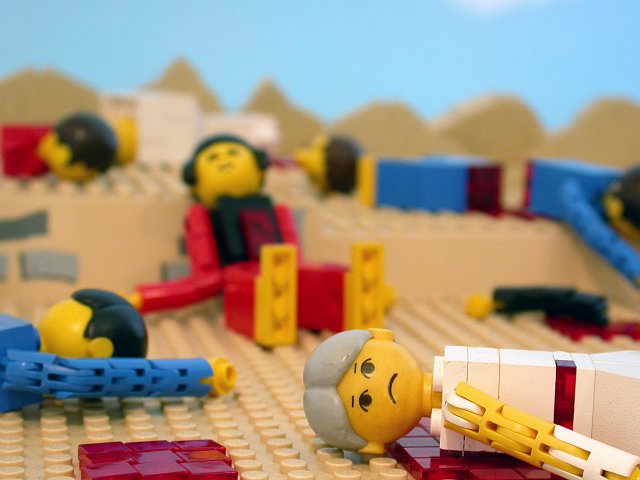
(Much of this post taken from my essay in progress, "Inventing with Animals in the Middle Ages." Comments welcomed. The image of slaughtered Lego Anakim that begins this post is taken from the stunning Brick Testament of the Rev. Brendan Powell Smith, specifically here)