Showing posts with label hybridity. Show all posts

Saturday, March 21, 2009

Britoun Books, Written with Evaungiles, Again

by J J Cohen

Two weeks ago Karl catalyzed a vigorous discussion by posting on Reading Alla's Britoun Book. The topic is a rich one, and has stayed with me in ways small and large. Suzanne Conklin Akbari noted in the post's comments an excellent essay of hers at the moment I happened to be reading it for a different project. David Wallace pointed out to me that the BBC has adapted several Canterbury Tales, most successfully the MLT. From the website:
Constance (Nikki Amuka-Bird) is a Nigerian refugee found on a small boat in the Chatham docks by a couple, Mark and Nicky, who take her in. A devout Christian, Constance, cannot remember what has happened to her. At church a young man, Terry, falls for her. But the feelings are not mutual, as Constance is falling in love with Mark's boss, Alan (Andrew Lincoln). When Constance rejects Terry's physical advances, his violent revenge has tragic consequences for all involved.
I haven't viewed the program myself, but it seems this version picks up well on the tale's interest in racial and cultural differences.

Today, though, I want to focus on a comment made by theswain as part of the discussion in the original post:
Bede is not attempting to forget British Christianity in contrast to Rome. He's indicting British Christianity because according to Bede they failed to convert the Anglo-Saxons. Recall that he spends the majority of his first book talking about how Christianity comes to the island, and Pelagian heresy etc. It is clearly an indictment in the back of the MLT tale, as Aelle isn't Christian in spite of a "Britoun book" with the gospels ready to hand. I think Jonathan correct that the tale goes out of the way to mention the British gospel book, and I think it throws into relief the pagan leaders of Northumbria in spite of the presence of British Christians making books.
On the one hand, the statement is completely true: Bede (and Chaucer) indict the Britons for their failure to proselytize. They trace an origin for Christianity to Rome (the capital of Anglo-Saxon England) rather than allowing for an indigenous source. But indicting can be a form of forgetting, especially if the condemnation fundamentally alters the terms of judgment. Moreover, just because Bede and Chaucer state or imply that the Britons did not influence the conversion of the English, should we believe them? Don't both have something at stake in imagining that Northumbrian/Anglian/English Christianity comes not from the Britons but directly from Rome?

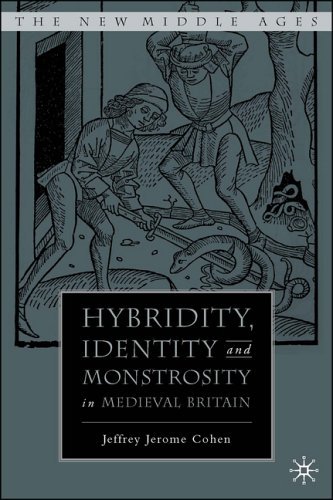
Here is what I wrote quite some time ago in Hybridity, Identity and Monstrosity when I was thinking about Bede's project of separating the Britons from the Angles in his Ecclesiastical History. I was trying to get at why Bede makes it seem as if cohabitation had not happened, as if the Angles and the Britons dwelled in separate, noncommunicating, ever-warring worlds:
By the time Bede set pen to vellum the inhabitants of Britain had long spoken a variety of languages in an abundance of dialects. No doubt rapidly changing patois enabled trade and other less ephemeral forms of exchange. Many islanders would have been multilingual, indeed multiracial. The peoples of Britain were for much of this period more alike than different: possessing cultures and speaking tongues that lacked internal uniformity; prone to forming princely, kingly, and familial factions of variable scope and duration; mixing pastoral and pillage economies with less mobile religious and agrarian pursuits; willing to ally themselves militarily and matrimonially with those outside their linguistic and cultural circles. The British archipelago was, in short, as unsettled as it was compound, a dynamic expanse engendering what contemporary theorists of the postcolonial label creolization, métissage, doubleness, mestizaje, hybridity. No surprise, then, that "Anglo-Saxon England" is famous for its syncretism, its ability to embrace diverse and even contradictory traditions simultaneously.

Yet Bede stresses throughout his Ecclesiastical History the separateness and the supersession of insular peoples, a point emphasized even in his opening observation that Britain was "formerly known as Albion" (1.1; by whom he never says). He therefore acknowledges hybridity only obliquely. In the narrative arc formed by the Ecclesiastical History 2.13-3.3, we witness Edwin of Northumbria forsaking his native ways and converting to Christianity, reorienting his northern kingdom along a Mediterranean axis.* The same king unites Britons and Angles in paninsular dominion. Rædwald of the East Angles, we are told, once erected a temple in which one altar served Christ and the other heathen deities. Papal epistles travel the world to ensure that the Northumbrian and Irish races (gentem Nordanhymbrorum, genti Scottorum) celebrate a unified Christianity. The pagan English of Mercia enthusiastically join forces with the Christian Britons of Gwynedd to overthrow Edwin. The exiled sons of Æthelfrith, the man from whom Edwin had captured the Bernician throne, dwell with their retinues among the Irish and Picts, awaiting Edwin's death. When these men return to their native kingdom, they immediately revert to their indigenous religion, a worship they had rejected after accepting baptism abroad.

Oswald, the newest successor to Northumbria, is witnessed mediating the Irish tongue of the visiting bishop Aidan of Iona as he addresses the Angles: "It was indeed a beautiful sight when the bishop was preaching the gospel, to see the king acting as interpreter of the heavenly word for his ealdormen and thanes, for the bishop was not completely at home in the English tongue [Anglorum linguam perfecte non nouerat], while the king had gained a perfect knowledge of Irish [linguam Scottorum iam plene didicerat] during the long period of his exile"(Ecclesiastical History 3.3). Bishop Aidan oversees monasteries that conjoin his native country to the Picts and the Angles. He lives on an island, Iona, which straddles the space between Britain and Ireland. His monastic community (if Adomnán of Iona is to be believed) amalgamates the Irish, Picts, English, and Britons. Through Aidan's friendship with Oswald, English Britain is transformed by Irish learning into a composite space (3.3).

Despite these multicultural vectors, however, most interminglings unfold only to be condemned. Rædwald's East Anglia is the location of the famous Sutton Hoo burial, an archeological discovery that – like the corpus of Old English poetry itself – suggests that the Rædwald's syncretism is far more indicative of the practice of Christianity in England than Bede's absolutist vision of pagan/Christian separation. Because Rædwald stations Christ alongside native gods and privileges neither, because his desire is to combine rather than to sort, the monarch must in Bede's account be deplored. The Mercians are allowed their alliance with the Britons only because they are pagans, and therefore as detestable as the confederates they treat as equals. The sons of Æthelfrith deserve their violent deaths because they move back and forth between the categories Christian and heathen, a troubling inconstancy rather than an easy fusion (they must be wholly one or the other; they are not permitted the strategic embrace of both). Oswald is allowed his Irish tongue and his subjects their Irish instruction because this source of Christianity does not come from a people, like the Britons, vying against Bede's Angles for possession of the island.

Onto Britain's primal and enduring heterogeneity Bede projects a reductive separateness. Bede's narrative is rather like the Hadrianic and Antonine walling projects that he describes early in the text, demarcations that engender unity through exclusion. In Bede's vision the entirety of the island constituted the natural dominion of a singular gens Anglorum, the English people. This group did not quite exist in Bede's day. Yet by imagining the island's past as a story heroically accomplished by this putative collective, by distilling a complicated historical field into the chronicle of a single people, Bede breathed life into the collective identity English and aided in the genesis of what was to become Europe's most precocious nation. The Ecclesiastical History imagines a past that, despite ample evidence to the contrary, seems monolithic, pure.
This is a long way of saying that Karl identifies in his post a preoccupation that unites Chaucer to Bede. Both authors lived with a past as well as a present where cultural borders were indistinct. Both nonetheless refused to see this messiness, describing instead an island where boundaries and segregations held impossibly firm.

*The source of Edwin's Christianity is crucial: not the Britons, living near and perhaps among his own people, but missionaries tied to the church in Rome. By denying the possibility of an indigenous connection for the Christianity adopted by the gens Anglorum, Bede instigates his process of separating the two peoples absolutely. For a reading that stresses the overlap and interchange between the two peoples during this period, depicting a world very different from Bede's purified spaces, see Patrick Sims-Williams, Religion and Literature in Western England, esp. 25-33, 77-84. Sims-Williams argues forcefully for the role Britons living with the Anglo-Saxons played in their conversion, at least among the Hwicce and Magonsætan. Walter Goffart observes that the Roman and Irish vectors in Bede's narrative of Christianization are meant to exclude the Britons in Narrators of Barbarian History 250.

Monday, December 15, 2008

Jewschool: multifaith, Jewish, impure

by J J Cohen

Related to this and this, there is this. An excerpt:

We mixed feel sorry for those who lack the self-confidence to be proud of their combined heritages and instead run panicked into the arms of religious fundamentalism. Chabad may be welcoming, Aish may posit answers, but their communities are founded on the same thing as “straight camp”: denying a part of you. They offer false absolutes. Our own lives speak to life’s intertwined, betwixt and between reality. Nothing is pure, nothing is clean, nothing really is kasher.

We are not their the community’s “problem” — we are your solution, for a society dying and dwindling, starved of new ideas. Contrary to Jewish communal in-speak, cultural fusion is the only way out of stagnation. Judaism is shot full of Christian ideas and precepts the same way that Jewish food is a stew of local foods sometimes adjusted for kashrut. There is no such thing as purely Jewish and we’re the new model. (Except maybe matzah, only we would invent that.)

Flash Review III: Daniel Boyarin, Dying for God

by J J Cohen

The thesis of Daniel Boyarin's Dying for God: Martyrdom and the Making of Christianity and Judaism is simple yet breathtaking: Rabbinic Judaism did not precede Christianity, but the two were twin births, two versions of the same religion, Judaism. Until the end of late antiquity, Boyarin argues, it was possible to be both a Christian and a Jew. Separation of the faiths was a retrospective process engaged in by both communities, after both religions had ceased to be new and were settling into comfortable orthodoxies that projected keen difference into a past actually filled with interpenetration, ambiguity, messiness:
for at least the first three centuries of their common lives, Judaism in all of its forms and Christianity in all of its forms were part of one complex religious family, twins in a womb, contending with each other for identity and precedence, but sharing with each other the same spiritual food, as well (6)
Judaism and Christianity are as a result not differentiated religions, but ongoing and vexed "conversations":
Without the power of the orthodox Church and the Rabbis to declare people heretics and outside the system it remained impossible to declare phenomenologically who was a Jew and who was a Christian. At least as interesting and significant, it seems more and more clear that it is frequently impossible to tell a Jewish text from a Christian one. The borders are fuzzy, and this has consequences. Religious ideas and innovations can cross borders in both directions (15)
You get the idea: acts of separation tend to be retroactive, and are never as clean as they make themselves out to be. Though Boyarin argues that "definitive schism" is evident by the fourth century (114), medievalists will likely pick up on his frequent mention that successful differentiation likely never occured in a full sense: "a tangled process of innovation and learning, competition and sharing of themes, motifs, and practices" keeps these twins bound, "jostling." "Sometimes," Boyarin observes in closing, "partings can seem more like encounters" (126).

Boyarin's method is to proceed via historically contextualized close readings of select texts. His careful exegesis typically reveals the double meanings and the contemporaneity of works that have often been taken as straightforward and faithful to the history they narrate. Having been reading quite a bit about over the past few years about the inherent mestizaje of most cultures, I can't say that I learned anything new about cultural hybridity per se, but the book was an excellent spur to rethinking the story of Christian-Jewish origins.

Thursday, November 27, 2008

Pour l'action de grâce

[image pilfered from here]
by J J Cohen

Clumsy post title, I know: French doesn't have a good translation for Thanksgiving. We at ITM are grateful for you, our readers and commentators. Merci, et merci encore.

But why all this frenchiness, tu demandes? Partly because my son's homework is to name each item at notre repas in French. Did you know that la compote d'airelles = cranberry sauce? Or that une tarte à la citrouille is pumpkin pie (something I won't eat, because it violates the ancient alimentary law against mixing vegetables with desserts)? You may even know that le dindon or la dinde is turkey, but what I want to know is: what about Tofurky?

Alex's French teacher also emailed us this short piece from the NYT, about a French connection for the holiday. Really, though, Davis provides a meditation on origins, cultural mixing, and willed forgetting that should be familiar to any medievalist:

Long before the Pilgrims sailed in 1620, another group of dissident Christians sought a haven in which to worship freely. These French Calvinists, or Huguenots, hoped to escape the sectarian fighting between Catholics and Protestants that had bloodied France since 1560.

Landing in balmy Florida in June of 1564, at what a French explorer had earlier named the River of May (now the St. Johns River near Jacksonville), the French émigrés promptly held a service of “thanksgiving.” Carrying the seeds of a new colony, they also brought cannons to fortify the small, wooden enclosure they named Fort Caroline, in honor of their king, Charles IX.

In short order, these French pilgrims built houses, a mill and bakery, and apparently even managed to press some grapes into a few casks of wine. At first, relationships with the local Timucuans were friendly, and some of the French settlers took native wives and soon acquired the habit of smoking a certain local “herb.” Food, wine, women — and tobacco by the sea, no less. A veritable Gallic paradise.

Except, that is, to the Spanish, who had other visions for the New World. In 1565, King Philip II of Spain issued orders to “hang and burn the Lutherans” (then a Spanish catchall term for Protestants) and dispatched Adm. Pedro Menéndez to wipe out these French heretics who had taken up residence on land claimed by the Spanish — and who also had an annoying habit of attacking Spanish treasure ships as they sailed by.

Leading this holy war with a crusader’s fervor, Menéndez established St. Augustine and ordered what local boosters claim is the first parish Mass celebrated in the future United States. Then he engineered a murderous assault on Fort Caroline, in which most of the French settlers were massacred. Menéndez had many of the survivors strung up under a sign that read, “I do this not as to Frenchmen but as to heretics.” A few weeks later, he ordered the execution of more than 300 French shipwreck survivors at a site just south of St. Augustine, now marked by an inconspicuous national monument called Fort Matanzas, from the Spanish word for “slaughters.”

With this, America’s first pilgrims disappeared from the pages of history. Casualties of Europe’s murderous religious wars, they fell victim to Anglophile historians who erased their existence as readily as they demoted the Spanish settlement of St. Augustine to second-class status behind the later English colonies in Jamestown and Plymouth.

But the truth cannot be so easily buried. Although overlooked, a brutal first chapter had been written in the most untidy history of a “Christian nation.” And the sectarian violence and hatred that ended with the deaths of a few hundred Huguenots in 1565 would be replayed often in early America, the supposed haven for religious dissent, which in fact tolerated next to none.

Starting with those massacred French pilgrims, the saga of the nation’s birth and growth is often a bloodstained one, filled with religious animosities. In Boston, for instance, the Puritan fathers banned Catholic priests and executed several Quakers between 1659 and 1661. Cotton Mather, the famed Puritan cleric, led the war cries against New England’s Abenaki “savages” who had learned their prayers from the French Jesuits. The colony of Georgia was established in 1732 as a buffer between the Protestant English colonies and the Spanish missions of Florida; its original charter banned Catholics. The bitter rivalry between Catholic France and Protestant England carried on for most of a century, giving rise to anti-Catholic laws, while a mistrust of Canada’s French Catholics helped fire many patriots’ passion for independence. As late as 1844, Philadelphia’s anti-Catholic “Bible Riots” took the lives of more than a dozen people.

The list goes on. Our history is littered with bleak tableaus that show what happens when righteous certitude is mixed with fearful ignorance. Which is why this Thanksgiving, as we express gratitude for America’s bounty and promise, we would do well to reflect on all our histories, including a forgotten French one that began on Florida’s shores so many years ago.
Merci à Mme Howard for sending this sobering reminder of forgotten histories to her students. And happy thanksgiving!

Wednesday, February 13, 2008

Geoffrey of Monmouth, Race, and Women

Yesterday in my Myths of Britain class I taught the segment of Geoffrey of Monmouth's History of the Kings of Britain that begins with the birth of Brutus and ends with the discovery of demon-born Merlin -- quite a chunk. We take a special interest in this course in those whose stories are alluded to but not fully narrated within the larger histories that feature them: Beowulf through the eyes of Grendel, or his mom, or Wealtheow, or Hondscio. With Geoffrey we spoke about his interest in some strong female characters.

Below is a section of my book Hybridity, Identity and Monstrosity in Medieval Britain relevant to the topic. It was fun to revisit the subject with eighty interlocutors.

--------------
(parts of this have appeared at ITM previously. Please see the book version for proper footnotes and references)
No matter what else the text might be, the History of the Kings of Britain is a foundation myth. As the twelfth-century Welsh who found in its narrative the promise of glory to come would attest, the History gives solidity and continuity to a dispersed people. It could legitimate the promulgation of a communal identity based upon shared history. By projecting a Norman mode of kingship and conquest into the past, it also implicitly buttresses the Norman conquest, and reinforces the distinctiveness of both the Normans and the Britons from the English. Perhaps this desire to keep the insular peoples distinct explains why the text recurrently envalues purity of blood.

When a womanless band of Picts arrive from Scythia and ask the Britons for wives, they firmly refuse to intermarry with such an inferior race (4.17). Once the fiercely expansionist leader Maximianus subdues Gaul, he imports a population of Britons for the area. Conanus Meriadocus, left in charge of this "second Britain," strives "to prevent any mixture of blood" between colonists and indigenes. Conanus therefore has seventy-one thousand women imported from the homeland (5.15). The misplaced passion of Brennius for a Danish princess almost causes Britain's ruin (3.2). Part of the great evil of Vortigern, the tyrant who improvidently invites the Saxons into Britain as mercenaries, is his refusal to respect the separation of peoples. He allows "pagans to mingle with the local population" (8.2), degenerating his kingdom to the point at which "no one could tell who was a pagan and who was a Christian, for the pagans were associating with [British] daughters and female relations" (6.13). Vortigern himself marries Renwein, daughter of the Saxon leader Hengest (6.12). Vortimer, Vortigern's pure-blooded son by a previous wife, rises against his father in an attempt to take Britain back for the Britons; he is poisoned by his treacherous stepmother (6.14). Perhaps a certain magical pool described to a wide-eyed Arthur says it all. Naturally fashioned in the shape of a perfect square, the pool harbors four types of fish, and "the fish of any one corner were never found in any of the others" (9.7). Substitute Britons, Picts, Scots and Saxons for the allegorical fish and Britain suddenly becomes perfectly unmixed, impossibly pure.

Square pools do not exist in nature, nor do fish self-segregate; that is why the pool is a marvel. In Geoffrey's British history, despite the fact that the purity of collective identities is so often declared paramount, peoples nonetheless intermingle. Just like the Norman-English and Norman-Welsh unions of Geoffrey's day, these couplings produce children who carry in their blood a compound heritage. At first glance, it seems that such mixed blood progeny cannot fare well. Assaracus, son of a Trojan mother and Greek father, agrees to help the exiled Brutus because of his anger at having been disinherited by a brother of undiluted blood. Brutus is happy to employ the man so long as he is useful, but the Trojan's subsequent talk of preserving the "purity of noble blood" suggests what he really thinks of his mongrel ally (1.4). Habren, the daughter of king Locrinus by a German concubine, is hurled into a river by his angry wife (2.5). Bassianus, the son of a Roman puppet ruler through a British woman, finds himself raised to the insular throne because his people prefer him over his brother of pure Roman descent (5.2). His reign is quite short, however, because a man named Carausius, humbly born but of untainted British ancestry, rallies the Britons to "massacre the Romans and wipe them out of existence and so free the whole island of that foreign race." The half-blood Bassianus soon lies dead on the battlefield (5.3).

Yet Constantine, the son of a Roman named Constantius and the Briton Helen, becomes not only the king of the whole island but emperor of Rome, "overlord of the whole world" (5.8). The founding father of the Britons, Brutus himself, takes the Greek princess Ignoge for his wife, mixing his genealogical line with that of an inveterate enemy. It could perhaps be argued that only the race of the father counts in a patriarchal society, overwriting or overcoding the blood of the mother. Such a model seems almost Aristotelian. The mother contributes inert matter to the child, the father gives identity and life. Thus Earl Morcar, an English rebel against the Conqueror, had a sister named Ealdgyth. She bore a daughter to her first husband, Gruffudd ap Llewelyn, upon whom was bestowed the resonantly Welsh name of Nest. Ealdgyth also had a son by her second spouse, King Harold II of England. This Ulf carried an Anglo-Scandinavian appellation that well embodied his royal father 's own heritage. In both cases the descent of the father determines the child's name. Perhaps, then, the children of Brutus are just as Trojan, and therefore just as British, as he.

Yet carrying the blood of two peoples in the History of the Kings of Britain seldom allows a singular or stable identity to be embraced, or for a dual ancestry to be forgotten. Despite the bias in favor of the separateness of the insular peoples throughout the History, in the actual unfolding of historical events Geoffrey demonstrates the impossibility – and sometimes even the sheer destructiveness – of rejecting out of hand hybridity and difficult middles. Attempts to maintain purity of blood invariably fail. Contrary to the British prohibition against taking their women as wives, the Picts do just that, "intermarrying more and more with the Britons" (5.3). These marriages are enabled by Carausius, the pure-blooded Briton who rallied his people to commit genocide against the Romans to keep the island free of foreigners. The intermingling of Saxons with Britons enabled by Vortigern cannot simply be undone, for in the wake of widespread intermarriage pagans and the Christians become indistinguishable (6.13). The desire of Conanus Meriadocus to prevent his soldiers from mixing with the Gauls spectacularly backfires when he sends to Britain for suitable wives. Of the 71,000 women shipped across the channel to meet his demand, the luckiest drown when their ships founder. The remainder is blown so far off course that randy barbarians either slay or enslave them (5.16). Conanus Meriadocus and his men, we must assume, were forced to take their brides from Gaul after all. Even Cadwallo, Geoffrey's reinvented and newly heroic leader of the Britons against the treacherous Saxons, is said to take a sister of Peanda of Mercia as his wife. Their son, Cadwallader, presides over the final loss of British hegemony on the island.

As Peggy McCracken has written in her penetrating analysis of the role of women's blood in medieval literature, descent might be claimed from the father, but the mother's contribution to her offspring's identity can never be completely effaced. Blood, especially when it comes from a woman, tends to be multivalent. A similar observation might be advanced more generally about women's roles in twelfth century historiography, especially in their relation to collective identity. Although from time to time a powerful female figure will emerge (Hild, Æthelflæd, Cordelia), the chronicles of the past written at this time are for the most part accounts of the deeds of men. Geoffrey is no exception, imagining a vigorously martial world in which most of the great leaders are male. Women are seldom eligible to have their stories told. There are, of course, vivid exceptions: Gwendolen, Estrildis, Cordelia, Tonuuenna, Genvissa, Judon, Renwein, Ygerna, Guenevere, Helena. Even women not given a name by the text can sometimes have moving stories narrated about them. Take, for example, the 71,000 women assembled in London to provide wives for the Britons in Gaul. They do not know that they are doomed to perish at sea, be slaughtered by enemies, or become slaves, yet few want to abandon home and family for unknown shores. "They all had their personal wishes in the matter" Geoffrey observes (5.16). When it is acknowledged that the desires of these women are not consonant with maintaining the purity of the Briton bloodline, we realize that the community being built with them is predicated upon a coercive harmonization.

No woman's story in Geoffrey's text resonates more lastingly than that of Ignoge, the Greek princess forced to become bride to Brutus. Geoffrey of Monmouth ordinarily composes his narrative with sangfroid: little human feeling animates its accounts of battles, wonders, political intrigue, strife. He is not given to moments of aching identification such as William of Malmesbury's wrenching account of the sinking of the White Ship (Deeds 5.419). Ignoge has little presence in Geoffrey's text, but as she sets sail with a husband she never chose for a future that is wholly uncertain, we are given a lingering depiction of her last vision of her native land. The episode is at once so evocative and so moving that, as Robert Hanning observes, it "interrupts the flow" of the narrative, so that "for a moment the issues of national birth and freedom are forgotten; history itself is forgotten." Here is Geoffrey's vivid portrayal of the fading shores of home as glimpsed through bereft Ignoge's eyes:
The Trojans sailed away ... Ignoge stood on the high poop and from time to time fell fainting in the arms of Brutus. She wept and sobbed at being forced to leave her relations and her homeland; and as long as the shore lay there before her eyes, she would not turn her gaze away from it. Brutus soothed and caressed her, putting his arms round her and kissing her gently. He did not cease his efforts until, worn out with crying, she fell asleep (1.11)

As Ignoge's home slowly recedes, lost are the possibilities for any life she might have desired for herself, for any history she might have dreamed. Destined to become an appendage of Brutus, the source of his progeny, we next see Ignoge in what appears to be an afterthought, legitimating the birth of three sons (2.1). She is not mentioned again. Her children divide the land and carry on their father's work. It never occurs to them that in their bodies the blood of Troy mingles with that of Greece, that they possess hybrid blood in which two enemies have uneasily been conjoined. The sons of Brutus assume that they are simply Britons, as their father christened his people. They never dwell upon the complexities of history and descent.

Ignoge's gaze opens up the possibility of another story. An alien among strangers, suspended between cultures and no longer able to be of one or the other, Ignoge embodies everything her children so easily forget. Yearning for a home that can never be hers, this princess conveyed to an unfamiliar place suggests the difficulties faced by those who carry an identity full of difference, ambivalence, conflict. Ignoge inhabits that middle space where conqueror meets conquered, where a war unfolds between loathing and desire. She looks back to a receding homeland and forward to the impossible bind of mixed progeny on an island increasingly dominated by a single people. Ignoge is Greek, her husband Trojan, her children Britons, but her tears prevent such easy separations.

Geoffrey of Monmouth dreamed of a world where at first glance history and descent keep insular peoples solitary. As his textual world unfolds in all its intricacy, however, the peoples that populate Britain mingle and become -- despite their own fervent belief to the contrary -- impure. Geoffrey's ambivalent entwining of purity with hybridity is rather like William of Malmesbury's. Both writers posited clean separations but undercut them with anxious, medial spaces: one through marvels, the other through blood. The separateness of the island's peoples might be an impossible dream, but that did not stop this dream from being passionately embraced, much to the sorrow of those who carried blood that could never seem untainted. For these impure beings history was filled with heartache, and the present never ceased to hurt.

Friday, July 06, 2007

Cynocephali, Animal Savagery, and Terror

Don't miss the vibrant tools discussion below. Go there first if you haven't already, and then, if you like, enjoy this long post for/over the weekend.

Sometime before 865, Ratramnus of Corbie wrote his Epistola de Cynocephalis, a teratologic work remarkable for focusing on only a single type of creature and for eschewing moralization. In essence, its concern is whether Cynocephali merit evangelization, not whether they, for example, represent backbiting. Following the Augustinian criteria of City of God XVI.8, the letter asserts that the Cynocephali are descended from Adam and hence human, but it doesn't stop here. The rest of letter compiles a Cynocephalic ethnography, muses in an Isidoran fashion on portents, and, finally, demonstrates incontrovertibly that these creatures possess reason.

Understandably, Ratramnus first handles the Cynocephalic voice and form:
forma capitis et latratus canum non hominibus, sed bestiis similes ostendit. Hominum denique est rotundo vertice caelum conspicere, canum vero longo capite rostroque deducto terram intueri, et homines loquuntur, canes vero latrant. (155: 24-27)

the form of their heads and their canine barking shows that they are similar not to humans but to animals. In fact, the heads of humans are on top and round in order for them to see the heavens, while those of dogs are long and drawn out in a snout so that they can look at the ground. And humans speak, while dogs bark.
But he raises these points only to counter them with a list of behaviors that argue for Cynocephalic humanity. That the Cynocephali live together in towns and engage in agriculture, that they evidence modesty by wearing clothing, and that they live together under a law, “Haec enim omnia rationalem quodammodo testificari videntur eis inesse animam” (155: 34-35; all these things seem to demonstrate that some kind of rational soul is in them). Ratramnus also observes that, “Homo vero a bestiis ratione tantummodo discernitur. Quae quod videtur inesse his de quibus loquimur, homines potius quam bestiae deputandi videntur” (156: 13-14; humans can be distinguished from beasts only by reason. From these things, a rational soul would seem to be in those of which we speak; they would seem to be regarded as humans rather than beasts). Ratramnus asserts that anyone who doubts the link between these behaviors and reason must himself lack reason (156: 9).

Ratramnus can't seem, however, to convince himself. Uncertainty pervades his letter, perhaps most evidently in its frequent use of videri (to seem): “videntur eis inesse animam,” “videtur inesse his,” “homines...videntur.” At this stage of his letter all Ratramnus allows, and that tentatively, is the possibility of Cynocephalic humanity, but neither the behavior he has cited nor the teratologic traditions of Christopher and monstrous births to which he next refers provide him with any definitive conclusions. It is only with his final point that Ratramnus at last transforms the uncertain videri to the active, confident videre (to consider or to see):
Accedit ad haec, quod scripta vestra testantur, domesticorum omne genus animalium, quae nostris in regionibus habentur, apud illos haberi. Hoc vero fieri posse, si bestialem et non rationalem animam haberent, nequaquam video; siquidem homini animantia terrae fuisse divinitus subjecta Geneseos lectione cognoscimus. Ut vero bestiae alterius a se generis animantia, et maxime domestici generis, curent et eis diligentiam adhibeant suisque cogant imperiis subjacere et usibus parere, sicut nec auditum ita nec creditum cognoscitur. (157: 10-15, my emphasis)

It is added to these things to which your letter bears witness that all the kinds of domesticated animals that are managed in our regions are managed among them. I consider that this could not be if they had a bestial and not a rational soul, since the living things of the earth were subjected to men by heaven, as we know from having read Genesis. But it has never been heard or believed that animals of one kind can by themselves take care of other animals, especially those of a domestic kind, keep them, compel them to submit to their rule, and follow regular routines.
Ratramnus takes three steps to establish these creatures as human and thus worthy of a missionary effort or, at least, to make them signal the necessary breadth of missionary activity: he silently eliminates their anthropophagy (a usual trait in the teratologic tradition on Cynocephali); he gives them agriculture, shame, clothing, and other human cultural characteristics; above all, he makes them keepers of domestic animals. Ratramnus defines the subjugation of these animals with a clause, “suis cogant imperiis subjacere,” crammed with three synonyms for command. It is this total assurance that confers humanity upon its actors: humans must monopolize dominion over animals if they are to claim human identity through it. With such a reckoning, Ratramnus has no need to account for the partially animal bodies of Cynocephali or their barking: his determination of the Cynocephalic relationship to animals dissipates any counterargument.

Something nevertheless continues to trouble Ratramnus. He adds that, “At vero Cenocephali, cum domesticorum animalium dicuntur habere multitudinem, eis minime convenit bestialis feritas, quorum animalia domestica lenitate mansuefiunt” (157: 15-18; but since the Cynocephali are said to possess a multitude of domestic animals, then animal savagery does not fit them because they tame their domestic animals gently). In characterizing the violence in which the Cynocephali supposedly do not engage with two words meaning “beast,” Ratramnus evokes a moral tradition that associated ferocity with animals: for example, Ambrose’s Hexaemeron VI.3.10 cautions, “If you revel in ferocity, the dominant trait of savage beasts for which reason they are slain, see that you, too, may not become a victim of your own atrocious cruelty.” The moral context cannot, however, exhaust the significance of Cynocephalic gentleness. It must be recognized that bestiae are, in a way, only animalia that refuse the humiliation of domestication, and that domestication cannot be enacted without some kind of subjugation. Nor, given the evidence of Ratramnus’s letter, can the subjugation of the Cynocephali be readily understood as gentle: the Cynocephali wear hides (presumably animal), and the excessiveness of the clause “suis cogant imperiis subjacere” strongly suggests that the Cynocephali master their animals at least through a monopolization of violence. It may be said that they dominate their animals gently, but no animal could ever resist their gentle regime. Ratramnus has not, then, purged his Cynocephali of violence: he has preserved its aspects of mastery for his newly born humans while imperfectly displacing the violence away from its enactors and onto its victims.

Today, I found myself reading Žižek in my study's hideous chair, where I ran across a passage that inspired me to repurpose more of my material on Cynocephali in what, I have to warn you, is going to be more of the same compounded by low-rent Žižekianism. In another discussion on "obscene enjoyment," this time in The Parallax View, Žižek characterizes the torture at Abu Ghraib as "a clash between anonymous brutal torture [i.e., that of S. Hussein's government] and torture as a mediatic spectacle in which the victims' bodies serve as the anonymous background for the stupidly smiling 'innocent American' faces of the torturers themselves" (372) through which the Iraqi victims become initiated into American culture in all its obscene excess; they simultaneously experienced American personal freedom and the outsourcing of torment that sustains it. Towards the end of the discussion, Žižek contrasts the Cold War to the War on Terror (and let's put aside whether his historical contrast works: I'm not so sure it does), where he observes, "The power which presents itself as being under threat all the time, living in mortal danger, and thus merely defending itself, is the most dangerous kind of power, the very model of Nietzchean ressentiment and moralistic hypocrisy" (373).

We have seen the response to the terrorist threat from enemies portrayed as religious fanatics, misogynists, and torturers; the appropriate response, at least so far as the Right is concerned, is to become religiously fanatic, misogynist, and to torture (a common point, available in many places, for example here; there's also Amanda Marcotte's observation that "When conservatives say, 'Freedom isn’t free,' they seem to mean that it exacts a price, but perhaps a more accurate translation would be, 'Freedom is slavery'). As you might expect me to do (and by anticipating your anticipation, I of course promise my secret possession of more thought on the matter than you see here: in other words, "as you might expect me to do" is a profoundly dishonest thing to say, and if I go any further, I won't get out)...okay, as you might expect me to do, I observe that the Cynocephali, despite Ratramnus's testimony, themselves must engage in animal savagery to keep their animals domesticated. They must, because animals are, now per Ratramnus's testimony, by their nature savage. One can hardly blame the Cynocephali, then, for what they must do (although Ratramnus implicitly blames them by declaring that they in fact don't do what we know they must do).

The low-rent Žižekianism follows. In this sense, then, the Cynocephalic body is the image of the constitutive excess of humanity, the 'bestial' acts--subjugation, carnivorousness--in which it must engage to distinguish itself from animals. Simply because of their bodies, the Cynocephali cannot help but act bestially; but they should not be thought other because of this. They are rather the desublimated form of the conflict internal to human identity. At least so long as it's a humanity defined by difference to animals (and I'm becoming increasingly uncertain that that's the only way to do it), there is no way to be human without being bestial.

I think I've hit the end of my tether, at least so long as I'm starting from where I do. I'm ready to try something different or, at least, to push Ratramnus and the Cynocephali to do something different (at least so long as we don't lose animality by reading them as disguised Saracens, which is the usual--and I should say productive--way to study Cynocephali): but I've no idea where to take it.

Texts

The letter, which survives in a single eleventh-century manuscript, is available in PL 121: 1153-56; Ernst Dümmler, ed., Epistolae variorum 12, Monumenta Germaniae Historica: Epistolae 6. (Berlin: 1925), 155-57 (quotations derive from, and are keyed to, this edition); and, in translation, in Paul Edward Dutton, ed., Carolingian Civilization: A Reader, 2nd ed., Readings in Medieval Civilizations and Cultures 1 (Peterborough, Ontario: Broadview Press, 2004). My translations mostly follow Dutton.

Note that a few other writers, all Greek, also remark on Cynocephalic animal husbandry; see Claude Lecouteux, "Les Cynocéphales: Étude d'une tradition tératologique de l'Antiquité au XIIe s." Cahiers de civilisation médiévale 24 (1981): 117-29, at 118, for Cynocephalic husbandry in Ctesias of Cnidus (5th-4th century BCE) and Aelian (1st-2nd century CE); at greater length, see Lecouteux, Monstres dans la littérature allemande, 21, who translates (from Greek into French) a medieval witness to Ctesias in a letter of Photios, a late ninth-century Patriarch of Constantinople.

Cartoon from Momma, by Mell Lazarus, Oct 31 2006, discovered through Comics Curmudgeon, which I love.

Friday, June 22, 2007

Mute Beasts

I cited some of my work on Cynocephali in this thread and felt compelled to share some more on dog-headed monsters. Does this have anything to do with our recent interests: wonder, privacy, cosmopolitanism, and the heterogeneity of the past? Perhaps not; you may wish to consider what follows only as a parenthesis.

--

In a tradition epitomized by Isidore of Seville, to the degree that Cynocephali bark, they lack language, therefore resemble animals, and are likely only animals. Isidore wrote that Cynocephalic barking “magis bestias quam homines confitetur” (reveals them to be more beasts than men), and the eighth-century Liber monstrorum, which emphasizes its monsters' inhumanity, describes Cynocephalic speech as “contaminated” or “perverted” by barking ("Cynocephali quoque in India nasci perhibentur, quorum sunt canina capita, et omne uerbum quod loquuntur intermixtis corrumpunt latratibus"): their voices, as much as their bodies, are contaminated to the degree that they are canine. The thirteenth-century Old French moralized translation of the section on monsters in Thomas of Cantimpré's De naturis rerum similarly observes that Cynocephali “com chien glatisent…/ mes sens de gens est lors savoirs” (489-90; bark like dogs, but have human sense): with the conjunction “mes,” it's clear that barking occludes or opposes the human qualities Cynocephali possess.

The depiction of Cynocephali (labelled "gigantes") on the Hereford Mappamundi seems to belong to this tradition. It is unclear, however, whether the map depicts only barking, which would, following the Isidorian model, demonstrate speechlessness and hence inhumanity; or speech, human by definition; or something for which neither the teratologic tradition nor traditions of natural history normally account: barking that is intelligible as speech to the Cynocephali but not to humans. After all, these Cynocephali face each other and look as though they are communicating. If the barking of the Liber monstrorum and the Hereford map is not opposed to sense, but is rather language evidencing sense, the “mes” of the moralized bestiary should perhaps be an “et”: barking would not be a contamination, but only another mode of communicating. If Cynocephalic barking can be a kind of language, then by the same token humans might reconsider other animals’ noises as potentially linguistic, though incomprehensible to humans. In that case, a key justification of the human subjugation of animals—the animal absence of language, frequently advanced as evidence of animal irrationality—might no longer obtain: if barking could be speech, the world of animals might either be a world of language or, just as confusingly, a world in which creatures or species must be individually assessed for the possession of language. In such a world, the previously homogeneous, predictable irrationality of animals gives way to uncertainty.

Granted, some medieval theories of language allowed for some manner of animal language: Roger Bacon observes that “gallina aliter garrit cum pullis suis quando invitat eos ad escam et quando docet eos cavere a milvo” (hens prattle to each other with their chicks when they summon them to eat and when they teach them to beware the kite), and Abelard allowed that dogs might intend different meanings with different barks. In each case, however, medieval theorists of language would still reserve something exclusively for the human, such as the power of abstraction.

But the gestures of the Hereford image are not the gestures of mere animals; they are not engaged in the merely instrumental communication through which hens share food or warn against predators; rather, their postures suggest intellectual work or at least conviviality among nonhuman mortal creatures. In response to this suggestion, the only recourse to establish or reestablish Cynocephalic animality would be simply, regardless of evidence, to declare them nonhuman. But such a declaration, effective as it might be, also declares the ineffectiveness of relying on animal noise to classify Cynocephali—or indeed any nonhuman creature—as animal. The only certainty is the cold comfort of a chauvinist tautology: if Cynocephalic barking is inhuman, it is because humans declare it to be so.

Sources Used and Essential Works on Cynocephali apart from Friedman

Eco, Umberto, R. Lambertini, C. Marmo, and A. Taborroni, “On Animal Language in the Medieval Classification of Signs,” in Umberto Eco and Costantino Marmo, eds., On the Medieval Theory of Signs, Foundations of Semiotics 21 (Amsterdam: J. Benjamins, 1989).

Hilka, Alfons, ed., Eine altfranzösische moralisierende Bearbeitung des Liber de monstruosibus hominibus orientis aus Thomas von Cantimpré, De naturis rerum, Abhandlungen der Gesellschaft der Wissenschaften zu Göttingen 7 (Berlin: Weidmann, 1933).

Lecouteux, Claude. “Les Cynocéphales: Étude d’une tradition tératologique de l’Antiquité au XIIe s.” Cahiers de civilisation médiévale 24 (1981): 117-29.

Newall, Venetia.”The Dog-Headed Saint Christopher,” in Folklore on Two Continents: Essays in Honor of Linda Dégh, ed. Linda Dégh, et al. (Bloomington: Trickster Press, 1980).

Orchard, Andy. Pride and Prodigies: Studies in the Monsters of the Beowulf-Manuscript, Rev. ed. (Toronto: University of Toronto Press, 2003).

Westrem, Scott D., The Hereford Map: A Transcription and Translation of the Legends with Commentary, Terrarum Orbis (Turnhout: Brepols, 2001).

White, David Gordon. Myths of the Dog-Man (Chicago: University of Chicago Press, 1991).


Monday, April 30, 2007

Mary Beard on Hadrian's Wall

In the latest entry of her blog, A Don's Life, Mary Beard examines the idée reçue that Hadrian's Wall was an attempt to insulate a Roman zone from a barbarian one. She points out that the structure is ineptly designed if it was originally intended to serve only defensively. She then describes the Roman notion of a frontier zone, a place not so much of fearful Us Versus Them as a geography of vivacious intermixture:

Despite the impression given by Hadrian’s Wall (and by a few other places largely in Germany) that they saw a linear divide between the empire and the barbarian world, the Roman image of the frontier was usually much more subtly nuanced. The empire shaded into “foreign” territory across many kilometres that were melting pot of cultural difference and often a hot-spot of trading and commercial activity. It was a question of frontier zones, rather than frontiers – governed partly by Rome, partly by a whole variety of non-Roman powers. Hadrian’s Wall, whatever its function, was an exception.

President Bush and our other wall-crazy political leaders might learn from that.

She's referring to the Bush administration's idea of a security wall demarcating the US from Mexico. Who says late antiquity studies have nothing to say to contemporary immigration policy?

Wednesday, April 25, 2007

Hybridity as the conjunction of the disparate, not the synthesis

From Judson J. Emerick's review of Charles B. McClendon, The Origins of Medieval Architecture: Building in Europe, A.D. 600-900, in The Medieval Review:
McClendon ... describes ... a merging of "artistic traditions," classic and non-classic, that is, Antique and Germanic ... I find this a core issue that all readers of McClendon's survey will
wish to ponder. For instance, in Chapter 4, devoted to Anglo-Saxon
architecture in the seventh and eighth centuries (mostly in
Northumbria), McClendon tells of several ways in which Anglo-Saxon
builders followed Antique and Late Antique Roman tradition—by focusing
worship spaces on icons and stained-glass windows, and by building in
stone with arches, piers, and columns more Romano. At the same
time, McClendon insists, they also "subtly combined" that tradition
with ideas, motifs, and approaches from their own non-Antique,
Germanic practice. Thus the plans of the abbey churches at Wearmouth
and Jarrow follow that of the typical royal Anglo-Saxon long hall,
built of wood. A stained-glass window (he illustrates a reconstructed
example from Jarrow) or a columnar portal (the famous one from the
façade of St. Peter's at Wearmouth) incorporate forms or motifs from
Germanic Style II Animal ornament in Anglo-Saxon metalwork (see
McClendon's summary on pp. 82-83).

But do we really deal in these cases with the fusing, blending, or
mixing of traditions? Or do we encounter something more like
pastiche, the kind of bricolage that energizes virtually all
visual/architectural composition, and that takes effect from stark,
even violent juxtapositions? The plans of the late seventh-century
Northumbrian abbey churches may well play off that of the chieftain's
hall, borrowing the latter's prestige to make a political point, but
we need not present that as the result of any merging of Germanic and
Christian (Mediterranean, classic) taste or sensibility in
aesthetic terms. I would see rather one tradition (or practice
or visual habit) interrupting the other. The male saint depicted in
the stained-glass window from Jarrow functions like any Mediterranean
icon; those aspects of the portrait that echo motifs familiar from,
say, the jewels decorating the Sutton Hoo purse lid, overlie and
clash, rather than fuse with the Late Antique icon. The portal from
Wearmouth (pp. 73-79) conforms closely (if brutally) to norms
established centuries previously in ancient Roman Imperial Corinthian
scenic design: the builders merely substitute some Germanic
interlaced birds for the typical acanthus vine scrolls we expect to
see. Pastiche perhaps, but not, I submit, any blending of
practices, much less of any Antique architectural one with a
barbarian art of small-scale bodily adornment.

Much of our work here at ITM has stressed this phenomenon: cultural intermixture tends not to produce new stabilities so much as the conjoining of the disparate in its conflicts. This topic so interests me that I wrote a book about it (you can read the introduction here)... and am still thinking about hybridity for a current project.

Monday, March 12, 2007

Tis Like the Howling of Irish Wolves Against the Moone

In a thirteenth-century Latin poem on the Wonders of Ireland, immediately before a description of a man who lived headless for 7 years and a few entries before yet another one of those surprising references to ships floating in the air, there's this:
De hominibus qui se vertunt in lupos

Sunt homines quidam Scottorum gentis habentes
Miram naturam majoram ab origine ductam,
Qua cito quando volunt ipsos se vertere possunt
Nequiter in formas lacerantum dente luporum,
Unde videntur oves occidere saepe gementes;
Sed cum clamor eos hominum seu cursus eorum
Fustibus aut armis terret, fugiendo recurrunt.
Cum tamen hoc faciunt sua corpora vera relinquunt,
Atque suis mandant ne quisquam moverit illa;
Si sic eveniat, nec ad illa redire valebunt.
Si quid eos laedat, penetrent si vulnera quaeque,
Vere in corporibus semper cernuntur eorum.
Sic caro cruda haerens in veri corporis ore,
Cernitur a sociis, quod nos miramur et omnes.
(Thomas Wright and James Orchard Halliwell, eds, Reliquiae Antiquiae: Scraps from Ancient Manuscripts Illustrating Chiefly Early English Literature and the English Language, Vol I, London, 1841, 105; also available online here in Mommsen's edition; best edition in Gwynn's The Writings of Bishop Patrick, Dublin, 1955)

"There are certain men of the Celtic race who have a marvelous power which comes to them from their forebears. For by an evil craft they can at will change themselves into the shape of wolves with sharp tearing teeth, and often thus transformed will they fall upon poor defenseless sheep, but when folk armed with clubs and weapons run to attack them shouting lustily then do they flee and scour away apace. Now when they are minded to transform themselves they leave their own bodies, straitly charging their friends neither to move or touch them at all, however lightly, for if this be done never will they be able to return to their human shape again. If whilst they are wolves anyone hurts or wounds them, then upon their own bodies the exact wound or mark can plainly be seen. And with much amaze have they been espied in human form with gobbets of raw bleeding flesh champed in their jaws" (lovely quaint translation from Montague Summers, The Werewolf in Lore and Legend, 1933, 207-208)

According to Bernard Merdrignac, "Les loups, saint Guénolé et son double," in Religion et mentalités au Moyen Âge, 2003, 457-65 (via Hervé Martin), the poem is a paraphrase of material by an eleventh-century Bishop of Dublin, Patrick (d. 1084). In other words, it's a pre-conquest poem likely revived for use in an Ireland conquered yet again. Apart from the Merdrignac and the Martin (presumably, since I've yet read it), the poem doesn't yet seem to have received what we owe it. A search of google books turns up virtually nothing; the International Medieval Database suggests Máire West, "Aspects of díberg in the tale Togail Bruidne Da Derga," in Zeitschrift für celtische Philologie 49-50 (1997): 950-964; and the closest the MLA gets us is Winifried Schleiner, "'Tis Like the Howling of Irish Wolves Against the Moone': A Note on As You Like It, V.ii.109," English Language Notes 12 (1974): 5-8. I'm certainly missing something, as this putatively exhaustive search turns up neither the Merdrignac nor the Martin nor the work on wolves by Philippe Ménard or Aleks Pluskowski. In other words, I'm probably missing something, but all I have right now is my own library and the false plenitude of the internets.

I don't have much to say about the poem yet. My point here is simply to introduce it in the hopes that someone will recall an essential article on the poem, invisible to google books and the main databases, or, better yet, in the hopes that it generates interpretation and wonder from my co-bloggers and our readers. For now, I'm struck first by the poem's muddling of responsibility for the lycanthropy. Does the power to turn into wolves come "ab origine ductam"? In other words, is the power racial and hence to some degree outside their power? Is it a natural wonder ("miram naturam")? Or is it by will ("quando volunt")? Whence comes the evil (since they're changing shape "nequiter")? Or are these the wrong questions to ask?

I also wonder about the "men who run at them armed with clubs and weapons" [q: what makes a club different from armum?]--their Irish (?) enemies--and about suis--their Irish (?) Werewolf (?) companions? Who colludes and who does not? And, to sharpen/hobble Wright's translation in the last lines, who are the witnesses to all this? ("One with raw flesh stuck to the mouth of his true body has been seen/examined thus by (our?) associates/colleagues/allies, which we and all others wondered at")? And what of the raw flesh of sheep (not of humans) stuck to their face? Why should violence be the ineluctable mark of their racial stain (?), whether the violence they suffer or the violence they cause?

One way in might be through JJC's discussion of Gerald and Werewolves in On Difficult Middles:
Medieval writers were fond of attaching allegorical meanings to fauna, spawning a tradition of bestiaries that were ultimately more about humans than animals. Gerald leaves us in no doubt what the wolf represents when he writes later in the Topography that 'wolves in Ireland generally have their young in December, either because of the extreme mildness of the climate, or rather as a symbol of the evils of treachery and plunder which here blossom before their season.' The Irish inside their wolfskins are not very different from the treacherous, plunder-driven Irish inside their human forms. Their lycanthropy only makes visible in their bodies what they already are... (86-87)

With that in mind, I wonder about the poem's insistence on "true bodies"? Why should the werewolf's true body be a human form rather than a form that admits of both bodies? Doesn't the mouth smeared with sheepblood display the doubled body that is their actual, true form, the wolf and the human together? Building on her work on resurrection doctrine, Caroline Walker Bynum speaks of werewolf stories as indicative of an understanding of "the embodied nature of self" and reflecting "less a desire to shed body than an effort to understand how it perdures, less an escape into alterity than a search for the rules that govern change" (Metamorphosis and Identity, 109), where the human form, the "corpora vera" underneath the wolf, persists despite mutability. But I wonder if the truth smeared over the face is another kind of bodily truth, one not of bodily depths underneath but one of surfaces, one of stains.

What do you all make of this?

Thursday, February 08, 2007

Two journal issues of note

(1) Arthuriana 16.4 (2006), a special issue on Saracens in Malory, guest edited by Jacqueline de Weever. I especially liked "Saracens and Black Knights" by Maghan Keita, on the African presence in Malory. Donald Hoffman's "Assimilating Saracens" contains this amazing footnote:
"A few centuries later, [Fulcher's narration of Christian cannibalism of Muslims] is revisited in Voltaire's Candide when the Old Lady suffers the loss of a buttock eaten by starving Moors. In this reversal of Christian and Muslim cannibals, we undoubtedly have here a vivid example of the principle of turning the other cheek" (footnote 6, p. 62)


(2) Journal of Medieval and Early Modern Studies 37.1 (2007), a special issue on "Mapping the Mediterranean." Many good essays here, and a stellar one by Sharon Kinoshita and Jason Jacobs called "Ports of Call: Boccaccio's Alatiel in the Medieval Mediterranean." This is what a transnational medieval studies looks like.

Friday, January 20, 2006

Draft of Introduction, Hybridity, Identity, and Monstrosity in Medieval Britain


(The book is currently in production. For the time being, here is the draft of the introduction, sans footnotes. The volume will appear in May. Follow the link at right [under "Books"] for more information).

Introduction: In medias res


When contemplating the many peoples who had inhabited their island's expanses, writers in twelfth-century Britain found themselves pulled in two divergent directions. Living in the difficult aftermath of conquest, they were powerfully attracted to a stark vision of past and present in which collective identities remained constant, retaining their elemental differences. The triumphant arrival of a new people (the Romans in the days of Caesar, the English in the fifth century, the Normans at Hastings) had led, they supposed, to a transfer of dominion, a change in power that strengthened the boundaries between communities rather than eroded them. This idea of a keenly distinct past for each insular people had been bequeathed to the twelfth century by predecessors like Gildas and Bede. One a polemicist for the native Britons and the other a partisan of the parvenu Angles, these writers arrived from opposite sides of a bitter struggle for British hegemony. Both composed narratives stressing the separateness of the peoples with whom they identified. Neither allowed some middle space to exist where the two might ally, mingle, even combine. Like the classical and patristic authors in whom they had been trained, Gildas and Bede assumed the enduring distinctiveness of the earth's populations.

Yet there also lurked the haunting knowledge that the world is combinative and complicated. Bede's immigrant ancestors may have eradicated or marginalized many of Britain's indigenes, but they are just as likely to have merged with these populations, spurring mutual assimilations and profound collective transformations. The Normans may have conquered England and annexed Wales, but they also vanished in the process, assimilating to -- as well as altering -- native ways. Between imagined or desired absolutes like "Angle" and "Briton," "English" and "Norman," "Christian" and "Jew" flourished recalcitrant impurities. In the wake of conquest as well as less martial types of cultural encounter, fusions of difference inevitably arise. Postcolonial theorists label such conflictual convergence hybridity. As Robert J. C. Young has observed, hybridity is a concept that can carry two antithetical meanings, "contrafusion and disjunction … as well as fusion and assimilation." Like its contemporary manifestations examined by Young, hybridity in medieval Britain tended to mix both these senses. Never synthetic in the sense of homogenizing, hybridity is a fusion and a disjunction, a conjoining of differences that cannot harmonize them.

Because, for the most part, medieval historiography stressed the timeless separation of peoples, generic and linguistic constraints ensured that hybridity was not easy to express. Coincidence of the divergent was especially disquieting to writers who carried admixture in their very body, writers who had to labor to invent some lexicon for representing their own compoundedness. The historian William of Malmesbury and the ethnographer Gerald of Wales were the biological products of conquest. Their mixed descent triggered self-conflict , fostering an uncertainty and hesitation evident in the texts they composed. Yet even authors who appeared to lack such postcolonial ambivalence were ultimately unable to efface completely the hybridity that permeated their worlds. Bede (who bequeathed to the twelfth century its dominating picture of the English past), Geoffrey of Monmouth (who authored a counter-history in which the Britons replaced Bede's glorious Angles) and Thomas of Monmouth (who wrote a saint's life that attempted to revitalize a city sundered by conquest) composed texts in which the island's peoples seem, at first glance, to form well bounded communities. These authors limned the borders of collective identities by demonizing Britons, Saxons, Jews. On deeper examination, however, all three of their texts yield glimpses of a deep interpenetration of peoples and cultures, of tempestuous intermediacies that undermine such clean separations.

Hybridity, Identity and Monstrosity maps the perturbed expanses between collective identities in twelfth-century Britain. Such middle spaces were "difficult" in a double sense: difficult to articulate, and difficult to inhabit. And yet they were everywhere. Hybrid geographies burgeoned in the wake of migration, conquest, colonization. They proliferated at interstices, beside borders, along margins. They could also thrive within seemingly homogenous centers. The ambit of this book therefore wanders Ireland, the Welsh march, provincial as well as cosmopolitan England. Difficult middles, I do not doubt, erupted within many genres of writing in twelfth-century Britain. I limit myself here, however, to provocative examples from three Latin discourses: historiography, ethnography, and hagiography. William of Malmesbury's Deeds of the Kings of the English, Geoffrey of Monmouth's History of the Kings of Britain, Gerald of Wales various Welsh and Irish texts, and Thomas of Monmouth's Life of Saint William of Norwich betray a recurring fascination with abstruse but spectacular phenomena -- prodigies, transformed persons, sorcerers, bestiality, tempests formed of blood, monsters, reveries of dismemberment, cadavers possessed of abiding life. These arresting figures embody the medialities precise language could not well express. Refusing the chaste solitude of singular categories, they intermixed and confounded all that was supposed to be held apart.

By the time the twelfth century drew to a close, the vigorous English community disrupted by the Norman conquest had reformed, in part by dehumanizing people who differed in religion, language, custom, descent, history. The pages of this book follow the struggles that occurred in Wales, in Ireland, and within England itself as some of their residents strained against debasing representation. The Welsh, the Irish and the Scots found themselves depicted as barbarians or beasts, dwelling at a savage periphery. Likewise demonized were the Jews, imagined to imperil the lives of Christians in the English cities where they cohabitated. Narratives of separation in the guise of ethnography, history and hagiography helped to bring exclusive political and cultural solidities into being. Yet difficult middles proliferated at the heart or along the margins of these circumscriptive works, promising alternative histories, visions of the past and present in which difference never proves absolute, and English triumphalism becomes only one possibility among many others.

Of the peoples populating twelfth-century Britain's imagined past, some possessed a lengthy history, real or assumed (English, Irish, Scots, Welsh); some had vanished through emigration, acculturation or eradication (Romans, Picts, Danes); one was a minority whose cultural importance far overshadowed its meager physical presence (the Jews); one was paradoxically both separate and rapidly assimilating (the Normans); and one was not a group who had ever inhabited Britain, but who were present all the same through historiography, crusade polemic, and the visual arts (Saracens). Yet these collective identities do not, at some profound level, exist. In reviewing Marjorie Chibnall's important book The Normans, Leah Shopkow notes that the founding fathers of Normandy were not French-speakers but a diverse array of Scandinavians; that Normans never constituted a majority population of any geography they made their own; that Norman invaders tended to adopt quickly local languages and customs; that their invasion forces were ethnically diverse; and that a century and a half after their unprecedented expansion the only Normans who had not vanished into other populations were those who had remained in Normandy, where they were destined to be absorbed into France. We may therefore wonder with Shopkow what exactly made all these people Normans to begin with. Yet, despite the difficulties we contemporaries might have with the collective noun, the Normans themselves were confident that they possessed what G.A. Loud labels a "racial distinctiveness." Even while their official histories acknowledged their mixed origins, they seldom wavered in their conviction that they were a singular and united people, set apart from all others.

As part of our medieval inheritance we often speak as if groups such as the Normans, Britons and English persisted from time immemorial, continuous and unchanged. Typically, however, the peoples in question were heterogeneous solidarities that changed radically over time, both in composition and self-definition. Such mutable groups possess no stable or core essence. They are not reducible to genetic inheritance or biological descent. Their enduring status as a collective belongs to the realm of fantasy, where it nonetheless demonstrates a powerful ability to give substance and historical stability to what is ultimately impalpable. Community has to be imagined, to use Benedict Anderson's useful phrase, because it never arrives preformed. Such communalization is typically a process of sorting difference, establishing boundaries, and separating the world's disorder into peoples held to be patently discrete.

It used to be assumed, as the medieval sources themselves assume, that Rome dissolved when Europe was invaded by culturally homogenous groups like the Goths. The large-scale movements of these barbarians, it was thought, displaced aboriginal populations, either through genocide or forced relocation. Recently, however, scholars such as Walter Pohl have argued that via a process dubbed ethnogenesis collective identities can quickly metamorphosize. Ethnogenesis typically works when a minority elite imposes its culture upon a subjugated population. Invaded peoples are not eradicated but absorbed into a newly dominating identity. Much contemporary work on the peoples who eventually became known as the Britons, the Anglo-Saxons, and the Danes of the Danelaw stresses that the number of immigrants to the British Islands was likely to have been small. Freshly arriving warriors would have intermarried with indigenous peoples, impressing upon them their art, religion, values, culture, making it appear that what was in biological fact a mixed community constituted a fairly unified group of "Britons" or "Anglo-Saxons" or "Danes." In this way a native population could be transformed at the hands of a band of conquerors. As Florin Curta points out in his summary of recent anthropological work on ethnicity, moreover, group identity may be culturally constructed through such impositions, but it is not thereby rendered insubstantial: "ethnicity is not innate, but individuals are born with it ... it is not biologically reproduced, but individuals are linked to it through cultural constructions of biology."

Collective identity is paradoxical. Although it may seem to offer at any given moment an impermeable boundary, firmly separating one people from another, over time its contours tend to be elastic, altering to adapt to changing political and cultural contexts. This dynamism can be productive, allowing a previously divided or heterogeneous group to cohere. Strategic adoption of communal nomination, the embrace of a mythic history, and the monsterization of those exterior to community can give even a newly amalgamated identity a seemingly ancient solidity. Yet enforcement of a circumscriptive boundary to demarcate the members of this ascendant identity often foists restrictive union upon those who have been excluded. Should this latter people also be politically subordinate, the reconfigured identity bestowed upon them will tend to congeal into a carceral category, locking them in alien terms. It will often seem that between those who have been "othered" (represented as inferior, bestial, monstrous) and those who belong to some dominating collective (in this book typically the English, but sometimes the Normans) stretches only a line of segregation. Yet this geography always turns out to be far vaster than most sorting of the world allows. Between these belongings stretch endless medial spaces, precarious expanses inhabited by hybridities irreducible to one side or another of a bifurcated world.

In the Middle
Much of my previous scholarship has been dedicated to exploring the middle spaces of the Middle Ages: the regions between the human and the monster, the normal and the queer, woman and man, Christian and Jew and Saracen, human and animal. Much of this work has made use of psychoanalytic theory and the philosophy of Gilles Deleuze and Félix Guattari. Hybridity, Identity and Monstrosity continues this ongoing investigation into identity at its limits, making quiet use of contemporary critical race, feminist and postcolonial theory. This project is intended to contribute to what a collective of fourteen medievalists have nominated the Postcolonial Middle Ages, where "postcolonial" stands for a diverse alliance of work that stresses the uneven structures of power that come into being when cultures meet. Conquest, domination, and injustice are predictable outcomes of such clash. Innovation, hybridity, and resistance are, however, never far behind. Postcolonial theory has explored at great lengths and within a multitude of traditions the discordant commingling of differences that produces hybridity. The utility of such work as a spur to reconceptualizing cultural admixture in the medieval period is immense. Hybridity does not indicate some peaceful melding of colonizer and colonized. It does not imply the purity or homogeneity of categories like "subaltern" prior to the advent of conquest, and it neither obliterates nor supersedes the histories it intermingles. Hybridity is so useful because it can never be an absolute category. Ashcroft, Griffiths and Tiffin aptly call it a productive "interleaving" that engenders the new without superseding anterior cultures. Homi Bhabha describes hybridity as provisional, unstable, even ludic. Incapable of calling into being some "totalizing, transcendent identity," hybridity is a space where "cultural differences 'contingently' and conflictually touch," inducing panic, resisting binarism. Bhabha's work has rightfully been instrumental for medievalists engaged in postcolonial-inflected projects. Yet I have also made ample use of critical models amplified outside of English India. Analysis of Caribbean creolization by Antonio Benitez-Rojo and Edward Kamau Brathwaite are especially provocative for their emphasis on how hybridity proliferates novel forms without obliterating their incongruous histories. Gloria Anzaldúa's poetic framing of mestizaje at the US-Mexican borderlands conjoins a somber contemplation of past violence to an exuberant exploration of future becomings. Her reverie on border identities seems at times positively medieval with its inventive deployment of marvels and monsters. Although I will not explicitly engage much of this work until midway through this book, the influence of these writers should be evident throughout.

Hybridity, Indentity and Monstrosity focuses mainly upon the southeast portion of the island of Britain, an area that consolidated itself into a unified kingdom and baptized itself England. I stress, however, the dependence of that nation's self-definition upon those with whom it shared geographic and imaginative space. The book is divided into five chapters that tell a cumulative though not quite chronological story about the intertwining of collective identity, history, hybridity, and monstrosity in twelfth-century Britain. Some of the common threads binding the analysis are an interest in the dynamics of community formation, especially in the wake of conquest; an emphasis upon exclusion and demonization as catalysts to self-delimitation; and an inquiry into what function narratives play in precipitating or revitalizing such unions. Every chapter centers upon or comes back to the impurity and heterogeneity that impossibly neat categories like "English" and "Christian" conceal. The tumultuous admixture of what was supposed to be held separate is frequently the work of the medieval monster, a defiantly intermixed figure who is in the end simply the most startling incarnation of hybridity made flesh. The monster can embody the abject, such as when the Welsh or the Jews are transfigured into bloodthirsty foes, bereft of humanity. Yet the monster can also offer a body through which can be dreamed the dangerous contours of an identity that refuses assimilation and purity.

"Acts of Separation," the first chapter, provides a succinct overview of the components from which collective identity was held to be formed in twelfth-century Britain. Many of the elements integral to status as a separate people seem at first glance to be disembodied or abstract: customs, ritual, law, language, religion .Yet each of these was understood to be a nearly congenital inheritance, the corporeal performance and fleshly expression of a shared and pre-existent selfhood. The sheer embodiedness and therefore the intractability of collective identity was reinforced by theories that tied national character to ancient climatological and environmental influence. Of course, history proves that a people's laws can be changed, languages can be learned or extinguished, and a heterogeneous assortment of peoples can become a single race that believes firmly in its own individuality. Difference can be abjected onto foreigners or subalterns, people who might be represented as not in possession of full humanity; yet group status and relative prestige tend to fluctuate over time. Because of the human tendency towards mutability and admixture, collective identity was always troubled by its own fragility.

Chapter Two, "Between Belongings," examines texts by Bede, William of Malmesbury, and Geoffrey of Monmouth, three historians who turned to the past to imagine collective identities essential to a troubled present. When Bede composed his Ecclesiastical History of the English People, no England yet existed. The southeast of the island was a battleground of small kingdoms in martial competition. These petty realms were amalgams of peoples whose ancestors had arrived from various parts of northern Europe, displacing and absorbing native Britons. By imaging that a multicultural and conflictual expanse was the natural dominion of a single race, the gens Anglorum, Bede bequeathed to history a powerful formulation of English singularity. When a country called England did arrive two centuries later, it was happy to embrace Bede's myth of origin. The events of 1066, however, struck a severe blow against this unity. Writing early in the twelfth century, the monk William of Malmesbury attempted to restore continuity to what seemed a disjunct past. Of dual Norman and English descent, William thought that he was well positioned to accomplish this task. Yet reconciling the two pieces of his identity proved no easier than accommodating the Normans into native history. A fascination with the monstrous, with bodies that cannot reconcile their constitutive differences, pervades William's narration of postcolonial England. As anxious as William may have been about English identity, however, he probably never felt the same defensiveness as the Welsh, a people dismissed by the English and Normans alike as barbarians. The last section of the chapter examines how Geoffrey of Monmouth wrote an alternative account of Britain that could challenge the anglocentric version originated by Bede and reinvigorated by William. A mischievous and confounding text, Geoffrey's History of the Kings of Britain renarrated the British past, founding the island upon blood that at first glance seems remarkably pure but on closer examination turns out to be far more hybrid than even that which coursed through William of Malmesbury's veins.

A compound heritage haunted another famous writer of the twelfth-century, a man who was at once celibate cleric, Paris-educated intellectual, court chaplain, preacher of crusade, and descendant of a Norman conquistador and a Welsh princess. Gerald of Wales spent his long life discovering that his multiplicitous identity could be severely circumscribed by the definitional power of others. The English elite could dismiss him as Welsh, while the Welsh could reject him as French. Gerald was never able to reconcile the multiple histories that he incarnated, the doubled blood that he bore. Early in his career he alleviated some of his uncertainty by energetically participating in the conquest of Ireland, an island distant enough for him to imagine that its population was a subhuman race, barely distinguishable from livestock. As Gerald began to sympathize and in part identify with another barbarian people, the Welsh, he became obsessed by monstrous bodies. Strangely admixed forms became his dominant mode not only for representation of hybridity but for launching an exploration of his own conflicted flesh.

The analysis moves in the fourth chapter, "City of Catastrophes," from the vastness of national and international space to the confines of a provincial city. The dominant urban center in East Anglia, Norwich became an economic force during the period of the Viking settlement and was, at the eve of the Norman conquest, among the most populous communities of England. Perhaps because of its associations with the family of the last English king, Norwich was profoundly reconfigured by these new wielders of insular dominion. The implantation of a massive castle, towering cathedral, and French borough radically altered urban topography. Native architectural and social structures were demolished, replaced by imported ones different from anything Norwich had previously known. "City of Catastrophes" reads these challenges to identity and community not only from surviving texts but from the architecture itself, arguing that in the transformation of Norwich can be glimpsed the material consequences of the conquest, and especially its shattering effect upon indigenous ways of life. To restore harmony to this fractured, violently commingled community was going to take not only time but a miracle.

Or a whole series of miracles. The last chapter, "The Flow of Blood in Norwich," investigates the attempts by the masters of the Norman cathedral to foster a new saint's cult. In 1144 a twelve-year-old boy named William was found murdered in the woods just outside the city. His corpse bore the marks of torture. An accusation was made by his family that William had been martyred by Norwich's most recent immigrants, the Jews. The boy's bereaved family found surprising allies in the monks who staffed the city's cathedral, and William's cult enabled a city sundered by history to begin to imagine itself as a unity. This chapter explores how the Life of St William, composed by Thomas of Monmouth, attempts to imagine this new community, but at the same time betrays the lingering differences that prevent an ultimate harmony. Thomas's text sloughs onto the Jews the alterity that once characterized the Normans arriving in Norwich, and makes the argument that should the city rid itself of these monsters dwelling amongst them, the traumatic history still evident in the city's topography will finally be surmounted. The text attempts to perform a purification, purging the city of hybridity and lasting difference by embodying all that is intolerable in the homicidal Jews.

My evidence throughout this book is gathered mainly from narratives composed by a changed island's clerical elite. These energetic and literate men, introspective and unfailingly ambitious, turned to the writing of history, hagiography and ethnography in order to make sense of a difficult present. They lived during a time of extraordinary cultural clash and social change. Many were, as a result, of mixed heritage. William of Malmesbury was Norman on his fathers' side and English on his mother's. In the body of Gerald of Wales the blood of Norman Marchers alloyed with that of Welsh royalty. Geoffrey and Thomas, both of whom styled themselves "of Monmouth," were of unknown descent, but traced their origin from a border town known for its commingling of Welsh, Bretons, Normans and English. Not all of the texts examined in this book are linguistic, however, nor is the focus simply upon communal identifications as grand as the nation. My discussion of Gerald of Wales focuses upon an identity agonizingly personal. The book's fourth and fifth chapters are forays into local and urban history, reading upheavals in communal belonging through the drastically altered contours of a city. Although this book focuses upon England, my approach is oblique: England by way of the archipelago into which it was rapidly expanding, England without anglophilia. By stressing the internal heterogeneity of the inhabitants of the British Isles, my aim is to foreground the differences that had to be surmounted in order to imagine that England constituted a homogeneous unity. By stressing the importance of minority populations in general and one in particular, I also intend to counteract somewhat a limitation that Sheila Delany aptly labels inherent in "our normative training" as medievalists, a training that tends to be "profoundly eurocentric and, within that, christiancentric." This book is therefore populated by the Jews, barbarians, and other human monsters who found themselves ineligible for inclusion in the burgeoning England of the twelfth century. Throughout my analysis, whether of histories that link present perturbations to a more settled past in the hopes of a stable future, or of hatred unleashed against outsiders in order to bring internal cohesion to collectives, or of the irreconcilable differences that a postcolonial society plants deep in the flesh of its members, I find in every case that medieval narratives of collective identity are bordered by and frequently enclose at their heart confounding hybridities.


It is to an examination of the construction of corporate identity that I now turn, with an eye to explaining why it that a people can seem at once eternally stable and perpetually in flux, and what middle spaces expand between even the most solid of boundaries.