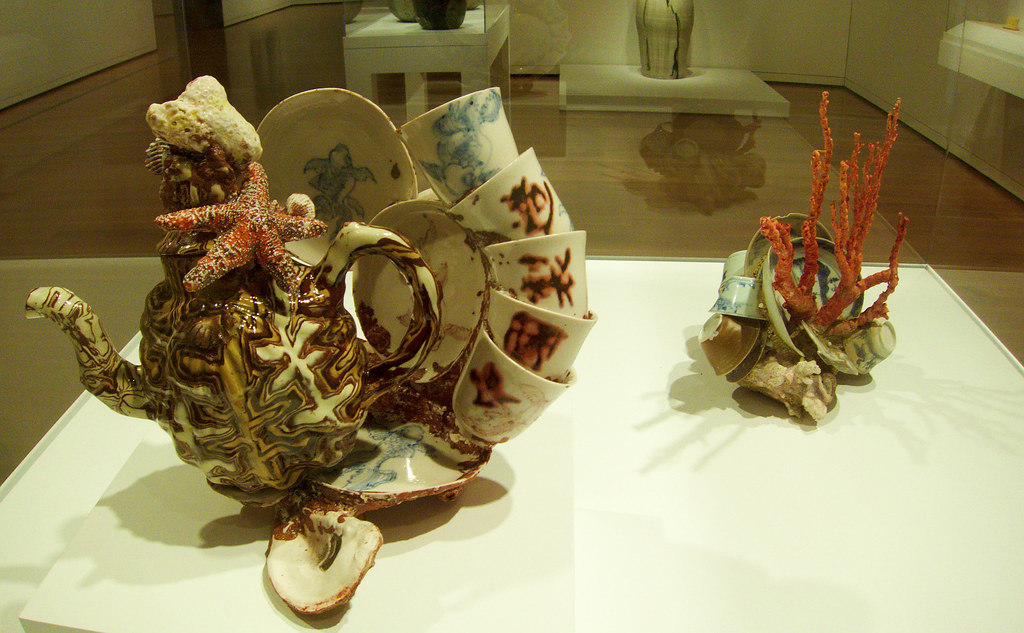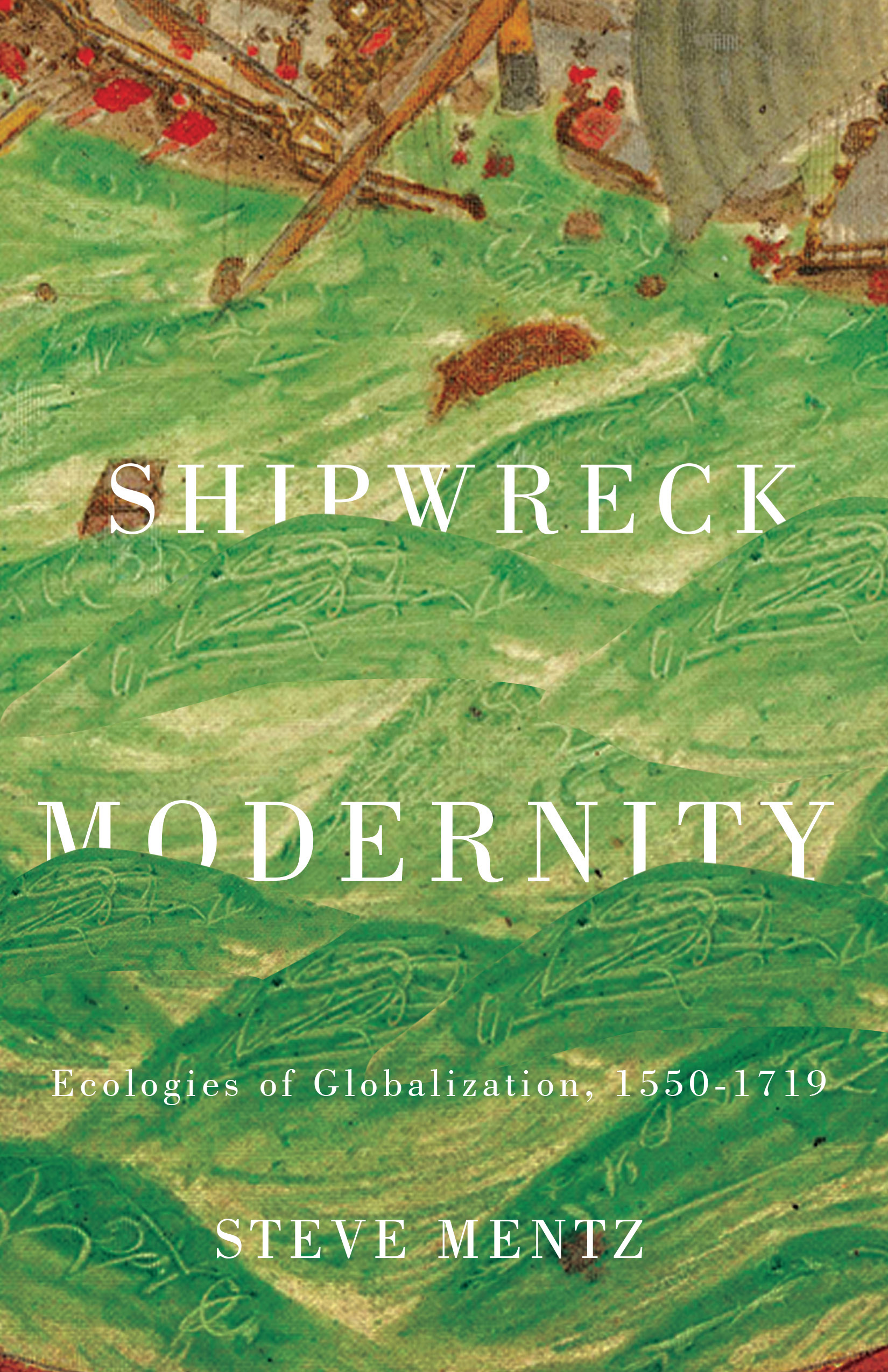
Between the split of the ship and the hope for land, the book is at sea, which here, of course, I mean as praise.
Saturday, February 20, 2016
“Unto the Bottom of Those Gulfey Waves”: Steve Mentz’s Shipwreck Modernity
Between the split of the ship and the hope for land, the book is at sea, which here, of course, I mean as praise.
Sunday, July 28, 2013
"Trading Tongues" is HERE!
Saturday, January 15, 2011
Not Dead Yet: Richard Burt, Medieval and Early Modern Film and Media
by KARL STEELA problem of arriving at interpretive closure follows from the erosion of the paratext’s authority and related policing functions: in a radical manner even more avant-garde than Eric Rohmer’s Perceval le Gallois (1978), the film repetitively deconstructs and reinscribes (and reanimates) a distinction between meaning and nonsense, logic and illogic, parody and its policing; even more radically, it deconstructs a generic distinction between the film as medieval historical film and a documentary about the making of such a film. The shot of the police car entering the frame near the end of the film is followed by handheld cinéma verité shots of the police that continue to the end, making it seem as if we are witnessing a documentary about reenactors of a medieval battle. Yet this tension between historical film and documentary is present even in the historical sequences, made manifest through pointless but immediate point of view shots from inside the Green Knight’s helmet as he fights the Black Knight, the handheld shots of the mob rushing to burn the “witch” and the knights charging in the final battle, to take only a few of many such examples. What counts as the death of film, the cut from the policeman’s hand blocking the camera to the end of reel footage to the black screen and carnivalesque organ exit music that plays as if from a separate source in the theater (the same as the intermission music), amounts to a full-scale dismantling of the production and reception of the historical film. We get a deferral of closure rather than the dialectical sequence from documentary (profilmic real) to its fictionalization as diegesis and finally to simulation of documentary through excessive spectacular supplementary details, often in the form of extras, that according to Rosen (2001, 160–99) define the historical fiction film and differentiates it from the documentary film (to which Rosen tellingly devotes a separate chapter). If the historical film, in Rosen’s words, lets us conclude “what we see is not actually what was, but what it would have looked like” (182), Monty Python and the Holy Grail’s self-reflexive serialization of its narrative, subversion of its paratext’s authority, and use of extras playing knights who appear out of nowhere for the final and aborted battle estrange and confuse us, provoking us to wonder again and again about just what kind of film we are watching: a film parodying films about the Middle Ages such as Bergman’s The Seventh Seal (1957)? A documentary about making such a film parody? Or a documentary about a film about reenactors making a film about the Middle Ages played by actors who are acting as reenactors? One of the film’s many recurrent and hilarious tag lines—“Not dead yet”—may serve as a tagline for the problem of interpreting the film’s staging of its continual deferral of meaning, its refusal to deliver a narrative sequence of its own life and death.HAVE A LOOK: For students of psychoanalysis, of desire, of presence and disappearance and ineradicability.
Thursday, August 26, 2010
Women and Disability in Medieval Literature
Here's my blurb for Tory Vandeventer Pearman's forthcoming book Women and Disability in Medieval Literature. Look for it in (where elese?) Palgrave's New Middle Ages series.
Disability Studies is emerging as an essential entryway for rethinking the literature and culture of the Middle Ages. By combining this important interdisciplinary approach with solid work in feminist theory, Tory Vandeventer Pearman has written a book that both medievalists and disability studies scholars will want to read. Pearman's argument is sensitive to historical context and to the complicated relationships among power, authority, textuality and body. By focusing upon disabled female characters in the literature of high medieval Britain (including Marie de France, Chaucer, Kempe, Chestre and Henryson), she elucidates the centrality of gender to the creation of able-bodiedness. Disability is, like sex, both difference and process. Analyzing femininity in tandem with disability enables newly complicated understandings of how stigma is attached to certain bodies and what roles texts play in this process of othering. Women and Disability in Medieval Literature is a lucid and compelling piece of scholarship. With this book Pearman joins Irina Metzler and Edward Wheatley as a leader in the field.
Monday, November 30, 2009
E. Jane Burns, Sea of Silk
Just saw this reviewed by Laura Hodges in TMR. Here is the description from the U Penn Press website:
The story of silk is an old and familiar one, a tale involving mercantile travel and commercial exchange along the broad land mass that connects ancient China to the west and extending eventually to sites on the eastern Mediterranean and along sea routes to India. But if we shift our focus from economic histories that chart the exchange of silk along Asian and Mediterranean trade routes to medieval literary depictions of silk, a strikingly different picture comes into view. In Old French literary texts from the twelfth and thirteenth centuries, emphasis falls on production rather than trade and on female protagonists who make, decorate, and handle silk.
Sea of Silk maps a textile geography of silk work done by these fictional women. Situated in northern France and across the medieval Mediterranean, from Saint-Denis to Constantinople, from North Africa to Muslim Spain, and even from the fantasy realm of Arthurian romance to the historical silkworks of the Norman kings in Palermo, these medieval heroines provide important glimpses of distant economic and cultural geographies. E. Jane Burns argues, in brief, that literary portraits of medieval heroines who produce and decorate silk cloth or otherwise manipulate items of silk outline a metaphorical geography that includes France as an important cultural player in the silk economics of the Mediterranean.
Within this literary sea of silk, female protagonists who "work" silk in a variety of ways often deploy it successfully as a social and cultural currency that enables them to traverse religious and political barriers while also crossing lines of gender and class.Looks great, and I intend to add it to my list. Has anyone read it?
Wednesday, November 18, 2009
Cinematic Illuminations
We at In the Middle love collaboration. We love Marty Shichtman. We love Laurie Finke. So we therefore want you to know that these two longtime collaborators whom we love have a new book.
Saturday, August 08, 2009
Peter Travis, Disseminal Chaucer
by J J CohenIsn't that a great cover?
I was asked to blurb Peter Travis's new book, coming out in November from the University of Notre Dame Press. I did so happily, and was thereby able to peruse an advance copy. ITM readers will want to purchase the volume when it appears: it is readable, rigorous, and entertaining.
Some version of this praise from me will appear on its back cover:
Peter Travis opens the Pandora's box that is Chaucer's "Nun's Priest's Tale" by asking a disarmingly simple question about its genre. He proceeds to detail, brilliantly, the narrative's status as a multiplex parody, a medieval Ulysses. By refusing to reduce the tale to a singular meaning, and by maintaining that its proliferative ardors are part of its formal structure, Travis provides a tour de force analysis not only of the work, but of Chaucer's ambitions throughout the Canterbury Tales. Lucid, engaging, and great fun to read, Dissemimal Chaucer provides a compelling model for doing theory-savvy work that is scrupulously attentive to medieval textuality.And here is the official press copy, from the UND website:
Chaucer’s The Nun’s Priest’s Tale is one of the most popular of The Canterbury Tales. It is only 646 lines long, yet it contains elements of a beast fable, an exemplum, a satire, and other genres. There have been countless attempts to articulate the “real” meaning of the tale, but it has confounded the critics. Peter Travis contends that part of the fun and part of the frustration of trying to interpret the tale has to do with Chaucer’s use of the tale to demonstrate the resistance of all literature to traditional critical practices. But the world of The Nun’s Priest’s Tale is so creative and so quintessentially Chaucerian that critics persist in writing about it.
No one has followed the critical fortunes of Chauntecleer and his companions more closely over time than Peter Travis. One of the most important contributions of this book is his assessment of the tale’s reception. Travis also provides an admirable discussion of genre: his analysis of parody and Menippean satire clarify how to approach works such as this tale that take pleasure in resisting traditional generic classifications. Travis also demonstrates that the tale deliberately invoked its readers’ memories of specific grammar school literary assignments, and the tale thus becomes a miniaturized synopticon of western learning. Building on these analyses and insights, Travis’s final argument is that The Nun’s Priest’s Tale is Chaucer’s premier work of self-parody, an ironic apologia pro sua arte. The most profound matters foregrounded in the tale are not advertisements of the poet’s achievements. Rather, they are poetic problems that Chaucer wrestled with from the beginning of his career and, at the end of that career, wanted to address in a concentrated, experimental, and parapoetic way.
PETER W. TRAVIS is Henry Winkley Professor of Anglo-Saxon and English Language and Literature at Dartmouth College. He is the author of many influential articles and Dramatic Design in the Chester Cycle.
ADVANCE PRAISE: “ Disseminal Chaucer is an original work of criticism that breaks new ground in its treatment of The Nun’s Priest’s Tale in its approach to the tale and in its perspective on Chaucer’s poetry as a whole. It is very historicist based, which places it in the mainstream of current medieval practices, but its background material and authoritative reading will make it fresh and current for a very long time.” — Larry Scanlon, Rutgers University
Tuesday, August 04, 2009
For Your Summer Reading List: J. Allan Mitchell, Ethics and Eventfulness
by J J CohenToday I received via email a TMR installment reviewing Ruth Kennedy and Simon Meecham-Jones' edited collection Authority and Subjugation in Writing of Medieval Wales. I'm a fan of the book (I was one of the press readers, and then I blurbed it). The last line of Robin Chapman Stacey's very positive review struck me:
The New Middle Ages series edited by Bonnie Wheeler has produced some of the most innovative and exciting publications on medieval topics out there on the market today; this volume is a worthy addition to the list.More evidence on the "innovative and exciting" and front: J. Allan Mitchell's Ethics and Eventfulness in Middle English Literature. I tried to secure a copy at Kalamazoo this year, but was beaten to the last copy. Professor Mitchell was kind enough to send me an autographed copy, and I am just about to lose myself in reading it. Here is the press advertising copy:
Medieval writers were fascinated by fortune and misfortune, yet the critical problems raised by such explorations have not been adequately theorized. Allan Mitchell invites us to consider these contingencies in relation to an “ethics of the event.” His book examines how Middle English writers including Chaucer, Gower, Lydgate, and Malory treat unpredictable events such as sexual attraction, political disaster, social competition, traumatic accidents, and the textual condition itself—locating in fortune the very potentiality of ethical life. While earlier scholarship has detailed the iconography of Lady Fortune, this book alters and advances the conversation so that we see fortune less as a negative exemplum than as a positive sign of radical phenomena.Mitchell is well read in medieval literature, philosophy, and theory (especially Deleuze and Derrida, from a quick skim). Put it on your reading list as well. We still have two or three weeks til classes begin.
Wednesday, July 08, 2009
CFP: Theorizing the Borders: Scotland and the Shaping of Identity in Medieval Britain
I met Katherine Terrell a few years back when she invited me to give a paper at Hamilton College. She contributed a terrific essay to Cultural Diversity in the British Middle Ages, on "Subversive Histories: Strategies of Identity in Scottish Historiography." Now she and Mark Bruce are assembling their own collection, on Scotland and Britain. Interested? Email Katherine and let her know: kterrell@hamilton.edu The collection looks like it will be a very important one.
-----------------------
One of the most fascinating current conversations in medieval studies concerns the application of post-colonial theory and border studies to the literature and culture of medieval Britain. Since the 2000 publication of Jeffrey Jerome Cohen’s The Postcolonial Middle Ages, several studies have addressed the creation and manifestation of bordered identities in medieval texts. However, while these studies have tended to couch the question of liminal identities in terms of England’s relationship with neighboring others such as the Irish and Welsh, internal others such as England’s (present or past) Jewish population, and more distant others like Muslims of the Middle East, there have been few studies of England’s nearest and arguably most contentious other: Scotland. Texts that originate in the Anglo-Scottish marches, as well as texts that actively seek to negotiate Anglo-Scottish cultural and political relations, offer some of the most fruitful occasions for the exploration of medieval borders, nationalism, and identity formation.
However, despite the recent growth in medieval Scottish studies, the last book devoted to a general exploration of cross-border literary influences was Gregory Kratzman’s Anglo-Scottish Literary Relations 1430-1550 (Cambridge University Press, 1980); Rhiannon Purdie and Nicloa Royan’s collection on The Scots and Medieval Arthurian Legend (Boydell Press, 2005) only begins to fill the gap. Anglo-Scottish relations have received more comprehensive attention from historians: for example in the work of Robin Frame and of Rees Davies, and in Andy King and Michael Penman’s recent collection, England and Scotland in the Fourteenth Century: New Perspectives (Boydell Press, 2007). Yet scholarship on cross-border literary relations, as well as work that addresses the interrelations between the literature and history of the two nations, remains scattered and underrepresented.
The proposed anthology, Theorizing the Borders: Scotland and the Shaping of Identity in Medieval Britain, will explore the roles that Scotland and England play in one another’s imaginations, addressing such questions as: How do subjects on both sides of the border define themselves in relation to one another? In what ways do they influence each other’s sense of historical, cultural, and national identity? What stories do they tell about one another, and to what ends? When do texts produced on the Anglo-Scottish border reify or critique mainstream notions of Scottish and English identities? How does the shifting political balance—as well as the shifting border—between the two kingdoms complicate notions of Scottishness and Englishness? When do hybrid categories come into being? We envision this as an interdisciplinary collection, bringing together literary scholars and historians working on both Scotland and England, with the goal of advancing scholarship on medieval Anglo-Scottish relations and the formation of identity.
Saturday, July 04, 2009
Queer Movie Medievalisms
by J J CohenOut (so to speak) this month. I blurbed this a while back so I got to read the galleys: it's a solid collection of essays that accomplishes innovative work. You'll also notice many ITM favorite writers here as well.
From the Ashgate website, where you can download the introduction and ToC:
How is history even possible, since it involves recapturing a past already lost? It is through this urge to understand, feel and experience, that films based on medieval history are made. They attempt to re-create the past, but can only do so through a queer re-visioning that inevitably replicates modernity. In these mediations between past and present, history becomes misty, and so, too, do constructions of gender and sexuality leading to the impossibility of heterosexuality, or of any sexuality, predicated upon cinematic medievalism. Queer Movie Medievalisms is the first book of its kind to grapple with the ways in which mediations between past and present, as registered on the silver screen, queerly undercut assumptions about sexuality throughout time. It will be of great interest to scholars of Gender and Sexuality, Cultural and Media Studies, Film Studies and Medieval History.
Contents:
Introduction: queer history, cinematic medievalism, and the impossibility of sexuality, Kathleen Coyne Kelly and Tison Pugh; The law of the daughter: queer family politics in Bertrand Tavernier's La Passion Béatrice, Lisa Manter; Queering the Lionheart: Richard I in The Lion in Winter on stage and screen, R. Barton Palmer; 'He's not a ardent suitor, is he, brother?': Richard the Lionheart's ambiguous sexuality in Cecil B. DeMille's The Crusades (1935), Lorraine Kochanske Stock; 'In the company of orcs': Peter Jackson's queer Tolkein, Jane Chance; The Eastern Western: camp as a response to cultural failure in The Conqueror, Anna Klosowska; 'In my own idiom': social critique, campy gender, and queer performance in Monty Python and the Holy Grail, Susan Aronstein; Performance, camp, and queering history in Luc Besson's Jeanne d'Arc, Susan Hayward; Sean Connery's star persona and the queer Middle Ages, Tison Pugh; Will Rogers' pink spot: A Connecticut Yankee (1931), Kathleen Coyne Kelly; Danny Kaye and the 'fairy tale' of queerness in The Court Jester, Martha Bayless; Mourning and sexual difference in Hans-Jürgen Syberbergs's Parsifal, Michelle Bolduc; Superficial medievalism and the queer futures of film, Cary Howie; Afterword, Glenn Burger and Steven F. Kruger; Index.
About the Editors:
Kathleen Coyne Kelly is Professor of English at Northeastern University, USA; Tison Pugh is Associate Professor of English at the University of Central Florida, USA
Reviews:
'Through readings of films familiar and obscure, foreign and domestic, recent and classic, Queer Movie Medievalisms challenges us to think deeply about how heterosexuality works and how it inevitably fails, about how a film offers not just multiple points of audience identification but multiple cohabitating times. A superb collection of essays, with an especially provocative afterword by Glenn Burger and Steve Kruger. I commend Tison Pugh and Kathleen Coyne Kelly for producing so valuable and timely a volume.'
Jeffrey Jerome Cohen, George Washington University, USA
'Queer Movie Medievalisms stands alone in the intense and far-ranging (pink) spotlight it deploys to examine cinematic encounters with the so-called "Dark Ages." Combining impeccable scholarship and enthusiastic engagement, the essays in this volume consider how "the medieval" becomes a destabilizing queer space for a range of American and European stars and films.'
Alex Doty, Indiana University, USA
Wednesday, June 17, 2009
Jonathan Boyarin, The Unconverted Self
Speaking of Jews (as we do so often here at ITM) ... Jonathan Boyarin's long awaited book on how Europe's experience of Jewish otherness set the terms for its encounter with the indigenous peoples of the Americas will be out by year's end. I just blurbed it, and thought I'd share my advance praise here, since Boyarin's work brings many of the issues we've been discussing to another geography:
The Unconverted Self: Jews, Indians, and the Identity of Christian EuropeMeet the New World, same as the Old World. Jonathan Boyarin's The Unconverted Self persuasively undermines historical divisions of such endurance that they have come to seem truths of history. Through his focus on spatiality and temporality, through his mapping of the intricate hybridities that undrgird and ultimately betray seeming purities, through his close attention to textual and contextual detail, Boyarin has composed a book that will change the way we think about the supposedly demarcative power of 1492. The Unconverted Self is a powerful work that anyone interested in the medieval and early modern periods, Jewish and Christian history, the New World encounter, or postcolonial studies will want to read.
Wednesday, June 03, 2009
The Timely Arrival of Some Untimely Material: J. Gil Harris, Untimely Matter in the Time of Shakespeare
by J J CohenJonathan Gil Harris (or "Gilly" as I frequently call him behind his back) is my colleague here in the GW English Department. He is also my friend. Posting about his new book is therefore both pleasurable and a little daunting. Readers of ITM may want to take what I say below cum grano salis: it hardly counts as unbiased peer review. Indeed, this post is going to sound (I fear) like a fan letter.
And how could it not? I am an unabashed devotee of Untimely Matter in the Time of Shakespeare. I've read it cover to cover twice, and believe it to be one of the liveliest and most perceptive works of scholarship I've encountered.
Time is a subject that has long preoccupied my own research: the "Midcolonial" section of The Postcolonial Middle Ages, "Time's Machines" in Medieval Identity Machines. I've deployed a proliferation of terms (midcolonial, extimité, inhuman circuit, difficult middles) to describe what Harris succinctly labels the polychronic , the simultaneous cohabitation of heterogeneous temporalities within a material object -- where materiality and temporality are active components of a hybridizing, mobile network rather than solitary and self-segregated pieces of a still world. The arguments of Untimely Matter are as relevant to medieval studies as they are to early modernists, insisting that temporality can be thought as something other than straightforward, historicist chronology. Untimley Matter is pitched strongly against what Harris calls the "national sovereignty model of temporality," in which each temporal moment is essentially its own country, with its own rules and borders and determinations of meaning (p. 2). Against synchronic (past as bounded and determinate field of meaning) and diachronic (past as array of discrete eras) readings, Harris argues for the "multiple traces of time embedded in things" (9), what Kathy Biddick has called "the temporality that is not one." His point of departure is Nietzsche's idea of unzeitgemässe, which might be translated as the temporally improper, "resisting absorption into a homogeneous present" (11) -- spurring us to think "how we might use the past to imagine alternatives to the present and to chronology itself" (13).
Harris's central figure in the book is the palimpsest: the work written over by other works, creating an evident simultaneity of times. Palimpsests can be textual (the Archimedes Palimpsest), architectural (Pisa cathedral has a stone embedded within its façade imprinted with IMPCAESAR, rendering evident its origin in a pagan monument; all cities are palimpsests), or conceptual: they are always, however, material and capable of agency, especially future-directed agency. The palimpsested past, in Harris's account, is thick with possibility:
- supersession (just as one text might be written over another, one time seemingly yields utterly to another ... and yet that other endures within it, as the earlier text remains legible, as Jews lived among Christians long after the triumph of Christianity)
- explosion (a heterogeneous past temporality is embedded in the new, like Jewish letters on a Christian London wall, triggering an "untimely irruption" that "shatters the integrity" of the present)
- conjunction (uneasy cohabitation: "polychronic matter can activate a heterodox temporality of conjunction, one that disregards the entrenched partitions and distances informing the geometric lines of chronological time" (171).
Given my own looming date with scholarship destiny, I read Untimely Matter with an eye towards how it might spur a rethinking of Jewish-Christian relations in the Middle Ages. The figure of the Jews wanders through Harris's work like, well, a Wandering Jew: surpassed but not quite in Herbert's The Temple, bequeathing explosive inscriptions to Stow's London, written as new Cabbala by Cavendish. Related figures are also central: the Oriental Other, the queer. Heterogeneity in temporality is inseparable throughout from cultural and geographical difference. Untimely Matter provides a rich vocabulary for describing the multiple temporalities that necessarily come into play when Jews lived among Christians in places like London, Lincoln, York and Norwich. Harris's idea of conjunction also ensures that I will be examining Jewish-Christian coinhabitation as dialogue-producing space (or network) where both identities are susceptible to change, to narratives and futures not given in advance.
I did wonder throughout the book about the place of its own author. Maybe that is simply because I know him ... and yet I found the traces of Harris that he leaves throughout the volume to cry out for more story. Photos of statues from Ludgate, now in St. Dunstan-in-the-West Church, are attributed to the author: with whom did he tour the church, and what did he seek, and what unfolded at the moment of beholding these statues mediated by Stow? The translation of the Hebrew characters Stow inscribes is attributed to Stella Harris: I could not stop myself from yearning for a story about this, because it seemed to me that something had to be at stake that was unspoken, something central to the book itself. In a brilliant chapter on Margaret Cavendish and Hélène Cixous, Harris suggests that three authors are touching ... but the one in "Washington, D.C., 2008" gets only that line. But I don't want this to be the kind of review that takes the author to task for not having written the kind of volume the reviewer would write: indeed, I get the feeling that the small traces without narratives were in fact a deliberate strategy on Harris's part.
Long story short: this is a brilliant book. I haven't enjoyed reading a work of scholarship so much in quite a while. I'd highly recommend that In the Middle readers add Untimely Matter to their summer reading lists.
Tuesday, May 05, 2009
Coming Very Soon: The Post-Historical Middle Ages
by J J CohenTo be released on 5/26/09 by Palgrave, The Post-Historical Middle Ages is an important addition to the burgeoning New Middle Ages series. I've blogged about this book frequently in the past here at ITM.
From the Palgrave Macmillan website:
Praise
“A superb collection of fearless essays. About its potential impact, one could say that it anatomizes the present field of medieval literary studies and points in the direction the field should go in the future—except that the volume as a whole so fully explodes the concept of a unitary present and a single direction in which any field ‘progresses.’ Suffice it to say, then, that the challenges posed by these smart essays are not ones that any historically minded literary critic can easily shrug off—like the past itself, which has its ways of living with us.”—Carolyn Dinshaw, Professor of Social and Cultural Analysis and English, New York University
“Seeking neither to bury nor to praise historicism, this vital collection instead provokes much-needed discussion about the oftentimes tacit commitments of the historicist modes of inquiry that have dominated medieval literary studies for well over two decades. A curiosity cabinet of medievalisms, the individual contributions—while espousing a variety of critical allegiances—all scrutinize what is at stake in the stories we tell about the past as well as our own desires to have the past speak to our current selves. Multiple questions come under examination here: What is the allure of the alterity of the medieval and what are its possible consequences? From whence issues the hegemony of historicism? Can materialism exist independently of historicism? In answering these questions and posing many more, the distinguished contributions assembled by Federico and Scala will have broad appeal for both those new to the medieval field as well as seasoned scholars.”—Kellie Robertson, Associate Professor of English, University of Wisconsin, Madison
“An extraordinarily elegant, lucid, and important collection. These essays demonstrate the rigors of an historical method that they also seek to reach beyond, and the brilliance of its editing makes this a real conversation. Many of these essays are important contributions to historical scholarship, and all demonstrate a canny awareness of the investment of and in “history.” Its great irony is that it may come to constitute a determinative moment in scholarly history—the post-Post-Historical Middle Ages—but also the end of attempts to shape medieval studies to fit constricted disciplinary ways of writing and effacing history, especially in cultural studies.”--D. Vance Smith, Director, Medieval Studies, Princeton University
Table of Contents
Introduction--Sylvia Federico and Elizabeth Scala * Amorous Dispossessions: Knowledge, Desire, and the Poet’s Dead Body--Patricia Clare Ingham * Time Out of Memory--Jeffrey J. Cohen * Historicism after Historicism--Maura Nolan * (Dis)Continuity: The History of Dreaming--Aranye Fradenburg * Recovering the Middle Ages?--Thomas Prendergast and Stephanie Trigg * Naked Chaucer--George Edmondson * Biography After Historicism--Daniel Birkholz * The Gender of Historicism--Elizabeth Scala * From Clio to JHMuse©: Literacy and the Muse Of Digitalia--R. Allen Shoaf
Wednesday, April 15, 2009
In Search of Lost Time Again
by J J Cohen"Although he had a weak spot for subclauses and patisserie, somehow, by sheer force of adjectives and loneliness, [Marcel Proust] intuited some of modern neuroscience's most basic tenets."
That elegant little sentence, with its unexpected conjunction of grammar and bakery, of wordcraft and solitude, comes from my recent bedstand reading, Jonah Lehrer's Proust Was a Neuroscientist. With chapters on Walt Whitman, George Eliot, Paul Cézanne, Auguste Escoffier, Igor Stravinsky, Gertrude Stein (a chapter that enabled me finally to understand the ambition of her work), and Virginia Woolf -- well, what modernist-enamored aesthete wouldn't love Lehrer's book? He combines an artist's prose (subtitle from the Proust chapter: "The Lie of Yesterday"), a scientist's enthusiasm for detail, and a journalist's ardor for Big Picture narrative. I recommend the volume highly.
As a side effect of reading Lehrer, I've been inspired for the third time to attempt to make it through A la Recherche du Temps Perdu -- if only because this blog has always been in search of lost time. My first Proustian failure was in graduate school, during a bleak summer in which I was consigned to a 'German For Reading Knowledge' course. I purchased an aged copy of Swan's Way to enjoy in my spare time, for no other reason than I had always wanted to read the book with a big cup of tea and a madeleine to dip in it. The promised spare time failed to arrive, however. Three years later the paperback's glue binding dissolved, scattering lost time across the linoleum. Shortly after the dissolution of the novel I found a copy in French at a yard sale, and decided it would be good for me to spend a summer reading the work in its original. I am not sure whether I reached page ten or page twelve -- but as yet I had not reached the cookie-in-the-tea dunk.
Last Saturday in New York City, my son Alex and I had a cold, wet afternoon to ourselves. We visited Nintendo World, wasting all of thirty minutes. We weren't meeting the rest of the family for quite some time, we were already soaked from walking ... so we did what any normal American father and son do: we headed to the nearest bookstore and each purchased the fattest volume we could lay our hands upon (Alex got one of these, don't ask me which one). We then retreated to the nearest coffee shop, sat with warm beverages, and read quietly in each other's company until five o'clock. That moment of rest during a four day whirlwind of seeing, moving, and doing was bliss. I've always had a fondness for reading on rainy days, especially when a large window yields a view of passersby, mobile in their solitude, their faces not intended to be interpreted.
So I am now farther into Swann's Way than I have ever been (which is to say p. 71 of the new Penguin translation). And you know, I am not sure I was ready earlier in life to be bowled over by a sentence like this one, in which Marcel describes the two rooms in Combray where his aunt lives her circumscribed life:
These were the sorts of provincial rooms which -- just as in certain countries entire tracts of air or ocean are illuminated or perfumed by myriad protozoa that we cannot see -- enchant us with the thousand smells given off by the virtues, by wisdom, by habits, a whole secret life, invisible, superabundant, and moral which the atmosphere holds in suspension; smells still natural, certainly, and colored by the weather like those of the neighboring countryside, but already homey, human and enclosed, an exquisite, ingenious, and limpid jelly of all the fruits of the year that have left the orchard for the cupboard; seasonal, but movable and domestic, correcting the piquancy of the hoarfrost withe the sweetness of warm bread, as lazy and punctual as a village clock, roving and orderly, heedless and foresightful, linen smells, morning smells, pious smells, happy with a peace that brings only an increase of anxiety and with a prosiness that serves as a great reservoir of poetry for one who passes through it without having lived in it.I love that single sentence so much that I'd give up any of the books I've written just to be able to compose something so artful. I immediately read it aloud to Alex in the coffee shop ... and he in return read to me a sentence from his own book, in which the Chaos Gem is shattered and legions of the undead enter the world riding dragons wrought of flame.
Wednesday, December 10, 2008
Flash Review II: Israel Yuval, Two Nations in Your Womb
by J J CohenIsrael Jacob Yuval's research has for a long time been -- paradoxically -- both influential and cited mainly at second hand, since relatively few scholars have the facility in Hebrew to read his work in its original. Most of these citations at one remove involve an article published in Zion (1993) in which Yuval argued for a relationship between the Jewish choice of mass suicide and the murder of loved ones during Crusader persecution, and the later circulation of the myth that Jews killed Christian children in mockery of the Passion. Two Nations in Your Womb: Perceptions of Jews and Christians in Late Antiquity and the Middle Ages (trans. Barbara Harshav and Jonathan Chipman) offers in lucid English the author's patient exploration of a thesis that has proven extraordinarily controversial -- challenging as it does the received idea that medieval Jews were the patient victims of an antisemitism bearing little relation to the realities of Jewish medieval life. Scholars had assumed, in other words, that no Jewish story could be discerned in narratives like Thomas of Monmouth's twelfth-century account of the boy-martyr William of Norwich. Such fables were the hateful dreams of a society that wanted no real knowledge of its Jewish other. The Blood Libel consolidated Christian community through fantasy; the host desecration myths had nothing to do with matzoh or Pesach. As a result of such analysis, medieval Jews in much contemporary scholarship seem to inhabit the frozen timelessness that Christians ascribed to them. But shouldn't they be just as eligible for voice, modernity, the possibility of affects both positive and negative (i.e. a life as something more than a holy, docile and long suffering people)? Can the truth of medieval Ashkenazic Jewry amount to something a little more full than an early version of Fiddler on the Roof?
Yuval's thesis is in many ways profoundly commonsensical, allowing that a story involving blood and sacrifice and children might travel across religious boundaries and become something different, yet connected. Medieval Jews and Christians did not inhabit closed spheres. They learned from each other and even borrowed beliefs, rituals, eschatology. Much of Yuval's work demonstrates the ways in which these Jews were not passive victims to Christian violence, but possessed a well developed mythology of a Messiah King who would take vengeance against Christian violators. Jews could even dream of an End Time in which Christianity would be cleansed from the earth ... and imagine that one way to precipitate this apocalypse might be through spectacular acts of communal self slaughter.
Two Nations in Your Womb is a provocative, compelling book. In my own work I've been interested in how every cultural/social/racial/whatever barrier erected to segregate difference into discrete categories always ultimately fails. Yuval's research demonstrates how Jewish and Christian thought interpenetrated, and how in the end a Jewish story can be discerned in ritual murder and host desecration narratives. His closing chapter on the millennial hopes of the thirteenth century (the Christian year 1240 marked the year 5000 of Creation for Jews) made me see a troubling episode from Mandeville's Travels in an entirely new way -- about which more later. For the time being, though, let me say that every medievalist interested in Jewish-Christian relations during the Middle Ages ought to read this book, offering as it does a complicated view of stories that have too often been treated as not much more than yet another lachrymose segment of the road leading towards the Holocaust.
Tuesday, December 09, 2008
Flash Review I: Jim Simpson, Troubling Arthurian Histories
by J J CohenSo here is the thing about being department chair: I don't possess as much time to read as I did in days of yore, and what I do read I frequently don't have the leisure to blog about. It's a tough life. But since 2008 is coming to an end, and since every literary outlet uses the long empty space when the year is on life support and when we're all waiting for it to just terminate already to publish "Best Books of Year XXXX" lists, well, I've decided to do a series of flash reviews of books I meant to blog about this year.
So I'll start with one of my favorites, James R. Simpson's Troubling Arthurian Histories: Court Culture, Performance and Scandal in Chrétien de Troyes's Erec et Enide. To say that Simpson's work is the best book on Erec et Enide out there doesn't say enough: though a copious number of scholarly articles and sections of monographs examine the romance, very few books devote themselves entirely to the work. A meditation on (among other things) gender interrelations, homoerotism, desire, uxoriousness, aventure, the weight of history, aristocratic power and its performance, scandal and mischief, Erec et Enide is a complicated work -- and therefore a fitting first attestation of French Arthurian romance. Like other theorists of chivalry (Richard Kaeuper, Roger Sherman Loomis, Aranye Fradenburg are among those cited, but Larry Benson and Joachim Bumke would also have been appropriate), Simpson sees romance as offering a script for aristocratic behaviors in the real world: its "indebtedness to elsewheres and elsewhens" (28) cannot mask an abiding interest in reconfiguring the present. This performative notion of romance allows him to move quickly to Judith Butler and performative gender, but always with historical nuance intact: Simpson is a good excavator of the courtly context for the production and consumption of Chrétien's work.
This will not be a flash review if I dwell upon how Chrétien's depiction of Erec's recreantise might resonate with the military underachievement of Henry II's son (Henry, Duke of Normandy), or how the "salacious tang" of Eleanor of Aquitaine's family history might intersect with the romance's interest in scandal. But allow me to quote Simpson putting some of this together:
By incorporating or encoding family histories of Eleanor's kin and the Plantagenets into vernacular revisionings of the ancient past, romance texts arguably strengthen a historical and genealogical 'middle ground,' reinforcing the compositional weave of what might otherwise seem like a more distant relation in which there would be nothing between the immediate present's foregrounded mime of a remote background past. The gesture is both one of projection (they are intimately contextualised in, or translated into that history) and appropriation (because they are in it, it belongs to, or is 'carried across' / translated to them). As with Erec's relation to the court, they do not just 'love' History, abjectly waiting on its regard: History 'loves' them, too. This context emphasises both lineage and seriousness of their cultural claims. (25)Such analysis is clearly sensitive to the text's ambitions within the work's generative context. Yet Simpson's work is not so historicist that the only possible explanations to Chrétien's highly aesthetic text are those provided by an extensive knowledge of political shenanigans in Northern France towards the end of the twelfth century. The book concludes, for example, with a powerful (if implicit) argument for the power of presentism: invoking the funeral of Princess Diana, Zizek on Coca Cola, the film The Queen, Cicero, and Napoleon's condemnation of the Directoire of the young Republic to point out the necessity of illusion, spectacle, and performance to both terror and "the rational life of the polis." That is complicated when I type it all out: trust me that Simpson does a far more lucid job of explicating the nexus between absolutist claims and the danger of the bloodless bluff far better than I can ... and in his reading, it all comes down to the troubling figure of Arthur.
Simpson's writing style is clever, playful, creative -- and for that reason supremely appropriate to an analysis of Chrétien de Troyes, surely one of the most ludic and innovative writers of the Middle Ages. Who says that hardcore philology, continental philosophy, and history-minded literary analysis should not when combined also be great fun? Simpson is as hilarious as he is insightful, a perfect match between writer and subject.
Tuesday, December 02, 2008
ITM Congratulates Rob Barrett ...
by J J Cohen... on the publication of his new book Against All England: Regional Identity and Cheshire Writing, 1195–1656.
Look for an excerpt here at In the Middle later this week. Meanwhile, here is the press write up:
Against All England examines a diverse set of poems, plays, and chronicles produced in Cheshire and its vicinity from the 1190s to the 1650s that collectively argue for the localization of British literary history. These works, including very early monastic writing emanating from St. Werburgh’s Abbey, the Chester Whitsun plays, Sir Gawain and the Green Knight, seventeenth-century ceremonials, and various Stanley romances, share in the creation and revision of England’s cultural tradition, demonstrating a vested interest in the intersection of landscape, language, and politics.
Barrett’s book grounds itself in Cestrian evidence in order to offer scholars a new, dynamic model of cultural topography, one that acknowledges the complex interlacing of regional and national identities within the longue durée extending from the post-Conquest period to the Restoration. Covering nearly five centuries of literary production within a single geographical location, the book challenges still dominant chronologies of literary history that emphasize cultural rupture and view the “Renaissance” as a sharp break from England’s medieval past.
Robert W. Barrett, Jr., is associate professor of English and medieval studies, at the University of Illinois at Urbana-Champaign.
Friday, October 31, 2008
Buy this Book: Untimely Matter
by J J CohenMy colleague and friend Jonathan Gil Harris has just published his new book Untimely Matter in the Time of Shakespeare. One reason to purchase or shoplift the tome is that -- unlike those works that we complain about here at ITM that pretend medievalists have never examined the topics they explore -- this volume is quite generous: many of our favorite communal citations from this blog are in the bibliography (and, more importantly, within the work). A second reason is that the project is brilliant. Here me now, O readers: buy this book.
And no, I am not getting any kickbacks for saying that. I really am that much of a fan of Gil's scholarship.
Friday, October 24, 2008
Dumbarton Oaks Medieval Library
The Dumbarton Oaks Research Library is launching a new series of medieval texts, "The Dumbarton Oaks Medieval Library." Published by Harvard University Press and modeled after the revered Loeb Classical Library, these books will offer works in Byzantine Greek, Medieval Latin, and -- yes! -- Old English, all with facing page translations.
Dan Donoghue is the general editor for the Old English series. The editorial board also includes Rob Fulk, Drew Jones, Andy Orchard, Toni Healey, Elizabeth Tyler, and Katherine O'Brien O'Keeffe. I'm about to head off to the wine reception to celebrate the launch at the little Georgetown mansion that houses the research library... though the books won't be out until 2010, when the first ten titles debut. Still, why not drink to them now?
Thursday, September 25, 2008
Another Reason to Study Old Norse: You Can Keep Up with Teen Lit
by J J CohenAlthough I did not go myself (I was in the Hermit Hut, working on a @#$%! Mandeville lecture), my son last night attended a Christopher Paolini book signing. Like all imaginative eleven year olds, Alex is a big fan of this guy's work. I'd been looking at the title of Paolini's latest volume, Brisingr, ever since Alex brought it home, discerning a vague familiarity in the word (to be honest, I seldom see my son's face any more: it is hidden perpetually behind this colossal book). Alex's big news about the reading -- other than the fact that Paolini is home schooled and, like, eleven years old himself -- was that brisingr is Old Norse. I knew it had a fiery resonance to it, and that masculine nominative ending should have been a giveaway of some sort ... Anyway, Paolini is apparently a big fan of Norse mythology.
Maybe I'll even read one of his books.