Friday, February 13, 2009

Loss, Mourning, Affirmation

[illustration: memorials]
by J J Cohen

Apropos to a lively discussion that has come to focus on education jobs, as well as to this recent post about mourning, and especially to this ancient post about grieving for a lost teacher (see #6), I want to share with you an event that has preoccupied my family over the past few days. Though its relevance to this blog is at best tangential, writing about it seems (for reasons unclear to me) a necessity more than a choice.

My son Alexander entered sixth grade this year, and thereby transitioned from a small elementary to a vast middle school. The place can seem chaotic, especially in the morning as hundreds of preteens arrive en masse, or when a bell rings and a sudden swarm races for rows of lockers. I feared that Alex would have a difficult time adjusting, but assisted by compassionate teachers he adjusted to his new life without problems.

His favorite teacher this year has been Mr. Hegedus, who teaches sixth grade Ancient World History. Last autumn during visiting day I observed his class. I was impressed. Actually, I was both inspired and a tad envious. Using little more than a dog-eared book, a projector, a seemingly endless bag of Jolly Rancher candies, and his considerable charisma, Mr. Hegedus kept a classroom of thirty eleven-year-olds fascinated by the minutiae of daily life in a Mesopotamian city. The population of this required social studies course is quite diverse, with kids of various backgrounds and motivations brought together for a communal exploration of a subject that likely seems remote from them. Yet Mr. Hegedus made his students feel the kind of palpable connection to that distant past that requires a teacher of great personal magnetism to conjure.

Of course, given that Alex chose to be Augustus Caesar in his third grade wax museum, the Ancient World has been an easy sell to him. He loved the section on Greece because it gave him an excuse to watch the historically accurate film 300 again. He marveled when Mr. Hegedus brought up the topic of Greek homosexuality, and offered that the word gay doesn't always mean the same thing at every time period. He enjoyed composing a letter from a Roman footsoldier to his family at home, describing what it was like to be part of a frontier legion (much emphasis on various military hazings in that one). He already has his toga ready to go for Greco-Roman day at school. I also see that Alex has deeply enjoyed having a male teacher, a first for him.

On Tuesday Mr. Hegedus was driving home from the school at which he has taught for 13 years when he suffered a stroke. Fortuantely he was able to pull to the side of the road before he lost consciousness. When informed of their teacher's perilous condition on Wednesday, students and teachers wept. I do not believe a more popular educator can be found at the school. I met Alex as he walked home that afternoon: he fell against me and cried. Later I took him to his piano lesson, and we had an uncanny encounter with a hawk: the bird sat in a tree watching us with such attention and such fearlessness that it gave us both a feeling of foreboding (even though we knew very well that we were overinvesting a natural event with human significance).

Yesterday Mr. Hegedus died.

His students had no chance to speak their farewells. The cards they created remained undelivered. Alex told me that the most unbearable part of the day was walking into the social studies classroom, knowing Mr. Hegedus would not be present. Not knowing what else to do, he swiped a pen from his favorite teacher's desk. When I asked him why, he said: "Because the last thing Mr. Hegedus said to me was 'Where is my pen?' He couldn't find it to check off my homework. Now I'll always have it for him."

In class yesterday Alex also created a small memorial to Mr. Hegedus, a sheet of red paper on which he inscribed his teacher's name and his two favorite sayings ("Veni, vidi, vici" and "Carpe diem"). Two paperclips are attached to the plaque. This weekend he will fasten two helium balloons to the clips, and -- as is now his custom -- will launch that message into the heavens, the good-bye he never was able to speak.

Thursday, February 12, 2009

Festive Friday Comes Early: Your Worst Job

by J J Cohen

We have an ancient tradition at In the Middle of bringing to the occasional Friday more frivil and festivousness than is our quotidian custom. Mentally I am already inhabiting Friday (mostly as a coping mechanism: if I keep telling myself I am not really imprisoned in Thursday I will potentially escape the meetings that are about to devour my day like so many keen toothed piranha). So, let the festivities begin.

Those of you who have spent any amount of time with me in the flesh know that in my ongoing quest to assimilate to ordinary earthly conventions I sometimes employ discussion-breaking questions of the kind that a good diner party host will, just to render the guests convivial: i.e., what is your Proustian food? (thanks to Betsy McCormick for that one). The problem is that I'm not actually good at such things, and have a way of asking something too penetrating or too personal. In New York, for example, I believe I made us go around the table to admit our moment of most extreme humiliation, the one to which instant death was in every way preferable. Or later that evening I asked each person for a credo, a statement of heartfelt belief. I now understand why people generally avoid sitting in propinquity.

But here is an actual question that led to some interesting answers: what is the worst job you ever held?

My answer: In order to afford college I always worked an after-class job. I had a federal work-study grant, but the pickings for such positions were slender when I was a new student. I thought seriously about taking a make your own hours job at the medical center morgue, removing the corneas from cadavers. But what I chose instead was to be the guy who files the various smears of sundry growths removed from the skin of those who came to a dermatology clinic. To this day I know my squamous cell carcinomas from my actinic keratoses. I also have nightmare flashbacks to their purple puss-soaked ooziness.

What about you?

Wednesday, February 11, 2009

A Digital Codex


by Mary Kate Hurley

[illustration from the Lindisfarne Gospels -- thank you, BBC!]

Within a few hours of it being posted on the Valve last night, as a result of Scott Eric Kaufman's reading of a blog called "Readin" -- a number of my friends were emailing me about this. I haven't had the time to fully explore the website, but it would seem that UCLA has put together a page that allows for the easy browsing of all MSs that are digitally available online. Granted you may have already noted its existence through a post at ITM all the way back in December, but given that I noted it only in passing at the time, I thought it worth a second look.

From this article on the website:

Highlights of the virtual holdings include:
• The largest surviving collection of the works of Christine de Pizan, one of the first women in Europe to earn a living as a writer. The manuscript was commissioned by Queen Isabeau of France in 1414 and is now held by the British Library.
• An Irish copy of the Gospel of John, bound in ivory and presented to Charlemagne sometime around 800, now in the library of the monastery of St. Gall in Switzerland.
• The Junius manuscript, one of only four major manuscripts preserving poetry in Old English. Dated to around 1000, the book is now among the holdings of Oxford's Bodleian Library.
As an Anglo-Saxonist, I got no further than the Junius Codex. Along with Exeter, Vercelli, and the Nowell Codex, it houses Old English poetry, including Genesis, Exodus and Daniel. It was also my first Anglo-Saxon codex, which I saw at In the Beginning at the Smithsonian back in 2006. I'd be curious: do other medievalists out there remember their first manuscript? I mean, I'd seen other MSs here at Columbia's RBML, and at various museums and such. But to see the Junius, in person, even if I didn't get to "read" it more closely than through the glass protecting it -- that was pretty amazing.

I also couldn't help but think about the materiality of the codex. Of course I've gone on about this before. After a full semester, however, of one class on paleography and another on medieval book culture (the latter with Chris Baswell, who is part of the team that worked on assembling the UCLA site), I can't help but think about the objects themselves. Perhaps it's the lingering questions raised by Jeffrey's Weight of the Past talk last week, but I do tend towards feeling rather strange about digitized manuscripts. As teaching resources, they make the kind of intense paleographical work I did with Professor Dutschke possible in a way that before it would not have been outside of a few select places ten years ago.

However it also raises the question that all digital technology raises: that is, access. In this case, it's a question of access to the past. I'm working on a cataloging project with Prof. Dutschke for a few hours a week (along with several colleagues) -- and what I've realized is that there is so much to a manuscript that perhaps no digital reproduction, however fine, can represent. For example, I've often felt too squeamish to be a medievalist -- the thought of reading books that are written on animal skin often makes me hesitate to touch a manuscript. This Monday, for example, I sat in the Rare Books reading room and looked through a Chronicle written on parchment. The material of the text was utterly beyond my comprehension -- in addition to being in what was one of the worst late medieval hands I'd ever seen, the text was in German, a language I am slow to read when it's legible. However, the materiality of the book, the object itself, was exceedingly clear. Vellum, like un-moisturized skin, wrinkles. Yes, wrinkles. Texts age, and do so visibly. It's oddly similar to human skin in that regard.

This all tied in quite nicely to my Intro to the Major class, which I also taught this past Monday. I was introducing some of the ways medieval poetry thought about language, and the authority of the speaking or writing voice. After I gave an "introduction to Old English culture" that made me cringe slightly with its brevity -- we worked with one of my favorite of the Old English Riddles, Number 47:
Moððe word fræt. Me þæt þuhte
wrætlicu wyrd, þa ic þæt wundor gefrægn,
þæt se wyrm forswealg wera gied sumes,
þeof in þystro, þrymfæstne cwide
ond þæs strangan staþol. Stælgiest ne wæs
wihte þy gleawra, þe he þam wordum swealg.


A moth ate words; a marvelous event
I thought it when I heard about that wonder,
a worm had swallowed some man’s lay, a thief
In darkness had consumed the mighty saying
With its foundation firm. The thief was not
One whit the wiser when he ate those words.

Trans. Richard Hamer
When a poet in the Middle Ages looked at a book s/he didn't see something pristine, like my copy of Klaeber's Beowulf, which is still too new to be dog-eared and worn. Rather, books had long histories already, even when new -- it was not, as it were, their first life. And books were not safe from the ravages of time or even of the worms that also rend human flesh after death. Perhaps its worth remembering that even digital materials have worms which feed on data. Transience, it would seem, was and is part and parcel of textual experience. Rightly so, given that humans create them.

In part, and as always, it seems I've come back around to where I began when I started my musings: materiality and the medieval. We're always dealing, in some fashion, with what's left -- never an established whole, never a static object-of-knowledge. The medieval, it would seem, is always contextual, and therefore always contingent on the kinds of contexts we can find for it. It seems obvious, I suppose -- but every time I open my web browser and look at my first Anglo-Saxon codex, I don't know that I'll always acutely feel the absence of the codex Junius (given that it's not at my beck and call -- or even on this side of the Atlantic). But I do sense another kind of absence -- albeit one that is paradoxically full of lives and ideas and cultures that are always just beyond our ability to recall fully. I'm sure someone else has already said this -- but maybe we're always missing the Middle Ages?

Thanks to Scott Kaufman of The Valve for bringing this back to my attention, and to all the friends who forwarded it to me.

Cross posted at OENY.

More on something Beowulfian -- the conference for which it is intended -- on the morrow.

Haecceity / Motion / Pause

[illustration: my current Facebook profile picture, a sourpuss expression that offers a tiny window to my ugly soul. Plus, my hair is out of kilter.]
by J J Cohen

Last week I gave a paper at NYU. Time has already conveyed that event far from me, in the way that time will sometimes pluck and flee with that which you most want to hold close.

My New York trip offered some moments of pause during a period of intense activity. The preceding week had been filled with twelve- and thirteen-hour days as festivities related to my chairing the English Department and my directing GW MEMSI vied with obligations less enjoyable to fulfill. The New York trip, on the other hand, offered a brunch chez Karl that began around noon and ended only as the sun was forcing long shadows from the Brooklyn trees, late drinks at a bar where we lingered in growing quiet until the place closed, a train ride during which I surrendered every thought to Chrétien de Troyes while lounging in the "Quiet Car" (what library-loving scholar invented the "Quiet Car"? Why doesn't every transportational mode have a "Quiet Car"?).

These moments of pause did not last. The moment I returned home I was attacked by an eleven year old and a four year old, both of whom wanted many things from me -- primarily the sugar-fortified treats I had lugged from the Zaro's in Penn Station, but also this weird thing called "parental love" that I hear so much about and try hard to feel.

The week is only halfway elapsed, and already I am dreaming of its termination. Yesterday's agenda, for example, included attempting to answer ten to the ninth power of emails; ironing out problems with the fall teaching schedule; soothing a grad student and an adjunct in distress; and courting a potential donor over lunch. Then the president of GW hosted the English Department's faculty meeting at his home: he is, after all, a literary scholar and a member of my department. I seized the chance to appoint him Chair of the Student Complaints Committee, but he deftly avoided my authority. But I had to run from the cookies, sherry, and bons mots to grab my son Alex and convey him to Hebrew school -- a disciplinary apparatus about which, to his immense credit, he complains far less than I do.

On a typical Tuesday and Thursday my wife drops Alex off at synagogue because she can leave work earlier than I can get out the door. I pick up my daughter from preschool on my way home from GW, and then the three of us eat a quick dinner before I leave to retrieve Alex. We do this little ballet twice a week, and we do it pretty well. Yesterday, though, Wendy and Katherine had an obligation in Virginia, so I had to excuse myself from the department meeting/sherry swilling party early and dance the choreography solo. Fine, of course ... but as I said good-bye to Alex and wandered south into Glover Park to eat dinner by myself, I realized it was the first moment I had had to myself since running that morning (at 5 AM). I wasted most of this alone time by eating take out food from Whole Foods while reading the latest Studies in the Age of Chaucer: what a nerd. Afterwards, though, as the clouds darkened to deepest blue, I walked back towards the synagogue with my headphones on, my iPod turned to "In Our Bedroom After the War." I was early, so I was taking my time.

The breeze was too mild for February, the rush hour headlights too beautiful for mere machinery. The floodlit National Cathedral should have been the intrusion of postcard platitude into the dullness of an ordinary evening, should have made me return to my thoughts of business and of how time escapes. Yet the cathedral's tower drew my eyes and held them, impossibly clean and vexingly modern tribute to distant medieval architectures. There I was in Washington, the song playing, the evening warm, caught bewteen a church and a synagogue, and grateful for the pause.

Sunday, February 08, 2009

The Future of 'The Weight of the Past' / Credo

[illustration: a projector supported by The Flowering of the Middle Ages and The Faerie Queene, a talk supported by more collaborators than any bound volume could contain]
by J J Cohen

First, a tremendous thank you to those who invited and coddled me in NYC (especially Hal Momma, Liza Blake, the Anglo Saxon Studies Colloquium and the NYU English Medieval Forum), and to all who attended my talk, asked me questions that ripped away its foundational assumptions, and otherwise provoked me to rethink everything I thought I knew. Subjective destitution and an existential angst hangover are a small price to pay.

Highlights: a reception before my presentation, so that I could urge attendees that I would sound a lot smarter if they would imbibe a glass or five of wine; an intimate dinner for 22 afterwards, with an excellent food and excellenter company; shenanigans and antics later that evening; hanging out in Brooklyn chez Karl; a good Indian dinner with a taste-free dessert; shenanigans and antics Friday evening at a faux British pub with red telephone booths and an upscale nautical-themed bar serving absinthe-infused "zombie" drinks in ceramic tiki head cups (where we got deep).

So I gave a presentation entitled "The Weight of the Past" at NYU on Thursday.

Of all the pieces for public performance I've composed, "Weight" is my favorite. The talk originated as my Holloway Lecture at McDaniel College, then underwent a series of radical mutations as it was adapted and refined for some other venues. NYU was its final performance: a form of the essay will soon see print, and I observe that unwritten academic rule that thoughts hardened into books don't get oral existence any more. Yet the closing night of "The Weight of the Past" has already proven to be far from its last metamorphosis. To adapt what I was attempting to argue in the presentation itself: as substantial and as fully materialized as the thing might seem, its trajectory has yet to be arrested and "The Weight of the Past" keeps becoming other things. The questions I was asked at NYU were so penetrating that they've challenged me to refine and even reconceptualize some of what I yearn to achieve -- especially as this nexus of obsessions begins to take its form as a future monograph.

This reformulation will be most evident in the closing movement of "Weight." In its current version, the coda arrives just after a conversation I restage with my daughter Katherine, one in which we think about memorializing the dead, especially in museum displays of prehistoric corpses. I posted one version on the blog quite some time ago as Who Mourns for Lindow Man?, then later reflected on the function that these vignettes perform in The Moment of Interpretation and Those Carried in Its Wake -- though spurred by a question by Carolyn Dinshaw, I want to emphasize that these are for me moments of collaboration rendered visible, rather than the use of a story, person, or object to achieve something that does not necessarily require extrinsic participation or agency. So, here is the ending to "The Weight of the Past":
To intertwine meditation upon past and future while retaining some confidence that we are doing justice to history, we must encounter the materiality of the past in a way that grants life to what might otherwise seem inert. We must keep the distant past, the present moment, and the future—near and distant—alive, capable of plenitude, heterogeneity, change. We must never cease to grieve for Lindow Man, no matter who in life he was. We must never think of Stonehenge or of Avebury as anything but a ring of stones that does not cease to dance. We must never forget that the past has a weight, but that weight is seen only in the past’s movement, in its desire ever to remain alive.
And here is the provisional credo (or the credo of provisionality) that starts to move beyond such termination.

Many things about the closing paragraph do not ring true to what I had hoped to achieve in the piece: its hortative mode, its ethical high-handedness, its injunction to mourning, its funereal finality.* I realize now that what I have been attempting in "The Weight of the Past" project is not an ethics but an ethos: instead of an ethics of compulsion to remembrance, an ethos built upon the practice of wonder. I am attempting an explicitly collaborative praxis -- and by "collaborative" I actually mean "inhumanly collaborative": I'm as interested in alliances with rocks, texts, forces of nature, and corpses as I am with the living and the dead. The project offers, I hope, an invitation to coinhabit a world made strange.

I don't think I can say it better than that right now.

*Questions from Karl Steel, Glenn Burger, Carolyn Dinshaw, and many, many others made me realize these facts so essential and so close to me that I could not discern them well.

Saturday, February 07, 2009

Back

[illustration: utterly flavorless coconut custard dessert consumed in an Indian restaurant at 6th and 1st. I am still wondering what gave the gelatinous creation its vibrant orange color, and where they put the flavor once they extracted it.]

by J J Cohen

Had a great time at NYU and in NYC, and hope to do a blog post about the event soon. At this moment one child is begging me to play Pretty Princess and the other Risk 2210, so I have things to do.

In the meantime, though, enjoy this brief report about David Wallace's recent talk at GW.

Friday, February 06, 2009

Medievalists Trash Washington Square Hotel Bar: Fistfights, Mayhem, and De-ossification Ensue

by EILEEN JOY

Only one of the above things is true, and we leave you to guess which, but what we will say is that after Jeffrey's beautiful talk at New York University last night, "The Weight of the Past," which had a lot to do with rocks and stones and how heavy and inscrutable they are [but are also good dancers!]--well, really, the talk was much more complex than this, but we are too tired to provide a brilliant precis at present--and after a lovely dinner arranged by Hal Momma, some of us retired to the Washington Square Hotel Bar where we stayed until they kicked us out. Not for smashing chairs or throwing the Bosworth-Toller dictionary at the bartender's head or for asking the security guard to please take his hands off of us and yes, we really would come out from under the table and leave, and quietly, but because it was late and because there are laws, people, laws about this sort of thing. And, oh yes, because we were good and ready to go.

Thursday, February 05, 2009

Off to NYC ...

by J J Cohen

About to embark upon my frigid walk to the Metro station, thence to be conveyed via subway, train, and subway again to NYU. All four ITM bloggers meet up tonight and again tomorrow.

Antics may ensure. Watch this space for more.

Wednesday, February 04, 2009

The Holy Grail is Filled with Gatorade

by J J Cohen

So I've just discovered that a sports drink that comes in a rainbow of unnatural colors is citing Monty Python in its recent commercials. Even Les Hecklers have been redone. Just as two wrongs don't make a right, a parody of a parody remains a parody.

And makes me thirsty. I'm packing for my trip to NYC tomorrow, but first I've a hankering for some Gatorade brand energy drink "Fierce Berry" mixed with "Xtremo Mango" (only Gatorade brand energy drink can render fruit so ominous). I will be so energized I will be up all night. Plus my electrolytes will be back in balance.

Now I just need to find that Grail dish I had lying about in order to sip this most blessed of nectars...

Tuesday, February 03, 2009

Texts Inexhaustible to Meditation

by J J Cohen

So I taught Beowulf again, this time in an introductory level course with ninety students.

As I prepped for the class I tried to ascertain how many times I've read the thing, and came up with a number of approximately thirty -- not bad for someone who is not an Anglo-Saxonist. Two of those reads were early in my scholarly life, when as an undergraduate and again as a graduate student I took a semester-long course in which we translated the poem in its entirety. Beowulf has been on my syllabus since I started leading my own classes in 1992 ... though it didn't become as teachable as I find it now until Seamus Heaney's translation/reinvention appeared.

Thirty times through, and yet the poem offers novelty at every reading, opens new worlds at every discussion. So I wonder: what other texts do readers of ITM find never grow stale? What is your favroite work that, no matter how frequently you read or teach the thing, at each encounter something living, breathing and surprising emerges?

Sunday, February 01, 2009

The End of the Weekend

by J J Cohen
[illustration: my Sunday morning reading. Alex goes to Hebrew school, I go to the Seamus Heaney translation of Beowulf in search of something meaningful to say to my 90 students come Monday. Post title pirated from my favorite sex-death poem by Anthony Hecht]

In a few moments I'll join my family downstairs and watch the Superbowl, not out of any interest in which team wins, but simply to be there with them. For the moment, though, I am enjoying a moment of solitude ... and composing a real blog post: not an excerpt from my work in progress, not the kernel of my next article, not a snarky thing about slankets or medieval universities, but a post that ruminates in an off-the-cuff way on the happenings of the past few days.

And those happenings are legion. On Thursday I introduced Steven Knapp, the president of my university and a fellow professor of English, who then introduced Edward P. Jones, currently in residence in my department. The night was the most important since I became chair of my department, choreographed carefully to announce that (1) English reigns supreme at GW and (2) all must bow before the supremacy of English. My evil masterplan worked pretty well, in that the auditorium of 240 seats was standing room only, and the president hosted a well attended reception at his house afterwards. The evening marked the first time that Knapp has had anything to do with the department in which he holds his tenure. Times are a-changin.'

Edward P. Jones himself is an eccentric, smart, solitude-loving and (unlike the charming-to-the-point-of-revulsion but also solitude-loving Nadeem Aslam), quite shy. I love him. Hanging around with Jones has been so much fun: when you find the way to connect with him, he reveals himself as an incredibly witty, humane, and affable person. His devotion to our students is admirable ... and his ability to keep complex worlds in his head (he does not sketch out plots in notebooks, and if you have read The Known World you know how intricate the realms he envisions are: the novel was composed as he walked the other paths of his ordinary life, shopping at Safeway and waiting for the bus). I lingered for a long time after the reception with President Knapp, Edward, and a few donors, then drove Edward home. He lives not far from my house, near National Cathedral and the synagogue at which Alex was studying today while I rererererereread Seamus Heaney's Irishized Beowulf.

Friday David Wallace came to GW to give a talk under the auspices of GW MEMSI. I met David in 1990 or so, when I was still a graduate student and he was, I believe, at the University of Minnesota ... and widely held to be the coolest scholar in medieval studies (yes, I do realize that the competition was not what one would call "fierce"). He came to an afternoon series called "Medieval Doctoral Conference" where various people in various ill fitting clothing would typically deliver a paper about the precise geographical location of the Sir Gawain and the Green Knight Poet based upon a new survey of dialectic evidence, or macaronic verse as an underappreciated genre (take away message: appreciate this verse, because it is appreciable), or ... well you get the picture. There was nothing wrong with such topics, of course, but let us just say that they lacked a certain joie de vivre and did not tend to scintillate in their delivery. David, on the other hand, delivered his paper while slumped -- slumped -- in the throne-like chair in which they made speakers preside. He wore a leather jacket, was damn smart, and said things so unpredicatble and illuminating that I vowed I'd read everything he writes.

I've been very good about following up on that vow.

David delivered a typically erudite talk at GW centered around his latest project, a mapping of European literary history that does not stay within the conventional parameters of Europe, of the literary, or of history. Focused upon the post-plague, post-catastrophe period of 1348-1418, the project breaks into nine itineraries that follow wandering byways along the roads and waters of eastern and western Europe, and beyond, even to Africa: e.g., Aberdeen to Finistère by way of Iceland, the Orkneys, Dublin, and Cornwall; Palermo to Tunis by way of Mallorca, Aragon, Lisbon, the Canaries, Granada. We took him out for dinner afterwards at GW MEMSI's favorite restaurant, and then drinking at our favorite watering hole (ITM's DC venue, and the Tiny Shriner's haunt). We resisted the urge to befez him. All in all an excellent night.

After which I became extremely ill. The migraine that seized me at midnight had nothing to do with David's visit (he is about as low maintenance a medievalist celebrity as you could wish for), but everything to do with Thursday's hoopla: so much was at stake in the Edward P. Jones fest for my department that the stress was for me even higher than I realized. I don't often get a migraine ... and fortunately for me it did not come until Friday had ended, and did not linger past Saturday.

And so I find myself on Sunday evening with a weekend passed, Beowulf digested (not literally: Grendel attempted that, and see how things turned out for him?), and a week ahead that will bring me to NYC and many friends.

OK, and now for that Superbowl. It's a basketball game, right?

Back to the Middle Ages in Arizona Higher Ed

by J J Cohen

All monks, please don your Slankets: Arizona State University may need an as yet undetermined number of you. Or so says John Kavanagh, Chair of the House Appropriations Committee, of proposed budget cuts there:

Back to the Middle Ages . . . There are many ways to measure the impact of state-budget cuts. There's the obvious dollar amount. There's the effect on people's lives. And then there's the historical perspective.

Members of the House Appropriations Committee were debating the cost of photocopying at Arizona State University and whether those costs decline as the semester wears on and students drop classes.

But committee Chairman John Kavanagh, R-Fountain Hills, interrupted to say the conversation was way too 21st century.

"Since our cuts are going to send ASU back to the Middle Ages, the question is how many monks will they need?" he said.

Kavanagh warmed up to the Middle Ages metaphor, noting that the Department of Chemistry should be changed to the Department of Alchemy.

Department of Alchemy? I could be in to that (as would my vaguely Harry Potteresque son). Just don't change my English Department into a scriptorium. And please also void logic from the philosophy department, since the linking of budget cuts to medieval-destined time travel makes very little sense. Did Arizona really have an institution like Cambridge or Oxford or Bologna or Paris during the Middle Ages, and if so who was attending it? Was their budget truly that slender?

Story pasted from here. Thanks to my colleague Margaret Soltan for sending it my way.

Saturday, January 31, 2009

Briefly Noted: Upcoming Beowulf Performance

by KARL STEEL

Thanks to a heads-up from my Brooklyn College colleague Michael Meagher, here's something for medievalists and particularly Old Anglophiles in the tri-state area:
Beowulf: A Thousand Years of Baggage

Flawed heroes, sympathetic monsters and haughty professors collide as this hefty poem is rescued from the grasp of 1,000 years of highbrow analysis and transformed into a defiantly raucous musical. Presented by San Francisco's infamous Shotgun Players and New York's infectious Banana Bag & Bodice, this new SongPlay is an irreverent dissertation on art versus criticism in blood soaked Scandinavia! Written by Jason Craig, music by Dave Malloy, directed by Rod Hipskind.
April 9-19th at the Abrons Art Center. For those of you in the region teaching Beowulf this semester, maybe it's not too late for a field trip?

As for me, I'm of course offput by the distinction they draw between art and criticism. As we've seen repeatedly around these parts, and has been enshrined in a certain important volume, the best criticism is a "raucous...collision."

EDIT: Okay, I just posted this, but, what gives?: "rescued from the grasp of 1,000 years of highbrow analysis"?! First off, is there a tradition of engagement with Beowulf preceding Thorkelin? If so, Mssrs. Craig, Mallory, and Hipskind need to shock the academic world with their discovery! Second off, does this "rescuing from the grasp" business mean that the poem itself is poor struggling Grendel and "highbrow analysis" is Beowulf himself? Aargh, methinks this haughty professor needs some mead.

Thursday, January 29, 2009

Oh Lord, Bless This, Thy Hand Grenade

by KARL STEEL

Matthew Gabriele offered an excellent suggestion in my post below: to learn more about horses being cursed, learn whether or not horses were blessed. After a quick search I discovered, first, that I need to get myself to a library if I want to answer the question, and second, I discovered the original of the holy hand grenade. You there, yes you, you with the 20-sided die, you may be doubtful, but you will now know that I am right.


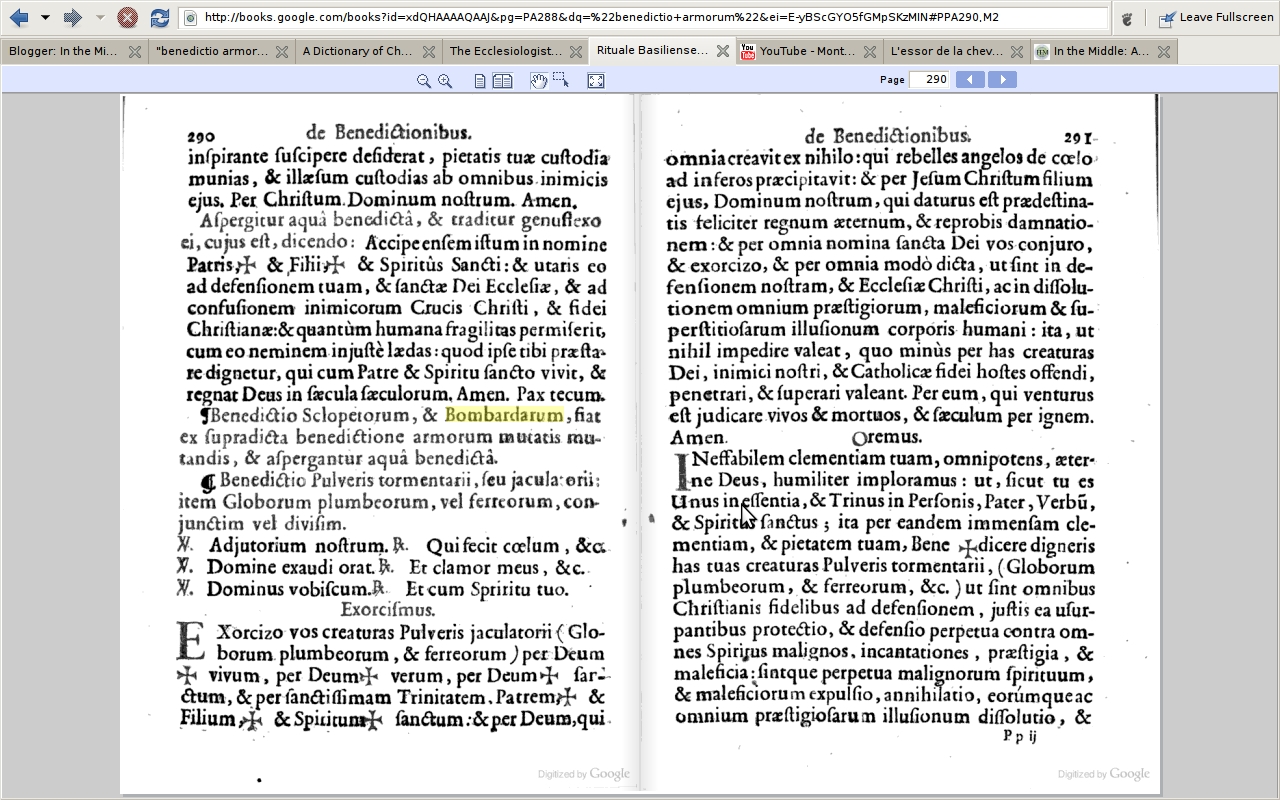
Have a look here and tell me if I'm not right. Some of the relevant portions of the image, taken from page 290 of an 18th-century volume, The Rituale Basileense juxta Romanum Pauli V et Urbani VIII include this blessing:
Benedictio Sclopetorum, & Bombardarum, fiat ex supradicta benedictione armorum mutatis mutandis, & aspergantur aqua benedicta. Benedictio Pulveris tormentarii, seu jaculatorii; item Globorum plumbeorum, vel ferreorum, conjunctim vel divisim.
In my typically hit or miss Latin, this means:
Bless the rifle and cannonball, and let the above blessing of the arms [be done] with all the appropriate changes, and let them be sprinkled with holy water. Let the gunpowder [?] be blessed, and the projectiles: namely, the bullets, whether of lead or iron, whether collectively or individually.
Thank you. Isn't there a Medieval Academy Prize for meritorious [I spelled that right I hope] service to Geekdom?

And your little dog horse, too

by KARL STEEL

Having astonished myself by completing my to-do list before 10pm on two successive days, I've been going through the stacks on Specula by my bed. First impression: I've been pleased to have read several articles on cultural contact zones (Leor Halevi, Oct 2008, "Christian Impurity versus Economic Necessity: A Fifteenth-Century Fatwa on European Paper" and Karrin Kogman-Appel, January 2009, "Christianity, Idolatry, and the Question of Jewish Figural Painting in the Middle Ages"). But that's not why I'm writing today.

In the July 2008 issue, Katherine Allen Smith published "Saints in Shining Armor: Martial Asceticism and Masculine Models of Sanctity, ca. 1050-1250," which concerns a couple dozen male saints who, imitating or appropriating chivalric identities, afflicted their bodies by constantly wearing armor, which was often ill-fitting or excessively heavy to boot. The frequent references to their doing battle with the spirits of the air of course (anachronistically) reminds me of Guthlac, and the self-inflicted ordeals of Lawrence of Subiaco (described on 586) certainly calls for a more affective, poetic engagement than Smith would have been able to give it in the course of the article.

It's a footnote, however, that really struck me. She quotes (582 n40) from a cursing from the 1031 Council of Limoges, the record of which is often cited in discussions of the development of the Peace Movement (and thus a key place in the debate over the emergence of chivalry and of the milites as a class: this article strikes me as a good take on the subject; the PL ascribes the record of the council to Jordan of Limoges, but it's actually by Adamar of Chabannes: see, among other places, Little's Benedictine Maledictions 214).

The relevant words of the curse:
let them [the excommunicated knights] be cursed and their accomplices in evil [adjutores eorum in malum]: let their arms be cursed, and their horses [et caballi illorum]: they will be with the fratricide Cain, and with Judas the traitor, and with Dathan and Abiron, who entered hell while still living.
I love all of this, but I highlighted what especially concerns me. We are likely all familiar with the chivalric circuit, and, thinking about medieval and modern armored cavalry, and about lobster knights, I wrote in comments here about how the "elite status of this military profession derives precisely from its inhuman interpenetration of armored cavalry with warrior," so it makes sense to me that cursing a knight would mean also cursing his arms and horse. Simply cursing the man would be incomplete.

With my apologies for the minimal payoff: although the word "adjutores" frustrates deleuzoguattarian readings of the curse--the deleuzoguattarian circuit isn't one of dominant center AND accomplice--it still fascinates me. It's odd to me that the horse and armor should be in the same semantic and taxonomic register; and it's odd to me that they should be accomplices. With "adjutores," the curse seems to grant too much agency to armor and horse, while at the same time muddling the distinction between nonlife and life. A horse is like armor in that it's a necessity for a knight, but otherwise it's very much not like armor. What conception of the animal, I wonder, allows for the horse to be cursed in the same breath as armor? What conception of the animal allows the horse to be cursed, like armor, as an accomplice?

(image from here by twoblueday under a Creative Commons license)