Showing posts with label blurton. Show all posts

Monday, August 13, 2007

"the past, present and future of England itself"

My post on Cannibalism in High Medieval English Literature concerns Blurton's chapter treating "Cannibal Kings." Like Karl, I've provided you with a view of my marginalia, and you'll quickly see my own obsession: the relations among nation, kingship, ethnic identification (especially when more than one identification is simultaneously available for an author or a given historical person), and the transnational vectors of twelfth-century England. I'm wondering, really, if it is fair to call the work of Geoffrey of Monmouth, Gerald of Wales, and Walter Map English rather than British. And I'm wondering if it matters that the two regents the chapter treats, William Rufus and Henry II, were kings of England but were not English kings.

I've always thought that "William Rufus" should be translated as "Billy the Red." William Rufus makes it seem like he possessed two fairly unremarkable names ("William Rufus, you come over here this minute!") rather than a resonantly non-English name plus an epithet. Just like a pirate. Or a Viking. Or a Norman. You can see where I'm going with this. Billy the Red estranges the name enough to make it clear that it wasn't necessarily easy to accommodate him into the roll call of "English" monarchs. And think of how much more difficult it was to assimilate his father, Guillelmus Nothus (William the Bastard, whom we now politely call William the Conqueror).

So, picking up on what Dan Remein wrote about cannibalism and assimilation in the comments to Eileen's post, I'm wondering if some of the cannibal anxieties that surround William Rufus, even as a doppelgänger for Henry II, don't have to do with the nation per se but with the regent himself, especially as a body in which "Englishness" is something of a problem. In a time of layered, hybrid, and even multiple ethnic/national/racial identities for the aristocracy, is it really all that easy to substitute the body of the king for the corpus and community of the realm? Henry II is a good illustration: his Norman granddad married Matilda, the daughter of Malcolm III of Scotland (but thereby also a descendant of Edmund Ironside and other greats of the "Anglo-Saxon" royal family). Henry II's father was the detested (by the English) Earl of Anjou, Geoffrey. This complicated descent makes Henry II many things, but "English" isn't all that easily one of them. Neither, really, is "Norman," making it not so easy to align him with William Rufus except in the way that both were potential intrusions of the strange. But then again, by the time Hnery II plopped his royal derriere on the throne England had long been ruled by men who were not fully English: not even the Confessor had been that.

So, here is my question. Much of the material Blurton examines is written by authors of compound heritage: Walter Map and Gerald of Wales and possibly Geoffrey of Monmouth had some Welsh blood; Marie de France, while of unknown origin, lived in England but composed in French (a language she interwove with English, Breton, and Welsh materials). So, if England had a "body politic," who then is this England? The non-international, quietly assimilated members of the aristocracy and upper class (call them the lower elites)? Or is "England" an imaginary corporate body that doesn't in fact have specific members -- that, in a way, exists nowhere except as a disembodied idea, and as an anthropophagous one at that?

Friday, August 10, 2007

Eating Harts: Blurton Chapter II

Blurton's second chapter considers Beowulf within the alimentary logic and wonders of the whole of its manuscript, Cotton Vitellius A. XV, whose contents, as our Anglo-Saxonists surely know, include "part of a life of Saint Christopher, a version of the Wonders of the East, The Letter of Alexander to Aristotle, and an Old English redaction of the Book of Judith" (37). I loved meeting Donestres, Cynocephali, and other old friends in this chapter, and also enjoyed Blurton's discussion of the problem word eoten. It's a word whose meaning is clear enough during Grendel's assault on Heorot "cannibal/anthropophage/maneater/whatever" (not Blurton's translation there, folks), but in the other five instances, for example, during the Fight at Finnsburg episode, it "seems to connote..a group of people rather than a group of giants or other monsters" (52). Blurton argues the word should be translated consistently as having to do with cannibals and cannibalism, not, for instance, as "monster." As she points out, Grendel is a threat not so much because of his size as because of his dietary habits, and also the Finnsburg fight is, like Grendel's assault on Heorot, about a metaphoric threat "of cannibalistic incorporation" and a quite literal threat to the body politic (55). In sum, she argues that "The Beowulf-poet weaves the word [eoten] through the narrative to stress [the] theme of the conceptual link between the cannibalizing of the human body and the cannibalizing of the social body" (55).

I'm highlighting this argument, first, because I enjoy a good linguistic crux, especially one that leads to conclusions as surprising as these, and second, because I'm not an Anglo-Saxonist, so I don't know what to make of her reading. In other words, I've love for some of my co-bloggers who know their way around Beowulf (in other words, the ones who aren't me), as well as some other Anglo-Saxonists (Richard Scott Nokes and Mary Kate Hurley for example) to weigh in on this matter.

My second observation on this chapter is also--I hope not characteristically--minor, but I wanted, as I did in my previous post, to add a little something from my own reading to Blurton's work. Inspired in part by the description of Grendel stepping through the "mouth" of Heorot, Blurton suggests that "Heorot is also a body of a kind. Heorot is itself metonymy for the body politic of the Danes" (36). You can see how this resonates with the interpretation I describe in the paragraph above. Now, Heorot is not just a kind of body; Heorot is in fact a very particular kind of body, namely (and obviously if you have Anglo-Saxon: which I don't), that of a hart. A few months back, I read William Perry Marvin's Hunting Law and Ritual in Medieval English Literature, where Marvin makes much of the hall's strange name (why not call it "Hrothgar's Place"?). In his chapter on Beowulf, Marvin describes two opposed modes of hunting: one in which killing an animal made the animal your property, and the other in which killing the animal made a claim to territory (he describes a third one as well, which I won't get into here). Hrothgar has taken land and gains retainers by sharing out booty. As Marvin puts it, Grendel's invasion of the Hart is an assault on Hrothgar's "gifting prerogative" to force "the parting out of pieces of the body of the Hart--literally, Scylding warriors in the flesh" (43). Marvin's political reading is a nice counterpart to Blurton's: e.g, "Grendel's actions appear regressive because he cannot stomach dynastic appropriation--an intolerance that is perfectly compatible with the most hard-bitten frontier egalitarianism of the migration and viking ages" (42). But what I also like about Marvin is that he doesn't lose sight of the fleshy materiality of either anthropophagy or the eating of harts. By contrast, Blurton's reading is emphatically metaphorical, and there's no foul there: certainly anthropophagy is symbolically charged.

My Kzoo paper on anthropophagy (auto-horn-tooting) tried to answer why it should be so charged, but it also tried to keep in mind its fleshiness. So here I end with a different sort of question, meant for those of you in an answering mood: how might a fleshy reading of some of Blurton's cannibalism texts--Beowulf for example--work? How might this enhance or alter her readings?

I'll check in periodically over the weekend--I'm following my wife as she takes a quick worktrip to San Francisco--but I trust my fellow bloggers to keep things humming here.

Wednesday, August 08, 2007

Blurred Boundaries

In his comment to the first post on Cannibals, JJC ask in reference to Anglo-Saxon monsters: “Do any offer crisp boundaries, unblurred lines?” Of course, the implied answer is no, none really stand as distinct, isolated Others, and this is the source of much of their appeal and power in the period. I want to expand this question outward to monstrous geography. In Blurton’s discussion of Mermedonia, we see the blurring of the boundary between the local and familiar (Britain) and the distant and apparently monstrous (Mermedonia). This is only one method, though, in which Blurton’s monstrous texts use geographic confusion to challenge the reader’s sense of fixed location. Blurton writes that the Wonders of the East has:

“an almost obsessive concern with measuring distance and mapping location. The distances to and from the reader’s stops on this strange journey through a fabulous eastern landscape are carefully measured out on two different scales, by direction (south of), or topography (near a river; on an island). The effect of these descriptive directions is to paint a mental map of the east, with location, distance, and landmarks all clearly located.” (48)

This notion is somewhat similar to that espoused by Lisa Verner in The Epistemology of the Monstrous in the Middle Ages (New York: Routledge, 2005), who refers to the Wonders as “geographically linear.” (65) Both of these texts are right to note the obsessive focus on geography in the Wonders, but if carefully observed, the directions are seen not to locate the monsters clearly but rather, to dislocate them, and to confuse and muddy our understanding of eastern geography, rather than to clarify it. If we were to actually follow the directions (those which can be followed—some are complete non sequiturs and others are so vague that they only confuse, such as those that being “[O]n summon lande,” or “In a certain land…”), we would have to travel, it seems west, east, south, west, east, north, west, south and finally north again. This image (click it for a larger and more legible version) shows my very loose and intentionally quixotic attempt to map the journey described by the Wonders on the Cotton Map, the earliest medieval mappaemundi, and that closest in date to the Wonders (and bound with an illustrated copy of the Marvels of the East, a bilingual work derived from the Wonders). This journey is by no means “linear,” nor does it really help us to get a good sense of location. Instead, these vaguely described and depicted beings seem to exist in a land where boundaries are fluid. The result is that here, unlike on the Psalter Map, the giant, anthropophagous monsters are not contained, not locked into tidy boxes in distant Africa and India, but rather, like the promised post-Apocalyptic hordes of Gog and Magog, they have been loosened upon the world.

Blurton is interested more in identity than diet, really, as am I. In her discussion of the Mermedonias, she raises an excellent question related to this topic: The description of the “sylfætan,” or “self-eaters” “contains an inner contradiction … they only eat strangers.” (32) This, she notes, serves “as a locus for the consideration of the relationship between self and other.” (33) If Mermedonia is confused with Britain, if the English are cannibals, if monsters are human, and if the Wonders are not clearly delineated and contained, what remains to articulate the boundaries of humanity?


Partners in Grief: Andrew and the Starving Mermedonians

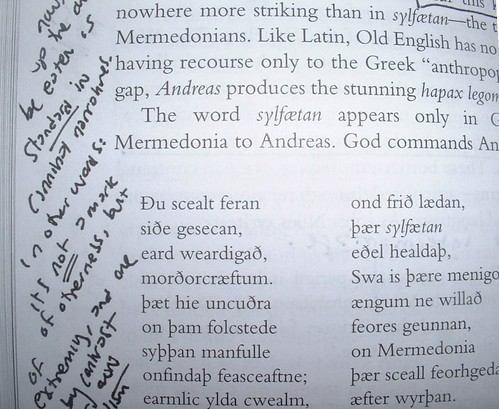
A entry in a book event, unlike a book review, makes no claim to completeness, finality, or even to treating the book under question directly. Consider yourself warned, because what I'm posting is a less-cluttered version of the marginalia you see pictured.

The subject of Blurton's first chapter is the Old English Andreas, which tells the story of a warrior saint sent to the anthropophagous Mermedonians. Soon after he arrives, Andrew frees Matthew and hundreds of others from prison, so depriving the Mermedonians of their food. They wail, of course, and feed on the corpses of the guards slain by Andrew. Still hungry, they fall to drawing lots to determine who will be eaten next. Blurton sets out a standard approach to this episode:
When a victim is chosen in this way, in order to save himself, he substitutes his small son in his place. While the Mermedonians are described as starving: "hungre wæron / þearle geþreatod" [they were cruelly harassed by hunger] (1114b-1115a; 139), the horror of the Mermedonians' ravenous rage turned against an innocent boy through the agency of one by whom he should be loved and protected highlights their depravity and, by extension, the righteousness of Andreas' mission. (17-18)
She of course sets out the standard approach only to muddle the clear binaries. As Mermedonia is an island that looks much like Britain, and since Andrew's mission seems to be as much one of conquest as it is one of conversion, we might say Andrew's gone a-Viking and the Mermedonians are his victims (25). The Mermedonian costume and military organization should themselves be uncannily familiar to the tenth-century English. And Andrew himself is someone who eats human flesh and drinks human blood: he's a Christian after all, and it had recently become de rigeur to demand that the Eucharist be understood as the real body of Christ.

Blurton explains in an early note that she won't be discussing famine cannibalism in her book (139 n2), but it strikes me that the topoi of famine cannibalism can be used to draw Andrew and the Mermedonians still more closely together. When anthropophagy is a custom, it's of course monstrous (indeed, as Blurton observes, it's a standard feature for many of the monsters in the Liber monstrorum), but when anthropophagy results from famine, it's a catastrophe, a cause for grief, and thus provokes a wholly different kind of horror, one that involves us rather than one that distinguishes us from some other. And it's usual to turn to eating children during a famine: see Leviticus 26:27-9, Deuteronomy 28:53-7, Lamentations 4:10, or 2 Kings 6 :28-29; or the story from Josephus of Mary/Maria of Jerusalem, who cooks and eats half her own child during Titus's siege (see my reference and its note in the first graph here); or the ninth-century Annals of Fulda, in which a family is saved from killing their child during a famine only when they steal a deer's carcass from hungry wolves; or the sad story of a father who killed and ate his own daughter during a famine at the command of his Saracen captors (Innocent III responds to the father's appeal for penance by enjoining him “nunquam de caetero carnibus pro quacunque necessitate vesceretur” (Epistola LXXX, PL 214: 1063D-64B; never again to eat any other meat for whatever necessity); or even, looking far afield, this law from the thirteenth-century Castillian lawcode, the Siete Partidas:
And there is another reason that a father can do this: according to the true law of Spain a father who is besieged in a castle he holds from his lord, may, if so beset with hunger that he has nothing to eat, eat his child with impunity rather than surrender the castle without permission of the lord (quoted from John Boswell, The Kindness of Strangers 329)
Blurton aims at doing a "contrapuntal reading" (see Said Culture and Imperialism) that "creates a counterpoint between a dominant cultural discourse and a resisting perspective, which opens up a new space for meaning" (18); in this case, "Reading Andreas contrapuntally uncovers what I refer to as its cannibal narrative, that is, a narrative that is sympathetic to the cannibal Mermedonians" (18). I would like to think that if I weren't suffering from a days'-long headcold, I could draw all this together. For now, I want only to observe that when the father saves himself by offering up his son to be eaten, any response that saw this only as monstrous would be self-congratulatory. But more likely, the response would have been the shock of the familiar, the shuddering memory of what horrors famines cause (on their frequency, and thus familiarity, see the list in P. Bonnassie “Consommation d’aliments immondes et cannibalisme de survie dans l’Occident du haut Moyen Age." Annales 44 (1989): 1035-56, at 1045: there were 29 major famines between 751 and 1100), and shared sorrow. For a time, the readers of Andreas would have felt for and with the Mermedonians.